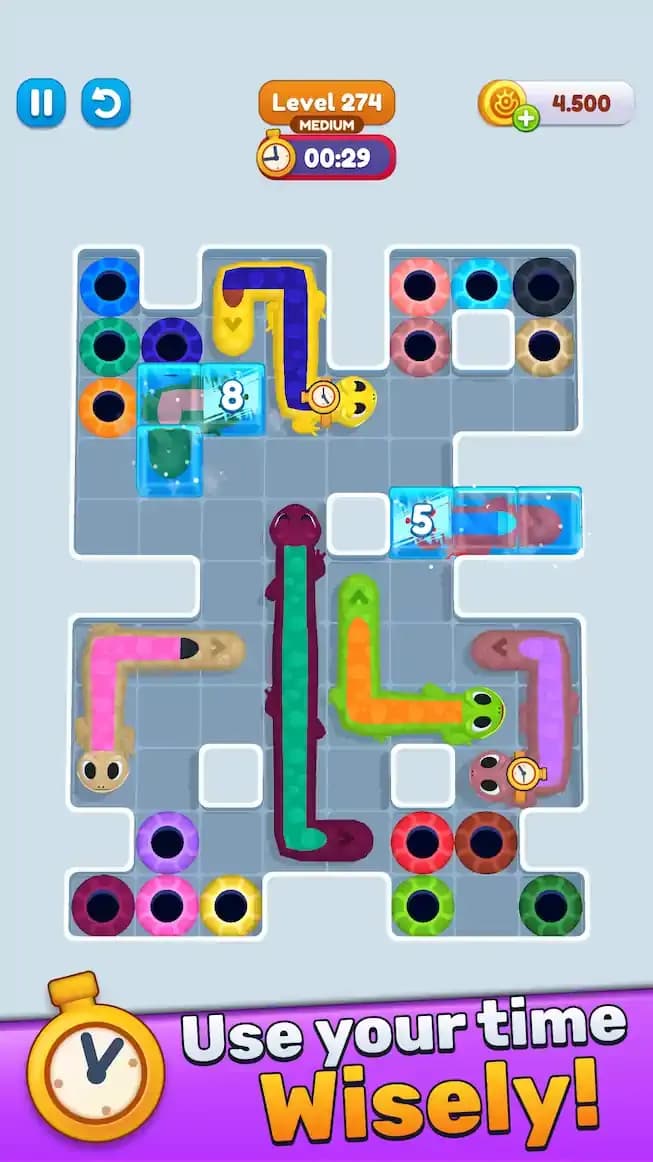
On paper, Gecko Out sounds simple: drag colorful geckos to their matching holes before the timer runs out. In practice? It’s a crunchy spatial puzzle with time pressure, layered mechanics, and levels that absolutely tank your first few attempts if you play on autopilot.
You’re not just matching colors. You’re managing snake-like bodies on a grid, reading traffic patterns, and sequencing moves so you don’t soft-lock yourself with 3 seconds on the clock. The game leans hard on strategic planning, fast decision-making, and path efficiency.
This guide is the deep-dive: how to think about Gecko Out, not just what to tap.
Know the Rules Before You Try to “Outplay” Them
Gecko Movement: The Core Logic
Every strategy in Gecko Out rests on a few basic rules:
- You drag from the gecko’s end, steering its head; the body follows like a snake.
- Each gecko must reach a hole of the same color to clear.
- Geckos can’t pass through walls, blocks, or most other geckos.
- Many levels are tight on space, so a single bad drag can box in half the board.

I like to think of each gecko as a flexible “block train” that you’re threading through a maze. The length matters: long geckos are fantastic blockers and horrible to get unstuck if you park them badly.
The Timer: Silent Final Boss
Gecko Out uses a time-based challenge system — you’re not allowed to sit there forever like in a pure logic pencil puzzle.
Two key things follow:
- Your path needs to be correct and efficient. Long scenic routes will lose you levels.
- Your decision-making has to be clean. Fumbling back and forth with micro-corrections wastes seconds and focus.
The game is totally solvable without boosters, even on hard levels, but sloppy time management makes it feel impossible.
Build a Gecko Out Mindset
Pause-Plan Before You Drag Anything
The game explicitly encourages you to take your time and study the entire board before dragging your first gecko.
Treat this as a hard rule:
- Don’t tap.
- Don’t “test a quick move.”
- Just read the grid.
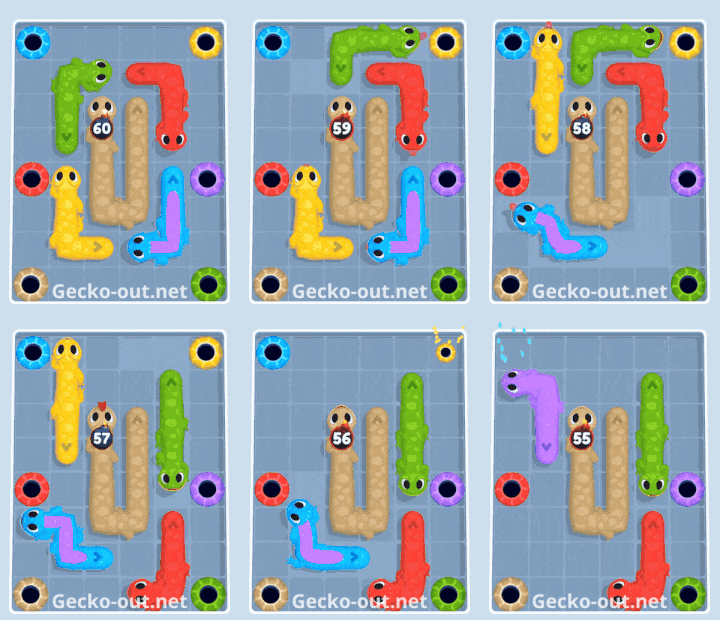
Ask yourself:
- Which gecko has the clearest path right now?
- Which pieces are choking the center?
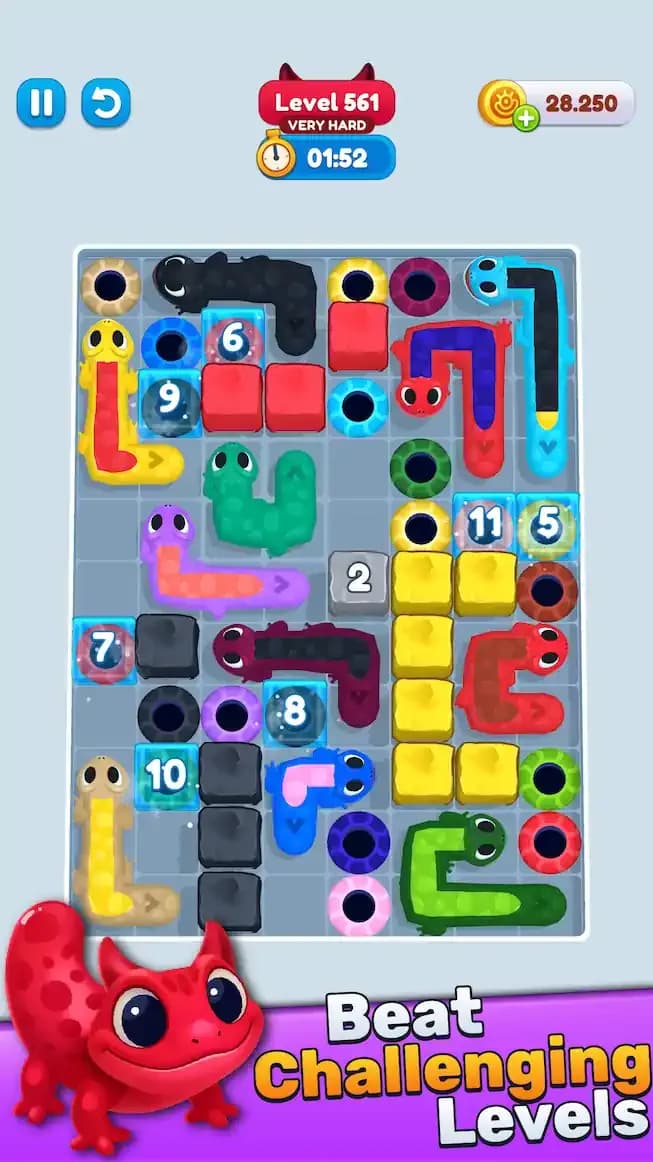
- Which obstacles (stones, crates, frozen pieces, gates) are gating the rest of the puzzle?
You’re front-loading thought so later you can just execute.
Work Backwards From the Holes
Instead of staring at the geckos and thinking, “Where can I go?”, do the reverse:
- Look at each hole and ask, “What must occupy the tiles leading into this?”
- Trace a quick mental path from hole back to gecko, not the other way around.
This shift helps you spot impossible angles (“That red gecko will never turn into that corner from here”) before you waste 20 seconds proving it the hard way.
Find the “Key Log” Gecko
On tight boards, there’s usually one gecko that’s acting like a log in a logjam:
- It might sit in the middle lane.
- It might be long and horizontal across multiple lanes.
- It might be blocking access to a gate, time bonus, or frozen piece.
If you unknot that gecko, everything else suddenly breathes. I like to identify a “key log” early and build my whole move order around clearing it safely.
Core Tactics That Work on Almost Every Level
Create Space First, Chase Exits Second
A classic mistake is instantly dragging any gecko with a visible path to its hole. Sometimes that’s correct; often it’s a trap.
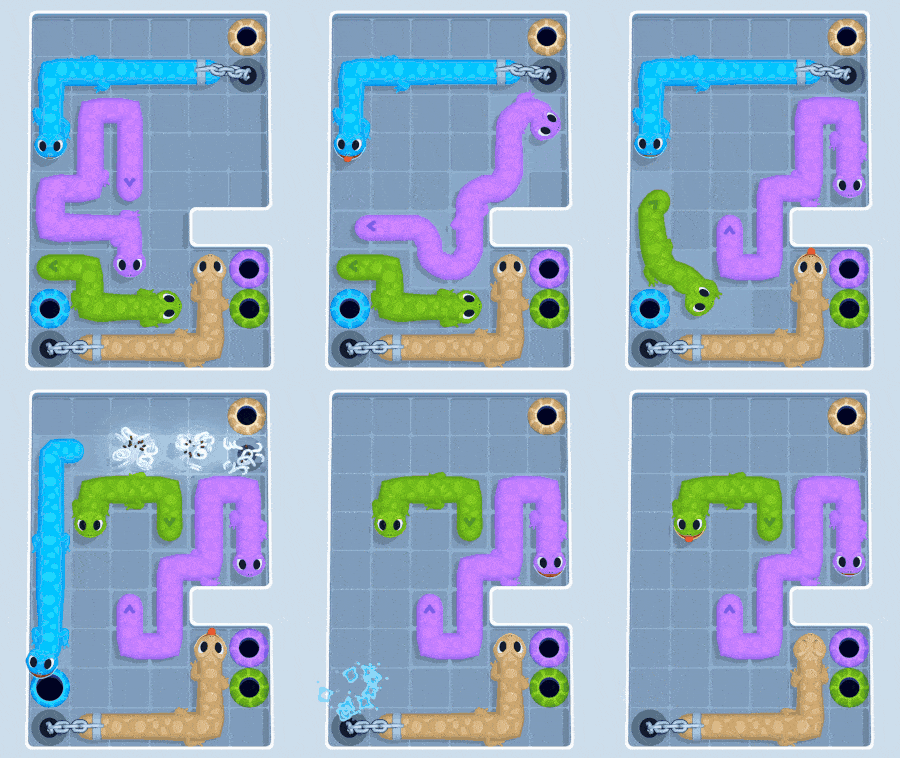
Better pattern:
- Prioritize moves that create central space – even if they don’t finish a gecko yet.
- Use that new space to maneuver long or awkward geckos.
- Convert early space into final exits only when you’re sure you’re not blocking future routes.
Think of it like a sliding-block puzzle: your first goal isn’t “solve it”, it’s “open the board up”.
Short Moves > Wild Dragging
Even though you can drag and swing geckos around freely, long freestyle drags:
- make mis-swipes more likely,
- eat time,
- and often leave you in worse positions.
So:
- Move in short, deliberate segments.
- Stop after each key shift and re-read the board for new openings.
- Avoid “vibing” geckos around just because they can move.
Managing Intertwined Geckos
On levels where geckos wrap around each other like spaghetti:
- Try to lift one strand at a time.
- Look for two-tile “parking spots” where a head can temporarily sit without blocking turns.
- If two geckos share a corridor, decide which one owns it first; don’t bounce them back and forth.
When I see a knot, I mentally assign priorities:
- “Blue gets out first, green waits as a blocker, yellow is last cleanup.”
Having that internal order stops you from accidentally shoving the wrong gecko into a crucial lane.
Recognize Irreversible Moves
Some moves can’t be undone without restarting:
- Filling a permanent hole (gecko stays as a fixed obstacle).
- Closing access to a gate-triggering gecko behind other bodies.
- Using a time bonus gecko in a way that doesn’t help your actual sequence.
Before you commit, ask:
“If I do this, will any gecko lose its only valid path?”
If the answer is “maybe,” wait and see if you can achieve the same progress with a reversible move.
Mastering Obstacles and Special Mechanics
Gecko Out’s obstacle roster is wild. You don’t need to memorize every name, but you do need to understand how to prioritize them.
Stacked & Multi-Stacked Geckos
Frozen Geckos, Frozen Holes, Stones, and Crates
These all share a theme: “feed me X geckos”.
Lock & Key, Colored Stones, and Color Paths
Here, color logic becomes routing:
- Locked geckos stay frozen until key-colored geckos are home.
- Colored stones and color paths only interact with matching colors.
Strategically:
- Route key-color geckos first but safely; they’re your unlock triggers.
- Use color paths to isolate traffic: e.g., a red-only lane where only one red can ever block.
Scissors & Ropes, Rope Carriers
These levels are all about order of operations:
- Scissor gecko must reach the hole to cut ropes blocking others.
- Rope Carrier gecko first needs to go into its own hole to drop a rope, then you must clear additional geckos based on the rope’s number.
So:
- Protect the scissor or rope carrier like VIP pieces.
- Don’t bury them behind long, less important geckos.
- Plan their path as one of your earliest “clean” routes.
Time Bonus & Bomb Geckos
- Time bonus geckos add extra seconds when placed.
- Bomb geckos blow the level if you ignore them too long.
General rule:
- Route bomb geckos early, but not before you’ve opened the path enough to move them cleanly.
- Save time bonus geckos for when you’re transitioning into the tricky middle/endgame of the puzzle, not right at the start when the timer is full.
Advanced Combinations: When Mechanics Stack
On higher difficulties, the game throws combos like frozen geckos + gates + multi-stacks + time bonuses at you.
Here’s how I break these monsters down:
-
Identify your hard gates.
- What’s locked, frozen, chained, or blocked by ropes?
- Note each unlock condition: “Need 3 geckos home”, “Need yellow key”, “Need scissor gecko”.
-
Map a minimal unlock route.
- Find the cheapest way to satisfy those conditions (short easy geckos, shortest paths to keys).
-
Sequence zones.
-
Treat the level like multiple mini boards:
- Zone A before gate
- Zone B after gate
- Zone C with the final exits
-
Solve Zone A to open B, then B to open C, etc.
-
Use geckos as temporary walls.
If a level feels “impossible”, it’s often because you’re trying to solve all zones at once instead of in this structured order.
Beating the Clock: Time Management Strategy
Plan in “Free Time”, Execute in “Paid Time”
The official tips literally say: look at the entire board before dragging your first gecko and don’t rush.
Use that like a speedrunner:
-
Before first drag:
- Scan for gates, frozen pieces, time bonuses, bomb geckos.
- Decide which gecko moves first, second, third.
-
After that:
- Commit to execution.
- Avoid mid-run re-thinking unless the board drastically changes.
When to Immediately Restart
If you:
- block a permanent hole,
- misroute a bomb gecko into a dead corner,
- or know you just killed the only path for a key-color gecko…
Don’t “hero it out.” Restart and run your improved plan. You’re saving both time and tilt.
Drag Efficiency
On a technical level:
- Use clean straight drags rather than zig-zags.
- Avoid over-correcting: if you overshoot, lift your finger and start a new, clean drag instead of scribbling back.
- On smaller phones, consider playing with two thumbs, not one, if it helps your precision.
These tiny optimizations matter when you’re down to the last 5–10 seconds.
Smart Use of Boosters and Power-Ups
The devs state clearly: every level is beatable without boosters.
Booster strategy is about saving your sanity and time, not paying to brute-force the game.
What Each Booster Actually Does
From the official description:
- Hammer – Removes a wall that’s blocking movement.
- Picker – Teleports one gecko straight into its matching hole.
- Time Freeze – Stops the timer temporarily, giving you extra seconds to finish.
When to Use Hammer
Best use cases:
Avoid:
- Breaking a wall just to shave 1 turn off a path that’s already very manageable.
When to Use Picker
Picker is absurdly strong and easy to waste.
Use it when:
Don’t use it to:
- Skip a short gecko with a clear path.
- Bail out of mild confusion — that’s what restarts are for.
When to Use Time Freeze
Time Freeze is your clutch tool:
Using it early just to “think more” is usually a waste — you can do your thinking before first drag for free.
Booster Meta: Where to Spend Them
I’d save boosters for:
- Challenge spikes,
- levels with dense obstacles plus a strict timer,
- or stages you’ve already tried multiple times and understand, but can’t quite execute fast enough.
If you’re still learning a mechanic, don’t booster past it. You’ll need that knowledge later.
Framework for Beating Hard and “Wall” Levels
When you hit a level that feels like a brick wall, use this repeatable checklist:
-
Board Read
-
Identify:
- All exits,
- all obstacles and locks,
- any bomb or time bonus geckos.
-
Label Priorities
-
Mark in your head:
- Key unlock geckos (keys, scissors, rope carriers, time bonuses, bomb geckos),
- “key log” geckos blocking huge sections.
-
Draft a Move Order
-
Roughly decide:
- Which gecko exits first, second, third…
- Which obstacles you’ll clear before others.
-
Run a “Dry” Attempt
- Play slowly but cleanly, focusing on whether your plan conceptually works.
- If you lose on time but the board flow felt good, your plan is solid — now you just need to speed it up.
-
Refine or Reroute
The official tips even recommend replaying with a fresh eye after breaks; that’s not fluff. Walking away and returning can reveal patterns you were blind to while tilted.
Tech & Performance: Underrated but Real
Even on a puzzle game, performance matters:
- Close other heavy apps if you notice stutters or input lag; laggy drags can cause misplacements.
- Watch out for notifications or calls that can interrupt runs or reset levels mid-play; consider muting during tough streaks.
- If something genuinely behaves wrong (gecko not moving as expected, timer bugging out), use the in-game support channel instead of assuming you’re missing a mechanic.
Clean input means fewer “I didn’t mean to drag that gecko” deaths.
Conclusion – From Surviving Levels to Actually Mastering Gecko Out
Mastering Gecko Out isn’t about grinding your face against each level until it randomly works. It’s about:
- Reading boards like a traffic engineer,
- Sequencing geckos with clear priorities,
- Respecting obstacles and their combinations,
- And using boosters as precision tools, not crutches.
As you climb, you’ll notice your brain start to auto-detect:
- which geckos are key logs,
- which corners are death traps,
- and which moves scream “don’t do this, it’ll tank the run.”
That’s when the game stops feeling chaotic and starts feeling like a very satisfying, very colorful chess puzzle on a timer.