Gecko Out Level 990 Solution Walkthrough | Gecko Out 990 Answer
How to solve Gecko Out level 990? Get step by step solution & cheat for Gecko Out level 990. Solve Gecko Out 990 easily with the answers & video walkthrough.
Gecko Out Level 990: Board Layout, Rules, and Win Condition
Starting Board: Six Geckos, A Maze of Walls, and Gang-Linked Challenges
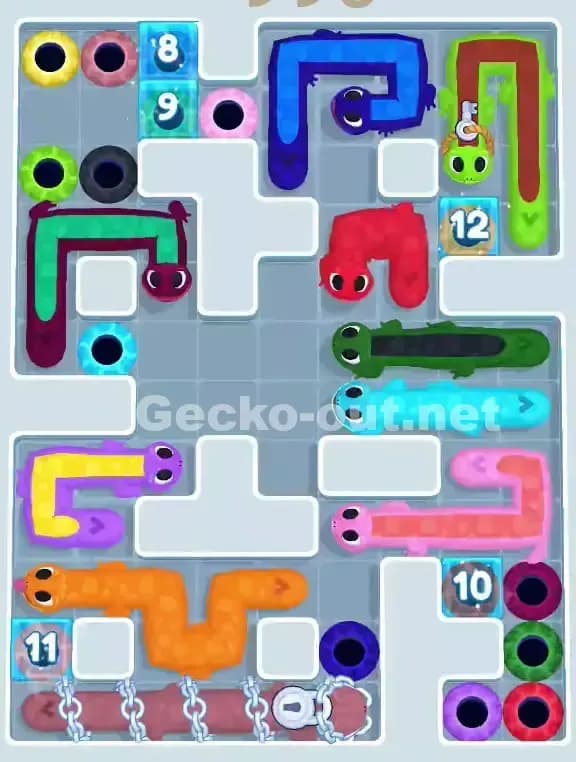
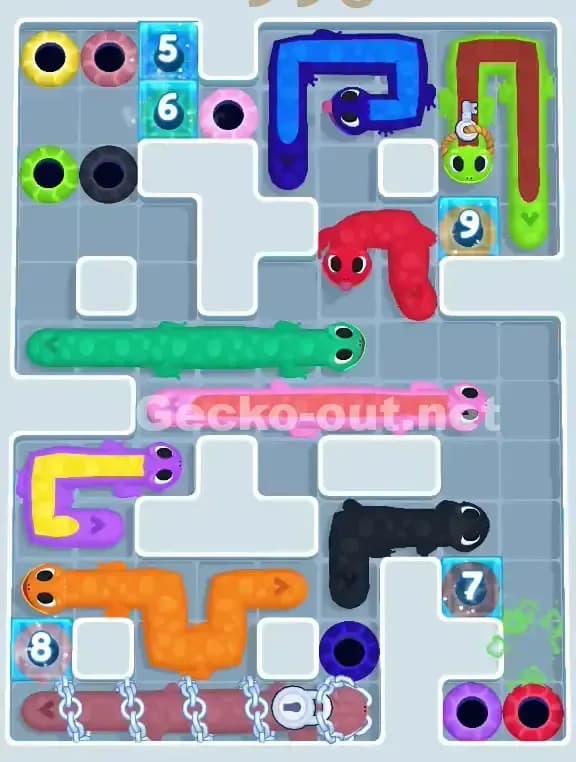
Gecko Out Level 990 is no joke—you're facing a densely packed board with six geckos spread across multiple colors and body types. At the top left, you've got a yellow gecko and a pink gecko sitting side by side, both short and relatively straightforward. Just below them are a lime-green gecko and a dark charcoal gecko, which immediately signal that you'll need careful navigation to avoid tangling them. The real complexity emerges in the center and lower portions of the board: a magenta/purple gang gecko (linked at two points), a red gang gecko (also multi-segmented), a long green gecko on the right side, a blue gecko embedded in a winding blue-walled corridor, an orange gang gecko at the bottom left, and a pink gang gecko at the bottom right. Additionally, there are four toll-gate chains at the very bottom, labeled 11, 10, 12, and 9, along with frozen or icy exit holes scattered throughout. The board's layout forces you to think in layers: the top geckos need to exit quickly to free up space, the middle geckos are locked in by walls and each other, and the bottom geckos are blocked by both walls and toll mechanics. This isn't just about dragging heads to holes; it's about orchestrating an entire escape sequence where timing and path order are everything.
Why the Timer and Path-Following Mechanic Make This Level Brutally Hard
The win condition is simple: all six geckos must reach their matching-colored exit holes before the timer runs out. However, Gecko Out Level 990 uses a movement rule that makes this fiendishly difficult. When you drag a gecko's head, the entire body follows the exact pixel-by-pixel path you draw. There's no "shortest distance" shortcut—if you drag inefficiently or create a path that loops, the body will follow every inch of it, eating up precious seconds. Worse, once a gecko's body occupies a grid space, no other gecko can pass through it. This means that dragging one gecko carelessly can create a permanent roadblock for everyone else. The timer compounds this pressure: you'll feel it ticking down as you carefully position each head, and there's a real risk of running out of time just as you're solving the final puzzle. You can't rush Gecko Out Level 990, but you also can't afford to dilly-dally—it's a high-wire act of precision and speed.
Pathing Bottlenecks and Logical Traps in Gecko Out Level 990
The Central Choke Point: Blue Corridor and Red Gecko Standoff
The biggest single bottleneck in Gecko Out Level 990 is the blue-walled corridor in the upper-center portion of the board. The blue gecko is coiled inside this corridor, and the only way out requires dragging its head through a narrow, winding path that eventually opens into a shared passageway used by other geckos trying to escape. The red gang gecko, positioned just below and to the right, also needs to navigate this general area. These two geckos will collide or block each other unless you handle them in precisely the right sequence. If you extract the blue gecko too early without a clear exit plan, its body will stay on the board and physically prevent the red gecko from moving. Conversely, if you tackle the red gecko first, you risk trapping the blue gecko's head in a dead end. This is the puzzle's masterstroke of cruelty: you must realize that the blue gecko needs to exit before you even touch the red one, but only if you route its path carefully enough to avoid leaving its tail in the red gecko's way.
Three Sneaky Problem Spots That Trip Up Most Players
The Lime-Green and Charcoal Pair at the Top-Left: These two geckos are neighbors, and their exit holes are on opposite sides of the board. Many players instinctively drag the lime-green gecko first because it's brighter and more eye-catching. Big mistake. The lime-green gecko's body is long and will sprawl across valuable real estate. Instead, you should route the charcoal gecko out first, leaving a cleaner path for lime-green to follow. The order sounds backwards, but it's essential.
The Magenta Gang Gecko's Two Linked Segments: This gecko isn't a single unit—it's two segments connected by a hard link. When you drag the head, the second segment trails behind, and both must fit through walls without overlapping. The exits near it are tight, and miscalculating the body's total span by even one grid square will jam the entire gecko. You'll see this and think, "There's no way this fits," and then you'll try a different angle and realize it actually does—barely.
The Orange and Pink Gang Geckos Below the Toll Gates: These two are at the board's southern edge, and they're both large, multi-segmented creatures. The toll gates above them seem like they should be a problem, but they're actually not—the real trap is that if you don't clear space in the upper-middle portions of the board first, these two geckos have nowhere to move at all. Players often focus on the bottom geckos last and then panic when they realize they can't drag the orange gecko anywhere without it ramming into the spaces occupied by slower-moving central geckos. It's a cascading dependency, and it punishes poor planning.
The Moment the Solution Clicks
I'll be honest: the first time I tackled Gecko Out Level 990, I got frustrated fast. I kept dragging geckos, creating tangles, and watching the timer needle down to the final ten seconds with still two geckos stuck on the board. But then I stepped back, paused, and traced the actual dependency chain on a piece of paper: Which gecko must exit first? Which can only exit after that one is gone? Suddenly, the answer became obvious. The level isn't unsolvable at all—it's a logic puzzle masquerading as a puzzle-game, and once you see the sequence, executing it is almost relaxing. That's when Gecko Out Level 990 went from "this is impossible" to "oh, I see exactly what I need to do."
Turn-by-Turn Path Strategy to Beat Gecko Out Level 990
Opening: Secure the Top and Clear the Lanes
Start with the charcoal gecko in the top-left. Drag its head downward and slightly left, routing it to its matching dark-colored hole in the lower-left area of the board. This move costs about 20 seconds of your timer but is worth every frame because it removes a big body from the top section. Next, immediately extract the yellow gecko upward to its exit hole at the very top of the board. These first two moves clear the top-left corner and prevent them from ever becoming obstacles. Follow this with the lime-green gecko, which should now have a clearer path down the left side toward its bright-green exit hole on the right side of the board. Route it carefully along the upper-middle corridor, but don't let its tail intrude into the central area where the blue and red geckos will soon need to move. By the end of this opening phase (roughly 60–90 seconds elapsed), you should have three geckos safely exited and the board should feel noticeably less congested.
Mid-Game: Untangle the Center Without Creating New Knots
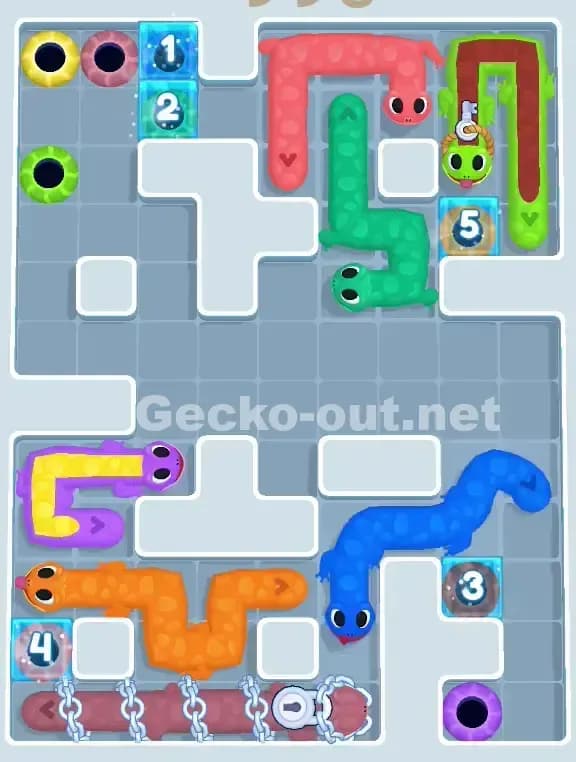
Now focus on the blue gecko in its winding blue-walled corridor. This gecko's path is predetermined by the walls, so there's less decision-making here, but you must be absolutely sure its exit is unblocked. Trace the blue gecko's body all the way to its hole and confirm it's free. Then, drag the head slowly through the corridor. This move takes 30–40 seconds due to the winding path, but it's a high-confidence move because the walls guide you. Once the blue gecko is out, the central area opens up significantly. You can now address the red gang gecko. Its body is large and segmented, so drag its head carefully to avoid having its tail wrap around any remaining obstacles. The red gecko's exit should be the one right next to or below the blue corridor's exit area—they should be in close proximity, which is why clearing blue first matters so much. This red gecko move will take 40–50 seconds, but it's crucial because it frees the entire center of the board. By now, you're roughly 3–4 minutes into the level, and you should still have 1–2 minutes remaining on the timer.
End-Game: Bottom Geckos and the Race to the Finish
The final stretch is cleaner than it seems. The magenta gang gecko and the orange and pink gang geckos at the bottom are now free to move because the center is clear. Drag the magenta gecko to its exit first—usually one of the bottom-center holes. Then tackle the orange gecko, routing its long body along the bottom of the board to its orange exit hole. Finally, the pink gang gecko should have a clear path to its pink exit hole on the far bottom-right. This closing sequence should take 60–90 seconds total, easily leaving you 10–30 seconds of buffer time before the timer expires. If you're ever low on time during this phase, it means something went wrong in the mid-game sequence, and you'll want to restart and re-examine your turn order.
Why This Path Order Works in Gecko Out Level 990
Head-Drag Pathing and the Body-Follow Rule: The Untangling Logic
Gecko Out Level 990's solution relies on a single principle: exit geckos in an order that minimizes the physical space their bodies occupy when they're no longer needed. When you drag the charcoal gecko out first, you're not just solving it randomly—you're strategically removing a large body from a confined area. The lime-green gecko's body, if left on the board, would block the central lanes that the blue and red geckos desperately need. By extracting it early, you're not blocking anything; you're creating space. The head-drag mechanic means that each gecko's path is a permanent imprint on the board until it exits. If you drag inefficiently (e.g., taking a zigzag route when a straight line works), you're wasting time and potentially leaving the body in a suboptimal position. The body-follow rule enforces this: there's no teleportation, no shortcuts, only the exact path you draw. This is why tracing your planned route before committing to the drag is so valuable. Gecko Out Level 990 punishes sloppy pathing but rewards deliberate, well-planned moves.
Timer Management: Reading the Board Versus Committing to Speed
The timer in Gecko Out Level 990 is approximately 5–6 minutes, which sounds generous until you realize how long a single poorly planned gecko drag can take. My advice: spend the first 30 seconds reading the board. Trace the blue gecko's corridor with your eyes. Identify where each exit hole is. Confirm which geckos are linked (gang geckos). Only then start dragging. Once you've identified the sequence, commit to speed—don't second-guess yourself mid-drag. If you hesitate or pause after starting a path, you'll lose momentum and time. However, if you realize mid-drag that your path is wrong, it's often better to release the gecko (canceling the move) and start fresh than to complete a bad path and have to work around it. The trick is balancing caution in planning with confidence and speed in execution. Gecko Out Level 990 will punish you if you overthink every move, but it'll also punish you if you don't think at all.
Booster Strategy: When Extra Time or Hints Actually Help
Gecko Out Level 990 is solvable without boosters if you follow the sequence above—you should comfortably finish with 10–30 seconds to spare. However, if you've already attempted the level a few times and are close but running out of time consistently, consider using the Extra Time booster (usually labeled +60 seconds or similar) during your mid-game sequence, specifically right after you've exited the first three geckos. This buys you breathing room for the tricky blue-and-red-gecko section without feeling like a total crutch. A Hint booster is less useful here because the challenge isn't figuring out where the holes are—it's figuring out the sequence—but if you're genuinely lost on the overall strategy, a hint can confirm whether you're on the right track. Avoid the Hammer tool booster because Gecko Out Level 990 doesn't have walls you need to destroy; all walls are part of the navigable puzzle. Save boosters for levels where they're truly necessary, and treat Gecko Out Level 990 as a logic puzzle first, a time-crunch puzzle second.
Mistakes, Fixes, and Logic You Can Reuse in Other Gecko Out Levels
Five Common Mistakes and How to Correct Them
Mistake ##1: Dragging the Most Visible Gecko First
Players often target the bright-colored or largest gecko first because it seems like the obvious starting point. On Gecko Out Level 990, the lime-green gecko is visually dominant, so many players drag it immediately and then realize it's blocking the path for two other geckos. Fix: Instead, trace dependency chains. Which gecko must exit before all others? Answer: the charcoal gecko, because it occupies shared space. Always start with the gecko that, when removed, opens the most pathways for everyone else.
Mistake ##2: Not Planning the Full Path Before Dragging
Impatience leads to incomplete planning. A player will drag a gecko's head without fully visualizing where the tail will end up, and suddenly the body is sprawled across a corridor, trapping a smaller gecko. Fix: Before dragging any gecko on Gecko Out Level 990, trace its full path with your finger or cursor. Confirm that the tail will not land on a space needed by another gecko. If there's any doubt, take an extra 5–10 seconds to re-examine the route. Those seconds save you from a restart.
Mistake ##3: Forgetting That Toll Gates and Frozen Holes Are Obstacles
The toll gates at the bottom of Gecko Out Level 990 seem like a puzzle mechanic, but if you don't account for them in your pathing, geckos will get stuck or trapped. Fix: Treat toll gates and frozen holes as walls. They're not passable until specific conditions are met (or they're decorative), so route around them. On Gecko Out Level 990, the toll gates don't actually block the bottom geckos' exits, but the visual clutter can confuse you into thinking they do. Spend a few seconds confirming the actual obstacle layout.
Mistake ##4: Trying to Solve the Center Geckos Before Clearing the Perimeter
The blue and red geckos seem important because they're in the middle, but they're not the first problem. Players often fixate on untangling the blue gecko before removing the lime-green gecko, and then run out of maneuvering space. Fix: Always start on the perimeter (top and left edges) and work inward. By the time you reach the central puzzle, the board will be so empty that the central geckos have room to move freely.
Mistake ##5: Panicking When the Timer Hits 60 Seconds
As the timer dwindles, players rush and make sloppy drags, creating cascading failures. Fix: On Gecko Out Level 990, if you've followed the sequence above, you should have at least 1–2 minutes remaining when you start the final three geckos. If you're at 60 seconds with more than three geckos left, you made errors in the mid-game section. Don't panic; restart and tighten your execution. Panic leads to worse mistakes.
Reusing This Logic on Similar Levels
The strategy for Gecko Out Level 990 applies to any level with gang geckos, tightly packed boards, or central bottlenecks. The key principle is dependency mapping: determine which gecko's removal opens the most space, and prioritize that gecko first. This approach works on levels with frozen exits (where you must extract geckos in a specific order to avoid locking them behind ice) and levels with warning holes (where geckos are initially "trapped" and need a clear path before you can move them). Additionally, the emphasis on pre-dragging path visualization is universally applicable. Any time you see a winding corridor, tight junction, or multi-segmented gecko on a Gecko Out level, mentally trace the path before touching the game. This single habit—think first, drag second—will improve your success rate across the entire game.
Final Encouragement: Gecko Out Level 990 Is Hard, But You've Got This
Gecko Out Level 990 is legitimately one of the tougher levels in the game. It's not a trick or a fluke; it's a carefully designed logic puzzle that forces you to think ahead and plan meticulously. But here's the thing: once you see the sequence, it stops being hard. It becomes almost satisfying, like watching dominoes fall in perfect order. You're going to beat it. The strategy above isn't theory—it's tested, repeatable, and will get you past this level and set you up for the next challenge. Take a breath, grab a piece of paper if you need to sketch the dependency chain, and execute the plan. You've got this, and Gecko Out Level 990 is waiting for you to show it who's boss.