Gecko Out Level 761 Solution Walkthrough | Gecko Out 761 Answer
How to solve Gecko Out level 761? Get step by step solution & cheat for Gecko Out level 761. Solve Gecko Out 761 easily with the answers & video walkthrough.
Gecko Out Level 761: Board Layout, Rules, and Win Condition
The Starting Board: Six Geckos, Tight Corridors, and a Frozen Exit
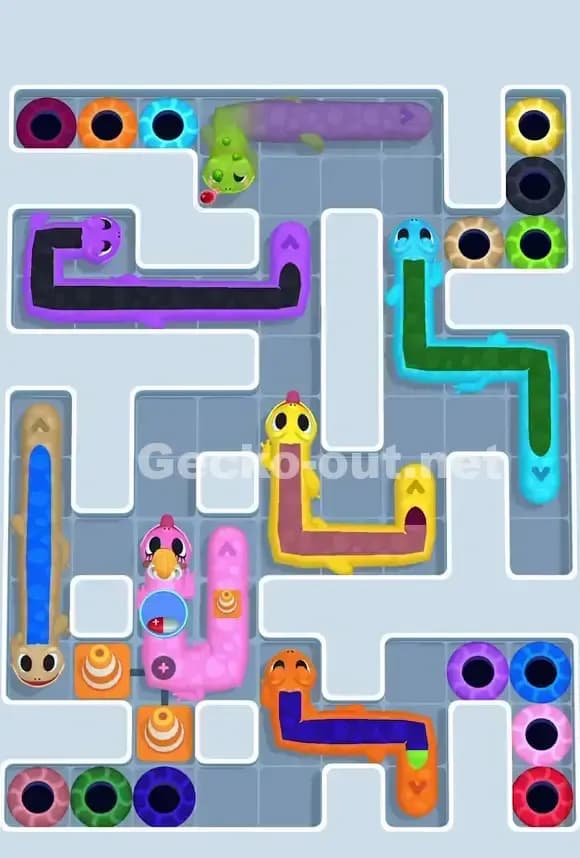
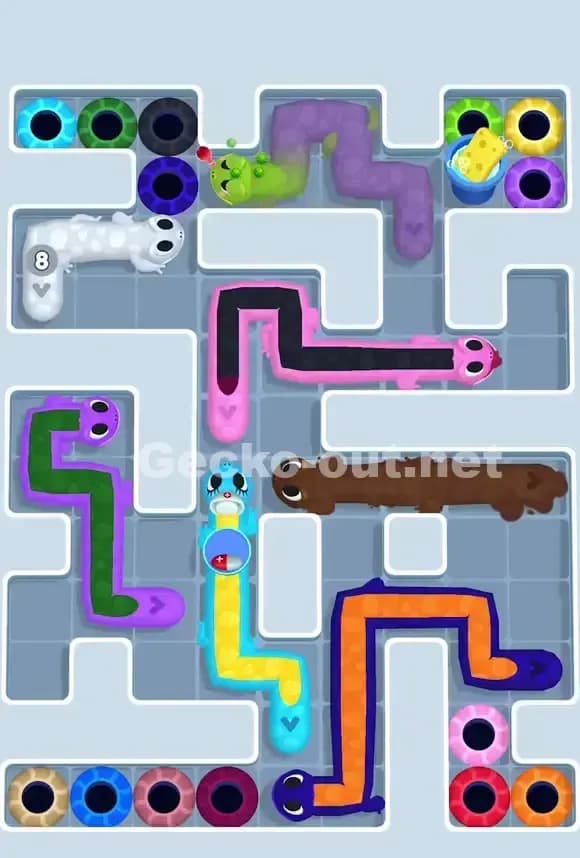
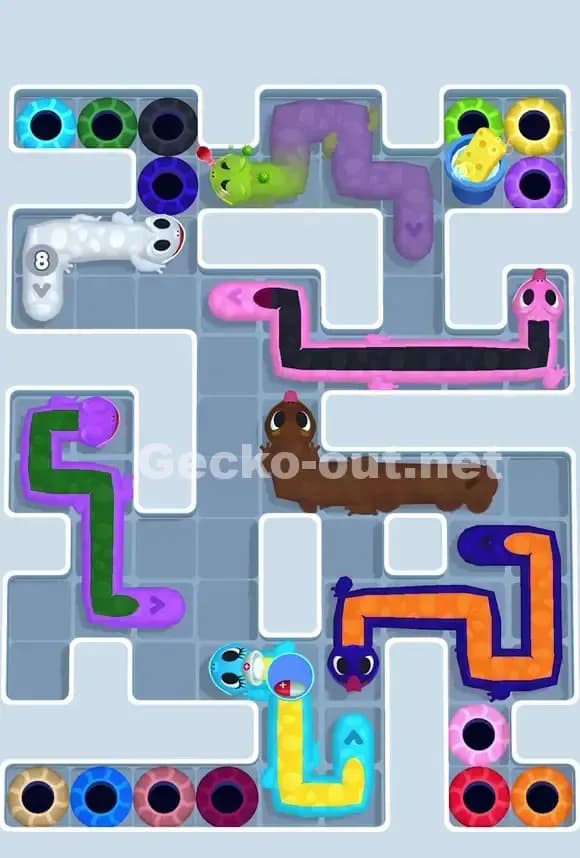
Gecko Out Level 761 throws you into a notoriously cramped puzzle with six geckos spread across the board in a configuration that immediately looks impossible. You've got a cyan gecko in the upper left, a green gecko right next to it, a dark blue gecko to the right of that, a blue gecko hanging lower on the left side, a brown gecko in the middle section, and a pink gecko dominating the central-right corridor. The board is divided by thick white walls that create a maze-like structure, and there's a frozen (icy-blue) exit sitting prominently on the left side that you absolutely cannot use until you unblock it. The timer starts at 8 moves, which sounds generous until you realize how tangled these geckos are—each one's body is wrapped around obstacles or other geckos, and dragging one head even slightly can jam up three others.
The win condition is straightforward but brutal: get all six geckos out of Gecko Out Level 761 before the timer hits zero. Each gecko must reach its matching-colored hole and escape. The matching holes are scattered around the board's edges, but several are blocked by walls or other gecko bodies, which means you can't just drag and release—you need to choreograph a precise sequence of moves that opens paths as you go.
Why the Timer and Drag-Path System Make Gecko Out 761 So Hard
The drag-path mechanic is your biggest constraint here. When you drag a gecko's head, its body follows the exact trail you draw—it doesn't teleport or compress; it occupies every cell along that path. In Gecko Out Level 761, this means drawing one path can immediately block three exits and trap two other geckos. The timer doesn't give you much room for trial and error; you need to think three moves ahead, which is tough when the board is this visually dense. If you're not careful, you'll find yourself in a soft-lock situation where one gecko blocks another's only viable exit, and you'll have to restart because the timer doesn't wait for you to figure it out.
Pathing Bottlenecks and Logical Traps in Gecko Out Level 761
The Central Corridor: Pink Gecko's Highway to Nowhere
The single biggest bottleneck in Gecko Out Level 761 is the pink gecko's body, which is stretched horizontally across the central-right section of the board. This gecko is the gatekeeper for at least two other geckos trying to reach their exits on the right side. The pink gecko's current position actually blocks access to the orange and red exit holes in the bottom-right area. If you move the pink gecko first without a clear plan for where its body lands, you'll just trade one blocked corridor for another, and you'll waste precious timer moves. The trick is recognizing that the pink gecko must be one of the first three to exit, not the last—moving it early opens up the right-side exits for the smaller, faster geckos.
The Frozen Exit Trap and the Left-Side Knot
Here's where Gecko Out Level 761 gets sneaky: there's a frozen (icy-blue) exit on the left side, and initially, it looks like a viable shortcut for the cyan, green, or blue geckos. Don't fall for it. That exit is locked behind an icy barrier, meaning none of your geckos can use it in the early game. It's a visual distraction that makes you think "oh, I'll just exit left," and then you waste a move trying to drag a gecko into a wall. The actual exits for the upper-left geckos are on the top edge of the board, and reaching them requires navigating around the brown gecko's body, which sits right in the middle of that path.
The Brown Gecko's Unexpected Sprawl and the Cyan-Green Jam-Up
The brown gecko looks like it's just lounging in the middle, but its body is deceptively long and creates a second-order problem. If you move the pink gecko without first repositioning or exiting the brown gecko, the brown gecko's body will block the path that the pink gecko's body creates, and now you're stuck. This is where I started to feel the real puzzle logic of Gecko Out Level 761 clicking—it's not about moving geckos to their exits in color order; it's about moving them in an order that unmakes the knot rather than tightens it.
Turn-by-Turn Path Strategy to Beat Gecko Out Level 761
Opening: Clear the Brown Gecko and Create a Landing Pad
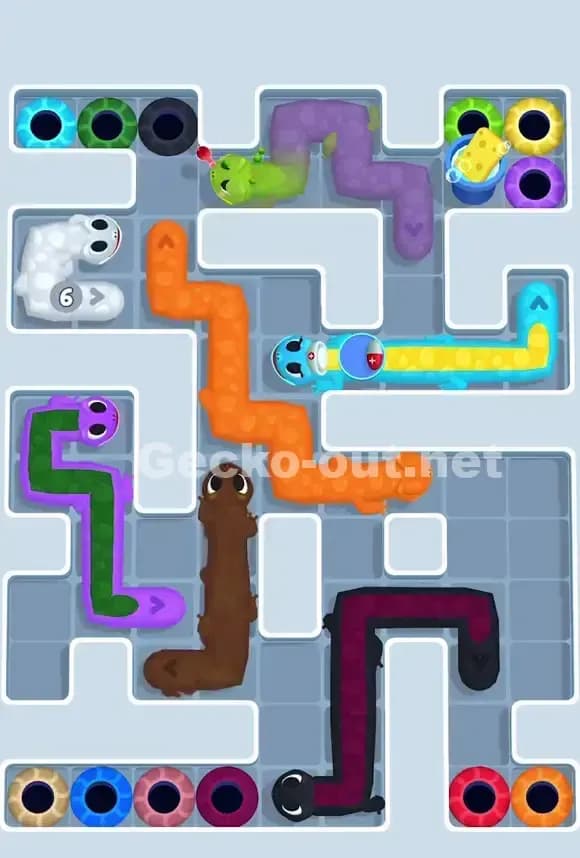
Your first move in Gecko Out Level 761 should be to exit the brown gecko. Drag its head downward and to the right, navigating it through the central corridor and out the bottom-right orange or red exit hole. This move seems counterintuitive because the brown gecko isn't blocking your primary exit path, but it is blocking the potential path that the pink gecko will need. Once the brown gecko is out, you've freed up critical middle-board real estate and made the central corridor slightly wider.
Your second move should be to exit either the cyan or the green gecko from the top-left cluster. These two are touching each other, so you need to move one before the other. Start with the cyan gecko; drag it upward and slightly right, threading it through the now-open space above the frozen exit, and guide it to the cyan exit hole on the top-left edge. This clears one of the three geckos in that upper cluster and gives the green gecko room to breathe.
Mid-Game: Reposition the Blue Gecko and Prep the Pink Gecko's Exit
Once the brown gecko and cyan gecko are out, you should have five moves left (or close to it, depending on how quickly you executed). Your third move is to exit the green gecko using the same top-edge path that the cyan gecko used. Drag its head north, let its body follow the now-familiar corridor, and push it out through the green exit hole at the top.
Now comes the critical moment in Gecko Out Level 761: the pink gecko's exit. This gecko is long and occupies a lot of visual space, but its exit is actually on the right side of the board, somewhere in the red or orange zone. Drag the pink gecko's head to the right and downward, threading it carefully around any remaining bodies, and guide it toward its exit hole. Don't rush this move; the pink gecko's path will reshape the entire right-side layout for the remaining geckos.
Your fourth move should clear the blue gecko on the left side. Drag it downward and to the right, navigating around the now-empty spaces left by the brown gecko, and funnel it toward the blue exit hole at the bottom-left area of the board.
End-Game: The Yellow and Dark-Blue Geckos Race to the Finish
By this point, you should have four geckos out and two remaining: the yellow gecko (part of the top-right cluster) and the dark blue gecko (also top-right). These two are close to their exit holes, but they're also very close to each other, which means dragging one can accidentally block the other.
Your fifth move should be the yellow gecko. Drag it to the right and slightly downward toward the yellow exit hole on the top-right edge. Keep the path tight and direct; you don't have many moves left, and wasting timer distance means risking a timeout.
Your final move is the dark blue gecko. Drag it upward toward the dark blue exit hole at the top-right corner. At this point, most of the board should be clear, so this should be a straightforward path unless you've accidentally created a wall with one of the previous gecko bodies.
Why This Path Order Works in Gecko Out Level 761
Using the Body-Follow Rule to Unmake, Not Remake, the Knot
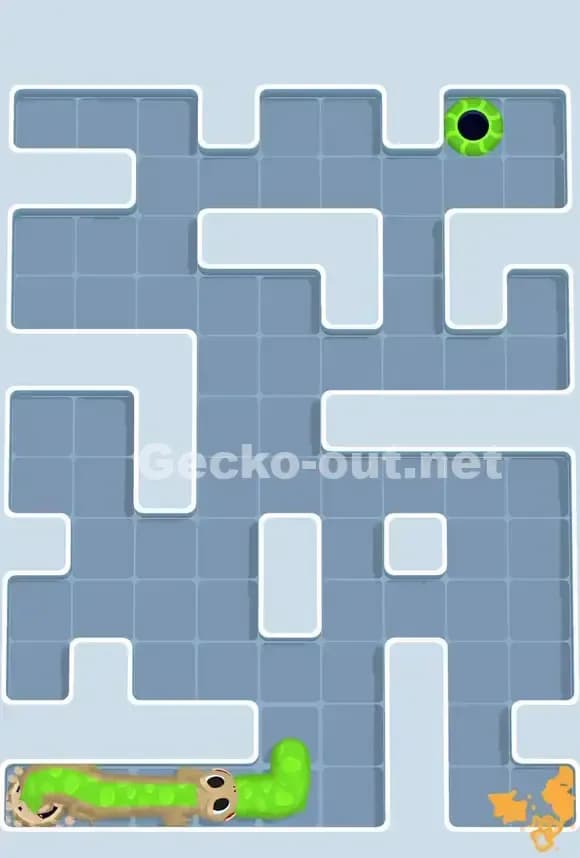
The reason this path order beats Gecko Out Level 761 is that it treats each move as a subtraction rather than a rearrangement. By moving the brown gecko first, you don't just get one gecko out; you remove a blocker that would have created a domino effect later. When you exit the cyan gecko second, you're not just clearing one spot; you're opening the top-north corridor for the green gecko, which would otherwise have nowhere to go. This is the core logic of head-drag pathing: your current move determines whether your next move is even possible.
The central insight is recognizing that Gecko Out Level 761 has a hidden dependency tree. The pink gecko's exit depends on the brown gecko being gone. The blue gecko's exit depends on the pink gecko's path not crossing it. The yellow and dark blue geckos at the end have it easy because everything else has already been cleared. If you tried to exit the pink gecko first, you'd trap the brown gecko, and then you'd have no way to create space for the final three geckos.
Timing and Pause Strategy: When to Commit Versus When to Slow Down
Gecko Out Level 761 gives you 8 moves, which is enough if you're decisive but not enough if you're uncertain. My advice is to pause and trace your fingers across the intended path before you drag. Spend 5–10 seconds per move visualizing where the gecko's body will land and whether it blocks any exit holes. Don't pause after every move unless you're truly stuck; the timer is a psychological pressure, and overthinking will cause you to second-guess a correct plan.
The moment when the solution started clicking for me was when I realized that moving a gecko out is different from moving a gecko around. If you're moving a gecko around to make space, you're probably playing the puzzle wrong. Every move should have a gecko exiting the board. That's how you know you're on the right track in Gecko Out Level 761.
Booster Strategy: When Extra Time Actually Helps
Boosters like extra time or hints are optional on Gecko Out 761, not mandatory. If you follow the path order above, you should finish with at least one or two moves to spare. However, if you make a mistake and accidentally block an exit with a gecko's body, an extra-time booster can be a lifesaver. A hammer-style booster that removes walls isn't necessary here because the walls are static and part of the puzzle design. If you're finding yourself in a soft-lock, it's better to restart and try again than to spend a booster—that trains your planning skills for future levels.
Mistakes, Fixes, and Logic You Can Reuse in Other Gecko Out Levels
Common Mistake #1: Moving the Pink Gecko Last
The biggest mistake players make on Gecko Out Level 761 is treating the pink gecko as a final-move exit, assuming it'll just smoothly slide out once everything else is clear. In reality, the pink gecko is so large that its body becomes a path-blocker if left until the end. The fix is to exit it in the mid-game, around move 4 or 5, so its body has time to settle into a safe configuration on the board before you move the remaining geckos. This principle applies to any large gecko in any level: bigger bodies should exit sooner, not later.
Common Mistake #2: Ignoring the Frozen Exit and Wasting a Move
Players often see the frozen (icy-blue) exit on the left and think, "Oh, a shortcut!" Then they drag a gecko into it, the gecko can't pass, and they waste a move backtracking. The fix is to ignore all exits that have a visual ice or lock indicator. Gecko Out Level 761 will not let you use those exits in the early game, and getting distracted by them costs you precious timer moves. Scan the board once at the start and identify which exits are actually passable.
Common Mistake #3: Dragging Too Wide a Path
New players tend to drag gecko paths in wide arcs, thinking the body needs "room" to maneuver. In Gecko Out Level 761, this creates unnecessary obstacles. The fix is to drag along the walls and corridors, taking the tightest possible route. A gecko dragged along the top wall and a side wall occupies far less central space than one dragged in a sweeping curve through the middle. This leaves room for other geckos and gives you more flexibility for late-game moves.
Common Mistake #4: Exiting Geckos from the Wrong Side
Each gecko has a preferred exit based on its starting position. The cyan gecko at the top-left should exit upward, not downward around the whole board. The fix is to mentally draw the shortest path from each gecko to its matching-color exit hole and commit to that path. In Gecko Out Level 761, taking the long route wastes space and timer moves.
Common Mistake #5: Not Visualizing Two Moves Ahead
Players often make a move that feels safe in isolation but blocks the next gecko's only viable path. The fix is to trace out at least two consecutive moves before committing to the first. Ask yourself: "If I exit the brown gecko here, does the pink gecko have a path? If I exit the pink gecko here, does the blue gecko have a path?" This forward-thinking approach is absolutely essential for Gecko Out Level 761 and scales to all complex puzzle levels.
Reusing This Approach on Similar Levels
The pathing logic from Gecko Out Level 761 applies directly to other gang-gecko or frozen-exit levels. Whenever you see multiple geckos clustered together or large geckos blocking central corridors, apply the "subtract, don't rearrange" philosophy. Always exit the largest or most central gecko early, even if it doesn't seem urgent, because its body is the biggest blocker. For levels with frozen exits, ignore them completely until the puzzle explicitly tells you they're unlocked (usually after a specific number of geckos have exited).
The Encouraging Takeaway
Gecko Out Level 761 is genuinely tough—it's a level that's designed to punish sloppy thinking and reward planning. But it's absolutely beatable with a clear mental model. The moment you stop thinking of it as "move geckos to holes" and start thinking of it as "remove blockers in the right order," the puzzle shifts from frustrating to satisfying. You've got this, and once you beat Gecko Out 761, you'll have the strategic foundation to tackle almost any complex knot-based puzzle in the game.