Gecko Out Level 706 Solution Walkthrough | Gecko Out 706 Answer
How to solve Gecko Out level 706? Get step by step solution & cheat for Gecko Out level 706. Solve Gecko Out 706 easily with the answers & video walkthrough.
Gecko Out Level 706: Board Layout, Rules, and Win Condition
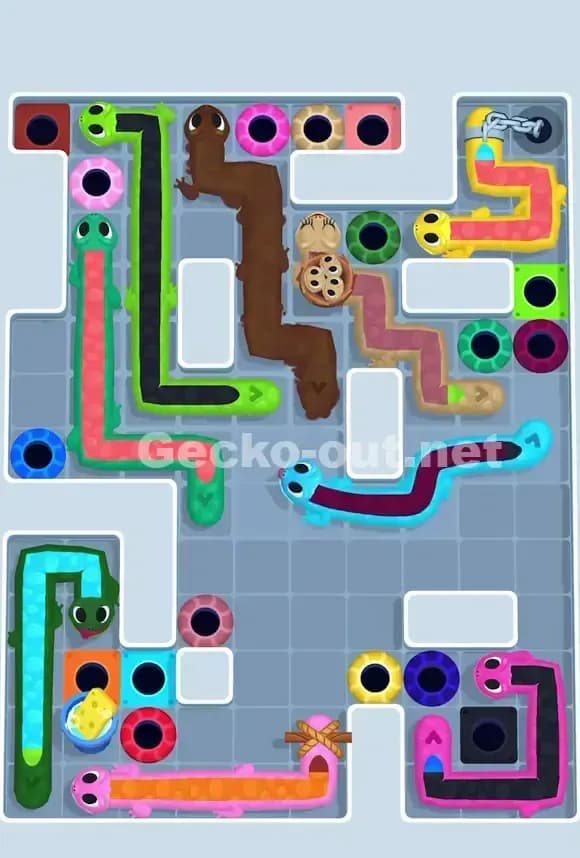
Starting Board: Geckos, Colors, and Layout Chaos
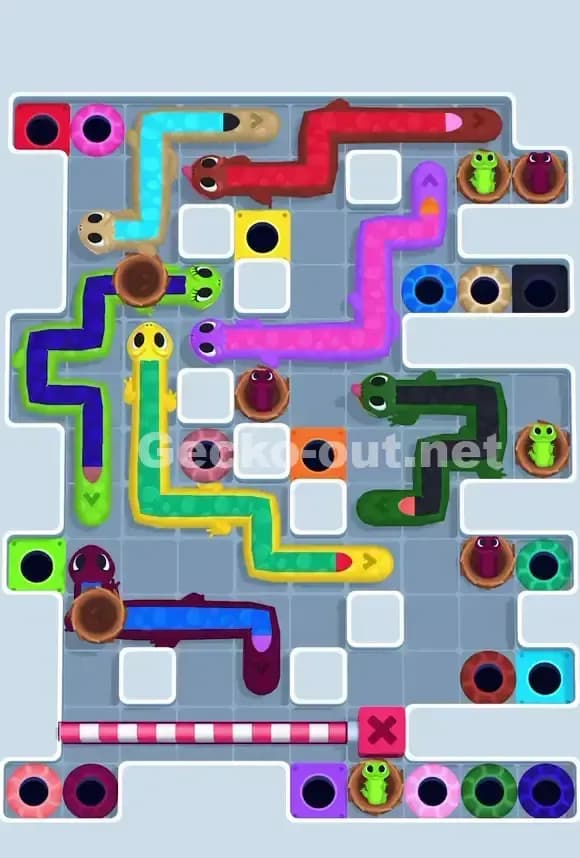
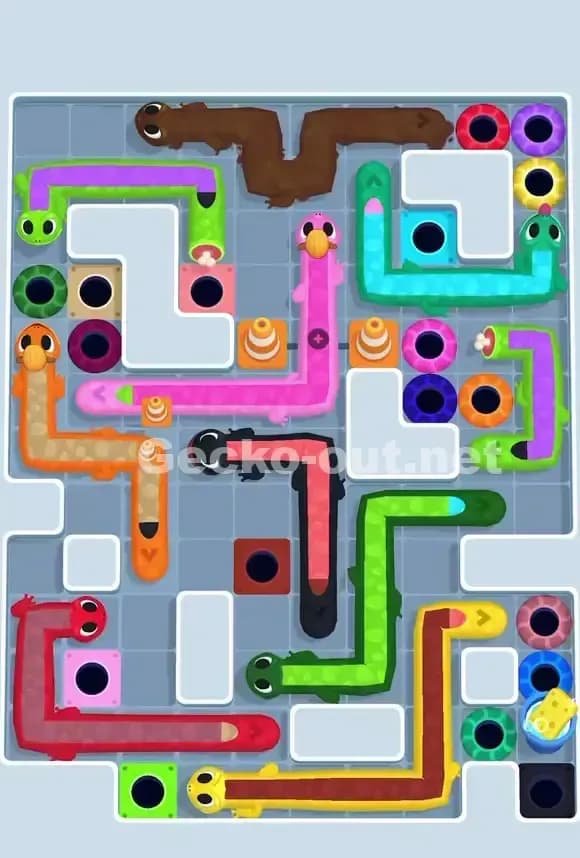
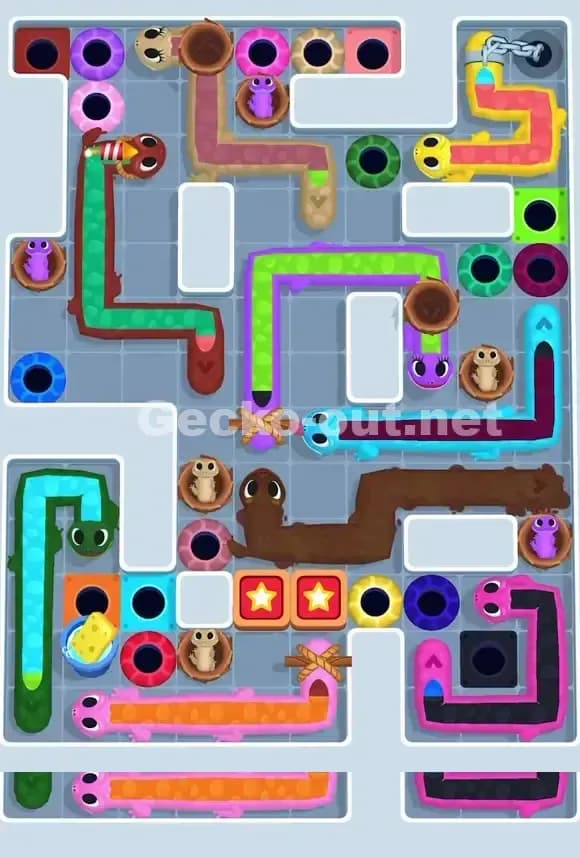
Gecko Out Level 706 is packed—you're looking at roughly ten geckos scattered across a maze-like grid with multiple color families and some serious spatial constraints. The board features red, purple, pink, blue, green, yellow, cyan, and brown geckos, each with matching colored exit holes. What makes Gecko Out Level 706 tricky right away is that many geckos are bunched together in the upper and lower sections, while the middle of the board is clogged with white obstacles (walls and locked zones) that force every path to wind around them. You've got two large white rectangular blockers taking up prime real estate in the center, plus additional barriers that funnel movement into narrow corridors. Some geckos are linked as "gang" units—meaning they move as one connected body—and a few exits appear frozen or locked initially, which adds pressure to your execution timing.
Win Condition and the Timer's Role
To win Gecko Out Level 706, every single gecko must reach its matching-colored hole before the timer expires. The timer is your constant pressure—you can't afford to get stuck experimenting or second-guessing your paths. Because you drag gecko heads to chart their routes, and their bodies follow that exact path without backtracking, one badly drawn drag can choke an exit lane for three other geckos. The goal isn't just to get everyone out; it's to choreograph an exit sequence where no gecko's body blocks another's only available route. That's what makes Gecko Out Level 706 so demanding—it's not about brute-force puzzle-solving; it's about spatial awareness and ordering.
Pathing Bottlenecks and Logical Traps in Gecko Out Level 706
The Central Corridor Bottleneck
The biggest chokepoint in Gecko Out Level 706 is the vertical corridor that runs down the center-right side of the board, roughly between the two main white obstacle blocks. This corridor is the only way several geckos can reach their exit holes, especially the green geckos on the left and bottom-left who must route through here. If you move a long gecko (or a gang unit) through this lane first without planning the exit order, you'll trap faster geckos behind it. I actually got frustrated on my first two attempts because I routed a purple or brown gecko through that corridor early, and then watched helplessly as a blue or green gecko had nowhere to go. The moment the puzzle clicked was when I realized I had to empty that corridor first before committing any long-bodied geckos to it.
The Upper-Left Gang and Interlocking Paths
The upper-left corner has what appears to be a linked group of geckos (purple and brown) that move as a single unit. This gang gecko is physically long and occupies multiple grid cells, so you can't just drag it anywhere without checking whether its body will clip walls or other heads. Combined with the narrow green pathway running down the left edge, routing this gang safely requires you to plan at least two moves ahead. If you get its angle wrong by even one cell, the entire body gets stuck, and you've wasted precious time.
The Lower-Right Exit Squeeze
At the bottom-right, there's a magenta or purple exit that's accessed via a tight L-shaped bend. Multiple geckos (magenta, possibly yellow) need to funnel through that same narrow passage, and only one can occupy the exit hole at a time. You can't queue them up inside the hole, so you have to time their arrival precisely or one will be forced to wait while another exits. If the timer is low and you've miscalculated, you might have a gecko stranded two cells away from its hole with no way to get past a stalled sibling.
Turn-by-Turn Path Strategy to Beat Gecko Out Level 706
Opening: Clear the Fast, Small Geckos First
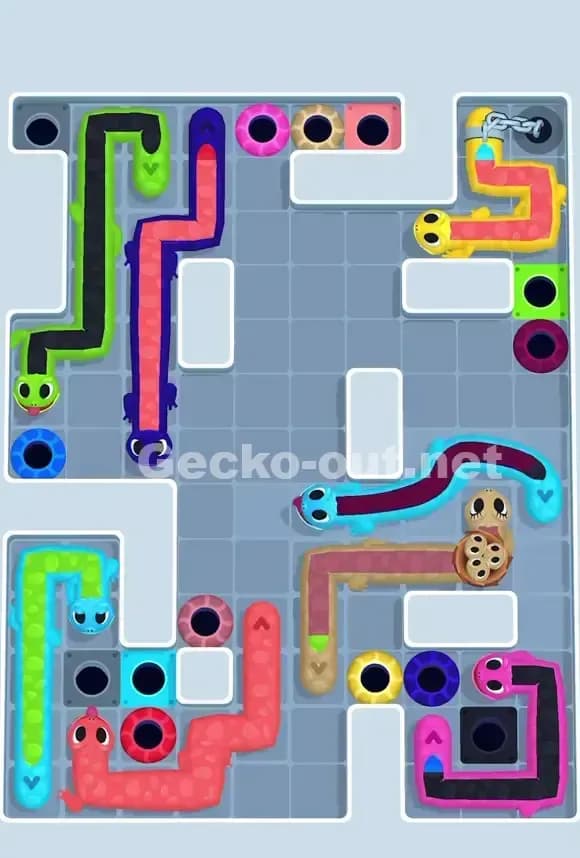
Start with the smallest, most mobile geckos—typically the blue, yellow, or cyan units at the edges of the board. These have short bodies and clear, direct routes to their holes, so they exit quickly and free up space. On Gecko Out Level 706, I'd recommend opening with the blue gecko in the lower-left area; drag its head directly to its matching blue hole and confirm the path doesn't clip any walls. Next, move a cyan gecko if it's isolated; these often have straightforward exits along the edges. By clearing these first, you reduce the visual clutter on the board and create breathing room for the longer, gang-unit geckos. This also builds momentum—you'll see geckos escaping, which is psychologically reassuring and gives you confidence that the level is solvable.
Mid-Game: Park and Reposition the Gang Unit
Once you've cleared two or three quick geckos, focus on the gang gecko or longest single gecko still on the board. On Gecko Out Level 706, this is likely the purple or brown linked unit. Don't drag it to its exit yet; instead, drag it to a "safe park" zone—an area away from the central corridor where it won't block anyone else's path. This might mean moving it into an upper corner or along a dead-end stretch temporarily. The goal is to get it out of the way so you can maneuver the mid-length geckos (reds, pinks, greens) through the hot zones. Once the corridor and main exits are clear for faster geckos, you can then route your gang unit through without it becoming a traffic jam. This "park and swap" strategy is essential in Gecko Out Level 706 because the board is too cramped for parallel movement.
End-Game: Exit Order and Avoiding Last-Second Locks
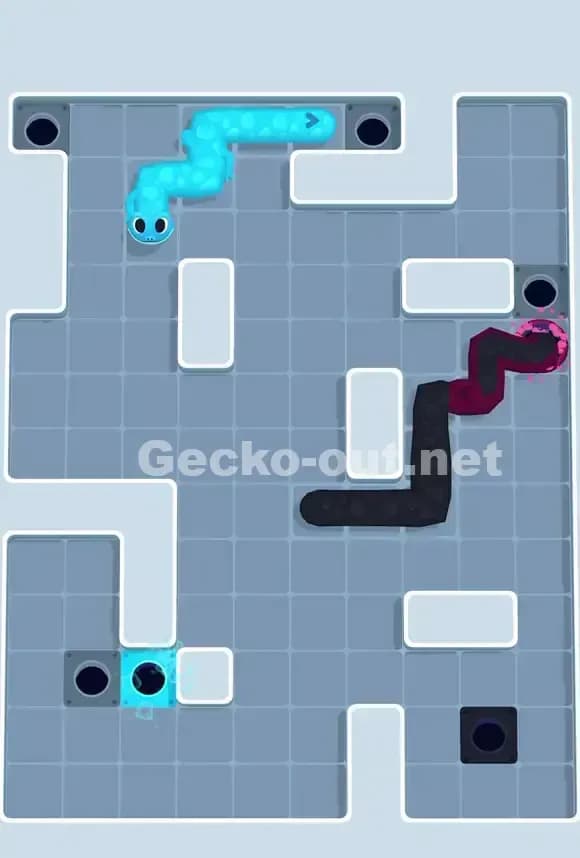
In the final stretch, you should have maybe three or four geckos left. Identify which ones share exit corridors—for instance, if two geckos both need to route through the center-right corridor to reach different holes, you must exit the closer one first. On Gecko Out Level 706, the bottom-right magenta exit squeeze is critical: prioritize whichever gecko is closest to that hole, drag it through, and get it out before the timer dips below thirty seconds. If you're cutting it close (timer below forty seconds), don't pause to overthink; commit to a path and execute. Hesitation at this stage often means the timer beats you because you're too busy second-guessing angles. Drag with confidence, and if a path looks blocked, tap the undo button once and reroute, rather than freezing up.
Why This Path Order Works in Gecko Out Level 706
Head Drag and Body-Following Untangles Instead of Tangles
The genius of this strategy in Gecko Out Level 706 is that you're leveraging the head-drag mechanic to your advantage. When you drag a gecko head along a specific path, its body traces that exact line—it doesn't cut corners or jump gaps. This means if you carefully route small geckos out first using only the perimeter and side lanes, you literally erase their bodies from the board, opening lanes for bigger geckos. If you'd tried to route the gang gecko first, its long body would occupy the center corridor for multiple moves, forcing smaller geckos to find alternate (often non-existent) routes. By reversing the typical instinct to "solve the hardest thing first," you solve Gecko Out Level 706 by removing obstacles in the right order.
Timer Management: Pause Strategically, Move Decisively
The timer on Gecko Out Level 706 usually gives you 60–90 seconds, which sounds generous until you realize how many moves are needed. Don't pause after every single drag; you'll burn time unnecessarily. Instead, pause once at the start to map out your opening sequence (first three to four geckos), then move quickly through those. Pause again around the mid-game mark when the board is half-empty, reassess which geckos remain and which are blocking, and commit to your final plan. In the last thirty seconds, don't pause at all—just execute. Practicing this rhythm on Gecko Out Level 706 will sharpen your ability to balance careful planning with decisive action.
Boosters: Optional, but the Time Bonus is a Safety Net
Gecko Out Level 706 is absolutely completable without boosters if you follow the order above. However, if you're down to your last thirty seconds and have two geckos left, a time-extension booster is a reasonable backup. A hint tool can also help if you're genuinely unsure about the corridor routing. I'd recommend treating boosters as insurance rather than relying on them, though. Solving Gecko Out Level 706 without them is more rewarding and teaches you the spatial reasoning you'll need for even harder levels.
Mistakes, Fixes, and Logic You Can Reuse in Other Gecko Out Levels
Common Mistakes and How to Fix Them
Mistake 1: Routing the Longest Gecko First
Many players instinctively drag the gang gecko or longest unit as their opening move. This is almost always wrong on Gecko Out Level 706 because a long body immediately blocks multiple lanes. Fix: Always identify and move the three shortest geckos first, regardless of color or position.
Mistake 2: Overlapping Paths in the Central Corridor
Drawing one gecko's path such that its body stays in a corridor while another gecko needs to pass through that same space. Fix: When routing through a narrow corridor on Gecko Out Level 706, ensure the gecko's full body is either completely past the exit or completely parked elsewhere before moving the next gecko through.
Mistake 3: Forgetting About the Exit Hole Itself
Some players drag a gecko's path right up to the hole but forget that the hole is a single cell—only one gecko can occupy it at a time, and if another gecko's body is blocking the entrance, it can't enter. Fix: Always confirm that the cell directly before the exit hole is clear and that no other gecko's body is occupying the hole area.
Mistake 4: Rushing the Mid-Game
After clearing two quick geckos, some players panic and start dragging random remaining geckos without a coherent plan, leading to a tangled mess by move seven. Fix: Take a breath after your second successful exit, look at the board, and write down (mentally) which three geckos you'll move next and in what order.
Mistake 5: Not Using Undo When a Path Looks Off
If your drag doesn't look right visually, don't commit it and move on—undo immediately. Fix: Trust your gut. If a path seems to clip a wall or doesn't align with your mental map, undo and redraw before confirming.
Reusing This Logic on Similar Levels
This "small-to-large, perimeter-first" strategy works beautifully on any Gecko Out level with a congested center and gang geckos. Levels featuring frozen exits or linked geckos especially benefit from this approach because you're systematically removing variables (geckos) from the board before tackling the hard stuff. Whenever you see multiple geckos bunched in the middle with narrow corridors, think "Gecko Out Level 706" and apply the same rhythm: assess, move the quick ones, park the long ones, then execute the finale with the remaining space.
Final Encouragement
Gecko Out Level 706 is genuinely challenging, but it's not unfair. The puzzle has a logical solution, and once you spot the bottleneck and realize you need to sequence your moves carefully, the level becomes a satisfying exercise in planning and precision. You've got this—take it step by step, trust the strategy, and remember that undoing a bad move costs nothing but a second of time. Beat Gecko Out Level 706 with confidence.