Gecko Out Level 1113 Solution Walkthrough | Gecko Out 1113 Answer
How to solve Gecko Out level 1113? Get step by step solution & cheat for Gecko Out level 1113. Solve Gecko Out 1113 easily with the answers & video walkthrough.
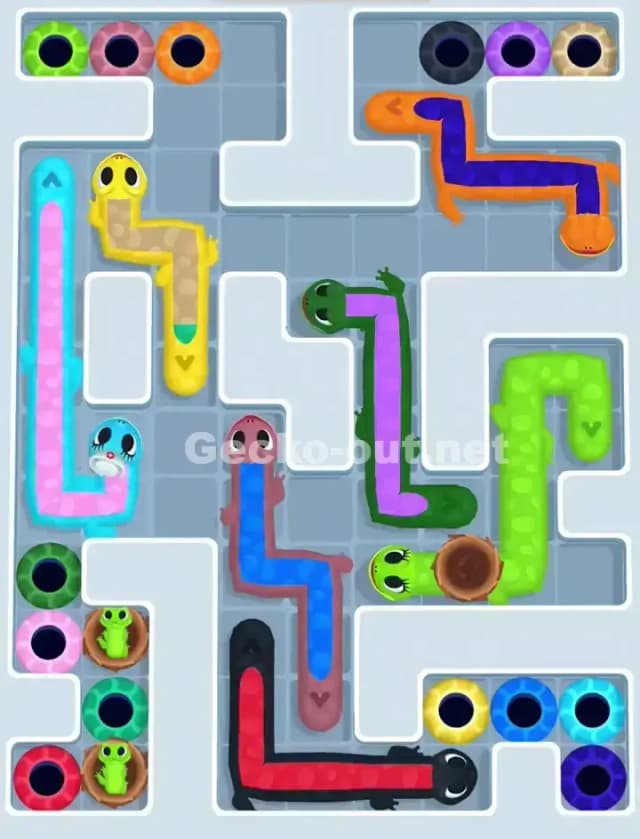
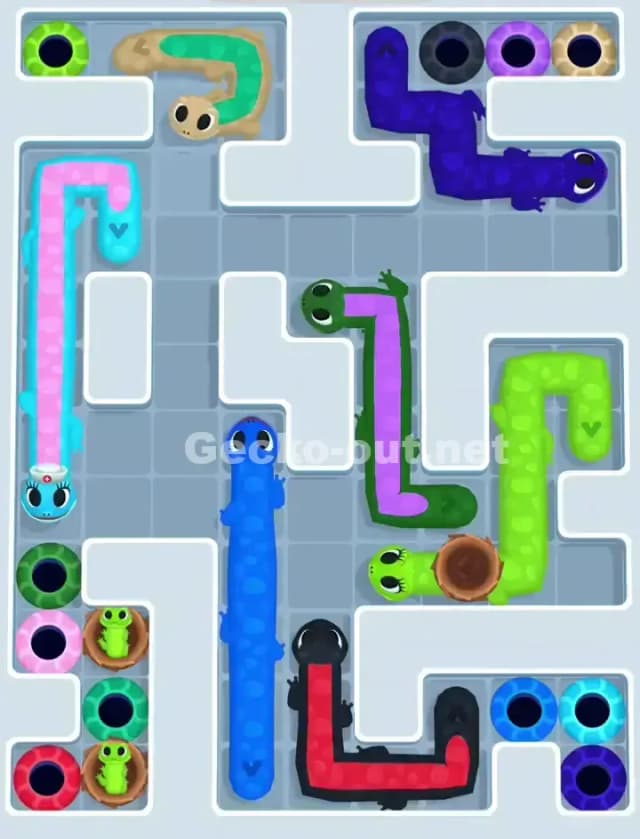
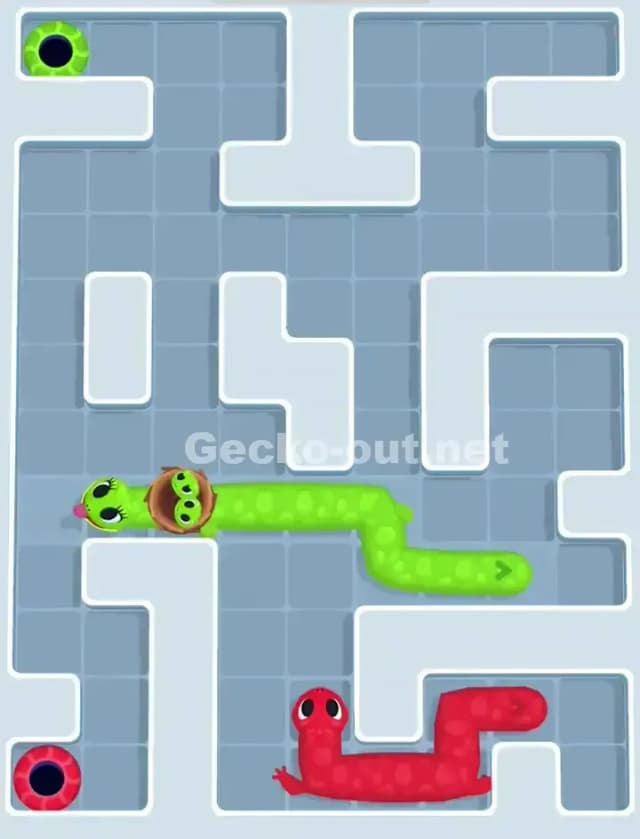
Gecko Out Level 1113: Board Layout, Rules, and Win Condition
The Starting Board: A Tightly Woven Puzzle
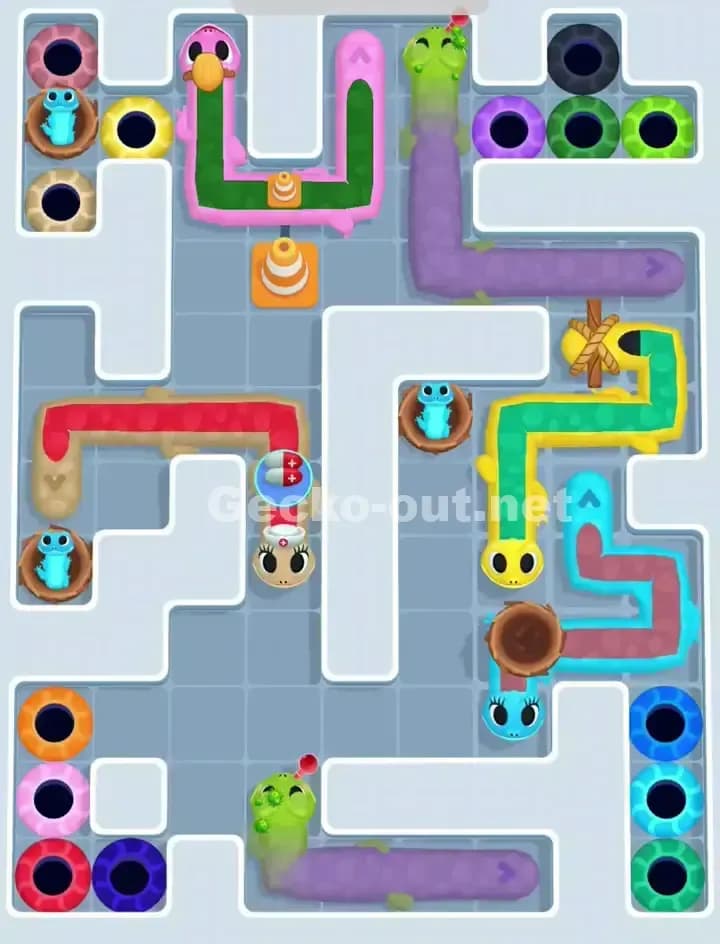
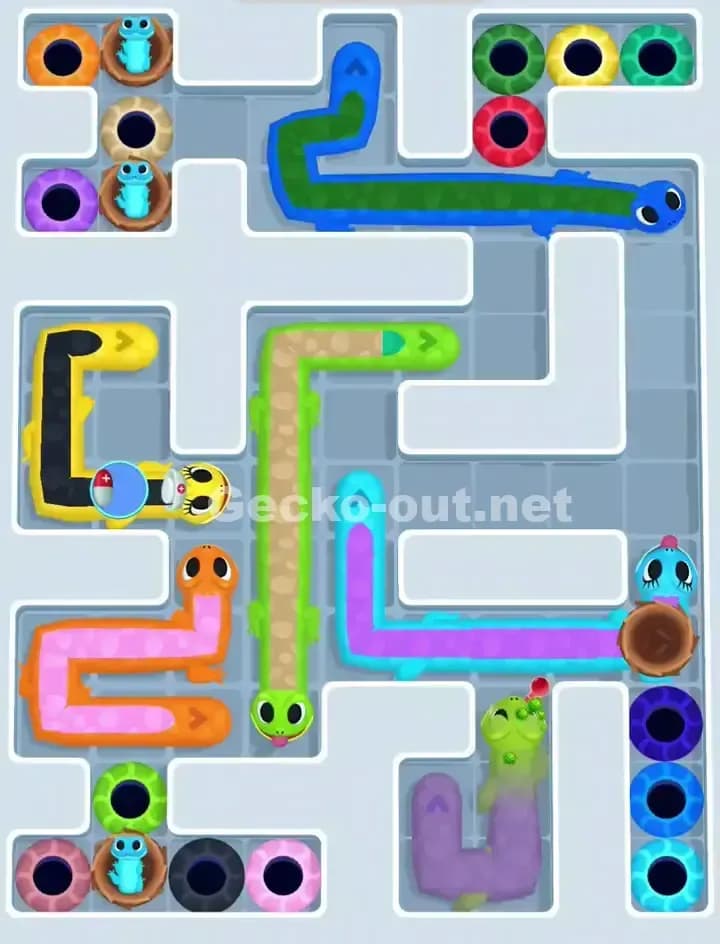
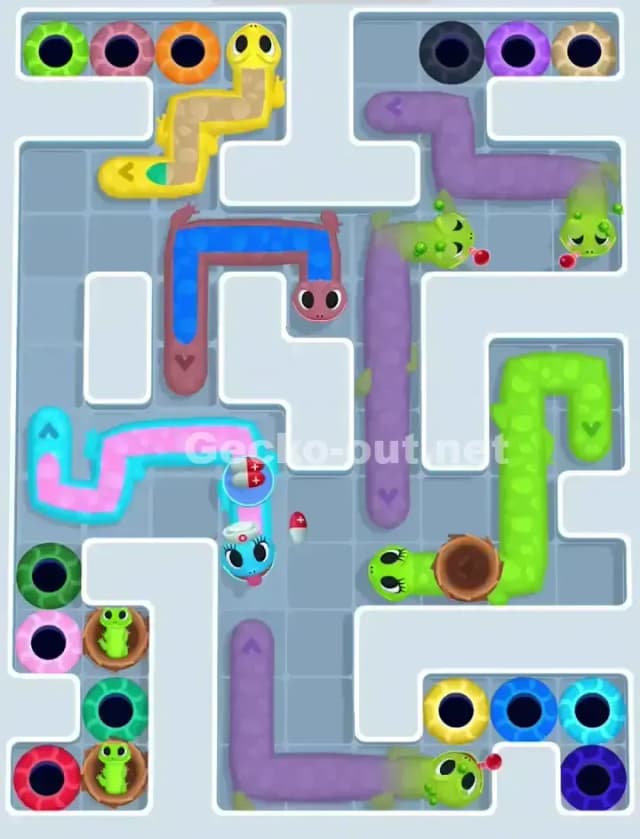
Gecko Out Level 1113 drops you into one of the game's most intricate knots yet. You're looking at eight geckos spread across the board, each one a different color: green, pink, orange, yellow, red, cyan, purple, and blue. The board itself is a maze of tight corridors, with white walls cutting across almost every major pathway like a chessboard of obstacles. What makes Gecko Out 1113 especially tricky is that several geckos are positioned in cramped starting zones, and their bodies are already extended across critical chokepoints. You'll notice a couple of longer gecko bodies snaking through the middle section of the board—these "gang" geckos are the main reason the puzzle feels so tangled at first glance.
The eight colored holes are distributed around the perimeter and a few key interior spots, meaning you can't just rush everyone out in any direction. Each gecko has a specific exit, and the board layout forces you to think several moves ahead. The timer is generous enough to reward planning, but tight enough that careless dragging will eat up your time fast.
Win Condition and Timer Pressure
To beat Gecko Out Level 1113, you must guide all eight geckos to their matching colored holes before the clock runs out. The timer doesn't kick in immediately, so use those first few seconds to trace each gecko's starting position, identify its hole, and spot which geckos are blocking which paths. If you let even one gecko's body linger on a critical corridor, you'll create a traffic jam that cascades into failure. The timer typically allows around 90–120 seconds for a level this complex, which sounds like plenty until you realize that a single mistaken drag can undo five careful moves.
Pathing Bottlenecks and Logical Traps in Gecko Out Level 1113
The Central Corridor Knot: The Real Villain
The single biggest bottleneck in Gecko Out Level 1113 is the central section where the red, cyan, and pink geckos converge. The red gecko's body winds through the middle like a long snake, and it physically blocks the path that the cyan and pink geckos need to take to escape. This isn't just a matter of timing—it's a puzzle dependency. You cannot move cyan or pink freely until the red gecko is completely out of the way. That means red must be your absolute priority early on, and you have to be surgical about dragging its head without accidentally steering it into a wall or accidentally crossing another gecko's path mid-drag. I'll be honest: the first time I tried Gecko Out Level 1113, I got frustrated because I kept undoing the red gecko's move three or four times before I found a clean path that didn't loop back on itself.
Subtle Traps: The Yellow Head and the Purple Gang
Look carefully at the yellow gecko in the upper-right area. Its hole isn't where your instinct says it should be—the wall layout forces you to drag it in a counterintuitive curve that most players get wrong on the first attempt. If you drag yellow straight toward the obvious opening, you'll find yourself stuck in a dead-end corner. Instead, you need to loop it backward first, which feels wrong but is absolutely necessary.
The purple gecko presents another trap: it's not a single gecko, but part of a longer chain that wraps around the right side of the board. This gang gecko is longer than it first appears, and its tail occupies space that you'll later need. If you move purple without a clear exit plan, you'll block your own path for blue or cyan.
When the Puzzle Clicked
Honestly, Gecko Out Level 1113 frustrated me for a solid two minutes until I stopped rushing and spent thirty seconds just tracing each gecko's body with my eyes. That's when it hit me: this wasn't a speed puzzle—it was a dependency puzzle. Once I mapped out the order (red first, then yellow, then the green geckos), everything else fell into place. The lightbulb moment came when I realized that moving one gecko out of the way actually opened two new paths for the others.
Turn-by-Turn Path Strategy to Beat Gecko Out Level 1113
Opening: Clear the Red Bottleneck First
Start by moving the red gecko out completely. Trace its head from its starting position and drag it toward its hole in the lower-left area. The path requires a gentle curve around the central white walls, but it's doable in one clean motion if you're careful. Don't rush this move—take your time and visualize the entire drag before you commit. Once red is out, you've just freed up the central corridor for cyan and pink, and the whole puzzle suddenly becomes less claustrophobic. Park any gecko you're not immediately moving to the side, away from active lanes. For example, after you move red, make sure yellow and the green geckos on the left side stay put and don't accidentally slide into the corridor you just cleared.
Mid-Game: Keep Lanes Open and Reposition Strategically
After red is gone, tackle the upper geckos: yellow, orange, and pink in quick succession. Yellow's counterintuitive loop is the key here—drag it backward first, then forward toward its hole. Once yellow is clear, pink and orange have more room to maneuver. The cyan gecko comes next; its path winds through the area that red just vacated, so move it before you touch the purple gang gecko. This is when you'll start to feel the timer pressure, but don't panic. Pause for a second between moves if you need to double-check your drag path. The time saved by avoiding one mistake is worth the two seconds of planning.
The tricky part is managing the longer geckos' bodies during repositioning. If you're dragging a gecko's head and its body is currently blocking another gecko's exit, you need to commit to moving it all the way out—not just partway. Half-measures create new knots.
End-Game: The Final Dash and Avoiding Last-Second Chaos
Once you've cleared red, yellow, pink, and cyan, you're left with orange, blue, the two green geckos, and the purple gang gecko. These four should have significantly more room to move now. The order here is less critical, but I recommend moving the green geckos second-to-last and purple last, because purple's long body can interfere with green's path if you're not careful. As you move into the final stretch, you should have at least 30–40 seconds left on the timer, which is plenty. If you're below 20 seconds and still have more than one gecko to move, you might have made a mistake earlier—but don't panic. Stick to straight, direct paths for the remaining geckos and avoid any fancy curves that aren't absolutely necessary. Speed matters more than perfection at this point.
Why This Path Order Works in Gecko Out Level 1113
Head-Drag Mechanics and Body-Follow Logic
The reason this sequence unravels Gecko Out Level 1113 instead of tightening it is rooted in the body-follow rule. When you drag a gecko's head, its body traces the exact path you drag—no shortcuts, no simplifications. This means that if a gecko's body is currently overlapping a corridor, dragging another gecko through that corridor won't work. By moving red first, you remove a 5-unit-long obstacle from the middle of the board, instantly creating two new viable paths for cyan and pink. This cascading unlock is the puzzle's intended solution. You're not fighting the layout; you're using the layout's dependencies to your advantage.
The yellow loop-back move exemplifies this principle too. You're not going around the wall because you can't go through it; you're looping back because that's the only way the body-follow mechanic will let you reach the hole. Once you see this, yellow's move feels inevitable rather than arbitrary.
Timer Management: Pause and Read, Then Commit
Gecko Out Level 1113 rewards deliberate play over reflexive button-mashing. Spend the first 20–30 seconds reading the board and mentally executing each move. Mark the red gecko as "move first" and the purple gecko as "move last." Once you've got the sequence, execute each move with confidence and speed. The timer won't punish you for thinking; it'll only punish you for undoing a move mid-drag or dragging in the wrong direction and having to backtrack. I've found that committing to a 3–5 second decision phase per gecko and then moving decisively leaves me with plenty of time and a clean board.
Boosters: Optional But Situational
Gecko Out Level 1113 doesn't require boosters if you follow the strategy above. However, if you find yourself stuck or running low on time, a "hint" booster can be invaluable—it'll show you the next gecko to move and the recommended path. An "extra time" booster is less useful here because the timer is already generous if you play efficiently. I'd avoid the hammer tool or other destructive boosters, as they tend to scramble the board and create new problems. Save your boosters for later levels that are genuinely unforgiving; Gecko Out Level 1113 is designed to be solved through planning, not brute-force tools.
Mistakes, Fixes, and Logic You Can Reuse in Other Gecko Out Levels
Five Common Mistakes and How to Fix Them
Mistake 1: Moving yellow first instead of red. Yellow gets stuck in a corner because red's body is still blocking the central route. Fix: Always identify the longest gecko body overlapping critical corridors and move it first, regardless of which color seems "closest" to an exit.
Mistake 2: Dragging red's head toward the obvious nearest hole instead of tracing the actual required path. The wall layout curves red's required path in an unintuitive way. Fix: Before you drag any gecko, trace the full path with your eyes and even your finger on the screen. Don't assume "nearest" means "correct."
Mistake 3: Parking geckos in active lanes while you work on others. This creates new bottlenecks. Fix: After moving a gecko out, position the remaining geckos in "dead zones" off the main corridors.
Mistake 4: Moving cyan before red is completely out of the way. Red's tail is still occupying space cyan needs. Fix: Wait until a gecko's body completely disappears from the board before moving any gecko that shares its corridor.
Mistake 5: Rushing the final four geckos and dragging in a curved path that accidentally overlaps another gecko. Fix: In the end-game, use straight lines and single-direction drags. Curved paths increase collision risk.
Reusing This Logic on Similar Levels
Gecko Out Level 1113 exemplifies a dependency puzzle: one gecko must move before others can. This pattern appears frequently in later levels, especially those with gang geckos or frozen-exit obstacles. The mental model—map dependencies, move the longest/most-blocking gecko first, then cascade downward—works on virtually any tangled board. If you encounter another level with a central knot and multiple geckos waiting for one to clear, apply the same red-first-then-cascade strategy.
Also, the yellow-loop-back move teaches a crucial lesson: sometimes the path to a hole involves going away from it first. This applies to any level where straight-line exits are blocked by walls. Always assume you might need to backtrack or loop; never assume the shortest visual distance is the actual path.
The Encouraging Takeaway
Gecko Out Level 1113 is legitimately challenging, but it's not unfair. It's a puzzle that rewards careful thinking and punishes rushes. The moment you stop treating it as a speed challenge and start treating it as a logic puzzle, it becomes solvable in under two minutes. You've got this—map the board, move red first, trust the body-follow mechanic, and watch the tangle unravel before your eyes.