Gecko Out Level 673 Solution Walkthrough | Gecko Out 673 Answer
How to solve Gecko Out level 673? Get step by step solution & cheat for Gecko Out level 673. Solve Gecko Out 673 easily with the answers & video walkthrough.


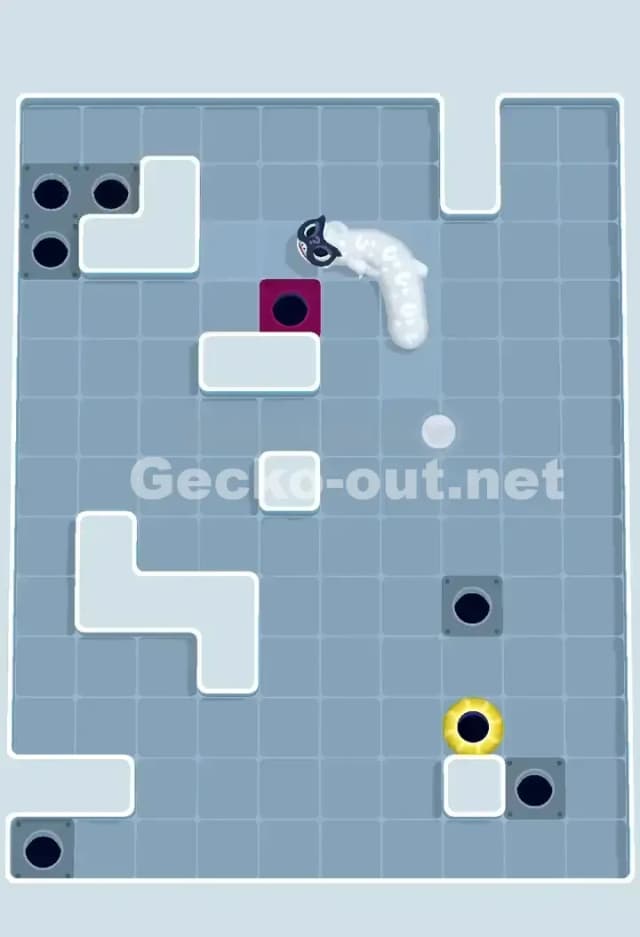
Gecko Out Level 673: Board Layout, Rules, and Win Condition
Starting Board Overview
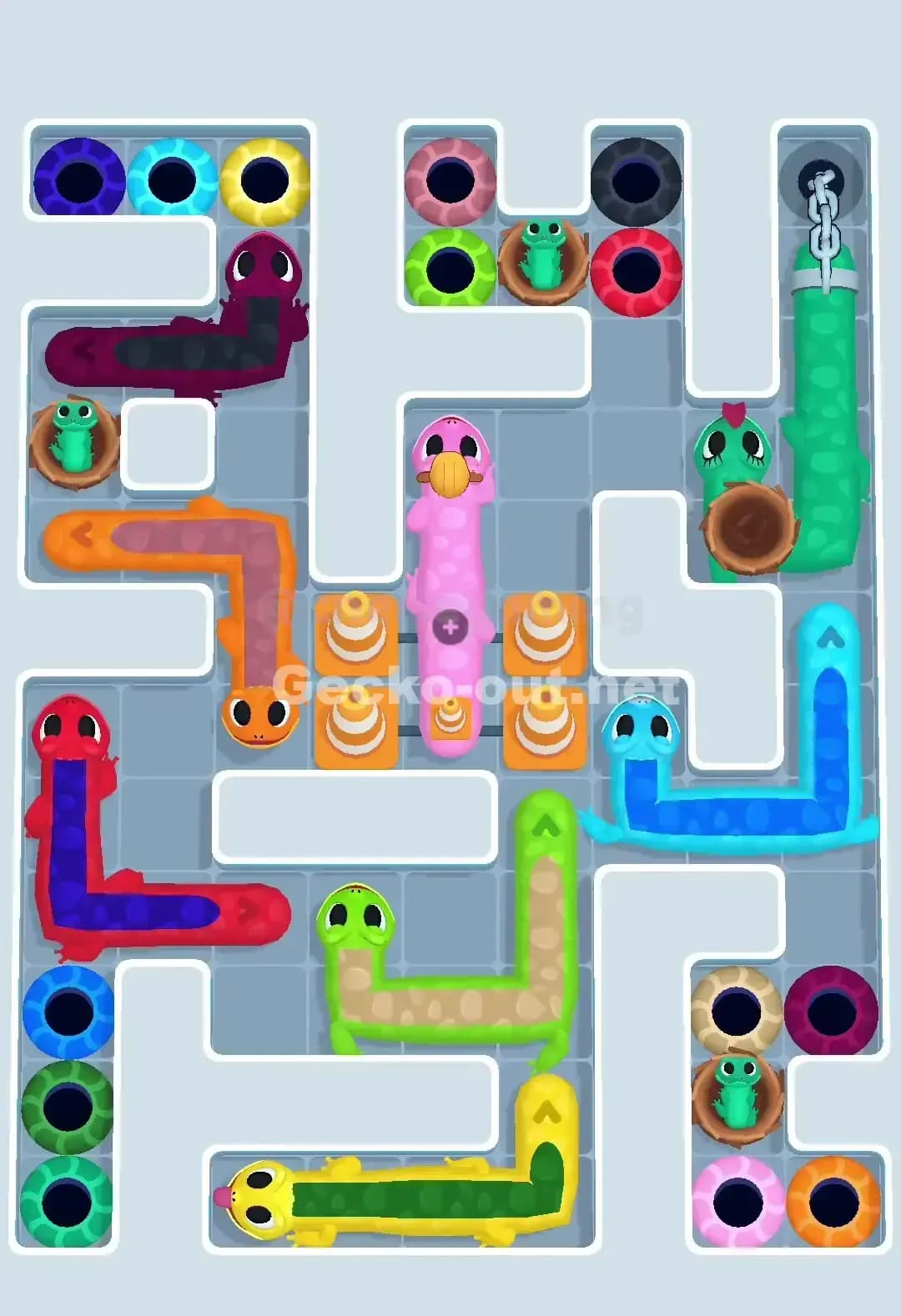
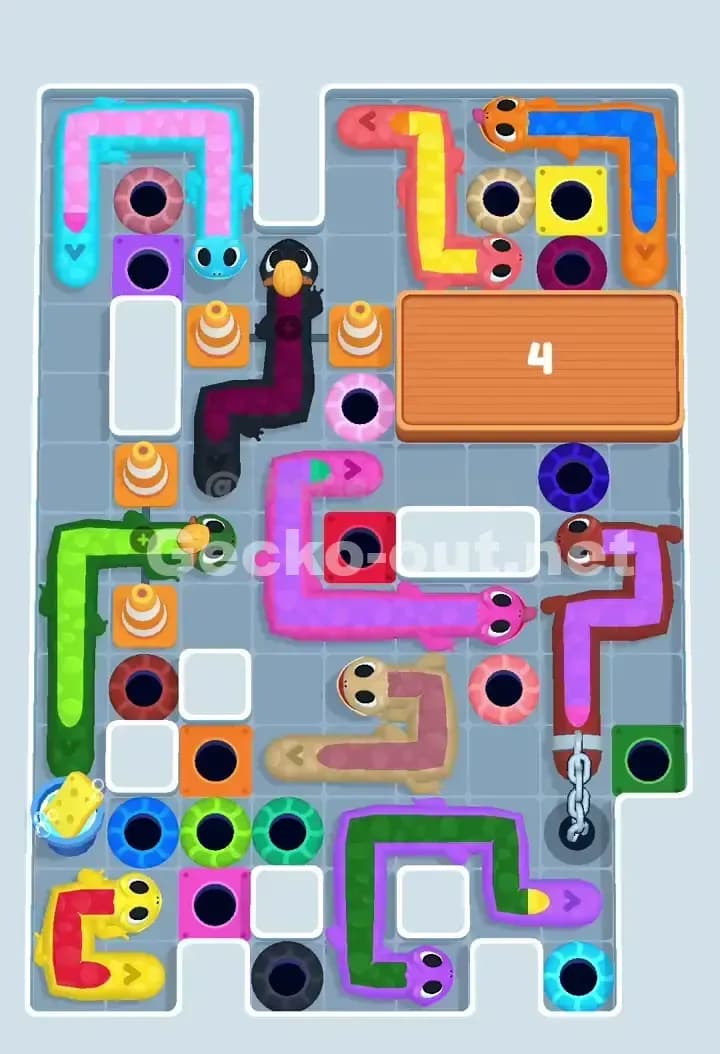
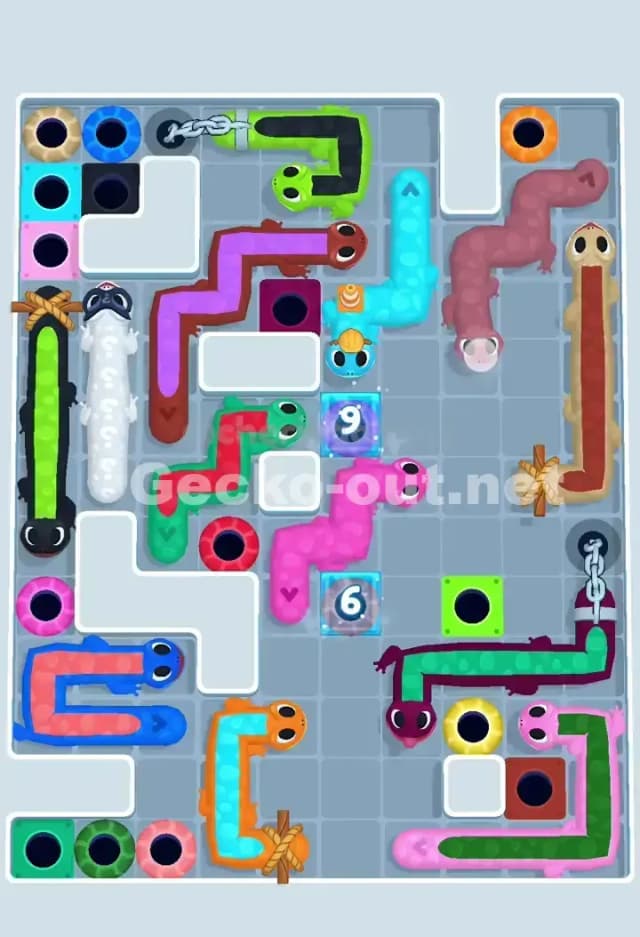
Gecko Out Level 673 is a dense, multi-colored puzzle featuring nine geckos spread across a maze of interconnected pathways. You're looking at a yellow gecko (top-left), a blue gecko, a cyan gecko, a pink gecko, a red gecko, an orange gecko, a green gecko (bottom-left, with two heads), a purple gecko, and a dark blue gecko. Each one needs to reach its matching-colored hole to escape, and they're all tangled up in a board packed with white solid walls, frozen obstacles, and tight corridors that create genuine logistical nightmares. The timer sits at ten turns, which sounds generous until you realize how many geckos are competing for limited space and how long some of these paths really are.
Win Condition and Time Pressure
Your job is simple on paper: drag each gecko's head along an open path until its body follows that route directly to its matching hole. The catch? All geckos must escape before the timer hits zero. Gecko Out Level 673 doesn't reward speed for its own sake—it rewards correct sequencing. Drag the wrong gecko first, and you'll box in three others. Rush a path without planning, and you'll create a body that blocks the only exit corridor. The timer is your silent judge, constantly reminding you that planning beats panic.
Pathing Bottlenecks and Logical Traps in Gecko Out Level 673
The Central Corridor Gridlock
The single biggest chokepoint in Gecko Out Level 673 is the narrow vertical and horizontal corridor system in the middle-right area of the board. Multiple geckos—the red, orange, and cyan ones especially—all need to thread through or around this zone to reach their holes. If you drag the red gecko's head through the central corridor first without thinking, its long body will sprawl across the passageway and trap the orange and cyan geckos on the wrong side of a wall. This is the puzzle's primary knot, and unraveling it is everything.
Subtle Problem Spots That Catch Players
The purple gecko at the bottom-center looks straightforward until you realize its exit path overlaps with the green gecko's route. Both want to use the same corridor section, but only one can go first. If you're not careful, you'll drag the purple gecko halfway through and then realize the green gecko is now boxed in. Similarly, the blue gecko in the top-left and the yellow gecko above it are linked by proximity—their bodies can easily tangle if you don't clear the blue gecko completely before moving the yellow one. Finally, watch the dark blue gecko on the right side; its hole is accessible, but the path to it winds through a super tight choke point where a single misplaced body blocks everything downstream.
The Moment It Clicks
I'll be honest: Gecko Out Level 673 feels overwhelming at first glance. There are so many colors, so many walls, and the timer ticking down creates real pressure. But there's a magical moment—usually about thirty seconds in—when you stop looking at all nine geckos as one impossible blob and start seeing the board as a sequence of unlocking steps. You realize, "Oh, if I move the cyan gecko out first, it clears the corridor for the red gecko, which then opens up space for the orange one." That moment of clarity transforms Gecko Out Level 673 from frustrating to genuinely satisfying.
Turn-by-Turn Path Strategy to Beat Gecko Out Level 673
Opening: Establish Safe Parking Spots
Start with the cyan gecko in the middle-top area. Its path to the cyan hole (right side, middle) is relatively clean if you drag it straight across without looping. Get it out in turn one—this immediately frees up the central corridor that every other gecko will need. While the cyan gecko exits, look ahead: you're going to need temporary "parking" zones for long geckos like the purple and green ones. Identify open grid squares (white, unblocked spaces) where you can safely coil their bodies without them blocking critical pathways. The left-center area and the bottom-right corner are good temporary hold zones.
Mid-Game: Keep Critical Lanes Open
Turns two and three are about clearing the middle-right bottleneck further. Send the red gecko next—drag its head through the now-clear corridor toward its red hole (bottom-center area). Its body is medium-length, so be deliberate: avoid unnecessary loops, and keep the horizontal lines of the board open. Once the red gecko is out, you've unlocked the path for the orange gecko, which should follow immediately. The orange gecko's route to its orange hole (bottom-right) should be straightforward now that you've relieved pressure from the central zone. By turn four, you should have three geckos safely out.
Now pivot to the left side. The green gecko (bottom-left, with two heads technically treated as one linked body) needs careful handling. Its path to the green hole (right-center) is long, and its body will snake across half the board. Drag it slowly, park the tail in that bottom-left corner space you identified earlier, and commit to the move once you're sure no other gecko's exit is blocked. This should be turns five or six. The pink gecko (left side, mid-height) and the magenta gecko (right-center) can follow, since their exits are now visible.
End-Game: Dodge Last-Second Choke Points
By turn seven or eight, you should have six or seven geckos out. The remaining ones—likely the yellow, blue, purple, and dark blue—need careful exit sequencing. The purple gecko's path overlaps slightly with the blue gecko's final stretch, so determine which one has the cleaner route to its hole and send that one first. Usually, the blue gecko (top-left) should exit before the purple one (bottom-center). Save the dark blue gecko for last if possible—its hole is on the far right, and it won't block anyone else. If you're down to two turns left and still have three geckos on the board, stay calm: pause for three seconds, visualize the shortest non-blocking path for each, and execute without second-guessing.
Why This Path Order Works in Gecko Out Level 673
Head-Drag Logic and Body-Follow Untangling
The key insight in Gecko Out Level 673 is that the body always follows the exact path the head traces. This means you're not just moving geckos; you're drawing their physical forms across the board. By exiting cyan first, you're not just removing one gecko—you're erasing a potential obstacle that would have blocked three others' paths. When you drag the red gecko next, its body lands in a corridor that's now clear because the cyan gecko's body is gone. This is the opposite of tightening a knot; it's systematic untangling. Each gecko you remove opens up physical space for the ones behind it.
Pause vs. Commit: Reading the Board
Gecko Out Level 673 rewards a hybrid approach to time management. Spend the first minute reading the board: identify the bottlenecks, trace each gecko's hole location, and mentally draft your exit sequence. Then commit hard. Once you've decided cyan goes first, drag it without hesitation. Hesitation wastes timer turns and clouds your confidence. However, before each move, take three seconds to double-check: "Will this gecko's body block anyone else's exit?" If yes, adjust the path slightly. If no, drag decisively. This rhythm—quick read, decisive move, brief verification—keeps you sharp and on-pace for Gecko Out Level 673.
Booster Strategy: Optional, Not Essential
Gecko Out Level 673 can be beaten without boosters if you execute the sequence correctly. That said, if you find yourself with one turn left and two geckos still on the board, the "extra time" booster is worth considering. Similarly, if you accidentally drag a gecko into a dead-end and realize the path is wrong, a "hint" booster can show you the correct route quickly. The "hammer" or obstacle-removal booster is less useful here since walls are fixed. Treat boosters as a safety net, not a crutch—they're there if you stumble, but a clear plan means you won't need them.
Mistakes, Fixes, and Logic You Can Reuse in Other Gecko Out Levels
Common Mistakes and How to Avoid Them
Mistake 1: Dragging the longest gecko first. New players often move the purple or green gecko (the longest bodies) first because they think clearing space helps. Wrong—long geckos need less crowded boards, not more. Always move short or medium-length geckos first to open corridors, then move the long ones when there's room. Mistake 2: Creating loops unnecessarily. If the cyan gecko's hole is directly to the right, drag it straight right. Don't loop it around the board "just in case." Every unnecessary grid square your path covers is a potential blocking point for someone else. Mistake 3: Ignoring the overlap zones. Before dragging, visually trace where that gecko's body will land. If it crosses a corridor another gecko needs, reconsider the order. Gecko Out Level 673 punishes this hard.
Mistake 4: Panicking in the final turns. If you're down to three turns and three geckos, resist the urge to spam moves. Pause. One more time, identify the bottleneck. Move the gecko that clears it. Then move the next. Panic kills more runs than bad planning does. Mistake 5: Forgetting that geckos can't overlap each other. This seems obvious, but it's easy to forget when you're moving fast. If a gecko's body is already on the board, the next gecko's path cannot cross it. Always verify the board state before dragging.
Reusing This Strategy on Similar Levels
The Gecko Out Level 673 playbook translates directly to any level with a central bottleneck and multiple long geckos. If you see a puzzle with a narrow corridor and several geckos competing for it, always apply the "clear the short/medium geckos first, then move the long ones" rule. Gang geckos (linked pairs or trios) need extra caution—treat them as super-long bodies that block even more space. Frozen exits and icy obstacles require you to plan paths that avoid them entirely; unlike walls, they can't be navigated around, so identify which geckos can legally exit through which holes from the start.
Final Thought on Gecko Out Level 673
Gecko Out Level 673 is genuinely tough, but it's not unfair. Every bottleneck has a solution, and every gecko has a path to its hole. The puzzle tests your ability to think sequentially and visualize how bodies occupy space. Once you crack that mindset, Gecko Out Level 673 becomes less a brick wall and more a satisfying logic problem. You've got this—clear the corridors, execute your sequence, and watch those geckos pop into their holes one by one.