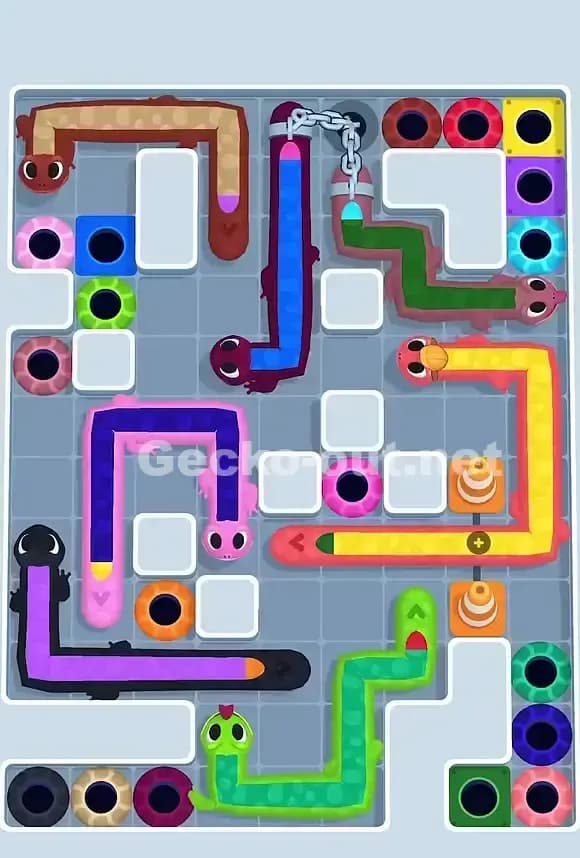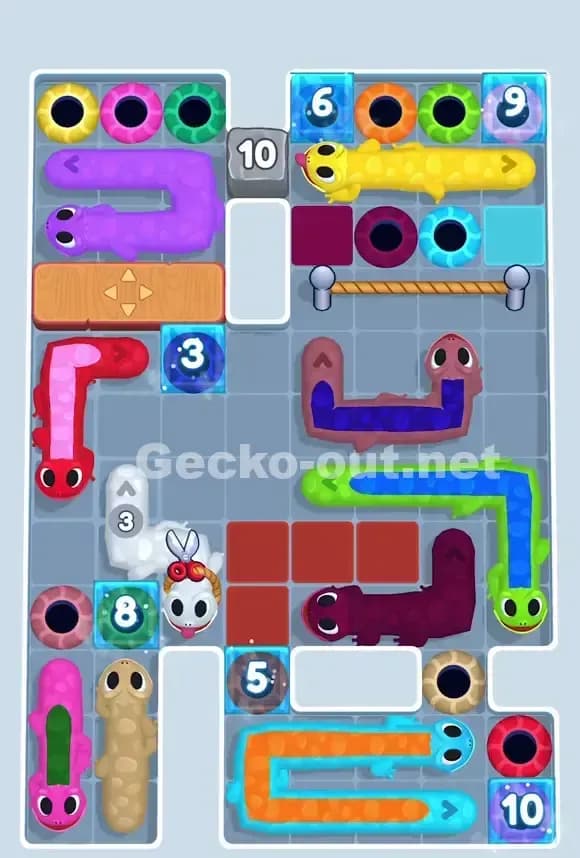
Gecko Out Level 807 Solution Walkthrough | Gecko Out 807 Answer
How to solve Gecko Out level 807? Get step by step solution & cheat for Gecko Out level 807. Solve Gecko Out 807 easily with the answers & video walkthrough.

Gecko Out Level 807: Board Layout, Rules, and Win Condition
Starting Board: Geckos, Colors, and Layout
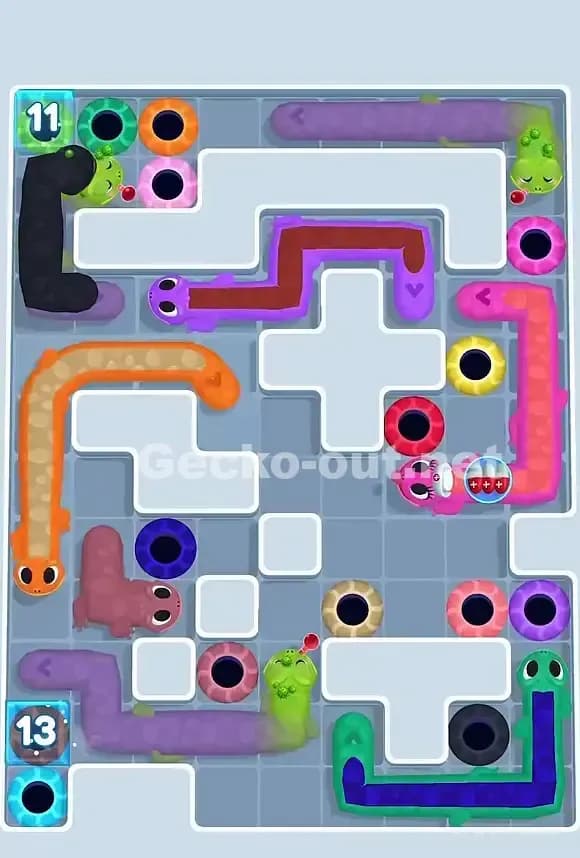
Gecko Out Level 807 is a dense, multi-gecko puzzle that'll test your spatial planning hard. You're looking at a board with at least seven geckos spread across different colors: green, orange, purple, pink, red, blue, and more. The layout is cramped, with white walls creating a tight maze that forces every gecko to snake around obstacles. Some geckos are positioned in the top-left corner (including a black gecko that's particularly long), while others are scattered across the middle and lower sections of the board. You'll notice a few geckos are "gang" linked together—meaning they move as one unit—which makes path planning even more critical. The exit holes are color-matched throughout the board, and several are tucked into corners or behind walls that create natural choke points.
Win Condition and Timer Pressure
Your goal is to drag each gecko's head toward its matching-color hole and guide the body to follow that exact path all the way to escape—before the timer hits zero. The timer shows 11 seconds (or 13 seconds depending on your current attempt), which sounds generous until you realize that long geckos need multiple careful drags, and overlapping bodies can jam your paths instantly. If even one gecko remains on the board when time runs out, you fail the entire level. This means Gecko Out Level 807 demands both speed and precision; rushing causes collisions, but overthinking wastes precious seconds you can't afford to lose.
Pathing Bottlenecks and Logical Traps in Gecko Out Level 807
The Critical Bottleneck: The Central Corridor
The single biggest choke point in Gecko Out Level 807 is the central white-wall corridor that runs roughly down the middle-right section of the board. Multiple geckos need to pass through or around this narrow channel to reach their holes, and if you don't clear the path in the right order, you'll trap a gecko's head on one side while its body gets stuck on the other. The orange gecko in the upper-left is particularly notorious; its long body wants to wrap around the left side of the board, but the black gecko's path can easily cut it off if you're not careful. The key insight is that you must exit the longest geckos first—or at least park their bodies safely in dead-end zones so shorter geckos can squeeze past.
Subtle Problem Spots to Watch
First, there's the gang-linked geckos near the middle-right corner: they move as one unit, so you can't split them up, and they take up nearly twice the board space. If you drag one without thinking about where its partner will end up, you'll accidentally barricade yourself. Second, the lower-left purple gecko looks tempting to exit early because it's close to its hole, but its curved body path will actually block the red gecko's exit route if you're not precise with your drag. Third, there's a tiny timing trap with the yellow and red geckos on the right side—they're so close together that if you drag one just slightly off-target, its body will overlap the other gecko's head, and you'll have to reset or restart.
The Moment It Clicks
I'll admit, my first three attempts at Gecko Out Level 807 felt like pure chaos. I was dragging random geckos out as quickly as I could, and every single time I'd get four geckos out, then suddenly the board would lock up because I'd left a 4-cell-long gecko body sitting across the only path left. But then I paused, really looked at the geometry, and realized: I had to map out the long geckos' paths first, even if it meant exiting them in a less intuitive order. Once I committed to that mental model—"longest first, shortest last"—everything else fell into place, and I beat Gecko Out Level 807 on my very next try.
Turn-by-Turn Path Strategy to Beat Gecko Out Level 807
Opening: Secure the Long Geckos and Clear Lanes
Start by exiting the black gecko (the long one in the top-left corner). Drag its head downward and then curve it around the left wall toward the black exit hole. This sounds slow, but it's the opposite: by removing this 5-cell-long body from the board first, you free up the entire left corridor for everyone else. While you're at it, mentally note where the orange gecko needs to go—it's also long, and it should exit second, following a path along the bottom-left of the board. Don't rush these opening drags; take 2–3 seconds per gecko to ensure the path is clean and the body won't clip any walls.
Mid-Game: Manage the Central Corridor and Reposition Carefully
Once the two longest geckos are out, you've bought yourself breathing room. Now tackle the gang-linked pair near the right side: drag them together toward their matching holes. If they're linked, you'll only need one drag to move both, but you've got to be extra careful that the shared path doesn't overlap any remaining gecko. Next, exit the purple geckos (there are two of them, often in different parts of the board). The trick here is to prioritize the one whose path will block others; usually that's the central purple gecko. Then move on to the pink geckos—they're smaller and more flexible, so they can often navigate around whatever bodies are left. As you're doing this, pause every 2–3 drags to visually scan the board and ask yourself: "Is there any path I'm about to draw that will trap a gecko on the other side?" If the answer is yes, choose a different gecko to exit first.
End-Game: The Final Three and Avoiding Last-Second Chaos
By the time you're down to the last three or four geckos, the board should feel much more open, but this is also where panic sets in. Don't rush. The yellow and red geckos on the right are usually your last pair; they're small enough that one clean drag per gecko will get them out. If you're running low on time (say, 2–3 seconds left), don't try to optimize their paths—just drag them straight toward their holes in the simplest way possible. It's better to use a slightly longer route and succeed than to fail because you were trying to be clever. The absolute final gecko should exit without any obstacles at all; if it doesn't, you've made a positioning mistake earlier, and you'll need to restart.
Why This Path Order Works in Gecko Out Level 807
The Head-Drag Body-Follow Mechanic and Untangling the Knot
The genius (and the frustration) of Gecko Out Level 807 comes down to how the body-follow system works. When you drag a gecko's head, the body doesn't teleport—it traces the exact path your drag created, cell by cell. This means if you draw a path that makes a tight spiral, the body will spiral too, potentially blocking other geckos. By exiting long geckos first, you're essentially removing the "knotty" parts of the board early, which makes every subsequent path simpler and straighter. The gang-linked geckos should come next because they take up double space; once they're gone, the remaining geckos (which are usually shorter) can navigate the now-open board with minimal collision risk.
Managing the Timer: Pause vs. Commit
The 11–13 second timer is tight, but it's not impossibly tight if you plan efficiently. Here's the balance: spend the first 2–3 seconds reading the board and identifying the order, then commit to rapid execution for the next 8–10 seconds. If you're the type to second-guess yourself mid-drag, you'll waste time. Once you've identified that the black gecko goes first, drag it in one smooth motion without pausing. The pause-and-analyze phase should happen before each gecko, not during. If you find yourself with 3 or fewer seconds left and one gecko remaining, don't panic-drag—take one breath, identify the shortest path to its hole, and execute it cleanly.
Booster Usage: Optional but Helpful for Learning
Gecko Out Level 807 doesn't require boosters, but if you're stuck after 3–4 attempts, the Extra Time booster (usually 5–10 extra seconds) can be a game-changer. It gives you room to slow down, plan more carefully, and refine your technique without the crushing time pressure. The Hint booster is less useful here because the puzzle isn't about finding a single hidden path; it's about execution and ordering. Skip the Hint, but if you're genuinely time-locked, grab Extra Time—it's your safety net, not a crutch.
Mistakes, Fixes, and Logic You Can Reuse in Other Gecko Out Levels
Five Common Mistakes and Their Fixes
Mistake #1: Exiting Short Geckos First. Players often go for the "easy" win by grabbing the pink or yellow gecko out of the way immediately. This backfires because you still have a long gecko whose body now has nowhere to go. Fix: Always map the longest gecko's path first, even if you don't exit it immediately. Know where it will go before you move anything else.
Mistake #2: Not Accounting for Gang-Linked Movement. You drag a gang gecko and forget that its partner is attached; their combined body blocks a critical corridor. Fix: Before you drag a linked gecko, trace where both bodies will end up, not just the one you're focused on.
Mistake #3: Dragging Diagonally When Walls Don't Allow It. Gecko Out Level 807's walls are strict; you can't cut corners. Players lose seconds by trying to drag a head toward a hole in a straight line and getting stuck on a wall. Fix: Always trace the exact grid-aligned path your drag must follow; if it requires a 90-degree turn, plan for that turn.
Mistake #4: Overlapping Bodies with Other Geckos. It's easy to accidentally cross one gecko's body path with another gecko's head or body. The game won't let you complete the drag, and you waste time. Fix: Before dragging, visually scan the entire board for other gecko bodies in your planned path. If there's any doubt, choose a different gecko to exit first.
Mistake #5: Running Out of Time on the Last Gecko. You've exited six geckos perfectly, but the timer hits zero while you're carefully planning the seventh gecko's exit. Fix: Prioritize speed on the final two or three geckos. Even a slightly longer path is better than no path at all.
Reusing This Logic on Similar Levels
The strategy of "longest gecko first, shortest last" works on any Gecko Out level with multiple long geckos and a tight timer. If a level has frozen geckos or toll gates, you'll need to incorporate additional steps (like hammering ice or collecting toll coins), but the sequencing principle remains: clear obstacles and long bodies first so shorter geckos can move freely at the end. Levels with warning holes (holes that don't match gecko colors) are also easier once you've practiced Gecko Out Level 807's spatial precision; you'll instinctively avoid those holes because you've trained yourself to read paths carefully.
Final Encouragement
Gecko Out Level 807 is undeniably tough—it's a knot, and it's designed to make you think spatially and plan ahead. But it's absolutely beatable with a clear head and a solid sequence. Once you've conquered it, you'll have the confidence and pattern-recognition skills to handle almost any gecko puzzle the game throws at you. You've got this.