Gecko Out Level 1070 Solution Walkthrough | Gecko Out 1070 Answer
How to solve Gecko Out level 1070? Get step by step solution & cheat for Gecko Out level 1070. Solve Gecko Out 1070 easily with the answers & video walkthrough.



Gecko Out Level 1070: Board Layout, Rules, and Win Condition
Understanding the Starting Setup
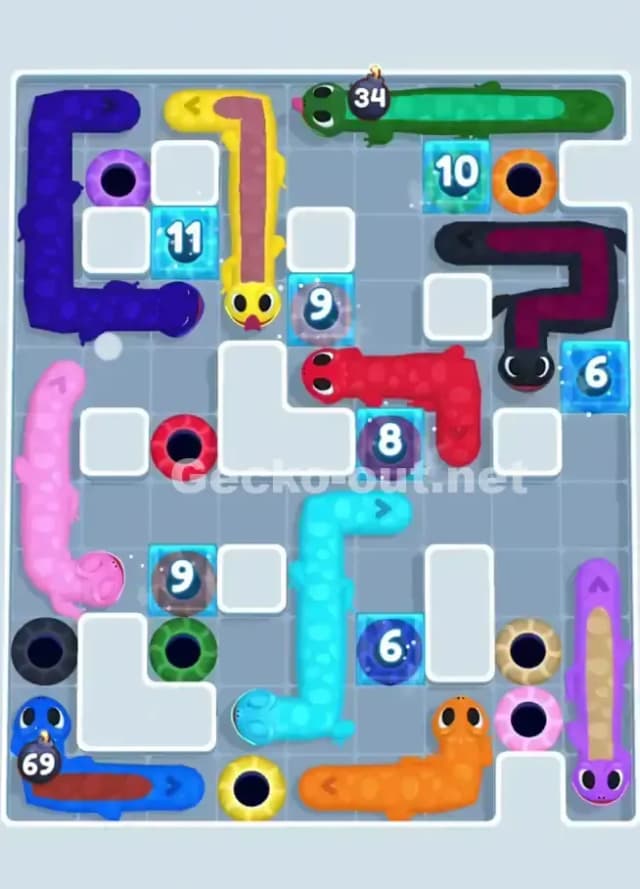
Gecko Out Level 1070 is a densely packed puzzle that demands respect from the moment you load it. You're working with seven geckos spread across the board in a tight configuration: a blue gecko (69 timer segments), a green gecko (34), a yellow gecko, a purple gecko, a pink gecko, a red gecko, and a cyan gecko. Each one needs to reach its matching-colored hole to escape, and here's the kicker—they're all tangled up like spaghetti, with white wall blocks creating a maze-like constraint that severely limits your movement options.
The board itself is a claustrophobic grid where every square counts. You'll notice multiple numbered warning holes (marked with numbers like 6, 8, 9, 10, 11) that act as false exits—landing a gecko in the wrong hole means instant failure, so precision is absolutely non-negotiable in Gecko Out Level 1070. The timer starts at 69 moves for the blue gecko, and you need all geckos out before the countdown hits zero. Unlike levels where you can meander and experiment, Gecko Out Level 1070 punishes hesitation and rewards a clear, committed strategy.
The Win Condition and Time Pressure
To win Gecko Out Level 1070, you must guide every gecko to its correct exit hole without any collisions, overlaps, or wrong-hole disasters. The timer is your constant pressure—it's not forgiving, and it won't reset between geckos. This means you can't afford to make three failed attempts on one gecko and still win; you need to get it right the first time, or at least use your limited retries wisely. The grid-based drag-and-release mechanic means that once you commit to a head path, the body follows that exact route, so a single miscalculation can block your exit route for the next gecko or trap you in a wall.
Pathing Bottlenecks and Logical Traps in Gecko Out Level 1070
The Critical Bottleneck: The Central Choke Point
The single biggest bottleneck in Gecko Out Level 1070 is the central corridor where the cyan and red geckos compete for space. The cyan gecko is a long, coiled body that takes up serious real estate, and the red gecko is nearly as long. Both need to snake through overlapping lanes to reach their exits, and if you move one before clearing the other's path, you'll lock yourself into an impossible knot. The cyan gecko especially is a problem because its exit hole is tucked behind the red gecko's current position. This means you must route the red gecko out of the way first, clearing the central zone so cyan has a clear path down. If you don't respect this order, you'll watch helplessly as cyan's head reaches the exit but its body wraps around red's coils, and you'll have to restart.
Subtle Trap One: The Yellow-Purple Intersection
On the left side of Gecko Out Level 1070, the yellow and purple geckos start in a region where their paths naturally want to cross. The yellow gecko's body curves upward, and the purple gecko's body curves downward, and if you're not careful about the sequence of your moves, yellow will block purple's upward exit route (or vice versa). What makes this trap especially sneaky is that both holes are visible and reachable, so you won't immediately see why your path fails—you'll only realize it when the body clips a wall that wasn't in your original line of sight.
Subtle Trap Two: The Green Gecko's Narrow Escape
The green gecko (34 timer) sits at the top right and has a relatively short path to its exit, but that path is flanked by walls on both sides, creating a narrow corridor. If any other gecko's body drifts into that corridor—especially the long yellow gecko above it—green will get stuck behind a living wall. You need to pre-emptively clear that corridor by routing the yellow gecko out before or around green's escape lane, which sounds obvious but is easy to miss when you're juggling seven geckos at once.
Subtle Trap Three: The Warning Holes' Psychological Trap
Those numbered warning holes (6, 8, 9, 10, 11) are positioned right near some of the actual exits. When you're moving quickly under timer pressure, your eyes might mistake a warning hole for the real exit, especially if you're dragging your gecko head on autopilot. In Gecko Out Level 1070, I found myself almost dropping the purple gecko into a warning hole by sheer muscle memory—it was only a split-second pause that saved me from a restart.
Personal Reaction to the Difficulty
Honestly, the first time I tackled Gecko Out Level 1070, I felt genuinely stuck. The board looked like a puzzle that required impossible timing, and I was convinced the solution involved some trick I was missing. But after restarting twice and forcing myself to slow down, I realized the trick wasn't about speed—it was about understanding the hierarchy of which gecko had to move first. Once I mapped out "red before cyan, yellow before purple, green after both," the whole level suddenly clicked into place. It's that moment when the chaos resolves into a logical sequence that makes Gecko Out Level 1070 so satisfying to beat.
Turn-by-Turn Path Strategy to Beat Gecko Out Level 1070
Opening: Establish Safe Zones and Clear the Red Gecko
Start by moving the red gecko out of its central position. Drag its head downward and then curve it toward its red exit hole on the right side of the board. This move is non-negotiable—red is the gatekeeper blocking cyan's path, so you must remove it from the board first. As red leaves, it opens up the central corridor and gives you breathing room to maneuver the longer cyan gecko. Parking red's exit first also builds your confidence because it's a large gecko with a relatively straightforward path, and clearing it early gives you a psychological win.
Next, move the blue gecko (69 timer) to its exit. Blue is on the left-bottom and has a clear path if you route it upward and then leftward toward its matching hole. The blue gecko is reliable—it doesn't interfere with many other geckos, so getting it out early reduces your board congestion.
Mid-Game: Execute the Cyan Escape and Manage Overlaps
With red and blue clear, the cyan gecko has a wide-open central lane. Drag cyan's head downward, following the corridor that red just vacated. Be careful to avoid the warning holes (marked 8, 9, 6) by keeping cyan's body to the left side of the corridor. Once cyan reaches the bottom, curve it toward its cyan exit hole. This is a longer path, so take your time and make sure the entire body trail is clear of walls and other geckos before committing the drag.
Now handle the yellow gecko. Yellow is a long gecko in the upper-middle area, and its path needs to curve around the purple gecko without tangling. Drag yellow's head to the right, following the top edge of the board, and then curve it downward toward its yellow exit on the right side. The key here is to keep yellow's body above the purple gecko's space, creating a clean separation between the two. If yellow's tail ends up overlapping purple's starting zone, you've locked purple in.
End-Game: Purple, Pink, Green, and the Orange Finish
Move the purple gecko next. With yellow out of the way, purple has a clear upward path on the left side. Drag purple's head upward and then curve it leftward toward its purple exit. Purple is relatively compact, so this move should be quick and clean.
The pink gecko is next. Pink is on the left-middle area and needs to curve around the white wall blocks. Route pink's head downward and then rightward, following the lower lanes of the board, and direct it toward its pink exit hole. Be aware of the warning hole (marked 9) in the lower-left area—avoid it by keeping pink's path slightly to the right.
The green gecko (34 timer) comes penultimate. By now, the board should be relatively clear. Drag green's head rightward and downward, navigating the narrow corridor on the right side of the board, and guide it toward its green exit at the top-right. Since the timer is running, move with confidence here—you've already cleared most of the board, so green's path should be straightforward.
Finally, move the orange gecko to its orange exit. Orange is in the bottom-right area and has a clear path if you simply drag it downward toward the matching hole. This is your last chance to succeed, so take a breath, commit to the path, and watch orange escape.
Why This Path Order Works in Gecko Out Level 1070
Untangling Through Sequence, Not Speed
The genius of this path order is that it respects the dependency chain of Gecko Out Level 1070. Red must leave first because it blocks cyan's corridor. Yellow must leave before purple because yellow's long body would otherwise cage purple in. Blue and pink can move in any order once their specific lanes are clear, but moving them early reduces overall congestion. This sequencing is the opposite of random thrashing—it's surgical, it's intentional, and it makes sure each gecko has a clean exit route when you need it.
When you drag a gecko head, its body follows the exact grid path you've traced. This means that if you route red through a certain lane, that lane is closed to all other geckos until red reaches its hole and disappears. By moving red first, you're essentially pre-emptively closing that lane and forcing cyan to find an alternate route—but because cyan has only a few valid routes, you're actually simplifying cyan's options rather than complicating them. This is why Gecko Out Level 1070 rewards planning over improvisation.
Managing the Timer: When to Pause and When to Move
The blue gecko's 69-timer segments are generous if you're efficient, but they evaporate fast if you hesitate. My advice: spend the first 10–15 moves planning your path on paper or in your head, identifying which gecko moves first, second, third, and so on. Then, once you've committed to the sequence, move with confidence. Don't redraw the same path three times; drag it once and release. Pausing mid-level to reassess is fine, but only pause between geckos, not during. If you're already dragging a path and you second-guess yourself, you'll burn time and potentially make a hasty error.
In Gecko Out Level 1070, the timer pressure is designed to reward decisiveness. Once you've internalized the sequence (red, blue, cyan, yellow, purple, pink, green, orange), you'll notice that each move takes only 5–10 seconds to execute. That leaves you ample time to clear the board comfortably before the timer expires.
Boosters: Optional, Not Essential
You don't need a booster to beat Gecko Out Level 1070 if you follow this strategy. However, if you're stuck on your final attempts and the timer is creeping down with two geckos left, an extra-time booster is a reasonable safety net. I'd recommend treating the extra-time booster as a backup only—don't rely on it as your primary strategy. If you find yourself using boosters every run, it's a sign to re-examine your sequence and make sure you're moving geckos in the optimal order. The hint booster can also be useful if you're genuinely confused about which path a gecko should take, but for Gecko Out Level 1070, the logical sequence is the real hint.
Mistakes, Fixes, and Logic You Can Reuse in Other Gecko Out Levels
Mistake One: Moving Yellow Before Clearing Purple's Space
Many players reflexively move the largest or most visible gecko first, which in Gecko Out Level 1070 means yellow. But this is wrong. If you move yellow before purple, yellow's body will occupy the space purple needs to escape upward, and you'll have locked yourself into a restart. The fix: identify which geckos are blocking other geckos, and move the blockers first. In any future level with gang geckos or overlapping bodies, always ask, "Which gecko is in the way?" before you drag.
Mistake Two: Forgetting About the Central Corridor
Players often move cyan too early, assuming it can navigate around red. But cyan is long and slow, and red's position is the critical blocker. The fix: respect the physical space on the board. If a gecko is longer than the available corridor, the corridor must be completely clear before you move that gecko. This principle applies to frozen exits, locked geckos, and any level with gang mechanics.
Mistake Three: Dragging Paths That Cross Warning Holes
Under time pressure, it's easy to route a gecko's body directly through a warning hole without realizing it. The fix: trace your entire path with your eyes before committing the drag. Follow the imaginary body from head to exit and make sure no part of it overlaps a warning hole. In Gecko Out Level 1070, take an extra half-second to visually confirm the path is clean—it's worth the safety margin.
Mistake Four: Parking Geckos in "Temporary" Spots
Some players try to move a gecko partway, leave it in the middle of the board, and move it again later. This almost never works in Gecko Out Level 1070 because the board is too cramped. The fix: commit to a full path from starting position to exit hole in one drag. If a gecko can't reach its hole without blocking another gecko's path, then that gecko isn't the one you should move right now. Move a different gecko instead.
Mistake Five: Underestimating the Timer
The 69-timer segments sound generous, but if you mess up once and have to restart a gecko, you're down to 59 segments and climbing stress. The fix: practice the sequence in your head before you start dragging anything. Spend 30 seconds planning, then 60 seconds executing. This approach is faster than a random, trial-and-error strategy and far less stressful.
Reusing This Logic on Similar Levels
Any Gecko Out level with long geckos, warning holes, and a cramped board benefits from this dependency-chain thinking. When you encounter a new level, ask yourself:
- Which gecko is the biggest physical blocker?
- Which exit holes are easiest to reach?
- Which geckos would trap each other if they moved in the wrong order?
Answer those questions before you start dragging, and you'll solve levels faster and with fewer restarts. Gecko Out Level 1070 is a masterclass in this type of spatial reasoning, so the skills you build here transfer directly to future challenges.
Final Encouragement
Gecko Out Level 1070 is tough, I won't sugarcoat it. But it's also entirely beatable with a clear plan and a commitment to sequence over speed. You've got this. Plan your moves, trust your path, and watch those geckos escape one by one. The satisfaction of clearing Gecko Out Level 1070 with a perfect run is absolutely worth the effort.