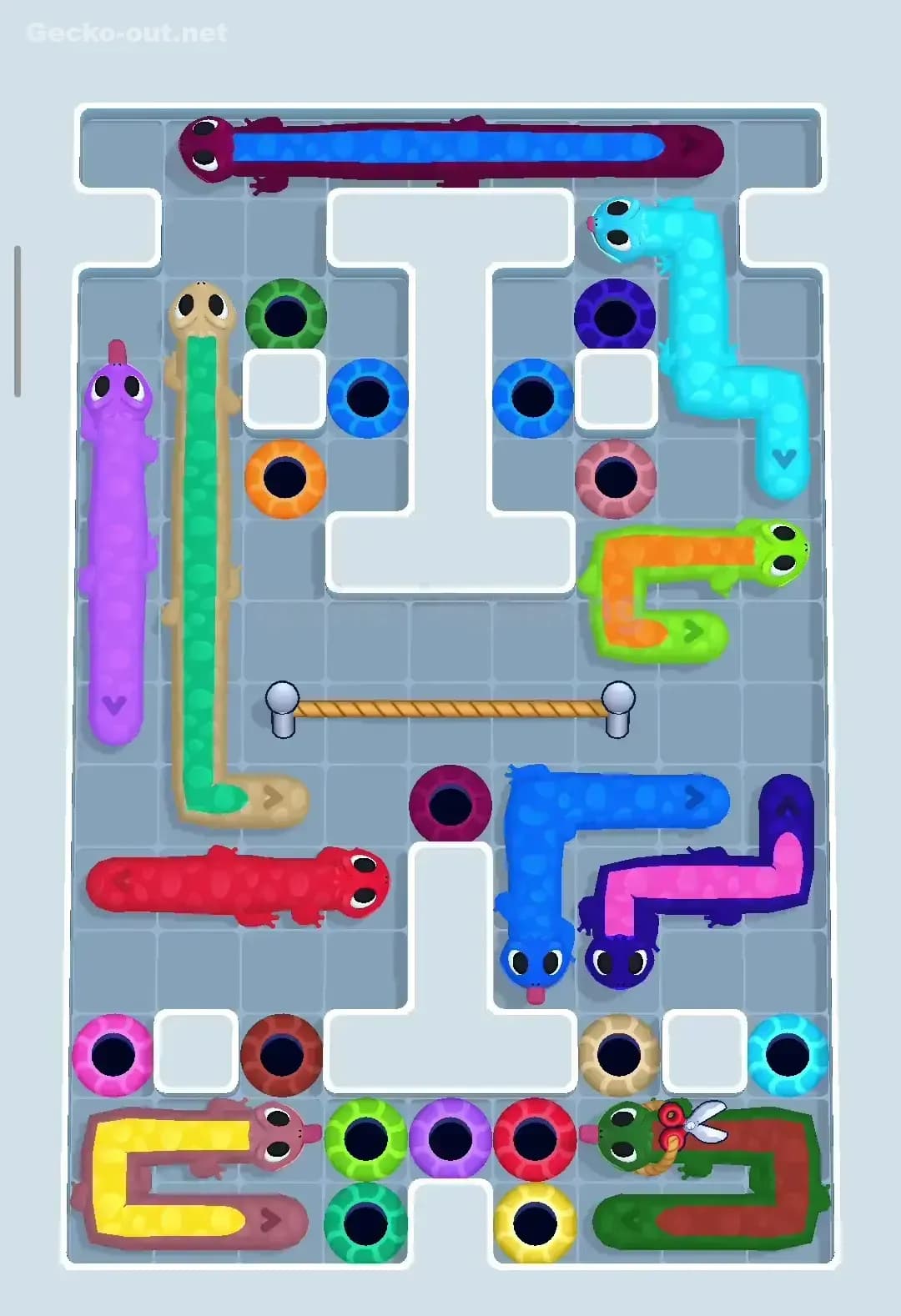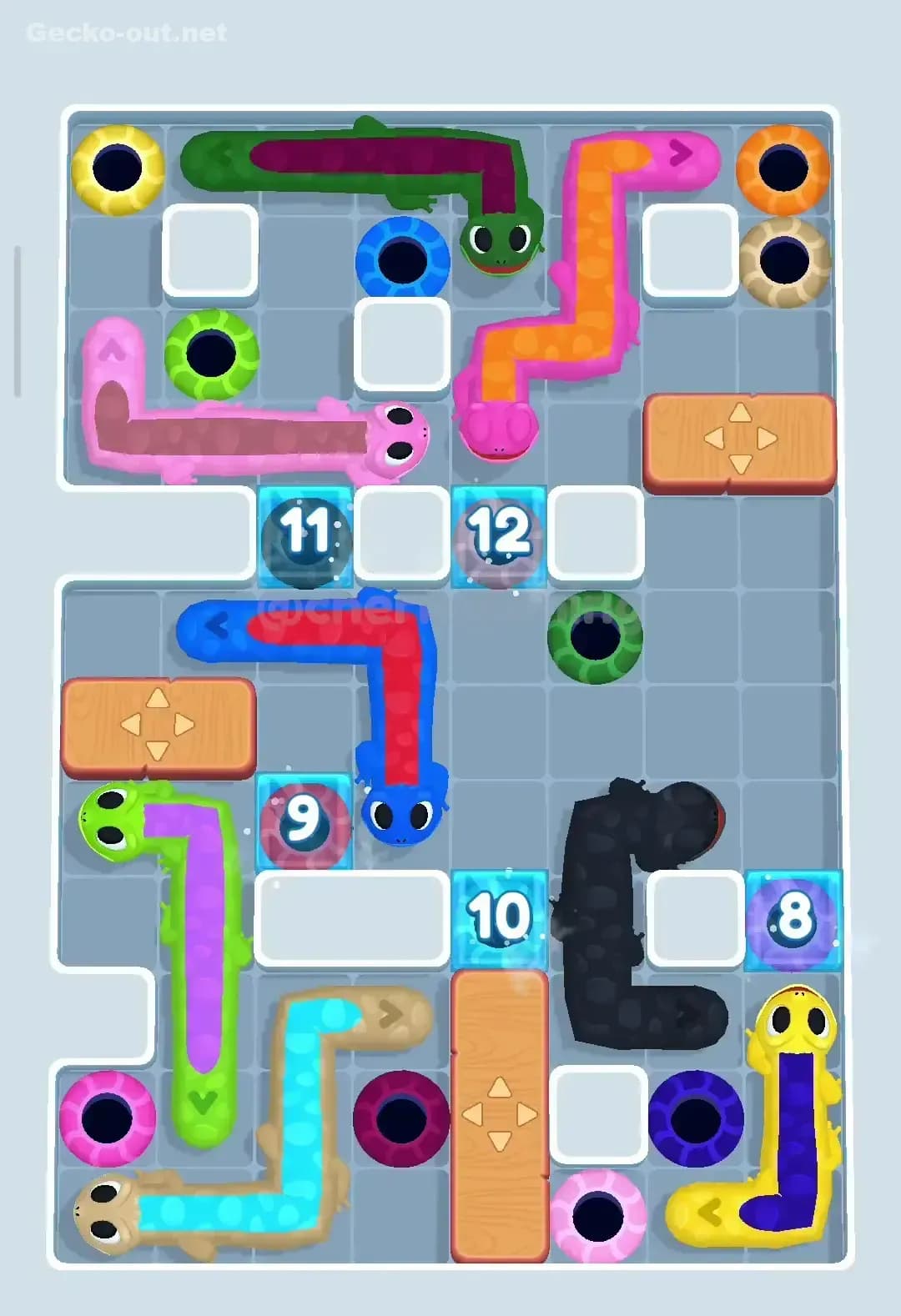
Gecko Out Level 135 Solution Walkthrough | Gecko Out 135 Answer
How to solve Gecko Out level 135? Get step by step solution & cheat for Gecko Out level 135. Solve Gecko Out 135 easily with the answers & video walkthrough.
Gecko Out Level 135: Board Layout, Rules, and Win Condition
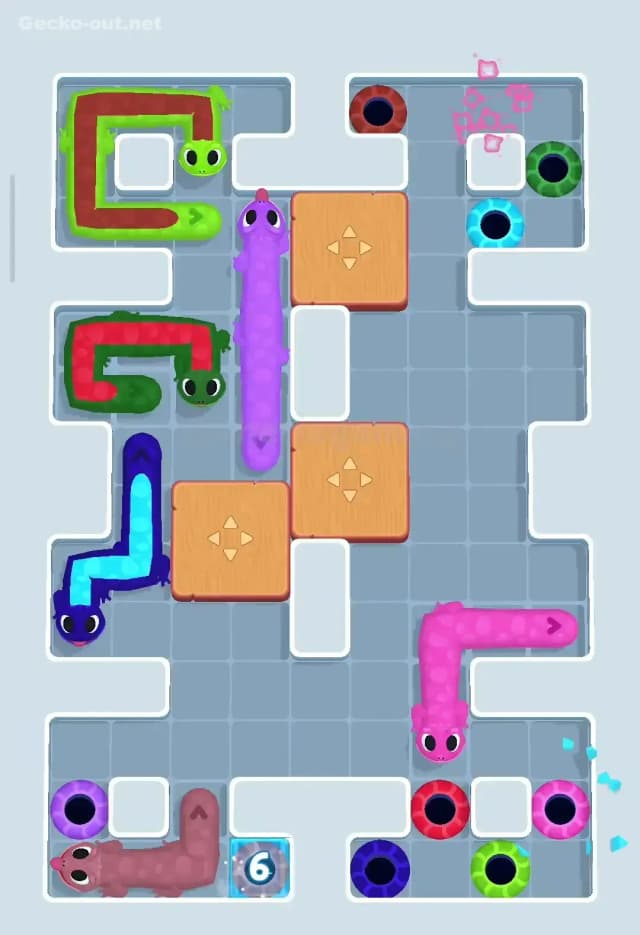
Reading the Starting Layout
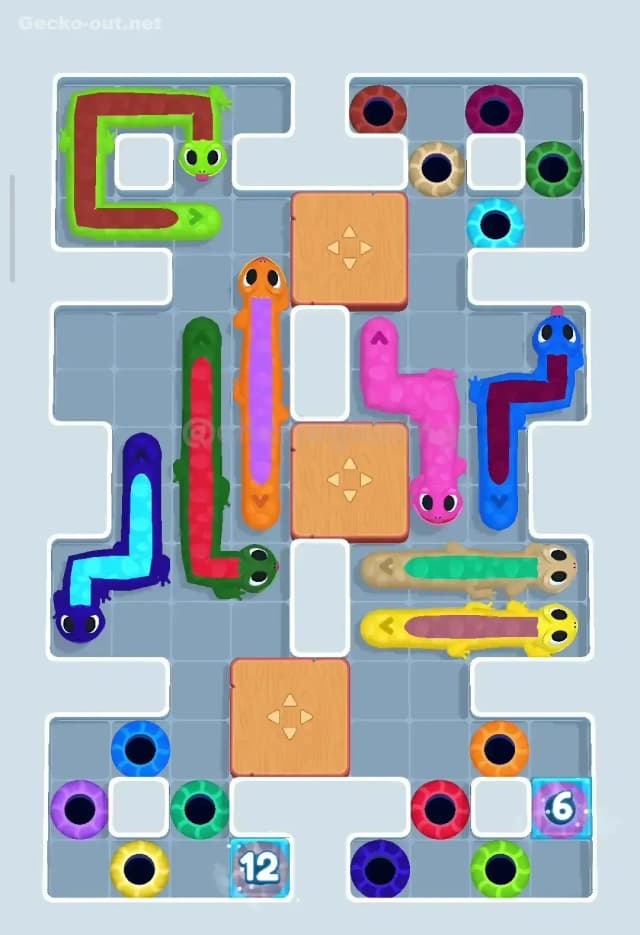
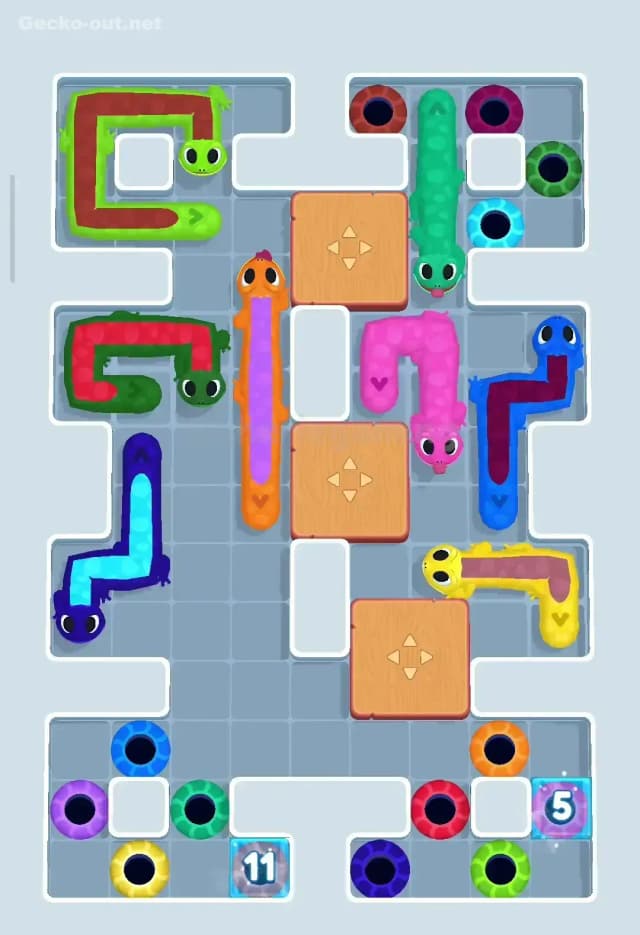
When you load Gecko Out Level 135 you’re dropped into a tall, narrow board split into three main zones:
- A cramped top section with several exits packed on the right and a single green gecko coiled tightly in the top‑left corner.
- A crowded middle where most of the gecko bodies are stacked vertically along a central shaft, squeezed between sliding wooden blocks.
- A bottom “exit hub” with a ring of colored holes on both the left and right and only a few open lanes between them.
You’ve got a mix of short and very long geckos. The long ones run almost the whole height of the board and are the main source of tangles. A few geckos sit horizontally near the bottom‑right, basically acting as a living barrier across the exits there. Others stand vertically around the center, pinning the sliding wooden blocks in place.
There are two key terrain types in Gecko Out 135:
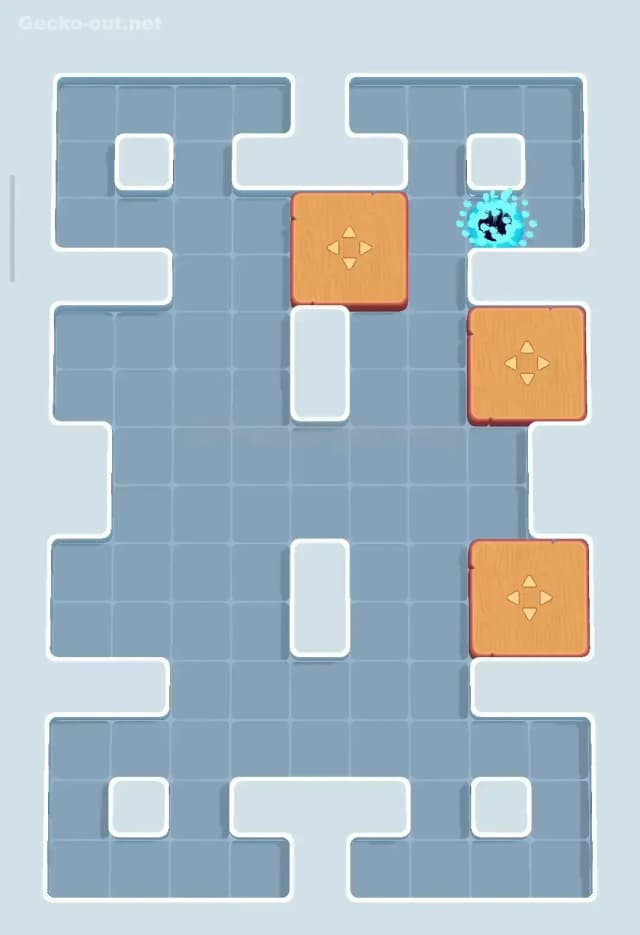
- Large wooden blocks with arrows on them: they slide a single tile when you drag them, opening or closing narrow corridors.
- Tight 1‑tile corridors that act as choke points between the top, middle, and bottom sections.
All exits are open (no frozen holes here), but the colors are scattered: some exits sit at the top‑right, others in clusters at the bottom‑left and bottom‑right. Matching each gecko to its colored hole isn’t the hard part; physically getting their bodies through the middle of the board is.
How the Timer Shapes the Challenge
The win condition in Gecko Out Level 135 is straightforward: drag every gecko’s head so its body path ends in a hole of the same color before the timer runs out. If even one gecko is still stuck when the clock hits zero, you fail.
What makes Gecko Out 135 tricky is the combination of:
- Long, snake‑like bodies that copy your exact drag path.
- One‑tile corridors where any wrong loop permanently clogs the board.
- A strict timer that doesn’t let you “feel it out” by trial and error.
You can’t just wiggle each gecko until it works. Every path you draw becomes an obstacle for the next gecko. So the real puzzle is: in what order do you move them, and where do you park them temporarily so they don’t jam the exits later?
Pathing Bottlenecks and Logical Traps in Gecko Out Level 135
The Main Central Bottleneck
The single biggest bottleneck in Gecko Out Level 135 is the vertical shaft in the middle of the board, framed by the sliding wooden blocks. Several tall geckos start in this area standing straight up and down.
Only one full body can pass cleanly through that shaft at a time. If you drag a gecko across the center and let its tail sit in that lane, you effectively cut the board in half:
- Top geckos can’t reach bottom exits.
- Bottom geckos can’t sneak up to the top‑right exits.
So your whole strategy revolves around keeping this vertical shaft and its immediate side corridors as clean as possible until the very end.
Subtle Problem Spots You Might Miss
I hit three “why won’t this work?” moments on Gecko Out 135:
-
The top‑left coiled green gecko.
It looks tempting to free it early, but its path naturally wants to sweep through the middle. If you drag it too freely, it draws a big loop that blocks the central shaft. It’s safer as a “last‑phase” gecko. -
The bottom‑right horizontal geckos.
The beige and yellow geckos near the bottom‑right behave like a door. If you exit them too early, their bodies fill the tight right‑hand corridor and make it harder for remaining geckos to slip into the bottom‑right holes. -
The sliding blocks themselves.
It’s easy to nudge a wooden block into a place that looks fine but actually removes the only turn radius a long gecko needed. One small shift can force a later gecko to draw a big U‑turn and clog the board.
When the Solution Clicks
I’ll be honest: Gecko Out Level 135 feels chaotic on the first few attempts. There’s a moment where everything seems to be in the way of everything else. The breakthrough for me was realizing I didn’t need to “solve” each gecko individually—I just needed to free lanes:
- First unlock a clean path between middle and bottom.
- Then use the bottom as a staging area, clearing exits that are already aligned.
- Only after that should you mess with the top‑left and top‑right crowd.
Once I started treating the middle shaft like a precious resource instead of just another corridor, Gecko Out 135 went from impossible to very structured.
Turn-by-Turn Path Strategy to Beat Gecko Out Level 135
Opening: Set Up the Lanes and Park Safely
In the opening of Gecko Out Level 135, your goal is to prepare the board, not to rush exits:
-
Slide the middle wooden blocks just enough to open a vertical lane from the upper half of the board down into the bottom hub. Don’t overmove them—one tile in the direction that gives you a straight-ish shaft is usually enough.
-
Move one of the central vertical geckos down into the bottom area using that shaft. Hug the walls as you drag so its final body lies along an edge and not across the central passage. If its hole is already accessible, you can finish the exit; otherwise, park it flat along the bottom-border tiles.
-
Shift the right‑side blue gecko (near the middle‑right) downwards into the lower zone, again hugging the right wall. Park it in a neat vertical or L‑shape that doesn’t cross the main lanes leading to the bottom‑right exits.
-
Do nothing with the top‑left coiled green gecko yet. Leave it as your “cleanup” gecko; it’s not blocking anyone right now.
At the end of the opening, you want the center mostly empty, a couple of long bodies tucked along the outer edges, and both bottom clusters of holes reachable.
Mid-game: Clear Critical Exits and Keep Lanes Open
The mid-game is where Gecko Out 135 is usually won or lost. You’ll now use the bottom hub as your processing area:
-
Prioritize exits that require minimal turning.
Typically, the shorter geckos on the left and the vertical ones that already align with the bottom‑left or bottom‑right clusters can exit quickly. Drag them straight down or down-and-over, drawing tight, wall-hugging paths that leave the central shaft untouched. -
Whenever you draw a path, think “thin and flat.”
Avoid spirals and U‑turns. Long, gentle lines along the outer borders are perfect because they leave maximum interior space for later bodies. -
Keep at least one side corridor from top to bottom open at all times.
If the central shaft fills, make sure either the left side or right side has a clear, simple ladder for remaining geckos to descend. -
Use the sliding blocks only to fix traffic, not to improvise.
If a long gecko can’t turn without colliding, nudge a block by one tile to create that curve, then move it back if it starts to close off another route.
By now, a good chunk of the bottom exits should be used: probably your shortest geckos plus at least one of the long central ones. The board starts to breathe, and the top‑right exits become more realistic targets.
End-game: Exit Order and Handling Low Time
The end-game of Gecko Out Level 135 is all about tightening the sequence:
-
Send any remaining middle geckos down first.
Use your preserved vertical lane to drop them into the bottom area and out through their matching holes. Don’t touch the top‑left spiral or the top‑right crowd until the middle is almost empty. -
Next, resolve the bottom‑right “door” geckos.
Once no one else needs to pass that way, drag the beige and yellow geckos (or whichever colors are guarding that corridor) directly into their holes using short paths. Since they’ll block lanes when they exit, they belong near the end. -
Then clear the top‑right exits.
With the middle free, you can drag the remaining upper geckos in simple down‑and‑over paths into the correct top‑right or bottom‑right holes without massive detours. -
Finish with the top‑left coiled green gecko.
Now that the board is mostly empty, you can uncoil it safely, run it through the central shaft, and drop it into its matching hole using the shortest route.
If you’re low on time in Gecko Out Level 135, this order still works. Just commit: drag in straight, decisive lines instead of over‑adjusting mid‑move.
Why This Path Order Works in Gecko Out Level 135
Using Head-Drag Pathing to Untangle Instead of Tighten
Because every gecko in Gecko Out Level 135 follows the exact route you drag, wide loops and zigzags are deadly. This plan focuses on:
- Moving long bodies early into parking spots that hug the edges.
- Keeping their paths as straight as possible, so they “cost” fewer tiles of usable space.
- Saving free‑moving, low‑impact geckos (like the coiled green one) for last, when they can’t hurt anything.
You’re essentially “peeling” layers off the knot from the center outward.
Timer Management: Think First, Then Commit
The timer in Gecko Out 135 is strict enough that random experimenting fails fast. I’ve had the best results with this rhythm:
- Spend your first couple of seconds just reading the board: identify which gecko can go straight to a bottom exit and which ones are clearly trapped.
- Plan your first three moves before you touch anything.
- Once you start, drag confidently—don’t stop halfway and redraw; that’s where the time disappears.
You’ll notice that once the central shaft is clear and a few exits are taken, the remaining moves are actually faster than your first ones.
Are Boosters Needed on Gecko Out 135?
Gecko Out Level 135 is absolutely solvable without boosters:
- A time booster helps only if you already know the plan but keep running out of seconds executing it.
- A hammer‑style obstacle remover would trivialize the sliding‑block puzzle, so I’d treat it as a last resort if you’re completely stuck.
- Hints can be useful once or twice to confirm your opening move, but they’re not required to understand the logic.
If you’re willing to restart a few times and refine your pathing, you shouldn’t need any boosters to clear Gecko Out 135.
Mistakes, Fixes, and Logic You Can Reuse in Other Gecko Out Levels
Common Mistakes on Gecko Out Level 135
Here are the big traps I see over and over:
-
Exiting the top‑left gecko too early.
Fix: Leave it for last so its long uncoiling path doesn’t clog the central shaft. -
Drawing fat spirals in the middle.
Fix: Hug walls and use straight lines; imagine every extra turn is one less space for another tail. -
Sliding blocks aggressively.
Fix: Move each wooden block a single tile at a time, only when a specific gecko needs that space, and then put it back if it starts closing lanes. -
Finishing the bottom‑right “door” geckos too soon.
Fix: Keep those horizontal bodies intact until no one else needs to use that corridor, then exit them near the end. -
Panicking under the timer and redrawing paths.
Fix: Take a short planning pause at the start, then drag with conviction. A slightly imperfect but quick path is better than a perfect one you redraw twice.
Reusing This Logic in Other Knot-Heavy Levels
The approach that works for Gecko Out Level 135 carries over nicely to other tight, knot‑heavy Gecko Out stages:
- Identify the true bottleneck lane first and protect it.
- Move the longest, most central geckos early, parking them flat along edges.
- Save isolated or cornered geckos for last; they’re usually non‑critical blockers.
- Treat sliding blocks and special tiles as tools to create just enough space, not as toys to play with.
Any time you see stacked vertical geckos and a ring of exits at the bottom, you can apply the “clear a shaft → stage in the bottom hub → finish corners last” pattern.
Final Thoughts: Tough but Totally Beatable
Gecko Out Level 135 looks like a mess at first, but once you respect the central shaft and plan a clean exit order, it becomes a very fair puzzle. You don’t need perfect reflexes or boosters—just a calm opening, tight paths that hug the walls, and the discipline to keep your bottlenecks empty.
Stick to the lane‑first strategy, and Gecko Out 135 goes from frustrating to satisfying in just a few attempts.