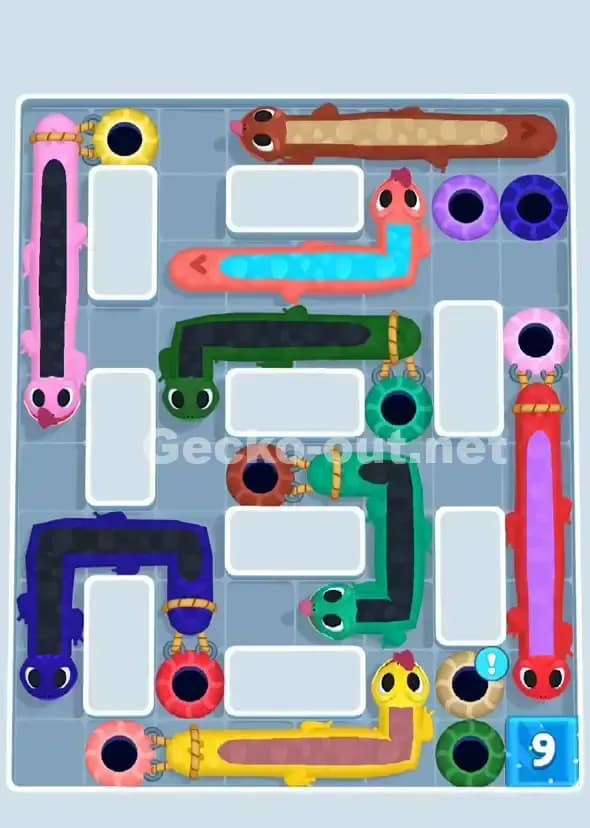
Gecko Out Level 911 Solution Walkthrough | Gecko Out 911 Answer
How to solve Gecko Out level 911? Get step by step solution & cheat for Gecko Out level 911. Solve Gecko Out 911 easily with the answers & video walkthrough.

Gecko Out Level 911: Board Layout, Rules, and Win Condition
Starting Board: Geckos, Colors, and the Tangle
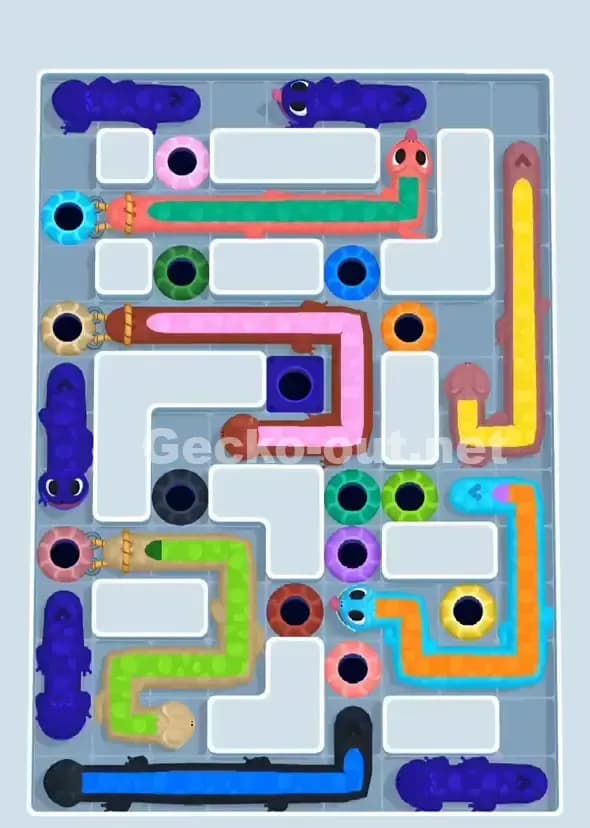
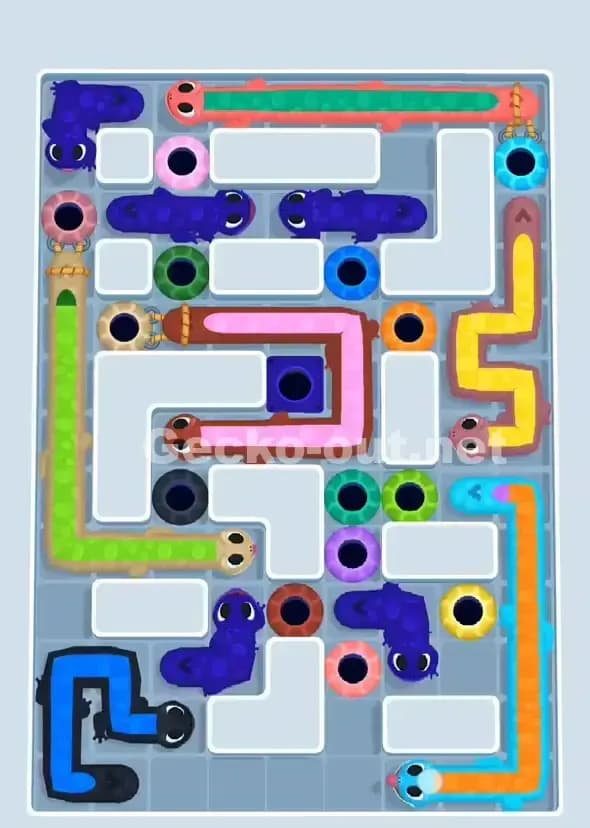
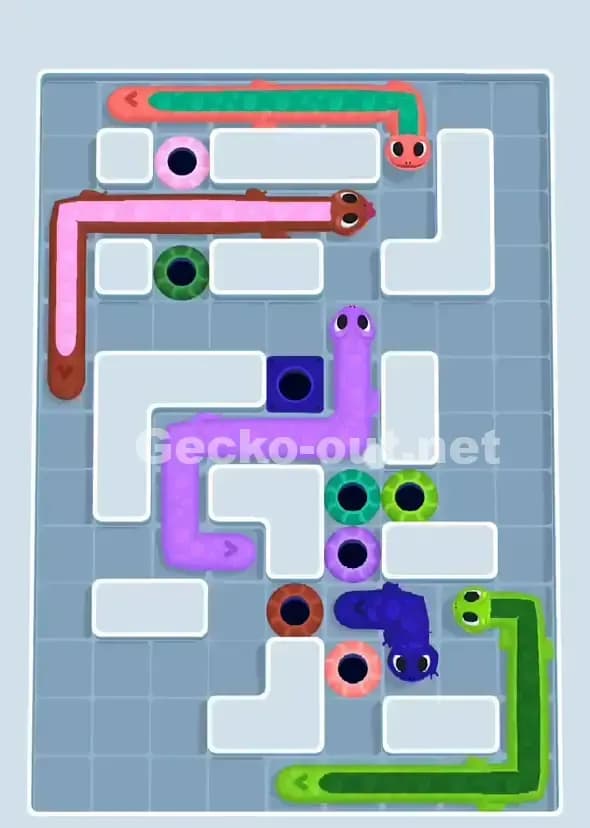
Gecko Out Level 911 is a beast of a puzzle with ten geckos spread across the board in a dense, overlapping arrangement. You've got blue geckos (multiple), pink, cyan, green, orange, purple, and black geckos all competing for space in a grid packed with white walls and colored escape tunnels on the right edge. The colored holes—yellow, orange, cyan, purple, and pink—are lined up vertically on the far right, which means every gecko must navigate a narrow corridor just to reach their exit. The geckos themselves are also "gang-linked" in pairs; several blue geckos move as one body, which means you can't separate them but you can move the whole linked unit by dragging one head. This interconnected setup means one wrong move tangles the entire board, and there's no room to undo mistakes without restarting.
Win Condition and Timer Pressure
To beat Gecko Out Level 911, all geckos must escape through their matching-colored hole before the timer expires—there's no negotiating with time here. Each gecko's body must follow the exact path you drag its head along, so the route you choose becomes permanent until the gecko exits. The timer adds serious urgency because you can't afford to take detours or experiment; you need a clear, logical sequence from the start. If even one gecko is still on the board when time runs out, you fail Gecko Out Level 911 entirely, which is why planning beats rushing every single time.
Pathing Bottlenecks and Logical Traps in Gecko Out Level 911
The Right-Edge Corridor: Your Critical Chokepoint
The biggest bottleneck in Gecko Out Level 911 is the narrow vertical corridor on the right side where all ten geckos must funnel through to reach their colored holes. Imagine ten vehicles trying to merge onto a single-lane highway—that's this level. The exit holes are stacked so tightly that only one or two geckos can navigate the final stretch at a time, and if you push a long gecko into that space too early, you'll trap shorter geckos behind it. The blue gecko pair on the left side is especially problematic because it's long and rigid; if you drag it into the right corridor before clearing the path, you'll create a gridlock that's nearly impossible to unwind. This is why your entire strategy must prioritize keeping that corridor open until the very end.
Three Subtle Traps That Will Wreck Your Run
First, the pink gecko in the upper-middle area looks like it has a clear shot to the pink hole, but there are walls and other geckos blocking direct paths. If you drag it too aggressively toward the right without plotting the exact route, its body will collide with the orange gecko or the walls, and you'll have wasted precious time repositioning. Second, the cyan and green geckos near the bottom-right are dangerously close to the exit corridor, and it's tempting to push them out immediately. Don't—they're actually flexible enough to wait, and getting them out early jams the corridor for the longer geckos that must exit in a specific order. Third, the linked blue geckos on the left side are deceptively long; dragging them even halfway across the board consumes massive space, so you need to plan their entire path before committing to a single drag.
The Moment Everything Clicked
Honestly, Gecko Out Level 911 frustrated me for several attempts because I kept trying to rush geckos out in whatever order they seemed convenient. Then I realized that the corridor was my constraint, not the starting positions—once I accepted that the last five exits would have to happen in a specific sequence because of that narrow right-side path, everything else fell into place. The puzzle isn't about moving geckos; it's about orchestrating a careful queue for the exit line.
Turn-by-Turn Path Strategy to Beat Gecko Out Level 911
Opening: Clear the Left Side and Park Strategically
Start with the dark gecko on the far left—it's short, has space to move, and can reach the black hole without much drama. Drag its head along the bottom corridor, curve it toward the right edge, and exit it. This removes one body from the board and opens up real estate on the left. Next, handle the pink gecko in the upper-middle area. Plot a careful route that avoids the orange gecko and the walls; you'll need to curve it downward and rightward, moving it in an arc rather than a straight line. Once it's exiting through the pink hole, you've cleared two more geckos and reduced congestion significantly. The green gecko at the bottom-left is also relatively small and flexible; get it out next using a similar curving path. These first three moves should happen smoothly if you read the board carefully and don't panic-drag—take maybe 30 seconds to plan all three routes before you start moving.
Mid-Game: Keep Lanes Open and Reposition Linked Geckos Safely
Now for the trickier part: the cyan, purple, and linked blue geckos. The cyan gecko near the bottom should not exit yet, even though it's close to the corridor. Instead, reposition it slightly upward or to the side so it's out of the way but still on the board. This sounds counterintuitive, but you're buying yourself space for the longer geckos. The purple gecko linked on the left side is a medium-length unit; drag it toward the right edge carefully, moving in a wide arc to avoid walls and the remaining geckos. Don't rush it into the corridor—stop it just before the vertical section and let it sit. The linked blue geckos (the longest units on the board) need the most delicate handling. Start dragging the upper blue gecko's head, and guide it along a gentle, winding path that hugs the existing walls and avoids other geckos. Your goal is to get them closer to the exit corridor without actually entering it yet. Think of this mid-game phase as a choreographed shuffle where every gecko moves closer to the exit but doesn't actually exit until you're ready to manage the final corridor sequence.
End-Game: Exit Order and Avoiding Last-Second Jams
In the final 20 seconds or so, you'll have maybe four or five geckos left, and they must exit in a very specific order to avoid gridlock. Start with the shortest remaining gecko—likely the cyan or green units—and push it all the way through the right corridor to its colored hole. Once it's out, immediately pull the next shortest gecko in. This "shortest-first" approach minimizes congestion and gives you maximum wiggle room for the longer units. Save the linked blue geckos for near the end; even though they're long, they're easier to manage when they have the corridor almost to themselves. If you're running low on time (say, under 10 seconds for three geckos), don't panic—drag decisively and trust your pre-planned routes. The timer is tight, but it's designed so you can make it if you don't waste movement on wrong turns.
Why This Path Order Works in Gecko Out Level 911
How Head-Drag Pathing Untangles the Knot
The body-follows-head rule in Gecko Out Level 911 means that the route you drag is the route the gecko takes—no shortcuts, no backtracking. This is actually your advantage if you plan correctly. By exiting geckos in order of size (shortest first) and by clearing the left and center of the board before touching the right corridor, you're using the physical space of the board itself to organize your queue. Each gecko that exits frees up wall-adjacent space that the next gecko can use, and the body-follow mechanic means that careful, deliberate dragging creates a cascading unlock pattern. Instead of thinking about "getting geckos out," think about "clearing the board from left to right so the bottleneck has room to breathe."
Timing Your Pauses vs. Committing to Movement
It's worth pausing for 3–5 seconds between each drag to visually trace the path in your head. Ask yourself: "Does this gecko's body collide with any walls or other geckos?" If the answer is yes, revise the path. If it's no, commit and drag decisively—hesitant dragging wastes time. In Gecko Out Level 911, you have roughly 90–100 seconds to move ten geckos, which is about 9–10 seconds per gecko on average. That's tight, but it's doable if you're not second-guessing yourself mid-drag. Pause once before each move, then commit fully.
Boosters: Use Them as Insurance, Not Strategy
Gecko Out Level 911 is absolutely solvable without boosters if you follow the sequence above. However, if you're stuck on your second or third attempt and time pressure is making you sloppy, a time-booster (extra 20–30 seconds) can give you room to breathe and experiment with small adjustments. A hint-booster is less useful here because the solution isn't obscure—it's just order-dependent. I'd recommend trying Gecko Out Level 911 three times without boosters before spending one, because every run teaches you something about the timing.
Mistakes, Fixes, and Logic You Can Reuse in Other Gecko Out Levels
Five Mistakes You'll Make and How to Fix Them
Mistake 1: Dragging the long blue gecko too early. Fix: Make a mental note that long, linked geckos should move in the last third of your sequence, not the first. Mistake 2: Pushing short geckos into the corridor prematurely. Fix: Reposition them to the side of the board instead; let them sit in a safe spot while you clear the longer geckos. Mistake 3: Not tracing the entire path before dragging. Fix: Pause and visually follow the route from head to hole, checking for walls and other geckos. Mistake 4: Panicking when the board looks "full." Fix: It's supposed to look full—that's the puzzle. Trust that exiting even one gecko opens up surprising amounts of space. Mistake 5: Trying to drag geckos in color-order rather than size-order. Fix: Color doesn't matter for exit sequence; size does. Smaller geckos move first, period.
Reusing This Approach on Similar Levels
If you encounter other Gecko Out levels with narrow exit corridors, linked gang-geckos, or frozen obstacles, use the same philosophy: identify your bottleneck first, then plan which geckos must exit last, then work backward to figure out which ones should move first. This reverse-planning method—starting from the exit and working backward—is a superpower in Gecko Out because it forces you to respect the geometry of the board rather than just reacting to gecko positions. Gecko Out Level 911 teaches you this pattern hard because there's no way around it.
Final Encouragement
Gecko Out Level 911 is genuinely challenging, and it's okay if it takes three or four attempts to nail the sequence. The level is testing your ability to think spatially and plan ahead, which are skills that pay off in every puzzle that follows. Once you beat Gecko Out Level 911, you'll feel a real sense of accomplishment because you outsmarted a genuinely tight constraint. You've got this—plan carefully, stay calm when the board looks crowded, and trust your path-reading. Gecko Out Level 911 is beatable, and you're closer to the solution than you think.