Gecko Out Level 653 Solution Walkthrough | Gecko Out 653 Answer
How to solve Gecko Out level 653? Get step by step solution & cheat for Gecko Out level 653. Solve Gecko Out 653 easily with the answers & video walkthrough.
Gecko Out Level 653: Board Layout, Rules, and Win Condition
Starting Board: Geckos, Colors, and Key Obstacles
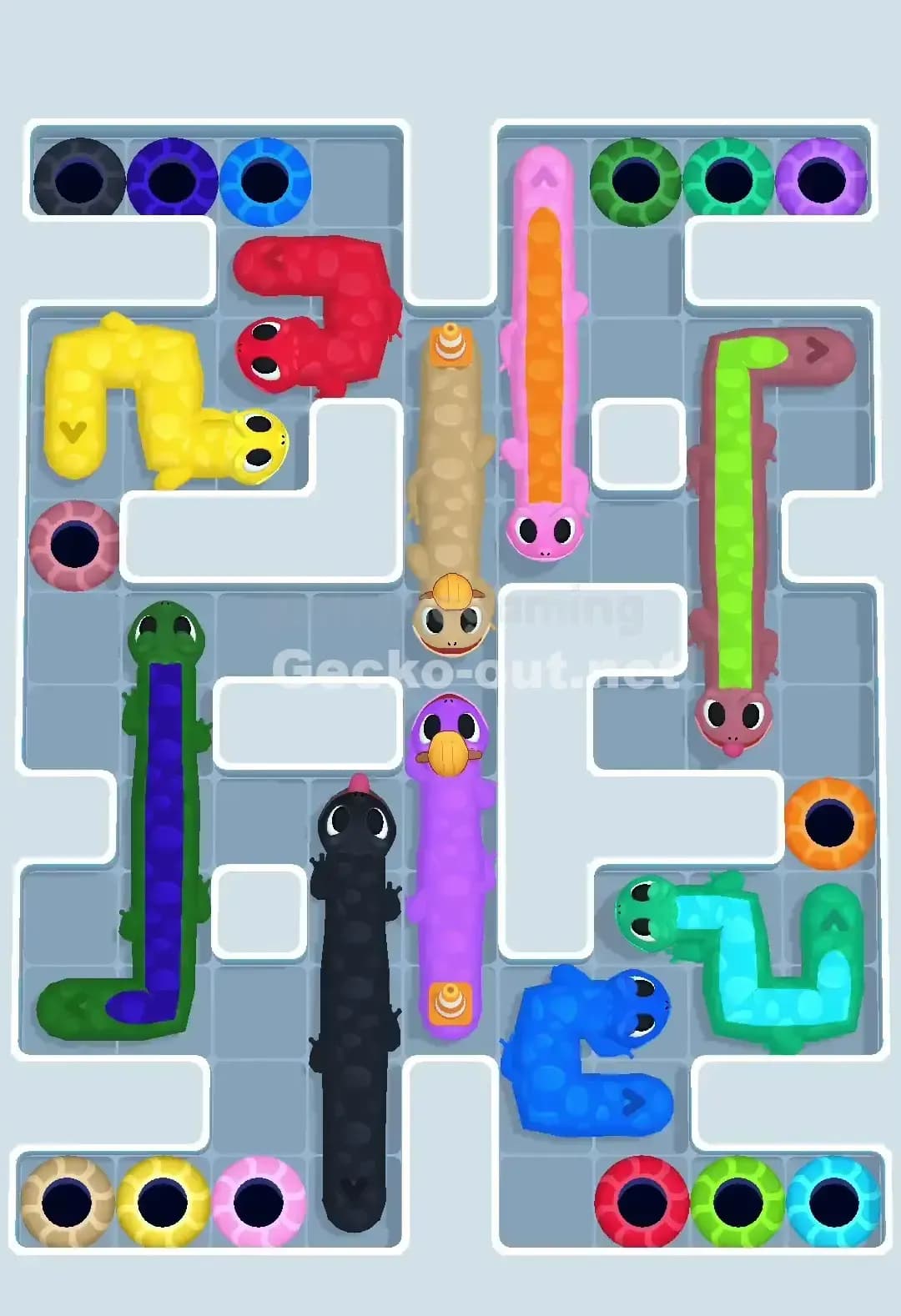
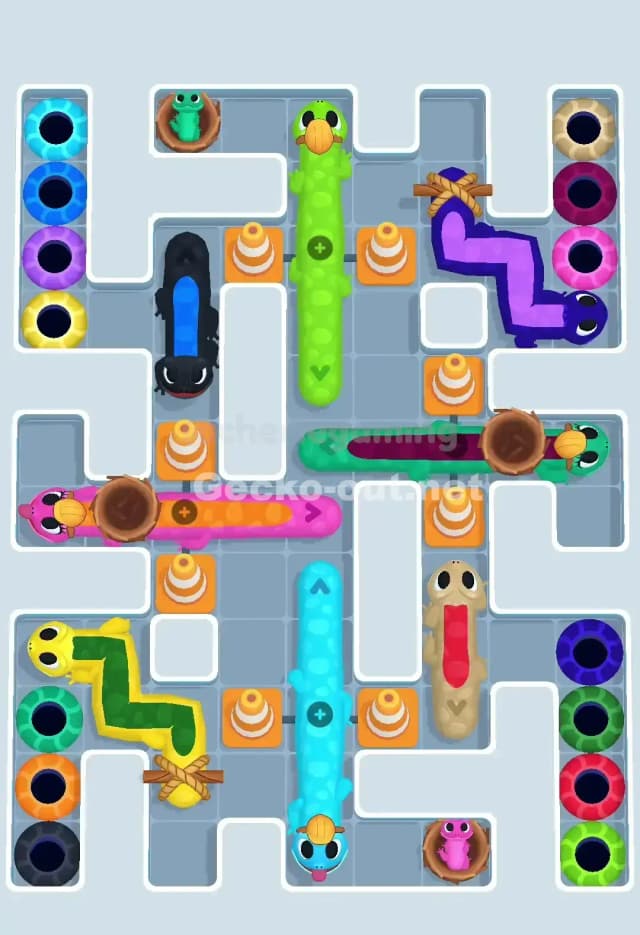
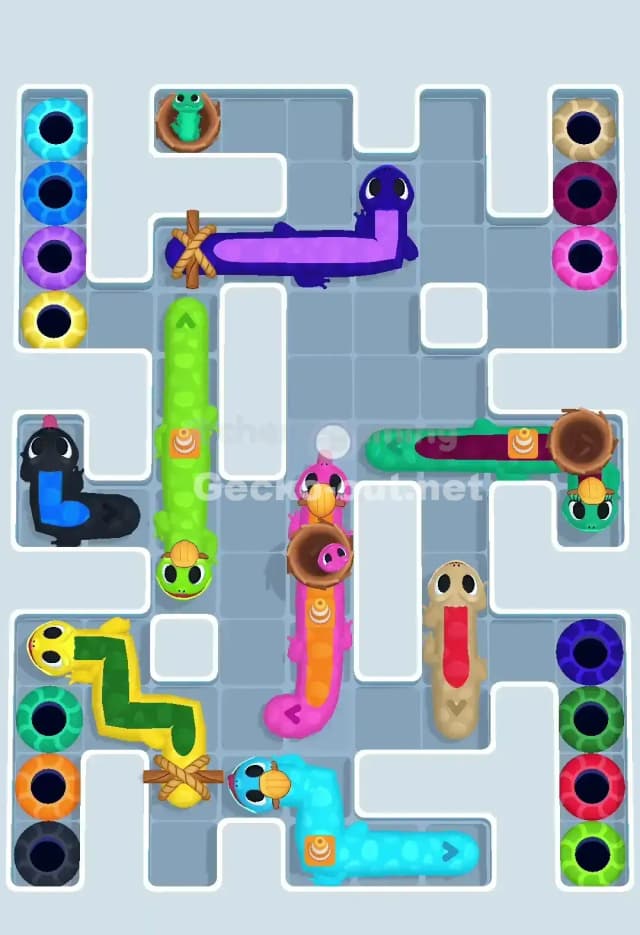
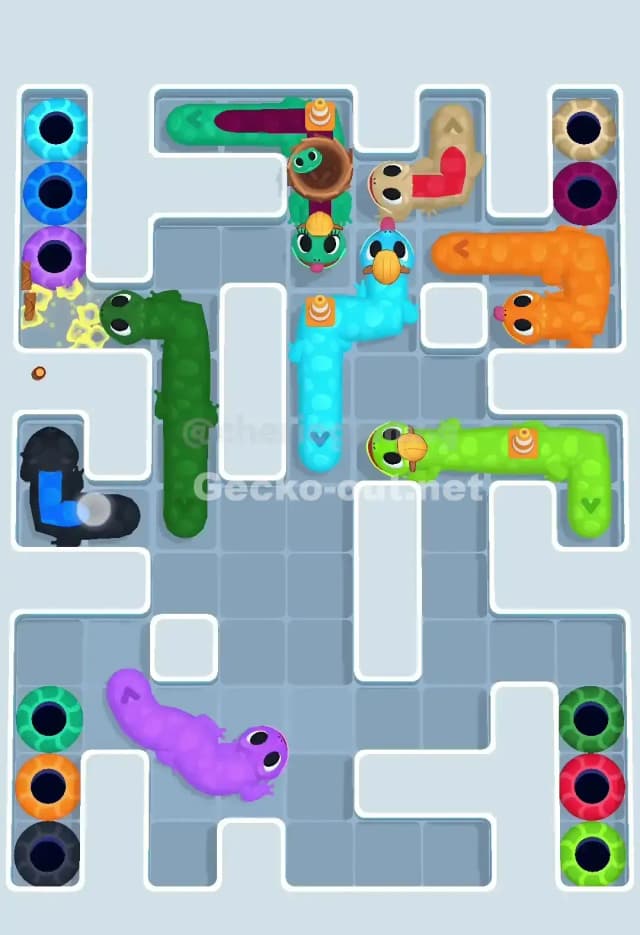
Gecko Out Level 653 is a complex, multi-gecko puzzle that'll test your patience and planning skills. You're looking at eight different geckos spread across the board, each one color-matched to a specific exit hole: cyan, blue, purple, yellow, green, brown, magenta, and orange. The board itself is a maze of interconnected corridors with multiple toll gates (those orange ring-shaped obstacles), frozen or icy sections, and tight choke points that force you to think several moves ahead. What makes Gecko Out 653 particularly punishing is that several geckos are gang-linked—meaning they move together as one unit—and their body lengths create immediate space conflicts. The cyan gecko running vertically down the center and the magenta gecko stretched horizontally across the middle are especially problematic because they block critical lanes that other geckos need to escape through.
Win Condition and Timer Pressure
To beat Gecko Out Level 653, every single gecko must reach its matching-colored hole before the timer hits zero. Unlike easier levels, you don't get extra breathing room here; the clock is tight, and one miscalculated path can cost you precious seconds or trap another gecko entirely. The drag-and-path mechanic means that once you commit to a route for a gecko's head, its body follows every grid square you've drawn—there's no shortcut or teleport. If that path crosses a wall, a locked exit, or overlaps with another gecko's body, you fail that attempt and must restart. This makes Gecko Out Level 653 fundamentally about spatial reasoning: you need to park long geckos safely so they don't block exits, and you need to exit shorter geckos first to clear the corridors for the long ones.
Pathing Bottlenecks and Logical Traps in Gecko Out Level 653
The Central Vertical Choke Point
The single biggest bottleneck in Gecko Out Level 653 is the central vertical corridor where the cyan gecko sits. This gecko's long body acts as a wall that divides the left and right halves of the board. If you don't move the cyan gecko early enough, you'll trap geckos on one side who need to reach holes on the other side. Once the cyan gecko is in motion toward its exit, that vertical lane opens up and suddenly three or four other geckos have a path forward. This is why moving cyan first feels counterintuitive at first—you're not solving for cyan, you're solving for access. The moment you drag cyan's head downward and commit to its escape route, you're essentially unlocking the entire board.
Subtle Problem Spots: Toll Gates and Gang Geckos
Watch out for the orange toll gates scattered throughout Gecko Out 653. These obstacles don't block movement outright, but they're strategically placed to force geckos into longer, more complex paths. You'll often need to thread a gecko's head around a toll gate, and if another gecko's body has already occupied that workaround route, you're stuck. The magenta and green geckos are gang-linked, which means they move as a single unit—their heads are connected, and the entire tangle has to escape together or not at all. This creates a secondary bottleneck on the right side of the board where both holes are stacked vertically. If you don't clear the path above them first, you won't have room to drag their heads upward without colliding with other bodies still on the board.
Another sneaky trap is the brown gecko in the upper-left area. It's easy to overlook because it's relatively short, but its starting position puts it in a corridor that the blue and purple geckos also need to access. If you move brown last, you'll find that its exit path is completely blocked by bodies you've already positioned, and you won't be able to reach its hole in time.
Personal Reaction: The "Aha" Moment
I'll be honest—when I first attempted Gecko Out Level 653, I felt genuinely frustrated. The board looked like spaghetti, and I kept failing because I'd move one gecko and accidentally trap two others. The real breakthrough came when I stopped trying to solve each gecko individually and started thinking about board state: What needs to move first to unblock everything else? That's when cyan's dominance clicked, and suddenly the entire puzzle reorganized itself in my mind. Gecko Out 653 isn't actually harder than earlier levels; it's just that the solution isn't obvious until you recognize the hierarchy of which geckos control access to which zones.
Turn-by-Turn Path Strategy to Beat Gecko Out Level 653
Opening: Cyan First, Then Purple
Start by moving the cyan gecko straight down through the center of the board toward its cyan hole at the bottom. Don't overthink this—drag its head directly downward, and its body will follow the vertical corridor. This single move opens up the entire left-right traffic pattern. Once cyan is confirmed in motion or already escaped, immediately tackle the purple gecko next. Purple is also relatively long and occupies the right-center area. Drag its head upward and slightly left to reach the purple hole in the upper-right corner. By clearing these two gang-like obstacles early, you're essentially clearing the congestion that was blocking everyone else. Park any shorter geckos temporarily in dead-end alcoves or side corridors where they won't interfere—the blue gecko and brown gecko are good candidates for this mid-level repositioning.
Mid-Game: Keep Critical Lanes Open
Once cyan and purple are out, focus on the yellow gecko (left side, lower area) and the green gecko (which is gang-linked with magenta). Move yellow upward along the left wall toward its yellow hole. This clears the lower-left section and opens a lane for other geckos to slide through. For the green-magenta gang, this is trickier because they move together. You'll need to drag their heads (whichever one is in front) toward the right side of the board, carefully threading around the toll gates. Don't rush this path; trace it slowly in your mind before you commit. The orange gecko also needs attention during mid-game—it's in the center-bottom area and has a medium length, so move it left or right toward its orange hole to prevent it from becoming a late-game obstacle. As you move each gecko, constantly check whether remaining geckos still have a clear route to their holes. If you see a path being blocked, pause and recalculate before the timer pressure forces a mistake.
End-Game: Final Geckos and Timing
By the end-game phase of Gecko Out 653, you should have three to four geckos left on the board. These are almost always the brown gecko, the blue gecko, and possibly the cyan or magenta if they were tricky. Move the shortest remaining gecko first to minimize the space it occupies while you're setting up the penultimate moves. Use the cleared board space to carefully plot the second-to-last gecko's path, ensuring it doesn't overlap any remaining bodies. The final gecko should have a completely clear route—don't let it get trapped by poor positioning of the gecko before it. If you're running low on time (less than 15–20 seconds remaining in Gecko Out Level 653), move fast but deliberately: drag in straight lines when possible, avoid zig-zagging, and trust that you've done the hard thinking already. The last gecko almost always has a direct escape route if you've managed the board correctly up to this point.
Why This Path Order Works in Gecko Out Level 653
Leveraging the Body-Follow Rule and Head-Drag Mechanics
The reason this strategy works is that it exploits the fundamental rule of Gecko Out 653: the body always follows the head's exact path. By moving long geckos and gang-linked geckos first, you're removing the constraints they impose on every other gecko's available routes. Short geckos are flexible—they can fit through tight spaces and adapt to awkward corridors. Long geckos are rigid; they occupy a lot of space no matter what. So you solve for the rigid constraints first, then use the freed-up space for the flexible geckos. The cyan gecko, for example, is acting like a vertical wall until you move it. Once it's gone, suddenly geckos on the left side of the board can reach exits on the right side. This isn't luck; it's a logical cascade where each move reduces the puzzle's complexity.
Managing the Timer: Pause Versus Commit
Gecko Out Level 653 gives you enough time to win, but only if you don't waste moves on inefficient paths. The strategy here is to pause and spend 10–15 seconds mentally tracing a gecko's path before you drag its head. This sounds counterintuitive when a timer is running, but it's faster overall because you avoid false starts and resets. Once you're confident about a path, drag it quickly and commit. Don't second-guess mid-drag. If a path fails, restart immediately rather than trying to salvage it—wasted correction attempts burn time faster than a clean restart. For Gecko Out 653 specifically, I recommend pausing before every cyan, green, and magenta move because these are the board-state-critical geckos. For the shorter geckos (brown, yellow, blue), you can move more fluidly once the board is open.
Booster Strategy for Gecko Out Level 653
In most cases, Gecko Out 653 doesn't require a booster to solve. The level is designed to be beatable with pure strategy. However, if you're running low on time in the final seconds and have one gecko left to position, an extra-time booster can be the difference between victory and failure. I'd recommend treating boosters as a last-resort tool here, not a crutch. If you find yourself regularly needing a booster to beat Gecko Out 653, it's a sign to re-examine your opening moves—you're probably not clearing the board efficiently enough in the first half. That said, if you've got a booster available and you're under 10 seconds with one gecko left, use it without hesitation. The goal is to beat the level, not to prove you can do it without help.
Mistakes, Fixes, and Logic You Can Reuse in Other Gecko Out Levels
Five Common Mistakes and How to Fix Them
Mistake 1: Moving short geckos first. In Gecko Out 653, players often tackle the brown or yellow gecko early because they're quick to position. This is backward thinking. Short geckos should move last because they're flexible and can adapt to whatever space remains. Fix: Always identify the longest geckos on the board first and ask yourself, "Does this gecko's body block anyone else's exit?" If yes, move it early.
Mistake 2: Dragging paths that cross through active corridors. A lot of players route the blue gecko through the center of the board because it looks direct, but that path intersects with the cyan gecko's route. When you drag the blue gecko, you're essentially reserving that corridor, and then cyan can't move. Fix: Before you drag any gecko, trace alternative routes. Can this gecko reach its hole by hugging the left wall instead of cutting through the middle? Usually yes, and that frees up the middle for larger geckos.
Mistake 3: Parking geckos too close to their own holes. This sounds silly, but it happens: you move a gecko most of the way to its hole and leave it there, thinking you'll finish it later. Then other geckos' bodies end up blocking the final stretch. Fix: Either move a gecko all the way to its hole and confirm it's escaped, or park it in a completely different zone away from its exit. Don't park it in the exit corridor.
Mistake 4: Forgetting about gang-linked geckos. In Gecko Out 653, the green-magenta pair is linked. If you try to move them separately or use their heads independently, you'll hit a conflict. Fix: Always read the board carefully at the start and mark which geckos are linked. Treat linked geckos as a single unit with two heads, not as two separate geckos.
Mistake 5: Rushing the final gecko. You've cleared the board, one gecko remains, and you're so focused on the timer that you drag its head carelessly and it hits a wall. Fix: Take a breath. The final gecko almost always has a completely clear path if the rest of the board is solved. Trace that path once, then drag deliberately. Speed comes from efficiency, not from panicking.
Reusing This Logic on Similar Levels
The strategy for Gecko Out 653 generalizes beautifully to other gang-heavy or knot-heavy levels. Whenever you see multiple long geckos or linked geckos on a complex board, ask yourself: Which gecko is the biggest constraint? That gecko should move first or early, even if it doesn't seem urgent. This approach also works on levels with frozen exits (icy holes that require a specific tool) or toll gates—you clear the board-state obstacles first, then handle the mechanical obstacles last. If a level has multiple colors and multiple corridors, always map out which gecko needs which corridor before you start dragging. This mental map takes 30 seconds but saves you minutes of failed attempts.
Final Encouragement
Gecko Out Level 653 is genuinely tough, but it's not unsolvable. The puzzle is elegant once you see the hierarchy: cyan first, purple second, then the flexible geckos fill in the remaining space. You've absolutely got the skills to beat this level. The fact that you're reading a guide means you're already thinking strategically, which is 80% of the battle. Trust your planning, commit to your paths, and remember that every gecko you move is a constraint you're removing from the board. Gecko Out 653 will fall—and when it does, you'll have cracked one of the trickiest levels the game has to offer.