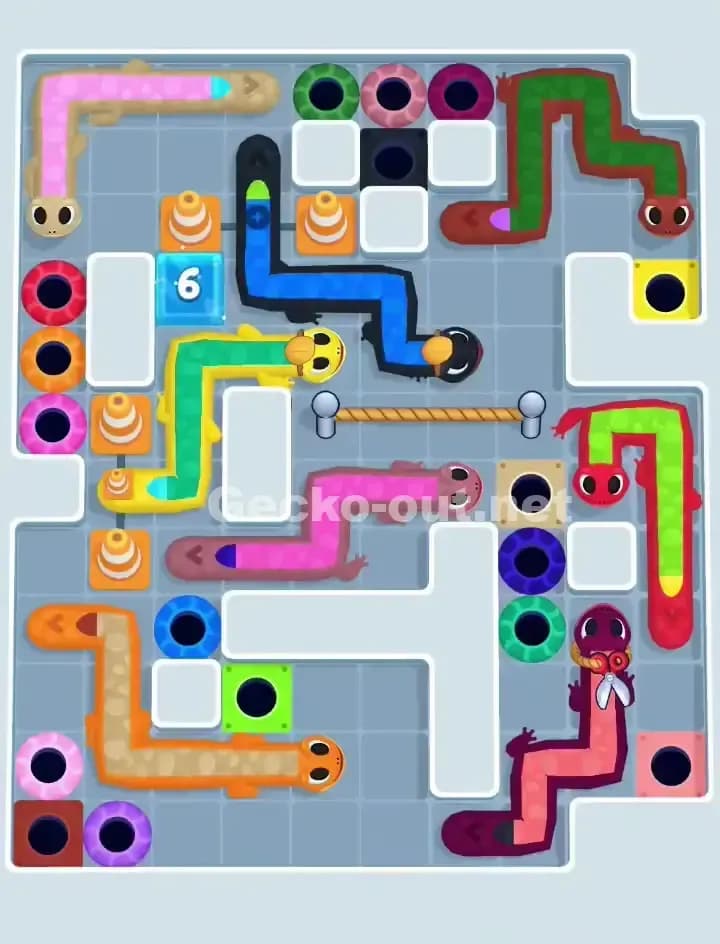
Gecko Out Level 1086 Solution Walkthrough | Gecko Out 1086 Answer
How to solve Gecko Out level 1086? Get step by step solution & cheat for Gecko Out level 1086. Solve Gecko Out 1086 easily with the answers & video walkthrough.


Gecko Out Level 1086: Board Layout, Rules, and Win Condition
Understanding the Starting Board in Gecko Out Level 1086
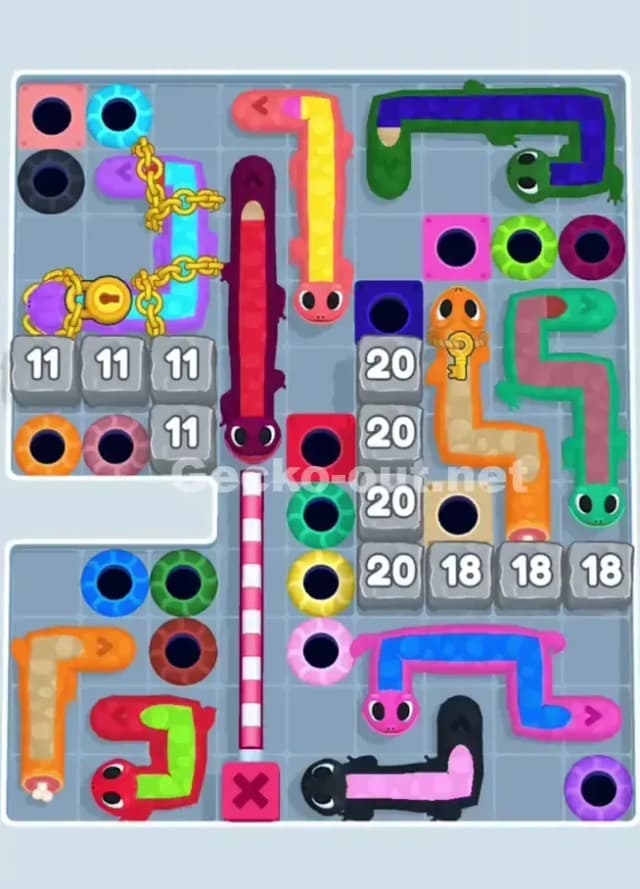
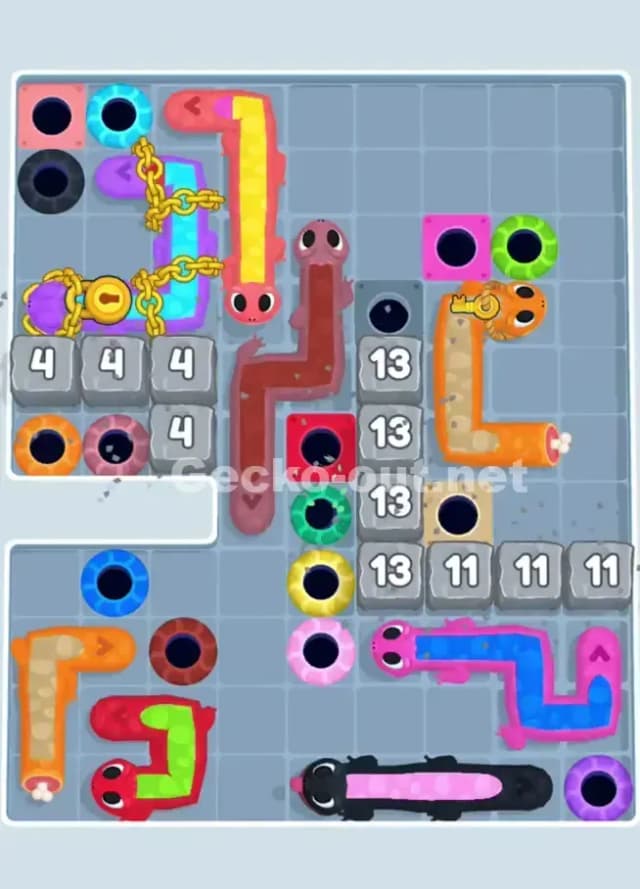
Gecko Out Level 1086 is a densely packed puzzle with seven geckos spread across the grid, each color-coded to match a specific exit hole. You'll find linked "gang" geckos connected by golden chains in the upper left—these move as a unit and demand careful choreography. There's also a pink-and-white striped gecko taking up valuable vertical real estate in the center, plus individual geckos scattered in various colors: orange, red, green, and blue. The board is studded with numbered toll gates (mostly counting down from 20 and 18), creating mandatory wait points that consume precious seconds. A few cells are also blocked by walls, forming tight corridors that only one gecko can traverse at a time. The complexity doesn't just come from the number of geckos—it's the combination of chained geckos, multiple toll gates, and interlocking paths that makes Gecko Out Level 1086 genuinely challenging.
The Win Condition and Timer Pressure in Gecko Out Level 1086
You win by guiding all seven geckos to their matching-color holes before the timer expires. Each gecko must travel an unblocked path from its starting position to its exit, and since you drag the gecko's head to steer its body, every pixel of movement matters. The timer in Gecko Out Level 1086 is aggressive—you'll need to plan your moves sequentially without wasting time on false starts or backtracking. Geckos can't overlap walls, each other, or frozen/locked exits, which means the order in which you move them is critical. A single poorly timed drag can lock two geckos into a collision course, forcing a restart. The pressure isn't just about speed; it's about reading the board correctly and committing to a sequence that flows smoothly from start to finish.
Pathing Bottlenecks and Logical Traps in Gecko Out Level 1086
The Central Vertical Corridor: Your Primary Bottleneck
The striped pink-and-white gecko running vertically down the middle of Gecko Out Level 1086 is the single biggest traffic jam on the board. This gecko occupies a narrow lane that other geckos need to navigate around, and if you move it carelessly, you'll create a wall that blocks at least two other escape routes. The moment I first tackled Gecko Out Level 1086, I got frustrated trying to route geckos on both sides of this central column—until I realized the solution was to move that striped gecko out of the way first, clearing the entire middle passage for the geckos waiting on either flank. This isn't just removing an obstacle; it's recognizing that the bottleneck gecko must be your opening move.
The Gang Gecko Chain and Spacing Traps
The linked chain of geckos in the upper left corner behaves differently because they move as one block. When you drag the head of the chain, the entire unit follows, which is both helpful and dangerous in Gecko Out Level 1086. If you yank the chain too quickly without accounting for its length, you'll jam it against walls or other geckos partway through the path. The trap isn't immediately obvious—players often assume they can route the gang gecko freely, then discover mid-drag that the tail is still tangled behind another gecko's body. You have to think of the chain as a single long object, not seven independent units.
The Toll Gate Cluster and Timing Chaos
Gecko Out Level 1086 has multiple toll gates stacked in one region, and they're not all synchronized. Some count down to 20, others to 18, which means if you send two geckos through the same gate area, you'll lose more time than expected. The "trap" is subtle—you might assume you can send the orange gecko through first, then immediately send the red gecko behind it. In reality, the gates are still processing, and the second gecko hits a delay that wasn't part of your mental timeline. The solution is to plan around these gates as hard stops, not passing lanes. Every gecko that passes through a toll zone must either sprint through while the gate is open or wait for it to reset. There's no middle ground in Gecko Out Level 1086.
Turn-by-Turn Path Strategy to Beat Gecko Out Level 1086
The Opening: Clear the Vertical Corridor First
Start by dragging the striped pink-and-white gecko straight down its column and out through its matching exit hole at the bottom. This move takes roughly 8–10 seconds but instantly opens up the center of the board, allowing you to see your remaining paths clearly. Don't try to optimize the route for speed on this first move; just confirm it exits cleanly without colliding with any walls or other geckos. Once it's gone, the upper half and lower half of Gecko Out Level 1086 suddenly feel less claustrophobic. Next, move one of the single geckos (I recommend the orange one near the lower left) through its exit. These solo geckos are forgiving because they don't drag along a chain or block multiple lanes. By clearing the first two geckos within the first 20 seconds of Gecko Out Level 1086, you've built momentum and reduced the mental load for the remaining five.
Mid-Game: Untangle the Chain and Manage Toll Gates
Once the board is slightly less crowded, tackle the linked gang gecko chain. Drag the head carefully northward and then east, following the outer edge of the board to avoid re-entangling it with other geckos. This path is longer but safer. The key to Gecko Out Level 1086 at this stage is patience—don't rush the chain through a tight corner. A 5-second detour saves you from a 30-second collision cleanup. As you move each gecko in the chain toward its exit, watch your timer. If you're burning more than 15 seconds per gecko, you're being too cautious; if you're burning fewer than 5 seconds, you're probably cutting corners that will crash into other geckos later. The sweet spot for Gecko Out Level 1086 is a steady, deliberate pace that avoids both recklessness and paralysis.
While the chain is moving, keep an eye on the toll gates. If you have two geckos waiting to pass through the same gate and you've got time, send them one at a time rather than stacking them. The gate's timer resets faster if you space out your traffic. You'll save roughly 3–5 seconds per gate pair in Gecko Out Level 1086 with this discipline.
End-Game: The Final Three Geckos and Avoiding Last-Second Deadlock
By the time you're down to your last three geckos in Gecko Out Level 1086, you should have at least 25–30 seconds left on the timer. If you have less than that, you're in trouble, and a booster might be necessary. Assuming you're on track, move the remaining single geckos next, clearing more space. Then send the last one or two linked geckos through their exits in whatever order reaches the holes without collision. If you're running low on time, pause for 2 seconds and trace the path visually with your finger before dragging. A deliberate 2-second pause beats a frantic drag that requires a restart.
Why This Path Order Works in Gecko Out Level 1086
Head-Drag Pathing and the Body-Follow Rule
The reason this sequence works for Gecko Out Level 1086 is rooted in how the drag mechanic works. When you drag a gecko's head, its body traces the exact path your finger took, pixel-perfect. This means the order in which you move geckos matters enormously—if a gecko's body is already occupying a square, the next gecko can't pass through it. By clearing the vertical corridor first, you create a clear "highway" that the remaining geckos can use to escape. By moving single geckos next, you shrink the congestion zone further. By the time you're herding the chain, there's only one or two geckos left, so the chain has maximum freedom. This order inverts the problem: instead of fighting to route geckos through a crowded board, you're progressively opening up space as you succeed.
Managing the Timer: When to Pause and When to Commit
In Gecko Out Level 1086, the timer punishes indecision more harshly than it punishes a slightly inefficient path. A perfect 15-second path that takes you 25 seconds to plan and execute is worse than a 20-second path you execute in 18 seconds. The rule I follow is this: spend the first 10 seconds reading the board and identifying the bottleneck (the striped gecko), then commit to the opening move. Don't second-guess yourself mid-drag. Once you start dragging, complete the action. Pause only when you've successfully exited a gecko and you're about to move a different one—that's your moment to check the clock and reassess if the remaining geckos can all escape in time. For Gecko Out Level 1086, three to four strategic pauses across the entire level is ideal.
Booster Use in Gecko Out Level 1086
You don't strictly need boosters to beat Gecko Out Level 1086 if you follow this plan, but if you find yourself with fewer than 15 seconds left after exiting five geckos, an extra-time booster is warranted. Don't use a hint booster—the level's logic is straightforward once you understand the bottleneck. A hammer-style tool is also unnecessary unless you've truly misrouted a gecko and need to blast through a toll gate. The true value of boosters in Gecko Out Level 1086 is as a safety net, not a crutch.
Mistakes, Fixes, and Logic You Can Reuse in Other Gecko Out Levels
Common Pitfalls and How to Avoid Them in Gecko Out Level 1086
Mistake 1: Moving the gang gecko chain first because it seems like the "main puzzle."
Fix: Identify the single biggest spatial bottleneck (in this case, the vertical gecko) and clear that first. The chain can wait.
Mistake 2: Trying to route geckos through toll gates in rapid succession without accounting for gate cooldown.
Fix: Space out your gecko traffic. One gecko per gate cycle is safer than gambling on overlapping timers.
Mistake 3: Dragging a gecko's head too quickly without tracing the body's path in your mind first.
Fix: Before you drag in Gecko Out Level 1086, mentally trace the path your finger will take. If it passes through a square occupied by another gecko's body, that drag will fail.
Mistake 4: Ignoring walls and assuming geckos can squeeze through tight corridors sideways.
Fix: Walls block movement entirely. In Gecko Out Level 1086, go around them, not through them. The longer path is sometimes the only path.
Mistake 5: Saving the easiest single geckos for last to "feel accomplished" as the timer runs down.
Fix: Move single geckos early and mid-game to clear space for the more complex chain maneuvers. By the end of Gecko Out Level 1086, you want the board as empty as possible.
Reusing This Logic on Similar Levels
This Gecko Out Level 1086 strategy is your template for any level with a high gecko count, a prominent bottleneck, and linked gang geckos. On future levels, ask yourself three questions:
- Is there a single gecko or obstacle that's blocking multiple escape routes?
- Are there linked geckos that I need to maneuver carefully to avoid tangling?
- Are there toll gates or time-consuming obstacles that benefit from spacing?
If the answer to any of these is yes, apply the same strategy: clear the bottleneck first, move single geckos to shrink congestion, then tackle the complexity. This approach works because it transforms a knot into a series of simpler sub-puzzles.
Your Gecko Out Level 1086 Victory Awaits
Gecko Out Level 1086 is undoubtedly one of the tougher levels you'll encounter, but it's not unfair or impossible. The difficulty comes from congestion and chained movement, not from hidden mechanics or randomness. Once you see the striped gecko as the opening move, the rest of Gecko Out Level 1086 becomes a methodical exercise in sequencing. You've got this. Take a breath, plan your first drag carefully, and trust that the space you create by moving one gecko successfully will guide you to the next move. Good luck!