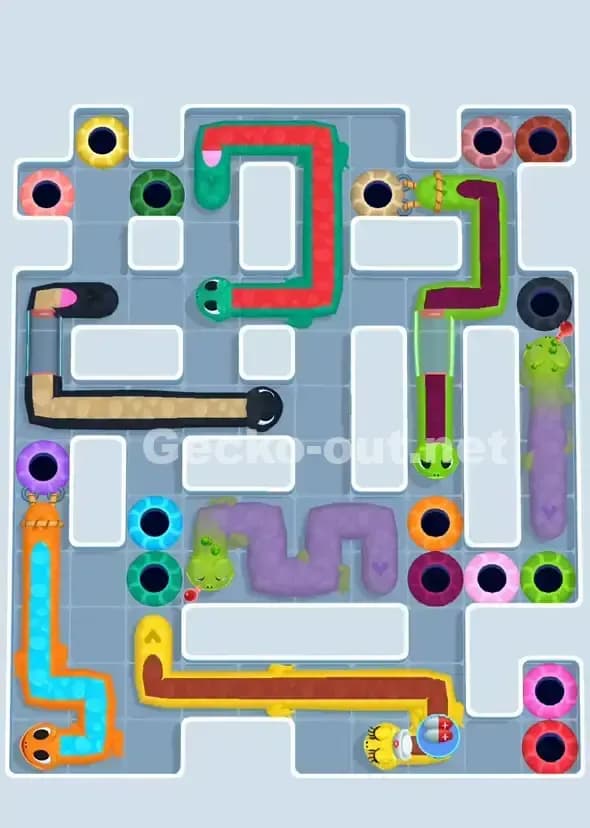
Gecko Out Level 903 Solution Walkthrough | Gecko Out 903 Answer
How to solve Gecko Out level 903? Get step by step solution & cheat for Gecko Out level 903. Solve Gecko Out 903 easily with the answers & video walkthrough.


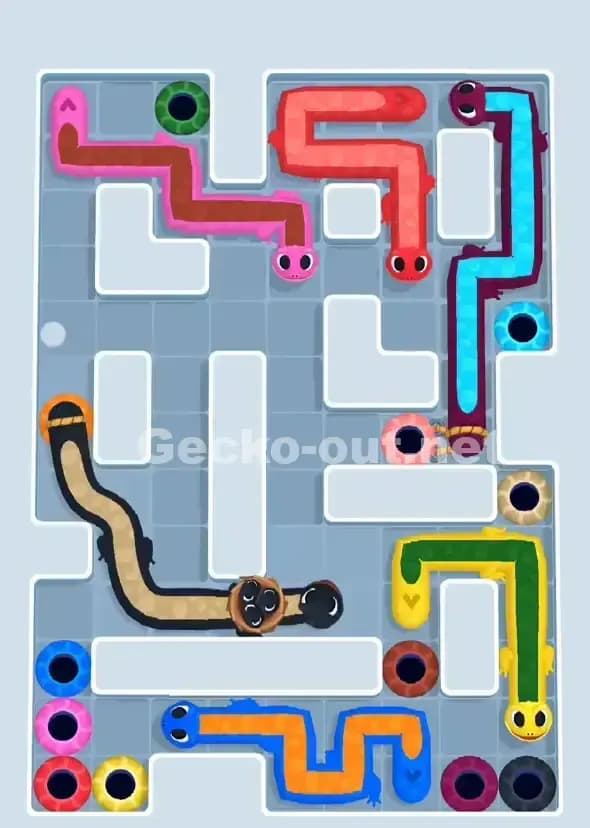

Gecko Out Level 903: Board Layout, Rules, and Win Condition
The Board Setup: Six Geckos, Three Distinct Zones, and a Maze of Walls
Gecko Out Level 903 is packed. You're looking at six geckos distributed across the board: a brown gecko in the top-left corner, a purple gecko trapped in a tight cyan-bordered pathway in the upper-middle zone, a green gecko in the top-right area, another brown gecko on the left side, a pink gecko in the center-right region, and a red gecko in the lower-left quadrant. Each gecko has a matching colored hole somewhere on the board—sometimes far from where they start—and that's your exit target. The board itself is a fortress of white walls creating a labyrinth of corridors and dead ends. What makes Gecko Out 903 genuinely tricky is that several geckos are positioned in tight spaces or near gang-style obstacles (geckos linked together), meaning one wrong drag path can lock you out of critical corridors for the rest of the puzzle.
Win Condition and Why Time Matters Here
To beat Gecko Out Level 903, all six geckos must reach their matching-colored holes before the timer runs out. Here's the catch: you can't pause once you start dragging a gecko's head. The body follows your exact path, which means slow, exploratory dragging eats seconds. Gang geckos (linked pairs) move together as one unit, so if you mess up the path for a two-gecko chain, you're essentially wasting two escape slots at once. The timer on Gecko Out 903 isn't absurdly tight, but it rewards decisive planning over trial-and-error fumbling. You need to know your route before you drag, not discover it along the way.
Pathing Bottlenecks and Logical Traps in Gecko Out Level 903
The Central Corridor Choke Point: Why the Purple Gecko is the Gatekeeper
The biggest bottleneck in Gecko Out Level 903 is the purple gecko trapped inside the cyan-walled L-shaped corridor in the upper-middle section of the board. This gecko's path is severely constrained by walls on three sides, and it's positioned near the red-walled path that leads upward and rightward. If you don't route the purple gecko out early and decisively, its body will remain sprawled across critical pathways, blocking other geckos from accessing the upper-right quadrant and potentially the middle zones. Think of it as a traffic jam waiting to happen. The purple gecko must exit before you attempt any major moves with the green or brown geckos in that region.
Hidden Trap #1: The Gang Gecko Pair and Wall Overlap Risk
There are linked geckos (gang members) scattered across Gecko Out 903, particularly near the lower-middle and right-side areas. When you drag a gang gecko's head, both bodies follow the same path simultaneously. A common mistake is dragging them in a way that one body clips into a wall or overlaps with another gecko's resting position. Because gang geckos move together, you can't separate them mid-puzzle, so you absolutely must commit to a path that keeps both bodies safe. On Gecko Out 903, this means either routing them both to the same region and exiting in sequence, or carefully planning two separate long corridors that don't intersect.
Hidden Trap #2: The Dead-End False Exits
Gecko Out Level 903 has several white-walled alcoves and corridors that look like they might lead to exit holes but actually dead-end. The bottom-left and bottom-right areas have particularly deceptive layouts. You might drag a gecko down a promising corridor only to realize halfway through that it's a dead end, and now you've wasted precious seconds pulling that gecko back and finding the real route. Always trace potential paths with your eyes before committing the drag. On Gecko Out 903, patience in the planning phase saves panic in the execution phase.
The Moment It Clicked: A Personal Reaction to the Knot
Honestly, my first two attempts at Gecko Out Level 903 felt chaotic. I was so focused on getting one gecko out quickly that I left another's body coiled across the board like a snake blocking traffic. The frustration peaked when I had three geckos successfully exited but couldn't reach the fourth gecko's hole because the third gecko's tail was in the way. Then I had an "aha" moment: instead of rushing to exit, I needed to think about the final position of each gecko's body. If a gecko's path goes "up then right then down," its body occupies all those spaces, so I need to plan end positions that don't block future paths. That single insight transformed Gecko Out 903 from a panic sprint into a solvable puzzle.
Turn-by-Turn Path Strategy to Beat Gecko Out Level 903
Opening: Unblock the Upper Zone and Secure Safe Parking
Start with the purple gecko in the cyan corridor. Drag its head out of the L-shaped enclosure by routing it upward and then rightward toward the purple hole in the upper-right area. This isn't the longest gecko on the board, so it should be your first move to clear the central bottleneck. While that path is open, immediately move the green gecko from the top-right downward and leftward in a controlled manner—don't let it sprawl across the center where the purple gecko's body might still be settling. Park the green gecko in a neutral zone (like a lower corridor) temporarily if its exit isn't immediately accessible. The brown gecko in the top-left corner should follow next; route it clockwise around the board toward the brown hole on the bottom-right or left side, depending on which path is clearest after the purple gecko exits. The key to the opening phase of Gecko Out 903 is not to have more than two geckos in motion or "in transit" at the same time, because every body on the board is a potential blocker for others.
Mid-Game: Manage Gang Geckos and Keep Corridors Clear
Once the top-zone geckos are out or parked, turn your attention to the gang geckos and the red gecko in the lower-left. The red gecko is a long, S-shaped creature, and its body will occupy a lot of real estate. Before you move it, map out a path that doesn't interfere with the gang geckos' routes. On Gecko Out 903, the gang geckos near the center-right and lower areas need clear corridors to escape without overlapping each other. Drag the red gecko in a wide arc—down and around the left side, then rightward—so its body forms a curve that doesn't block the vertical or horizontal main corridors. For the gang geckos, synchronize their exit by planning both bodies to follow a safe route. If they're linked horizontally, they might need to travel together down a wide corridor and exit side-by-side. If they're linked vertically, they'll occupy a tall space, so plan accordingly. The mid-game phase of Gecko Out 903 is where most players lose time because they're juggling multiple long bodies and trying to find gaps. Slow down, trace each path with your finger or mentally, and only drag when you're confident.
End-Game: Exit Order and the Final Countdown
With four or five geckos out, you'll have the pink gecko, possibly a brown gecko, and maybe a gang-gecko pair left. Check your timer—if you're comfortably ahead (more than 10–15 seconds), you can afford another careful route. If you're running close, commit decisively. The pink gecko in the center-right typically has a clear path downward or rightward to its matching hole, so it's a good late-game option. The final gecko should be the one with the most space around it, because a last-second miscalculation here is a run-killer on Gecko Out 903. If you're under 5 seconds, don't start dragging unless you're 100% certain of the path. It's better to time out on a gecko you've thought through than to panic-drag and hit a wall with 2 seconds left.
Why This Path Order Works in Gecko Out Level 903
Head-Drag Pathing: Using Body Mechanics to Untangle, Not Tighten
The genius (and frustration) of Gecko Out Level 903 lies in how the body-follows-head rule can either solve or amplify the knot. When you drag a gecko's head in a specific shape—say, an "S" curve or a wide spiral—the body conforms to that exact path and then stays put. If you plan wisely, each gecko's final resting position becomes a "solved" block that no longer blocks anyone; it's integrated into the solved state. But if you drag haphazardly, you create overlapping body trails that trap other geckos. The path order I've outlined (purple first, then brown, then gang geckos) works because it progressively opens corridors rather than closing them. By moving the gatekeeper gecko (purple) first, you free up space for longer geckos like the red one to find unobstructed routes. By routing the red gecko carefully in mid-game, you ensure the gang geckos have clear lanes in the end-game. This is the opposite of what a panicked player does—they route a long gecko randomly and then discover it blocks everything.
Managing the Timer: Pause and Read Versus Commit and Move
On Gecko Out Level 903, the timer is your feedback loop. If you're cruising through and exiting geckos every 5–10 seconds, great—you're well-paced. If you exit three geckos and then stall for 20 seconds trying to figure out gecko number four, you're in trouble. The solution is to pause between drags (the game typically allows you to sit and plan without the timer running, or at least very slowly). Use that breathing room to trace the path of the next gecko completely before you touch the drag control. Once you start dragging, move smoothly and commit. On Gecko Out 903, hesitation and second-guessing during a drag slow you down and can result in a clumsy path that wastes time later. My rule: 15 seconds of planning, 3 seconds of execution per gecko.
Boosters: Are They Needed on Gecko Out Level 903?
On Gecko Out Level 903, boosters like extra time or a hint are nice to have but not essential if you follow the strategy above. A time-booster is only worth using if you've exited five geckos and are genuinely stumped on the last one—and even then, it only helps if you use the extra time to plan, not to panic-drag more. A hammer or tool booster isn't applicable to Gecko Out 903 because there are no frozen exits or special mechanisms to break. A hint booster can be useful if you're stuck on which gecko to move first, but the path order I've outlined should eliminate that uncertainty. My recommendation: treat boosters as a safety net, not a crutch. Solve Gecko Out 903 with pure strategy first. If you time out, then consider a booster on the retry.
Mistakes, Fixes, and Logic You Can Reuse in Other Gecko Out Levels
Five Common Mistakes on Gecko Out Level 903 and How to Avoid Them
Mistake #1: Dragging the Red Gecko First
The red gecko looks prominent because it's a big, eye-catching shape in the lower-left. New players often drag it first to "clear the obvious," but this is backwards on Gecko Out 903. The red gecko's long body will sprawl across multiple corridors that other geckos need. Fix: Always tackle gatekeeper geckos (those trapped in tight spaces, like the purple one) before large, free-range geckos.
Mistake #2: Overlapping Gang Gecko Bodies with Other Geckos
Gang geckos move together, but players sometimes drag them into collisions with other geckos' resting positions. On Gecko Out 903, this causes an instant failure because you can't overlap. Fix: Before dragging any gang gecko, confirm that the route passes through empty corridors or corridors you've already cleared by exiting other geckos.
Mistake #3: Taking Long, Winding Paths When Short Routes Exist
A gecko doesn't have to take the scenic route. On Gecko Out 903, some players drag a gecko on a huge loop when a direct-ish path to the exit is available. This wastes time and occupies more board space. Fix: Always look for the simplest path that avoids walls and other gecko bodies. Simplicity is speed on Gecko Out 903.
Mistake #4: Not Recognizing Dead-End Alcoves
The bottom-left area of Gecko Out 903 is a maze of near-miss corridors. Players drag geckos into them thinking they lead somewhere, only to backtrack. Fix: Before dragging, trace the corridor with your eyes and confirm it actually connects to a hole or a major pathway.
Mistake #5: Leaving the Timer Too Close to Zero
On Gecko Out 903, if you exit five geckos successfully but are down to 3 seconds and still have one gecko to move, you'll panic and fail. Fix: Aim to exit geckos with at least 10–15 seconds on the clock. If you're moving faster, great; if you're slower, adjust your next gecko's route to be simpler.
Reusing This Logic on Similar Gecko Out Levels
The strategy for Gecko Out Level 903 transfers directly to any level with gang geckos, tight corridors, or multiple exit holes. The key principle is: identify bottlenecks, unblock them first, then use the freed space to route longer geckos safely. This applies to frozen exits (which block paths until melted, similar to how the purple gecko blocks zones until it exits), multi-level puzzles (where vertical corridors become bottlenecks), and levels with many geckos on a small board. The timer-management lesson also holds: on any Gecko Out level with 5+ geckos, prioritize gatekeepers, plan routes before dragging, and keep your exit pace around one gecko per 8–10 seconds to stay ahead of the timer.
The Takeaway: Gecko Out Level 903 Is Tough, But You've Got This
Gecko Out Level 903 feels like a knot, and that's intentional. It's designed to punish rushing and reward planning. But now that you understand the bottleneck (purple gecko), the body-mechanics (head-drag creates the path the body follows exactly), and the priority order (gatekeepers first, then large geckos, then gang pairs), you have a clear map. The first time you execute this strategy, you'll likely beat Gecko Out 903 with time to spare. And if you don't nail it on the first try, you'll know exactly which gecko gave you trouble and can adjust next time. That's not failure; that's learning. Gecko Out Level 903 is absolutely beatable with the mindset you've got now. Go in confident, trust your plan, and watch those geckos escape one by one. You've got this.