Gecko Out Level 916 Solution Walkthrough | Gecko Out 916 Answer
How to solve Gecko Out level 916? Get step by step solution & cheat for Gecko Out level 916. Solve Gecko Out 916 easily with the answers & video walkthrough.
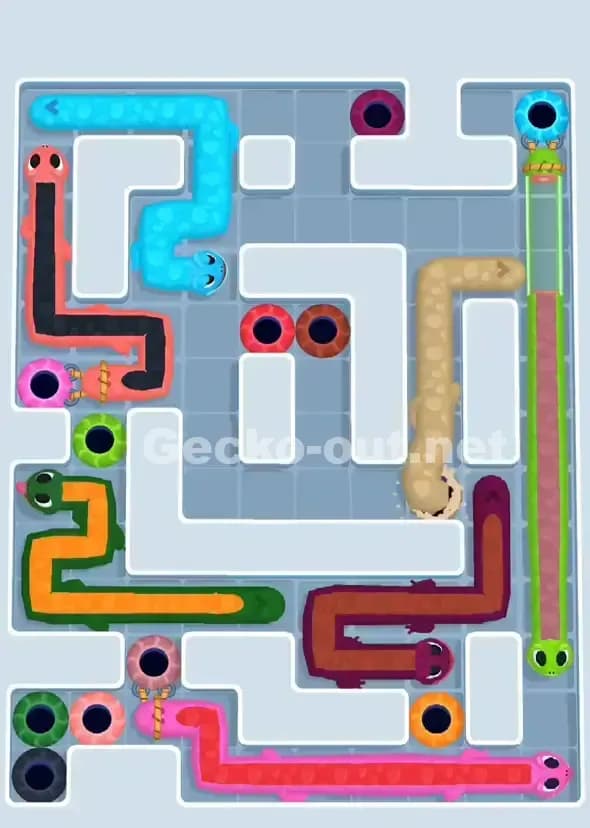
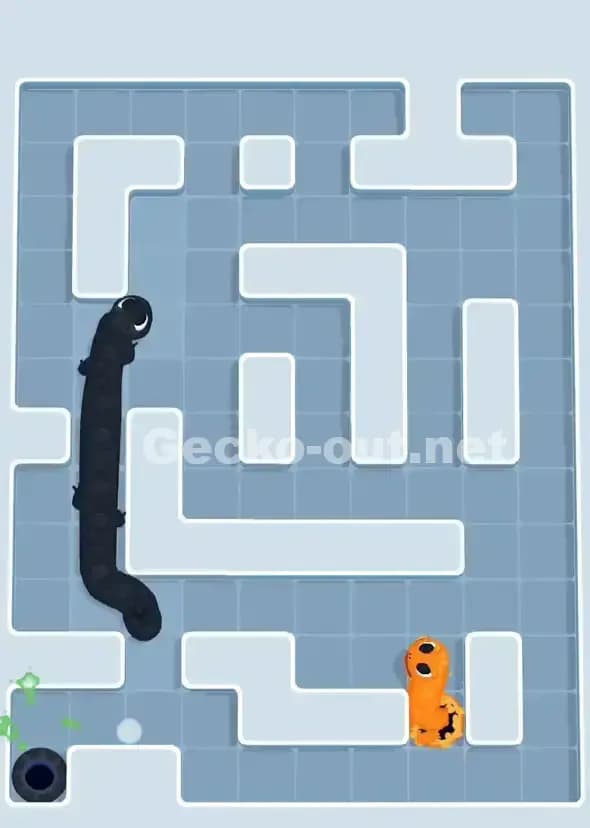
Gecko Out Level 916: Board Layout, Rules, and Win Condition
The Board: Five Geckos, Tight Corridors, and Interlocking Paths
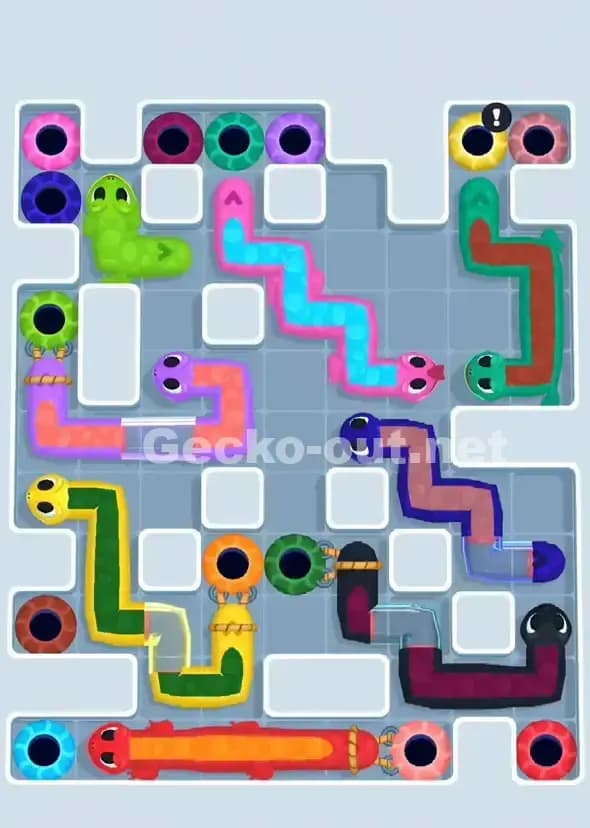
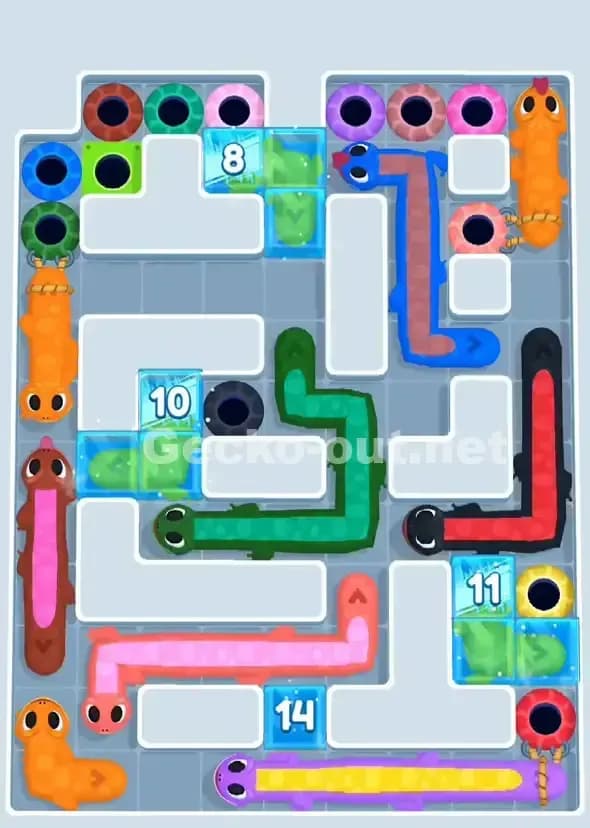
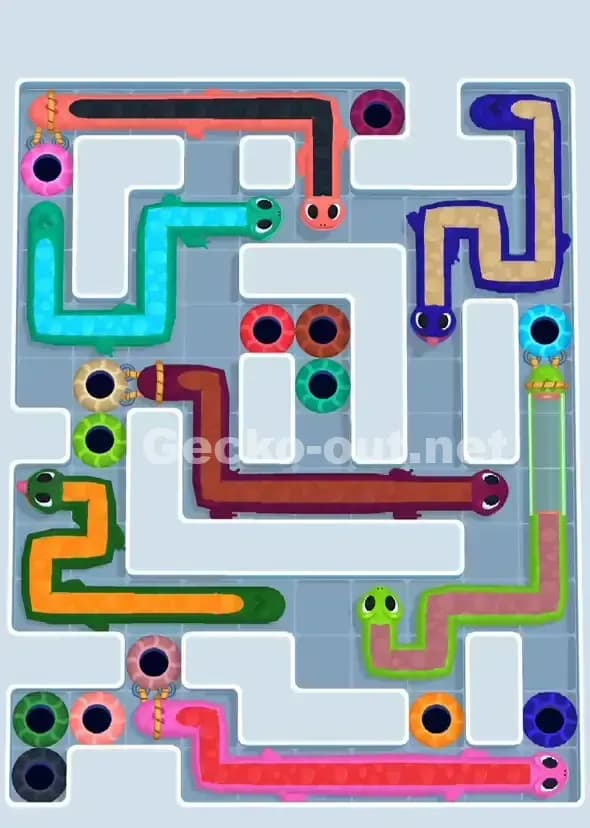
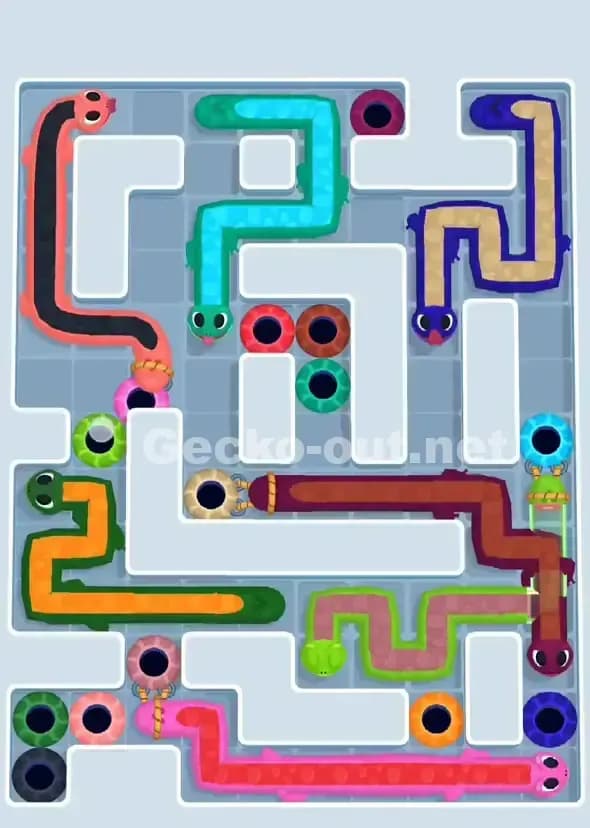
Gecko Out Level 916 throws you into the deep end right away. You're managing five geckos—red, magenta, cyan, orange, and green—each one locked into its own colored pathway that winds across a densely packed board. The layout is deliberately maze-like: narrow corridors, sharp turns, and walls that force you to think several moves ahead. Each gecko's body is already positioned along its colored track, and your job is to drag each head to its matching exit hole. What makes Gecko Out 916 deceptively tricky is that these paths overlap and intersect in ways that create natural chokepoints—places where moving one gecko blocks another's only route forward.
The board is divided into distinct zones: the upper left hosts the magenta and red geckos with a tight cluster of overlapping trails; the center is a tangle of cyan and orange pathways weaving through narrow gaps; and the lower right contains the green gecko on a longer, sprawling route. Each exit hole sits at the far end of its respective colored path, and they're positioned just far enough apart that you can't herd all five geckos to safety in a simple sequential push. The timer is your constant pressure—you've got a limited window to complete Gecko Out Level 916, so hesitation or backtracking will cost you precious seconds.
Why Gecko Out Level 916 Demands Precision Over Speed
You win Gecko Out Level 916 when all five geckos have reached their color-matched exit holes before the timer expires. The catch? Each gecko's body is tethered to follow the exact path you drag its head along. If you drag the red gecko's head in a sloppy arc, its body will snake around every part of that arc, potentially blocking other geckos' lanes. Unlike puzzle games where you can nudge or reposition freely, Gecko Out 916 punishes inefficient pathing because the body always occupies every tile it travels through. This rule transforms the level from "get everyone out" into "get everyone out without tangling them into an unsolvable knot." That's the real test of Gecko Out Level 916.
Pathing Bottlenecks and Logical Traps in Gecko Out Level 916
The Central Choke Point: Where Three Paths Converge
The single biggest threat in Gecko Out Level 916 is the central corridor where the cyan, orange, and red paths all funnel toward adjacent sections of the board. Here's the problem: the cyan gecko's body is already stretched across much of the middle, and its path to the exit winds tight against the orange pathway. If you move red first without clearing a safe "parking spot" for its body, you'll block cyan's access to its own exit. Conversely, if you ignore red and push cyan directly, red's tail will jam against cyan's midsection, and you're stuck. This convergence is the lynchpin of Gecko Out Level 916—solving it unlocks everything else.
The Subtle Traps That Catch Most Players
Many players overlook the magenta gecko's initial position in the upper left. It's easy to assume magenta is simple because its path appears short, but the exit hole sits at an awkward angle that forces you to drag magenta's head through a tight corner. If you don't pull magenta out early and with a clean, direct drag, its body will linger in the upper left, blocking the space where you need to route red's escape. That's the first subtle trap of Gecko Out Level 916.
The second trap is the green gecko on the lower right. It looks isolated and safe, but its path winds downward then left, crossing under the very space where orange needs to make its final turn. If you move green too late, you'll find that orange has nowhere to go—it's physically wedged between green's body and the exit corridor. This interdependency is what elevates Gecko Out Level 916 beyond a simple maze.
The third trap is underestimating the timer pressure. Gecko Out Level 916 gives you enough time to win, but not enough to experiment. If you get tangled and try to reverse or re-solve, you'll burn through your clock faster than you realize. The challenge isn't just solving the puzzle—it's solving it in the right order so you never have to backtrack.
The Moment the Solution Clicks
I'll be honest: my first three attempts at Gecko Out Level 916 felt chaotic. I'd move cyan, then realize red was stuck. I'd undo and move red, only to find magenta was now blocking the path I needed. But on attempt four, I paused the board and traced all five paths with my eyes, ignoring the timer for thirty seconds. I marked which gecko had to move first, which ones could be parked safely, and which ones had to be saved for last. Suddenly, Gecko Out Level 916 stopped feeling like a tangle and started feeling like a choreography. That mental shift from "I'll just try moving things" to "I'll plan the exact sequence" made all the difference.
Turn-by-Turn Path Strategy to Beat Gecko Out Level 916
Opening: Clearing the Upper Left and Creating Breathing Room
Start with the magenta gecko in the upper left. Don't overthink this—drag its head directly to its exit hole using the shortest, cleanest path available. The magenta exit is positioned at the top-right edge of the upper section, and magenta's body will follow that route. Why first? Because magenta is the least tangled with everyone else, and removing it clears valuable board space. With magenta out, you've created your first breathing room.
Next, tackle the red gecko. Red is also in the upper left, and its path is already partially mapped by its body position. Drag red's head down and to the right, following red's colored track toward its exit on the upper border. Red's exit is closer than you might think—it's at the top center area. Once red is moving, its body will sweep across the upper zone, but since magenta is already gone, red has clear real estate. Get red out before its tail interferes with the central tangle.
Mid-Game: Repositioning Long Geckos Without Creating New Jams
Now comes the crux of Gecko Out Level 916: the cyan gecko. Cyan's body is long and already snaking through the center of the board. Here's the key: don't pull cyan's head directly toward its exit immediately. Instead, do a preliminary move to "park" cyan's body somewhere safe. Drag cyan's head to the side or slightly downward, positioning it so that orange has enough corridor space to move. This might feel counterintuitive—you're moving cyan away from its exit temporarily—but you're buying yourself maneuverability. Once you've repositioned cyan, its body is out of orange's critical lane.
Next, move the orange gecko. Orange's path curves around the lower-center area and needs to reach its exit on the right side of the board. Drag orange's head deliberately around the bends and toward its destination. Orange's route is longer than it appears, so make sure you're following the actual track, not trying to shortcut through empty space. As orange moves, its body will occupy the lower-center corridor, which is fine because cyan has been parked elsewhere. Orange should be able to reach its exit without obstruction if you've planned cyan's position correctly.
End-Game: The Green Gecko and Final Timing
Once cyan and orange are handled, you've cleared enough space for the final two moves. Move cyan all the way to its exit now—drag its head to cyan's destination hole on the right side. Cyan can now move freely because neither red nor magenta are blocking, and orange is already safely in its hole. Cyan should exit cleanly.
Finally, move green. The green gecko is on the lower right, and it needs to navigate a path that curves and winds toward its exit on the far right edge. Drag green's head to its exit with confidence. At this point, the board is mostly empty, so green should have a clear route. If you're running low on time, prioritize speed over perfection—a slightly inefficient drag is better than running out of seconds while overthinking Gecko Out Level 916. Once green reaches its hole, you've beaten Gecko Out Level 916.
Why This Path Order Works in Gecko Out Level 916
How Head-Drag Pathing Prevents Tangling
The genius of this strategy is that it works backward from the bottleneck. By clearing magenta and red first, you eliminate the two geckos most likely to jam the central zone. The body-follow rule in Gecko Out Level 916 means every tile a gecko occupies is off-limits to others, so the fewer geckos on the board, the more freedom the remaining ones have. When you finally move cyan, it's not fighting for space—it's sliding into an open corridor. When orange moves, it's similarly unobstructed. This sequence transforms Gecko Out Level 916 from a three-dimensional puzzle into a series of simpler, one-at-a-time problems. You're not solving five geckos simultaneously; you're solving one gecko at a time by systematically removing obstacles in the right order.
Balancing Speed and Caution
The timer in Gecko Out Level 916 is generous enough that you won't fail if you move deliberately, but tight enough that you can't pause and re-solve repeatedly. My approach is to spend the first fifteen to twenty seconds reading the board, identifying which gecko blocks which, and mentally mapping the sequence. Then, move quickly and decisively without second-guessing. Each drag in Gecko Out Level 916 should be confident—not reckless, but not hesitant either. If you find yourself undoing moves or backtracking, you've lost valuable time. The five-gecko sequence I've outlined (magenta, red, cyan, orange, green) is the sequence that minimizes the chance of jamming, so committing to it from the start pays dividends.
Booster Strategy for Gecko Out Level 916
You don't need boosters to beat Gecko Out Level 916 if you follow this path order. However, if you're consistently running low on time despite good planning, the extra time booster is your safety net—use it right after moving orange, just to give yourself a cushion for cyan and green. Avoid the hammer tool; it's overkill for this level and wastes resources. The hint booster is optional but can be useful if you're genuinely stuck on the board layout itself. For Gecko Out Level 916, the booster should be backup insurance, not your primary strategy.
Mistakes, Fixes, and Logic You Can Reuse in Other Gecko Out Levels
Five Common Mistakes on Gecko Out Level 916 and How to Fix Them
Mistake 1: Moving geckos in alphabetical or arbitrary order. Players often move blue, then cyan, then green out of habit, without considering which gecko is actually blocking the others. On Gecko Out Level 916, this approach guarantees jamming. Fix: Always trace the board and identify the bottleneck gecko first, then work outward from it. Ask yourself: which gecko, if removed, opens the most space for others?
Mistake 2: Dragging geckos to their exit immediately without parking. The instinct is to push each gecko straight to its hole, but on Gecko Out Level 916, that's chaos. You'll create overlaps and block corridors you didn't anticipate. Fix: Before a final drag to the exit, consider whether parking the gecko elsewhere first would unblock critical lanes for the geckos still waiting.
Mistake 3: Ignoring the timer until it's critical. Many players watch the gecko animation and lose track of seconds ticking away. By the time they realize they're down to twenty seconds, they're panicking and making sloppy drags. Fix: Keep one eye on the timer throughout Gecko Out Level 916. If you're past the midpoint and haven't moved three geckos, you're falling behind—speed up deliberately.
Mistake 4: Assuming shorter paths are always better. A shorter drag sounds efficient, but on Gecko Out Level 916, a slightly longer drag that avoids other geckos' bodies is smarter. You're optimizing for safety and unblocking, not for distance. Fix: Mentally trace the full path before dragging. If a shortcut would make the gecko's body overlap with another gecko's current position, take the long way around.
Mistake 5: Not accounting for the body's spatial footprint. New players sometimes forget that the body doesn't disappear once you've dragged the head—it occupies the entire path the head took. On Gecko Out Level 916, this means a gecko that exited five seconds ago is still blocking space until it's completely through the hole. Fix: Wait for the full exit animation before moving the next gecko, and visually confirm the board is clear.
Reusing This Logic on Similar Levels
The strategy I've outlined for Gecko Out Level 916 applies directly to any level with multiple long geckos, overlapping pathways, and narrow corridors. Whenever you encounter a level with what I call "gang geckos" (geckos whose bodies are already tangled or adjacent), use the same approach: identify the bottleneck, clear the peripheral geckos first, and then untangle the center. This principle works on frozen-exit levels too—the order matters even more because you can't revise your approach. The "park and then push" technique is equally useful on levels with toll gates or warning holes, where you need to create space before committing to a final path.
Gecko Out Level 916 teaches you to think in sequences, not snapshots. Once you've internalized that mindset, you're prepared for the harder levels ahead. You've learned that the order of operations isn't arbitrary—it's the entire puzzle.
Final Encouragement
Gecko Out Level 916 is undeniably tough. It's a level that separates casual players from strategic thinkers. But it's absolutely beatable, and it's not because you need luck or reflexes—it's because the puzzle has a clear solution, and I've walked you through it. The first time you clear Gecko Out Level 916, you'll feel the satisfaction of having solved something genuinely clever. And you'll carry that problem-solving mindset forward to the even harder levels waiting for you. You've got this.