Gecko Out Level 351 Solution Walkthrough | Gecko Out 351 Answer
How to solve Gecko Out level 351? Get step by step solution & cheat for Gecko Out level 351. Solve Gecko Out 351 easily with the answers & video walkthrough.
Gecko Out Level 351: Board Layout, Rules, and Win Condition
Starting board: colors, knots, and obstacles
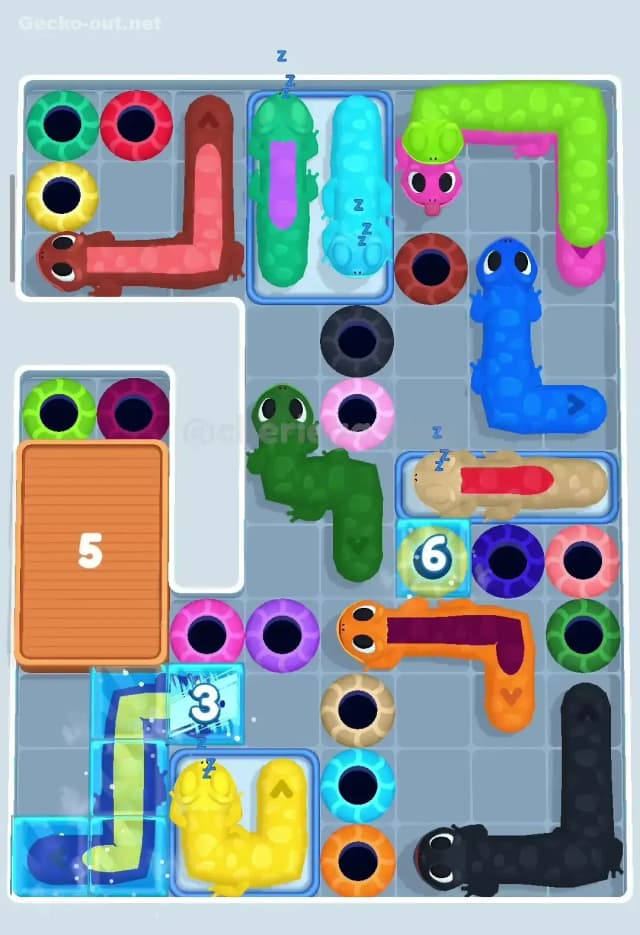
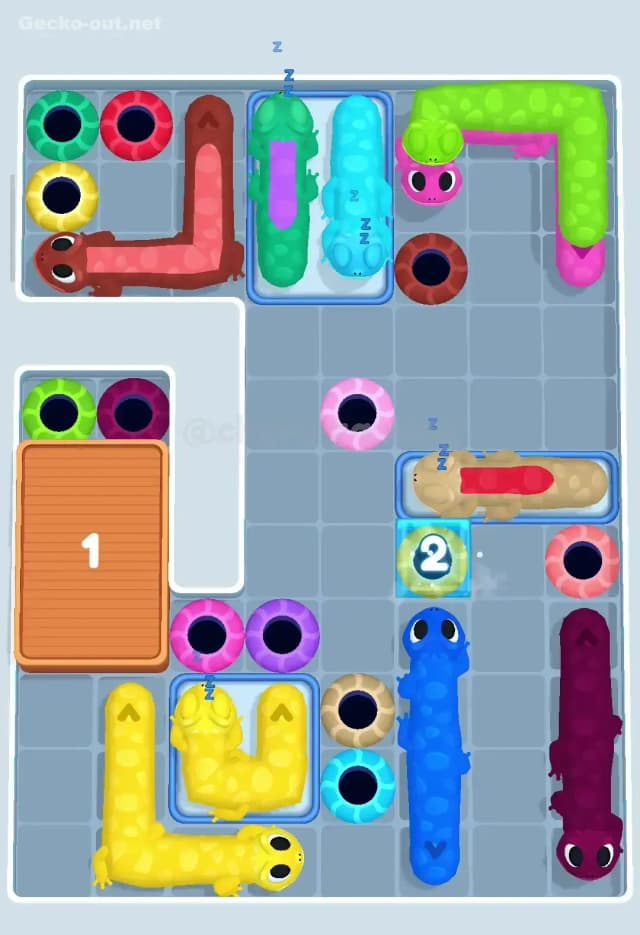
Gecko Out Level 351 drops you into a very packed board with a lot of long bodies and almost no empty squares. You’ve got around ten geckos in play: a long red L-shaped gecko along the upper left corridor, a pair of stacked turquoise/blue “gang” geckos asleep in the top-center lane, a pink‑headed L‑shaped gecko wrapping around the top-right corner, a tall blue L on the right side, a chunky dark‑green gecko in the middle, a beige sleeper with a red stripe on the mid‑right, an orange gecko near the bottom middle, a frozen yellow gecko in the lower left, and a long black gecko guarding the lower-right edge.
Several exits sit around and inside the board as colored donut holes. Some are easy to see but awkward to reach, while others are blocked by obstacles: the frozen yellow gecko is boxed in by ice tiles, the gang pair is locked in a narrow holding lane, and a big wooden panel with a “5” on it blocks the left channel toward a cluster of exits. A glowing “6” tile and an icy “3” tile act like special gates: you can route through them, but you need to plan around them because they’re sitting right where you’d naturally want to drag paths.
Win condition, timer, and why pathing is tricky
To beat Gecko Out 351, every gecko has to reach a hole of matching color before the level timer hits zero. As always, you drag the head to draw a route and the body follows that exact path. You can’t cross walls, other geckos, or blocked exits, and you can’t make two bodies overlap, even if it’s just briefly during a drag.
The timer and path system together are what make Gecko Out Level 351 feel nasty. You don’t have time to do a ton of trial-and-error dragging; if you draw messy zigzags, you’ll waste seconds and also wrap bodies around key lanes so tightly that nothing else can move. The real challenge is mapping a clean order in your head, then committing to smooth, low‑curve lines that open the board instead of tightening the knot.
Pathing Bottlenecks and Logical Traps in Gecko Out Level 351
The single biggest bottleneck
The main choke point in Gecko Out Level 351 is the central-right column around the blue L‑shaped gecko, the beige sleeper, and the cluster of holes near the glowing “6” tile. Almost every long gecko—blue, black, orange, and even the green in the middle—needs to pass through or around this lane. If you let the blue L sit twisted in the center or park the orange gecko across the bottom row, you seal off the only real highway that connects the lower half of the board to the exits above.
On top of that, the sleeping gang pair and the red L in the upper left depend on this same traffic lane being cleared later, once the right side opens. So the entire level revolves around clearing and then keeping that central corridor open for as long as possible.
Subtle problem spots that catch you off guard
First, the orange gecko’s natural move is to swing straight into the nearby orange hole in the lower-right cluster. If you route it with a wide hook, though, its tail ends up blocking the black gecko’s best escape route. I kept doing this—orange out, black stuck—until I forced myself to draw the shortest possible line for orange, hugging its own exit.
Second, the dark-green gecko in the middle looks like a harmless short piece, but if you park it sideways across the central holes, you create a hard wall that the blue L can’t get around. That one little body placement can turn a nearly solved board into a deadlock.
Third, the icy “3” area around the frozen yellow gecko is easy to forget about. If you start thawing that corner too early—before the bottom is mostly clear—you’ll just have another long body flailing around in the tightest part of the board, and you’ll regret waking it up.
When Gecko Out 351 finally clicks
I’ll be honest: Gecko Out Level 351 felt frustrating the first few times. I’d get four or five geckos out, then realize one long L‑shape had coiled itself into a perfect barricade and there was no way to unwind it before the timer expired. The turning point was when I stopped trying to save every gecko as soon as I saw its hole and instead treated a few of them as “moving walls” that had to be parked in deliberate holding spots.
Once I saw that the central-right corridor was the lifeline of Gecko Out 351, the whole layout made sense. The solution isn’t about fancy loops; it’s about clearing that lane early, cycling the right‑side geckos through it in a specific order, and only then waking the frozen and gang geckos to finish.
Turn-by-Turn Path Strategy to Beat Gecko Out Level 351
Opening: clear the right side and make parking spots
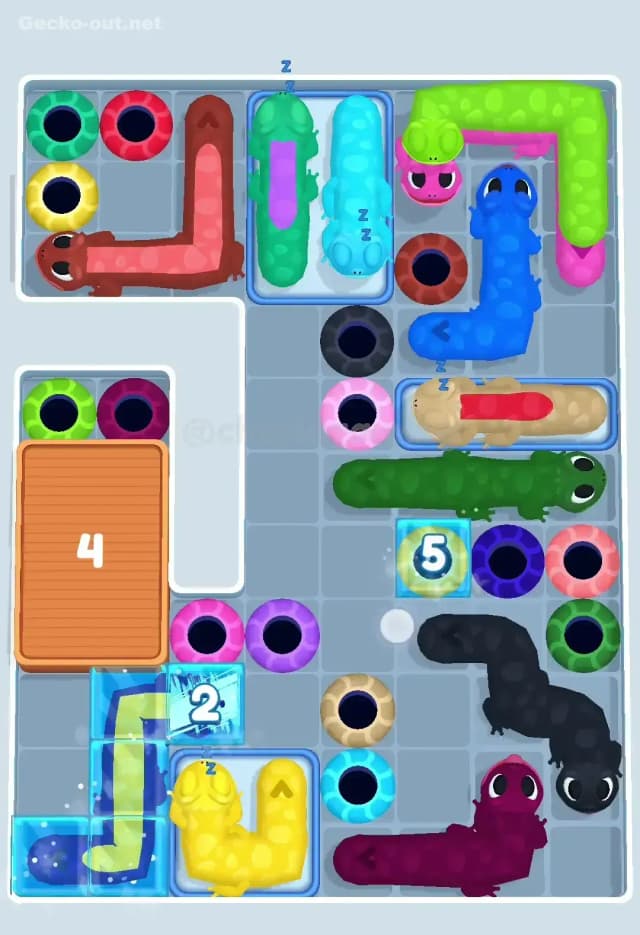
- Start with the black gecko on the lower right. Drag its head left into the bottom center area, then curve it slightly upward so it lies mostly horizontal under the orange gecko without covering any exits. This gets its long body out of the corner and opens the right wall.
- With that space freed, gently nudge the orange gecko into its orange hole in the lower-right section using as short a line as you can. Don’t loop around the central holes; aim to enter the exit from the closest side so its tail stays compact.
- Move the blue L‑shaped gecko next. Pull its head down and then left through the gap you just created, straightening it along the right edge or just above the black gecko. For now, park blue so that it forms a vertical line hugging the outer wall, not blocking the central column of holes.
- Shift the dark-green middle gecko slightly down and right into any small pocket that doesn’t cross that central lane. Think of it as sliding a puzzle piece out of the way rather than rushing it to the exit.
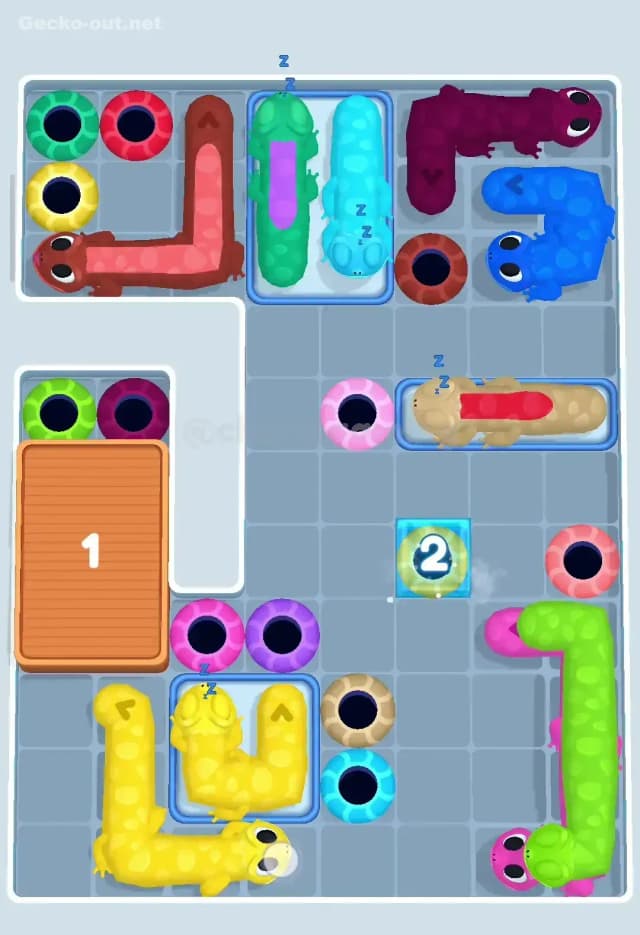
At the end of the opening, the lower-right quarter should be mostly free, the orange gecko should already be out, and the central corridor should be clear enough for long bodies to pass through without sharp turns.
Mid-game: cycle through the central corridor and wake sleepers
- Once the lane is open, send the blue L to its matching blue exit (usually near the central-right holes). Draw a smooth, minimal path that doesn’t snake into the bottom-left ice area or across the glowing “6” more than necessary.
- Use the space blue left behind to reposition the black gecko. Either slide it up the right wall or thread it carefully through the center so its tail doesn’t cover multiple exits. If the black hole is nearby, you can often score its exit now with a clean vertical or gently curved path.
- Only after blue and black are stabilized should you deal with the beige sleeper and the “6” tile. Drag another gecko across “6” if you must, but do it when the board is already open so the beige gecko can wake, stretch out into free space, and reach its hole in one or two drags.
- Now turn to the frozen yellow gecko in the bottom-left ice. When the lower row is mostly empty, guide a gecko along the icy “3” path to clear it, then immediately drag yellow into a safe parking L that doesn’t block the passage to the left-side exits. From there, it’s usually one short pull to get yellow to its matching hole.
During this phase of Gecko Out Level 351, you’re constantly thinking “Where will this tail end up?” Every move should either free an exit or create a clear parking lane for the next gecko.
End-game: gang pair, red L, and final exits
- With the bottom and right cleared, focus on the sleeping gang geckos in the top-center lane. Wake them when you have a straight route ready: pull the front one directly toward its matching hole along the shortest visible line, then immediately slide the second one through the same gap while it’s still open. Don’t let them twist into big loops; they’re long and will jam the whole top edge.
- Now the red L on the left and the pink‑headed L on the top right should have enough room to straighten. Use the gap near the wooden “5” panel as a temporary parking lane: straighten red downward, then bend it toward its red exit; do the same in reverse for the pink gecko, hugging the outer walls.
- The last one or two geckos are usually short: the dark-green central gecko and either yellow or beige, depending on your order. At this point, prioritize whichever has the cleaner direct line to its exit, simply to beat the global timer. If you’re low on time, trust your first clear route instead of over-optimizing curves.
If you follow this order, Gecko Out Level 351 resolves with the biggest bodies already gone, leaving just small cleanups for the final seconds.
Why This Path Order Works in Gecko Out Level 351
Using head-drag pathing to untangle the knot
This plan takes advantage of the “body follows the exact route” rule by avoiding fancy scribbles. Long geckos like black, blue, orange, and the gang pair move first or mid‑game, and you always give them straight, efficient lines. That prevents them from coiling around central holes where you’d later need to pass.
By parking geckos along outer walls and in already-cleared corners, you deliberately reshape the board into simpler corridors. Gecko Out Level 351 starts as a mess of overlapping L‑shapes, but after a few moves, it behaves more like a sliding‑block puzzle with clear lanes that you can reuse for multiple exits.
Managing the timer: when to think vs when to move
The safest way to handle the strict timer in Gecko Out 351 is to spend the first few seconds just looking. Before touching anything, mentally decide: “Black out of the corner, orange out, blue straightened, then I open yellow later.” That tiny planning pause saves more time than you lose.
Once you start dragging, commit. Draw bold, single-swipe lines; don’t stop halfway or wiggle the head around hunting for routes. Most failures on the timer come from redrawing paths multiple times, not from the actual number of moves.
Boosters: nice to have, not required
You can absolutely clear Gecko Out Level 351 without boosters, but they can bail you out if you’re stuck. An extra-time booster helps if you’re slow at the opening and consistently run out with two geckos left; pop it right after you free the second big L‑shape so you have breathing room for the gang pair. A hammer‑style tool is best saved for the wooden “5” or for an especially annoying frozen tile—removing one key obstacle can simplify the entire top-left section. Hints are optional; I’d use them only if you can’t see a safe order for the big bodies after several tries.
Mistakes, Fixes, and Logic You Can Reuse in Other Gecko Out Levels
Common mistakes and how to fix them
- Parking in the central lane: Many runs die because a gecko gets left lying across the cluster of holes in the middle. Fix it by adopting a rule: center is for traffic only, never for parking.
- Exiting orange too “stylishly”: Over‑curving the orange gecko’s path looks fun but blocks the black one later. Force yourself to use the shortest possible path to its hole.
- Waking frozen/sleeping geckos too early: Unfreezing yellow or the gang pair while the board is still crowded just adds chaos. Always clear the right/bottom first, then wake them when you already see a route.
- Ignoring tail position: Players focus on where the head ends; the real problem is where the tail snakes through. When planning a move in Gecko Out Level 351, visualize the full body path before you drag.
Reusing this approach in other Gecko Out levels
The logic behind Gecko Out 351—clear long bodies first, protect central corridors, and delay frozen/sleeping geckos—works on most knot-heavy stages. Any time you see multiple L‑shapes and a strict timer, look for: one main highway, one or two safe parking corners, and a set of “late-game” pieces you should ignore at the start.
On gang-gecko or frozen-exit levels, the same pattern holds: open space where they’ll move first, then trigger them when you’re ready to send them almost directly to their holes. Treat special tiles (ice, toll gates, warnings) as timing tools, not just obstacles.
Gecko Out Level 351 is tough, but beatable
Gecko Out Level 351 feels brutal at first because the board looks completely locked and the timer doesn’t let you experiment much. Once you respect that central bottleneck and follow a consistent order—right side first, then frozen/sleepers, then top corners—the level goes from “impossible” to a tight but satisfying win. Stick to clean lines, park bodies on the edges, and you’ll see the whole knot unravel run after run.