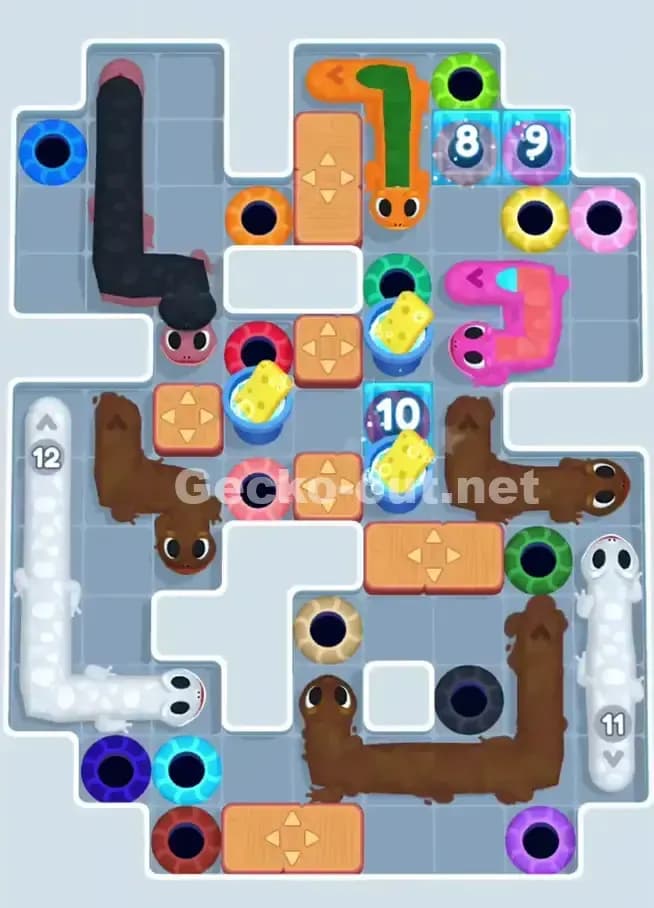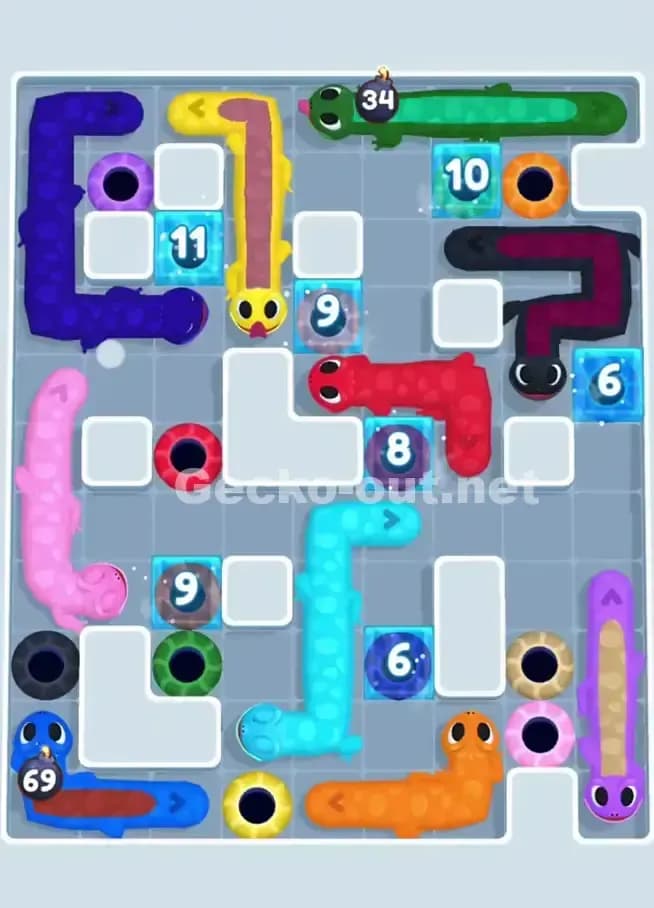
Gecko Out Level 1069 Solution Walkthrough | Gecko Out 1069 Answer
How to solve Gecko Out level 1069? Get step by step solution & cheat for Gecko Out level 1069. Solve Gecko Out 1069 easily with the answers & video walkthrough.
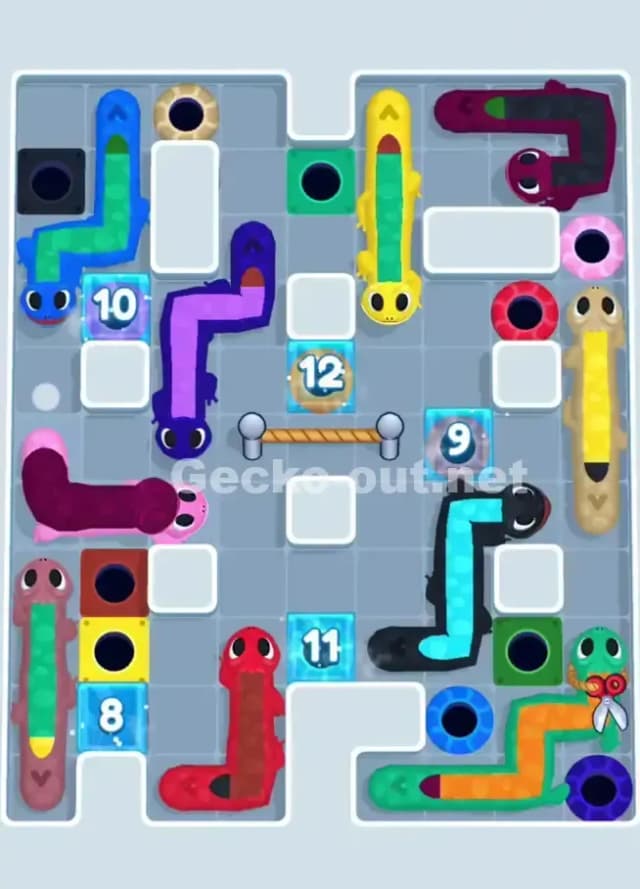
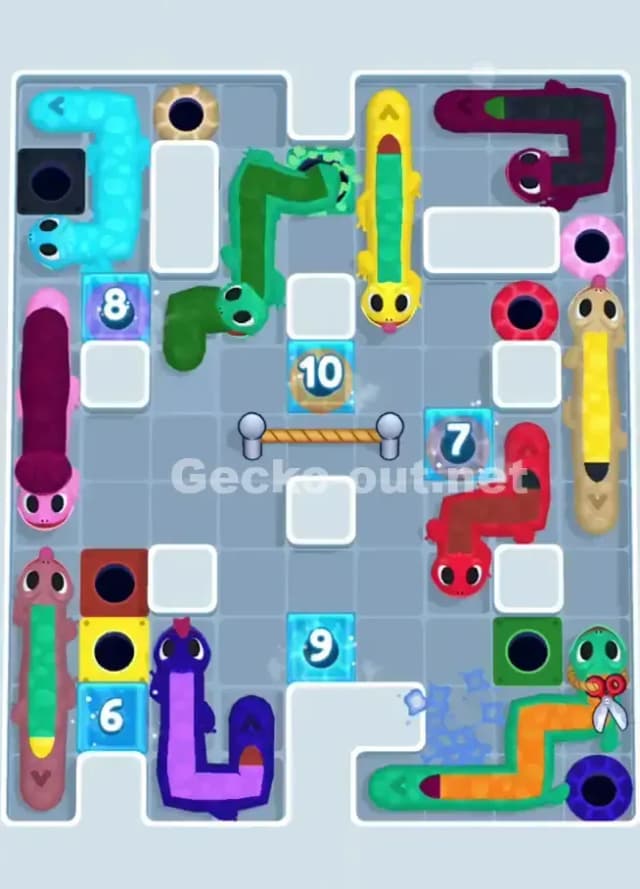

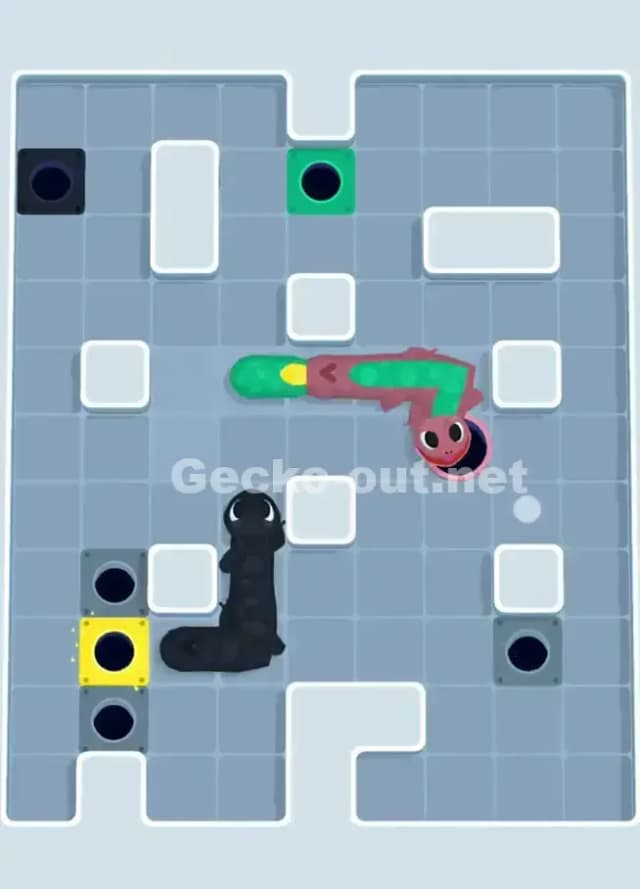
Gecko Out Level 1069: Board Layout, Rules, and Win Condition
Starting Board: Geckos, Colors, and Obstacles
Gecko Out Level 1069 is a densely packed puzzle with nine geckos—more than most standard levels—and the board is absolutely crammed with walls, obstacles, and tight corridors. You've got a blue gecko in the upper left, a yellow gecko dominating the center-right column, a purple gecko winding through the middle, a red gecko on the lower left and another in the center-bottom, a cyan gecko in the lower right, a pink gecko on the right side, and two or three smaller colored geckos tucked into corners. Each gecko has a matching colored hole somewhere on the board, and your job is to guide every single head to its exit before time runs out. The board itself is a maze of white blocking squares, narrow passages, and what appears to be some gang-linked geckos that move together as a unit. There's no room for sloppy pathing here—every drag counts.
Win Condition and Timer Pressure
To beat Gecko Out Level 1069, you must guide all nine geckos into their matching holes before the timer expires. The timer starts at a generous but firm countdown, and because you've got so many geckos to move, the clock becomes your silent antagonist. The drag-path mechanic means you can't just tap an exit; you have to physically trace a route from the head through the available grid squares, and the body will follow exactly that path. If a single gecko is still on the board when the timer hits zero, the level resets and you've got to start over. This setup means planning is absolutely essential—you can't afford to move geckos randomly and hope for the best.
Pathing Bottlenecks and Logical Traps in Gecko Out Level 1069
The Critical Bottleneck: The Yellow Gecko's Vertical Column
The single biggest bottleneck in Gecko Out Level 1069 is the yellow gecko occupying the central vertical column on the right half of the board. This gecko is long, it's blocking access to several other geckos' exit holes, and its body takes up prime real estate that other geckos need to traverse. If you don't move the yellow gecko early and decisively, you'll find yourself trapped: you can't route other geckos through that space without causing a collision, and the yellow gecko itself will become a wall that prevents progress. The yellow hole is on the upper part of that same column, which means you need to drag the yellow head upward, but the path is tight and surrounded by white blocking squares. This is your puzzle's crux.
Subtle Problem Spots: Gang Geckos and the Frozen-Exit Trap
The second major trap is the gang-linked geckos (if present on Gecko Out Level 1069). Gang geckos move together as a single unit, which means if you drag one head, you're actually moving multiple bodies at once. This can work in your favor if you plan it right, but it's a disaster if you drag too early. You need to confirm which geckos are linked before you start moving; otherwise, you'll accidentally drag three or four geckos at once and waste precious board space.
The third trap is visual: some holes or exits may appear blocked by white squares or may be accessible only from one specific angle. On Gecko Out Level 1069, there are several tight "approach corridors" where the only way into a hole is through a single narrow lane. If you route another gecko through that lane first, you've just locked the exit for good.
The Moment It All Clicks
Honestly, I found Gecko Out Level 1069 frustrating at first. I was moving geckos randomly, watching the timer tick down, and then suddenly realizing I'd created a gridlock in the center. But then it hit me: instead of thinking "move this gecko out," I started thinking "move this gecko to a safe holding area, then use its new position to unlock the exit for the next gecko." Once I embraced the sequencing—the idea that the order matters as much as the path—the level went from impossible to challenging-but-doable. That mental shift was everything.
Turn-by-Turn Path Strategy to Beat Gecko Out Level 1069
Opening: Secure the Yellow and Red Geckos First
Your opening move on Gecko Out Level 1069 should be to guide the yellow gecko to its hole in the upper-center area. Here's why: it's blocking the most traffic, and moving it first creates the most board freedom for every gecko that follows. Drag the yellow head upward through the available corridor, following the path around any white obstacles, and slip it into its matching hole. This should take 8–10 seconds and will immediately unlock critical pathing lanes for the other geckos. Once yellow is out, move to the red gecko on the lower-left side of the board. Red's path is relatively straightforward if yellow isn't in the way anymore, so guide it to the left or downward into its hole. Parking decisions: don't move the cyan, pink, or any small geckos yet. Let them sit and keep the board as open as possible while you work on the big blockers.
Mid-Game: Untangle the Purple and Blue Geckos, Then the Center Red
With yellow and the lower-left red out of the way, turn your attention to the purple gecko winding through the middle. The purple body is long and twisted, so you need to drag its head carefully to avoid looping it around other geckos or white squares. Trace a smooth path that doesn't cross itself or tangle with adjacent geckos. Once purple is heading toward its hole, move the blue gecko in the upper left. Blue's path should be relatively clear now, so guide it through its corridor and into its hole. Next, tackle the center-bottom red gecko. This is another long one, and it may be linked to other geckos, so confirm the gang status before dragging. If it moves alone, pull it toward its hole with a clear, deliberate path. Keep an eye on the timer here—you should have about 40–50 seconds left by this point.
End-Game: Pink, Cyan, and Small Geckos in Rapid Sequence
As the timer runs down below 40 seconds, you're entering the final phase of Gecko Out Level 1069. Move the pink gecko from the right side into its hole, then immediately guide the cyan gecko from the lower right. These two should be relatively simple because you've cleared most of the board clutter. Finally, handle any remaining small geckos (if present) in quick succession. Don't overthink the final three or four geckos; just confirm the path is clear and drag decisively. If you're suddenly low on time (below 15 seconds), resist the urge to panic—move slower and more deliberately rather than rushing and hitting a wall or creating a collision. A careful 10-second move beats a chaotic 5-second one that fails.
Why This Path Order Works in Gecko Out Level 1069
The Head-Drag Body-Follow Untangling Logic
The reason this sequence works is that it respects the fundamental mechanic: the body follows the head's exact path, but it can only occupy one grid square at a time. By moving the largest and most positionally disruptive geckos first (yellow, then red), you're removing obstacles rather than adding them. Each gecko you successfully exit frees up a lane that the next gecko can use. If you tried to move the small geckos first, they'd clog narrow corridors, and you'd find yourself unable to route the big geckos out. The sequencing turns a tangled knot into a linear problem you can solve step by step.
Timer Management: When to Pause and When to Commit
On Gecko Out Level 1069, you've got enough time to win, but not so much that you can afford to be wasteful. After you clear the first three geckos (yellow, lower red, and purple), pause for a moment and scan the remaining board. You're checking: Are there any gang-linked geckos I haven't identified? Are there any holes still blocked by white squares? Is there a gecko whose path I'm not 100% sure about? If you spot uncertainty, spend 5 extra seconds planning rather than moving blindly. Once the final four geckos are clearly pathable, commit and move quickly. Speed matters in the endgame, but accuracy matters more. A 3-second mistake costs you 10–15 seconds of board correction time, which you don't have.
Boosters: Optional, Not Mandatory
On Gecko Out Level 1069, boosters like extra time or hints are available but not required if you follow this strategy. If you're attempting the level for the first time, a "hint" booster might help you identify gang-linked geckos or the exact approach angle for a tricky hole—that's a reasonable use case. An "extra time" booster is purely a safety net; if you execute the sequence perfectly, you won't need it. Avoid using a hammer or explosion tool unless you're truly stuck in a physical collision that can't be undone by restarting. The real solution to Gecko Out Level 1069 is strategy, not brute-force boosters.
Mistakes, Fixes, and Logic You Can Reuse in Other Gecko Out Levels
Five Common Mistakes on Gecko Out Level 1069 and How to Fix Them
Mistake #1: Moving small geckos before big ones. Small geckos clutter narrow lanes and trap large geckos. Fix: Always move the longest, most spatially disruptive geckos first. Prioritize by size and board centrality, not by color or arbitrary preference.
Mistake #2: Dragging a path that crosses itself or wraps around another gecko. The body follows the head's exact route, so a self-intersecting path creates a collision. Fix: Trace your finger along the intended path before you drag. Confirm it doesn't loop or overlap with another gecko's current body.
Mistake #3: Assuming all exits are accessible from all angles. Some holes are accessible only from one specific direction due to surrounding white squares. Fix: Before you commit to a path, visually confirm the hole's entry corridor. If you can't clearly see an open lane into the hole, the gecko can't reach it.
Mistake #4: Moving gang-linked geckos before you've identified the gang. Dragging one gecko and discovering it's part of a group mid-drag wastes time and board space. Fix: Scan the board at the start and identify any geckos that appear to be touching or linked visually. Treat them as a single unit until they separate.
Mistake #5: Panicking when the timer drops below 30 seconds. Panic leads to careless drags and mistakes that cost you 20+ seconds of recovery time. Fix: If you're running low on time with just two or three geckos left, slow down, take a breath, and execute deliberate, correct moves rather than rushed wrong ones.
Reusing This Logic on Similar Levels
This strategy scales beautifully to other Gecko Out levels with high gecko counts, narrow corridors, or gang-linked mechanics. Whenever you face a densely packed board, apply the same principle: size and position first, then fill in the rest. Move long or central geckos before small or peripheral ones. If a level has frozen exits or toll gates, identify those constraints upfront and plan backward from the exits rather than forward from the starting positions. Gang-gecko mechanics appear on many mid-to-high-level puzzles, and the fix is always the same: identify the gangs, treat each as a single unit, and move the entire gang together to avoid wasting repositioning moves.
You've Got This
Gecko Out Level 1069 is genuinely tough—nine geckos, narrow corridors, and a unforgiving timer add up to a real brain-teaser. But it's absolutely beatable with a clear plan and deliberate execution. You're not relying on luck or trial-and-error; you're using logic to untangle a knot one step at a time. Trust the sequence, manage your time, and remember that the gecko that seems most annoying to move first is almost always the one you should move first. Good luck!