Gecko Out Level 1087 Solution Walkthrough | Gecko Out 1087 Answer
How to solve Gecko Out level 1087? Get step by step solution & cheat for Gecko Out level 1087. Solve Gecko Out 1087 easily with the answers & video walkthrough.




Gecko Out Level 1087: Board Layout, Rules, and Win Condition
Starting Board: Geckos, Colors, and Key Obstacles
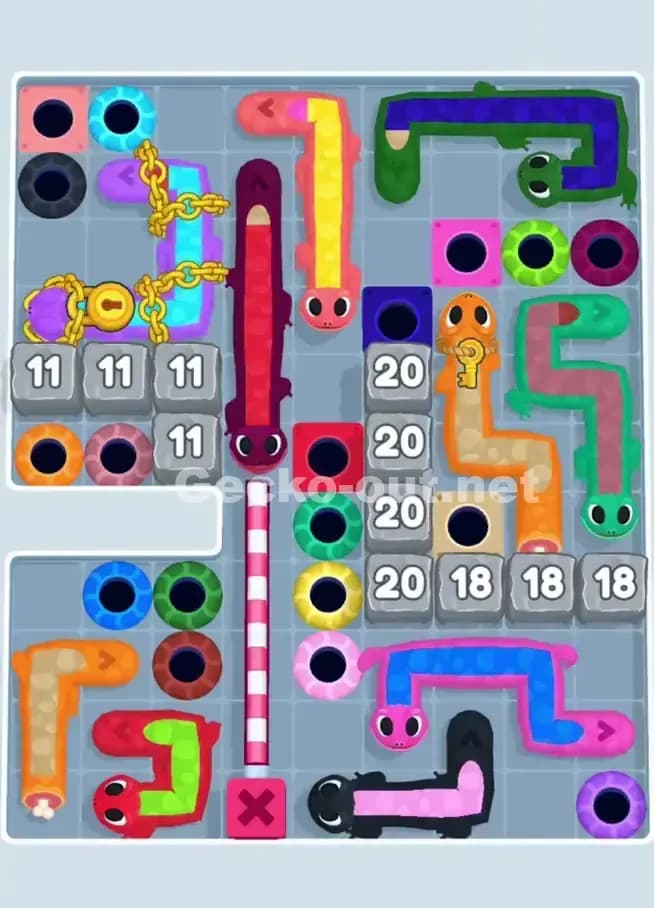
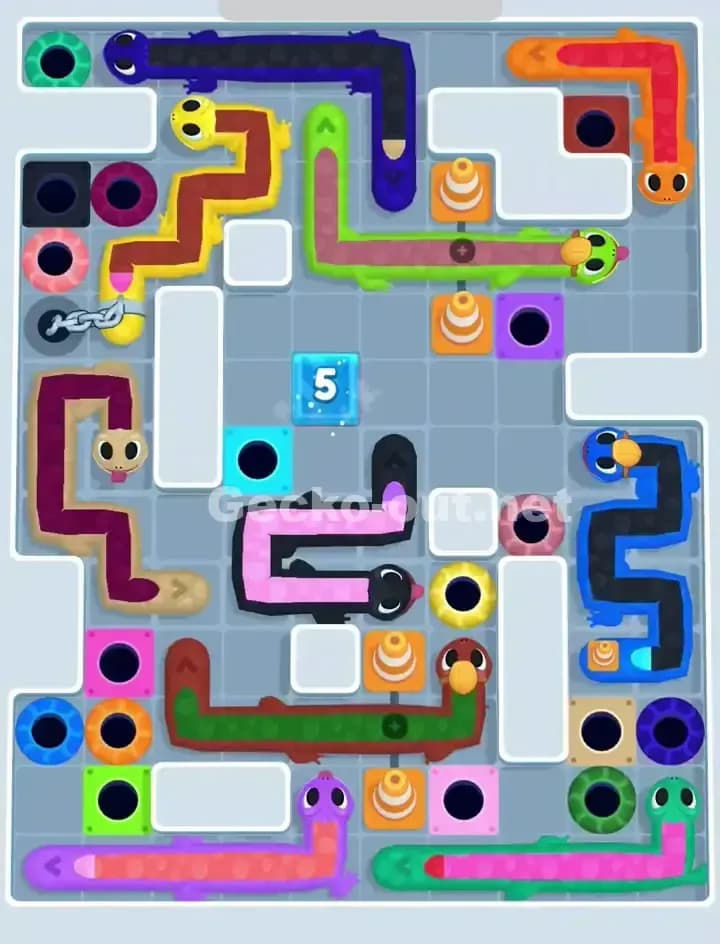
Gecko Out Level 1087 is a densely packed puzzle with eight geckos spread across the board, each needing to reach a matching-colored exit hole. You've got pink, orange, blue, green, red, and yellow geckos all competing for space on a relatively tight grid. The board is crammed with white wall blocks that create narrow corridors, and there are several toll gates (those rope-and-peg obstacles) that add extra complexity. What makes Gecko Out 1087 particularly tricky is that some geckos are quite long—especially the orange and pink ones—which means their bodies take up serious real estate as you drag them toward their exits. The exits themselves are positioned in the corners and edges of the board, so you're not just solving a puzzle; you're managing a traffic jam where every move either opens or closes a critical lane.
Win Condition and Timer Pressure
To beat Gecko Out Level 1087, all eight geckos must reach their matching-colored holes before the timer runs out. The timer is your silent enemy here—it's not brutally short, but it's short enough that you can't afford to waste moves or get stuck in a loop. The drag-path mechanic means that once you commit to a route, the gecko's body follows exactly where you've drawn, so if you make a mistake mid-drag, you might trap another gecko or block an exit. This is why planning your path order is absolutely critical in Gecko Out 1087. You can't just randomly drag geckos out; you need a sequence that keeps lanes open and prevents the board from becoming a tangled mess.
Pathing Bottlenecks and Logical Traps in Gecko Out Level 1087
The Central Corridor Bottleneck
The biggest bottleneck in Gecko Out Level 1087 is the central corridor running through the middle of the board. Multiple geckos need to pass through or near this area to reach their exits, and the white walls create a narrow choke point that only one gecko can really occupy at a time. The blue gecko, in particular, is sitting right in the middle of this corridor, and its long body is a major obstacle. If you don't move the blue gecko early and efficiently, you'll find yourself unable to route other geckos without them colliding with it or getting stuck behind its body. This is the single biggest knot you need to untangle first in Gecko Out 1087.
Subtle Problem Spots: Toll Gates and Long Bodies
The toll gates (those rope-and-peg obstacles) scattered around the board add a secondary layer of complexity. They don't block movement, but they do force you to be precise about your pathing—you can't just drag a gecko through them carelessly. Additionally, the orange gecko on the left side is incredibly long, and its exit is in the bottom-left corner. Getting that gecko out without its body wrapping around and blocking other paths is a puzzle within the puzzle. Finally, the pink gecko in the lower-middle area is also quite lengthy, and its exit is on the right side of the board. You'll need to carefully choreograph when to move it so that its body doesn't act as a barrier for the red and green geckos trying to escape on the right side.
The Moment It Clicked
Honestly, when I first looked at Gecko Out Level 1087, I felt that familiar frustration—too many geckos, too many walls, and the timer ticking away. But then I realized that the solution wasn't about moving every gecko as fast as possible; it was about moving them in a specific order that kept the board "open." Once I identified that the blue gecko had to go first and that the orange gecko needed to be routed early to clear the left side, the rest of the puzzle started to make sense. It's one of those levels where the difficulty isn't in the individual moves—it's in seeing the right sequence.
Turn-by-Turn Path Strategy to Beat Gecko Out Level 1087
Opening: Clear the Central Corridor First
Start by moving the blue gecko out of the central corridor. Drag its head toward its exit (the dark blue hole in the upper-middle area), being careful to navigate around the white walls and toll gates. This move is critical because it immediately opens up the middle of the board for other geckos. While the blue gecko is moving, you're essentially "parking" it in its exit, which removes a major obstacle. Next, tackle the orange gecko on the left side. Drag it down and around toward the bottom-left exit. This is a long gecko, so take your time and make sure its body doesn't wrap around and block the pink gecko's path. By clearing these two early, you've opened up roughly 40% of the board's usable space.
Mid-Game: Reposition and Maintain Open Lanes
Once the blue and orange geckos are out, focus on the pink gecko. It's long and positioned in the lower-middle area, and its exit is on the right side. Drag it carefully to the right, making sure it doesn't collide with the red gecko or block the green gecko's path. The key here is to move the pink gecko in a way that actually creates space rather than consuming it. After the pink gecko is out, you should have a much clearer board. Now move the red gecko (which is on the right side) toward its exit. The red gecko is shorter, so it's more maneuverable, but you still need to be mindful of the toll gates and white walls. Then tackle the green gecko, which should have a relatively clear path by this point. The yellow gecko (in the upper-right corner) is small and easy, so save it for later when you're confident about the board state.
End-Game: Final Geckos and Avoiding Last-Second Choke Points
By the time you're down to the last three or four geckos, the board should be significantly less crowded. Move the remaining geckos in order of their proximity to their exits—prioritize the ones that have the shortest, clearest paths. The yellow gecko is tiny and quick, so it's a good candidate for near the end. The pink and red geckos on the left side should be among the last to go, as they're furthest from their exits and require the most careful routing. Keep an eye on the timer; if you're running low on time, don't panic. Instead, take a breath, identify the gecko with the clearest path to its exit, and move that one next. Speed comes from confidence, not from rushing.
Why This Path Order Works in Gecko Out Level 1087
Head-Drag Pathing and the Body-Follow Rule
The reason this sequence works is rooted in how the drag-path mechanic functions in Gecko Out Level 1087. When you drag a gecko's head, its body follows the exact route you've drawn. This means that if you move a long gecko early, its body occupies space that would otherwise be available for other geckos to navigate through. By moving the longest geckos first (blue, orange, pink), you're essentially "clearing the board" of the biggest obstacles. The shorter geckos can then navigate through the remaining space without getting tangled up. This is the opposite of what many players instinctively do—they try to move the closest gecko to its exit first, which often leaves long geckos stranded in the middle of the board, blocking everyone else.
Timer Management: Pause and Commit
In Gecko Out Level 1087, the timer is generous enough that you can afford to pause for a few seconds and really study the board before making your next move. I recommend pausing after every two or three gecko exits to reassess the board state and identify the next best move. This prevents the panic-driven mistakes that come from moving too quickly. Once you've identified your next target gecko and planned its route, commit to the move and execute it smoothly. Don't second-guess yourself mid-drag; that's when mistakes happen.
Booster Strategy: Optional but Helpful
Gecko Out Level 1087 is absolutely beatable without boosters if you follow this strategy. However, if you find yourself with only one or two geckos left and the timer is getting dangerously low, an extra-time booster can be a lifesaver. I'd recommend treating boosters as a safety net rather than a crutch. If you're consistently failing Gecko Out 1087 with less than 10 seconds remaining, then consider using an extra-time booster on your next attempt. But if you're failing because your path order is wrong, no booster will save you—you need to rethink your strategy.
Mistakes, Fixes, and Logic You Can Reuse in Other Gecko Out Levels
Common Mistakes and How to Fix Them
Mistake 1: Moving the closest gecko first. Many players see a gecko that's already near its exit and move it immediately. In Gecko Out Level 1087, this often leaves long geckos stranded in the middle, blocking everyone else. Fix: Always identify the longest geckos first and move them early, regardless of how close they are to their exits.
Mistake 2: Not accounting for body length during pathing. Players often drag a gecko's head toward an exit without considering where its body will end up. In Gecko Out 1087, this can result in the gecko's body blocking another gecko's only viable path. Fix: Before you drag, trace the entire path mentally and imagine the gecko's body following that route. Make sure the body won't block any critical lanes.
Mistake 3: Rushing through toll gates. The rope-and-peg obstacles in Gecko Out 1087 require precise pathing. Dragging a gecko through them carelessly can result in the gecko getting stuck or its body wrapping around the obstacle in an unhelpful way. Fix: Slow down when approaching toll gates and drag carefully around them, not through them.
Mistake 4: Ignoring the timer until it's too late. Players often get so focused on solving the puzzle that they don't notice the timer creeping down. In Gecko Out 1087, this can result in a last-second failure even though the solution was correct. Fix: Glance at the timer every 30 seconds or so. If you're below 20 seconds and still have more than two geckos left, speed up your execution.
Mistake 5: Trying to move multiple geckos simultaneously. Some players think they can save time by planning multiple gecko routes at once. In Gecko Out 1087, this almost always results in miscalculations and collisions. Fix: Move one gecko at a time, confirm it's safely in its exit, and then move on to the next one.
Reusing This Logic on Similar Levels
This strategy—prioritizing long geckos, maintaining open lanes, and managing the timer carefully—is directly applicable to other Gecko Out levels with similar characteristics. Any level with multiple long geckos, narrow corridors, and toll gates will benefit from this approach. The key principle is that you're not just solving a puzzle; you're managing a traffic flow. By moving the biggest obstacles first, you create space for the smaller, more maneuverable geckos to navigate freely. This logic works on gang-gecko levels (where geckos are linked together) and frozen-exit levels (where exits are temporarily blocked) as well, because the underlying principle remains the same: clear the board strategically, don't rush, and always think two moves ahead.
Final Encouragement
Gecko Out Level 1087 is genuinely tough, but it's absolutely beatable with a clear plan and a bit of patience. The puzzle isn't designed to be impossible; it's designed to reward careful thinking and strategic sequencing. Once you nail this level, you'll have developed a problem-solving approach that carries over to dozens of other challenging Gecko Out levels. You've got this—take a deep breath, follow the strategy, and watch those geckos escape one by one.