
Gecko Out Level 768 Solution Walkthrough | Gecko Out 768 Answer
How to solve Gecko Out level 768? Get step by step solution & cheat for Gecko Out level 768. Solve Gecko Out 768 easily with the answers & video walkthrough.

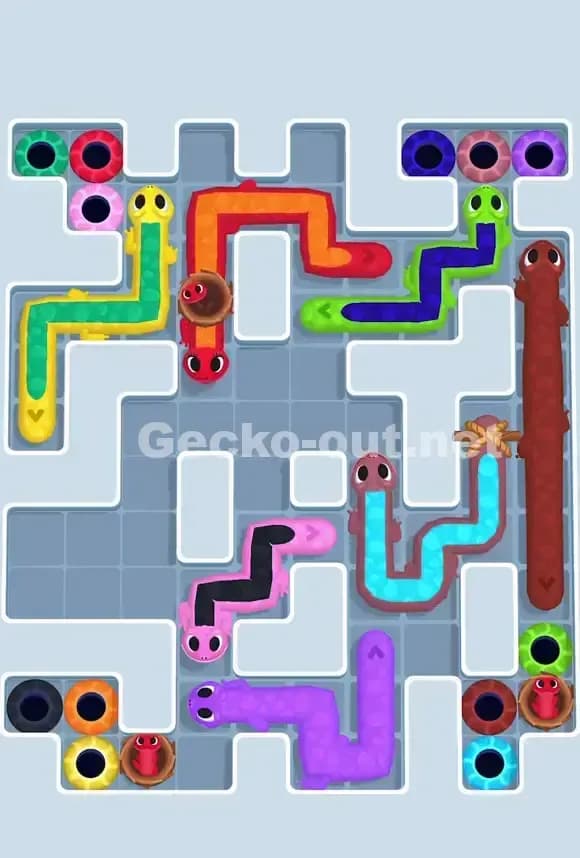
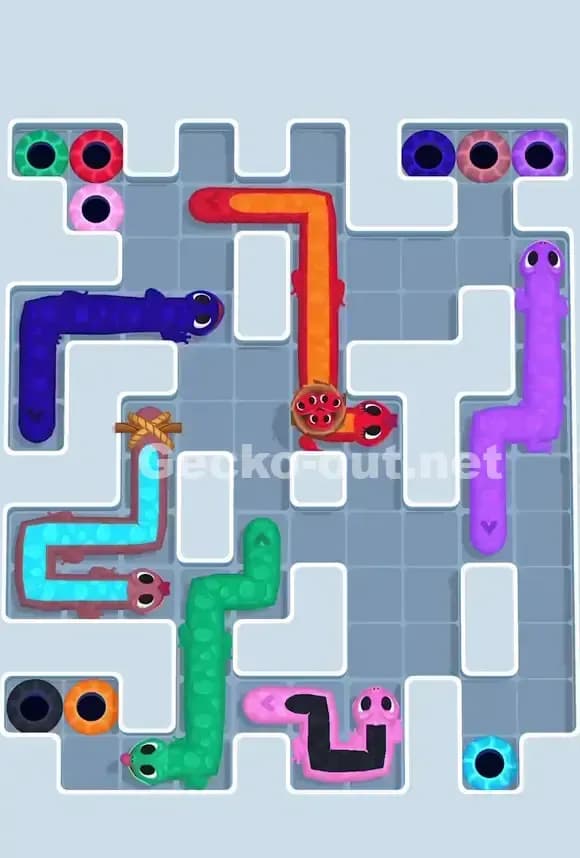
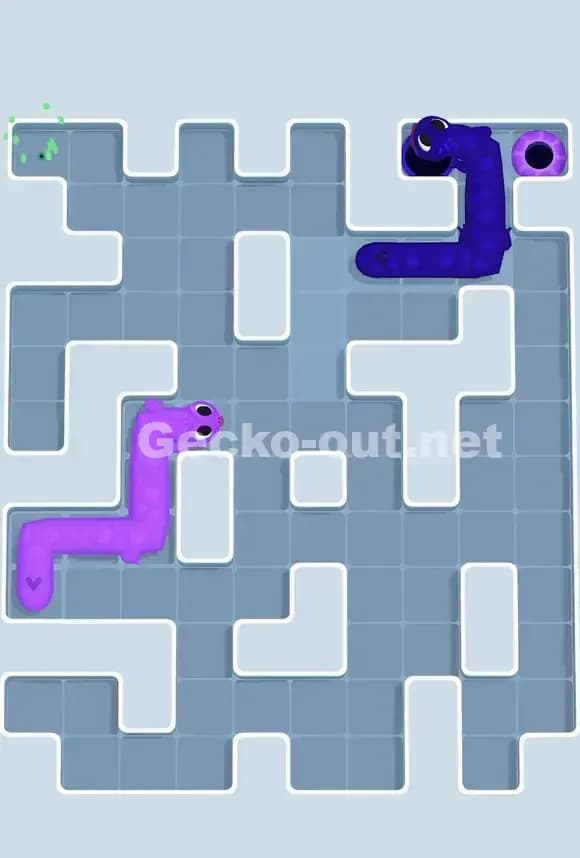
Gecko Out Level 768: Board Layout, Rules, and Win Condition
Starting Board: Geckos, Colors, and Obstacles
Gecko Out Level 768 is a multi-gecko puzzle that demands careful spatial planning. You're working with nine distinct geckos spread across the board in various colors: cyan, green, pink, red, orange, yellow, blue, and purple. Each gecko has its matching colored exit hole somewhere on the grid, and your job is to drag each head through the maze-like corridors without letting their bodies collide with walls, other geckos, or obstacles. The board itself is crammed with tight corridors, narrow choke points, and several locked or warning exits that'll trap you if you're not paying attention. You'll notice colored pathways carved into the gray stone—these are guide tracks that hint at intended routes, but they're not mandatory; your actual path is determined entirely by where you drag the gecko's head. There are also decorative booster items (hammers and warning signs) scattered around, suggesting this is a moderately advanced level.
Win Condition and Timer Pressure
To win Gecko Out Level 768, all nine geckos must exit their matching holes before the timer runs out. The timer is your silent enemy here—you get a limited window to orchestrate this entire exodus, which means hesitation and backtracking will cost you dearly. The challenge isn't just finding one correct path per gecko; it's sequencing them in an order that prevents gridlock. If two geckos try to occupy the same space or if a body gets stuck behind a wall because you routed it poorly, that's a failure. The body always follows the exact path you dragged the head through, so every pixel matters. This mechanic creates cascading dependencies: moving one gecko might open or block the route for another, meaning you need to think several steps ahead before you even place your first drag.
Pathing Bottlenecks and Logical Traps in Gecko Out Level 768
The Central Corridor Chokepoint
The biggest bottleneck in Gecko Out Level 768 is the vertical blue corridor in the upper-center portion of the board. This narrow passage is the only viable route for several geckos to reach their exits, and if you route a long-bodied gecko (or worse, a gang-linked pair) through it first without clearing space afterward, you'll jam up the entire mid-game flow. The blue gecko itself occupies part of this corridor, so you're already competing for real estate. I'd strongly recommend routing the blue gecko out early—within your first three moves—so that other geckos can use this critical hallway without stepping over its body.
Subtle Trap: The Cyan Gecko's Left-Side Loop
The cyan gecko on the far left looks straightforward at first glance; you might think dragging it down and around to its exit on the bottom-left is simple. But here's the gotcha: if you commit to that path too early, you're blocking the lower-left choke point for the yellow and red geckos that also need to exit near that corner. The cyan path is actually one of the last routes you should complete, not one of the first. It's easy to miss this dependency on your first attempt.
Trap: The Pink Gecko's Vertical Run
The pink gecko needs to drop straight down through a narrow corridor to reach its exit at the bottom-center. However, the orange and red geckos also need space in that general area. If you route pink first, its body will linger in that corridor and block orange's path entirely. You need to get orange and red out of the way before committing pink to its descent.
Personal Reaction and the Breakthrough Moment
Honestly, my first two attempts on Gecko Out Level 768 felt like I was solving a Rubik's Cube blindfolded. I kept routing geckos one by one, watching the timer tick down, and then hitting a wall where two geckos wanted the same corridor. The frustration hit hard around the six-second mark when I realized I'd boxed myself in. But then it clicked: instead of thinking "which gecko exits next," I started thinking "which gecko can I move safely to clear space for others?" That shift in perspective turned the chaos into a logical sequence. Gecko Out Level 768 became less about panic routing and more about recognizing the dependency chain.
Turn-by-Turn Path Strategy to Beat Gecko Out Level 768
Opening: Clear the Blue Gecko and Green Gecko First
Start by dragging the blue gecko (upper-center area) up and around through its dedicated blue pathway toward the top-right exit. This should take about 3–4 seconds and immediately frees up that critical central corridor. Don't overthink this route; the blue colored path on the board is a visual hint that this is the intended way out. Once blue is gone, move to the green gecko on the far left side. Route it down the green-marked corridor and out through the left-side exit. This opens up the lower-left quadrant significantly. These two moves should happen in your first 10 seconds, and they'll dramatically reduce board congestion. Park any geckos you haven't moved yet in their current positions; don't drag them unnecessarily.
Mid-Game: Manage the Red-Orange-Yellow Cluster
Now you're facing the densest knot: the red gecko (center), orange gecko (center-lower), and yellow gecko (bottom-right) are all in tight proximity with overlapping corridor needs. Route the orange gecko first by dragging it down and slightly left toward the bottom-center area, then up into its orange exit hole on the lower-right. This removes a physical blocker. Next, drag the red gecko through the middle corridor toward its red exit on the bottom-right side. Don't try to use the same corridor as orange; find an alternate path that loops around the central white walls. The yellow gecko should stay put for now—its exit on the bottom-right will be accessible once orange and red have evacuated. Keep the timer in mind: you should be around the 30-second mark by now, with at least five geckos still on the board. That's fine; you have room to breathe, but not much.
End-Game: Exit Pink, Cyan, and Purple in Sequence
Once red and orange are out, drag the yellow gecko down its straightforward path to the bottom-right exit. This should be a quick 2-3 second move. Now tackle the pink gecko by routing it down the vertical pink corridor toward its exit at the bottom-center. Be precise here; there's limited wiggle room. Follow with the cyan gecko, which now has a clear path around the left side to its bottom-left exit. Finally, drag the purple gecko (top-right) through its purple corridor toward the top-right exit. The purple route is fairly open by this stage, so it's an easy final move. If you're executing cleanly, you should finish Gecko Out Level 768 with 5–10 seconds remaining on the timer.
Why This Path Order Works in Gecko Out Level 768
How Body-Follow Pathing Untangles the Knot
The key insight for Gecko Out Level 768 is that every gecko's body occupies grid space for several seconds after you move it. Unlike games where units disappear instantly, here the body lingers as an obstacle. By removing blue and green early, you're erasing two long "obstacles" from the board, which mathematically shrinks the collision space for everyone else. The remaining geckos have more room to snake around without bumping into each other. When you then sequence red, orange, and yellow in that specific order, you're always moving the gecko whose exit is most constrained first, freeing up the less-constrained exits for later. This is a classic topological sort: identify dependencies and process the most-dependent items first.
Reading the Board vs. Committing to Speed
Gecko Out Level 768 rewards a brief pause before your first drag. Spend 3–5 seconds scanning the board, mentally tracing two or three gecko routes, and identifying the bottleneck corridor (that blue one). Once you've got the mental model locked, commit. Don't pause between moves—drag blue, drag green, drag orange in quick succession. Hesitation wastes timer, but thoughtless rushing wastes the solution. The sweet spot is "confident and continuous" after an initial 5-second plan phase. If you find yourself stuck mid-game, that's usually a sign you made a routing error early on, not that the plan was wrong; restart and execute the sequence more precisely.
Booster Strategy: Optional, Not Required
Gecko Out Level 768 does not require boosters if you execute the sequence perfectly. However, if you're learning the level, consider using a +10 seconds booster around the 15-second mark if you're still managing cyan or purple. This buys you a safety margin without changing the strategy. The hammer tools scattered on the board are red herrings for this level; there are no frozen exits or locked gates that demand them. Save boosters for when you actually mess up, not preemptively. A clean run of Gecko Out Level 768 is entirely possible without spending any boosters, and that's the real victory.
Mistakes, Fixes, and Logic You Can Reuse in Other Gecko Out Levels
Mistake 1: Routing a Long Gecko Through a Shared Corridor First
The Fix: Always move shorter geckos or geckos whose exits are "off the main path" first. In Gecko Out Level 768, blue is relatively compact compared to the red-orange-yellow trio, so it exits first. On similar levels, apply this principle universally.
Mistake 2: Not Recognizing the Bottleneck Until You're Stuck
The Fix: Before touching anything, spend 10 seconds identifying the single narrowest corridor or intersection on the board. That's your critical zone. Plan to clear it early and protect it fiercely. For Gecko Out Level 768, that's the central blue corridor.
Mistake 3: Assuming Colored Pathways Are Mandatory Routes
The Fix: Colored pathways are suggestions, not rails. You can deviate from them if it helps avoid collisions. On Gecko Out Level 768, the blue gecko's route naturally follows the blue path, but if you found a safer alternate, it'd be valid. Don't get locked into visual cues.
Mistake 4: Dragging a Gecko Partway, Pausing, and Then Continuing
The Fix: Drag from start to exit in one continuous motion. Pausing lets the timer burn and increases the chance you'll second-guess yourself and mis-drag. Gecko Out Level 768 punishes hesitation; commit to each drag fully.
Mistake 5: Forgetting About Body Collision With Walls
The Fix: The head can fit into tight spaces, but the body trail behind it needs clearance. Test your mental path by imagining the gecko's full length as it travels. On Gecko Out Level 768, the narrow cyan corridor at the bottom-left requires a careful drag to avoid the body clipping a wall; many players fail here on a second attempt because they don't account for body thickness.
Reusable Logic for Similar Levels
Any Gecko Out level with multiple geckos in a maze benefits from this approach: (1) Map the bottlenecks, (2) Sort geckos by exit constraint (most constrained first), (3) Execute continuously without pausing, and (4) Always think about body collision space, not just head space. Levels with frozen exits or gang-linked geckos add complexity, but the core principle—clear obstacles before they become problems—remains universal.
Final Encouragement
Gecko Out Level 768 is tough, no question. It's the kind of puzzle that makes you feel stuck for your first two attempts and then feels obvious on the third once you've spotted the sequence. The good news? You're absolutely capable of beating it with a clear plan and a bit of confidence. The sequence I've outlined works reliably, and the timer is generous enough to reward clean execution without demanding pixel-perfect perfection. Trust the strategy, commit to your drags, and Gecko Out Level 768 will fall. You've got this.