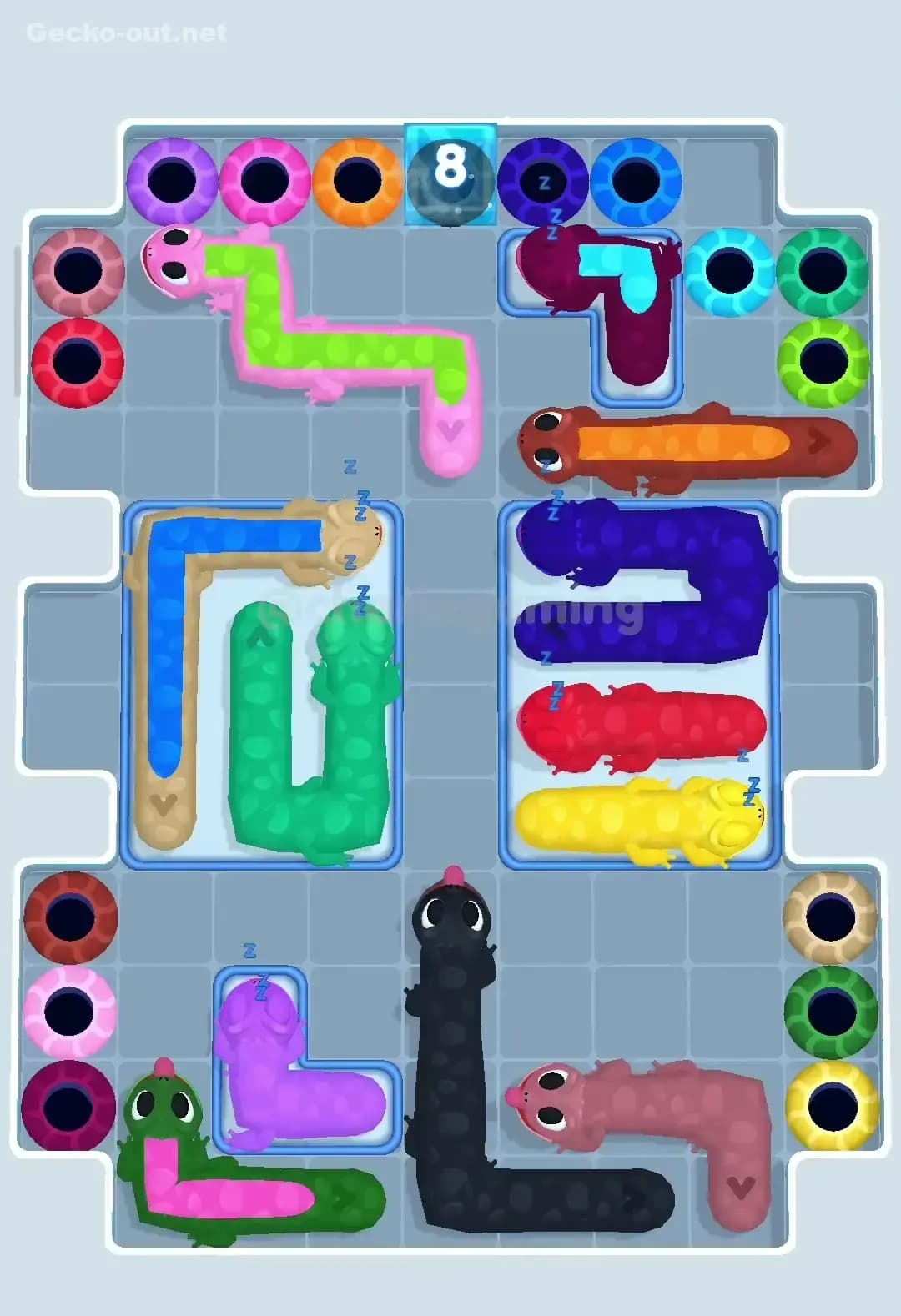
Gecko Out Level 281 Solution Walkthrough | Gecko Out 281 Answer
How to solve Gecko Out level 281? Get step by step solution & cheat for Gecko Out level 281. Solve Gecko Out 281 easily with the answers & video walkthrough.


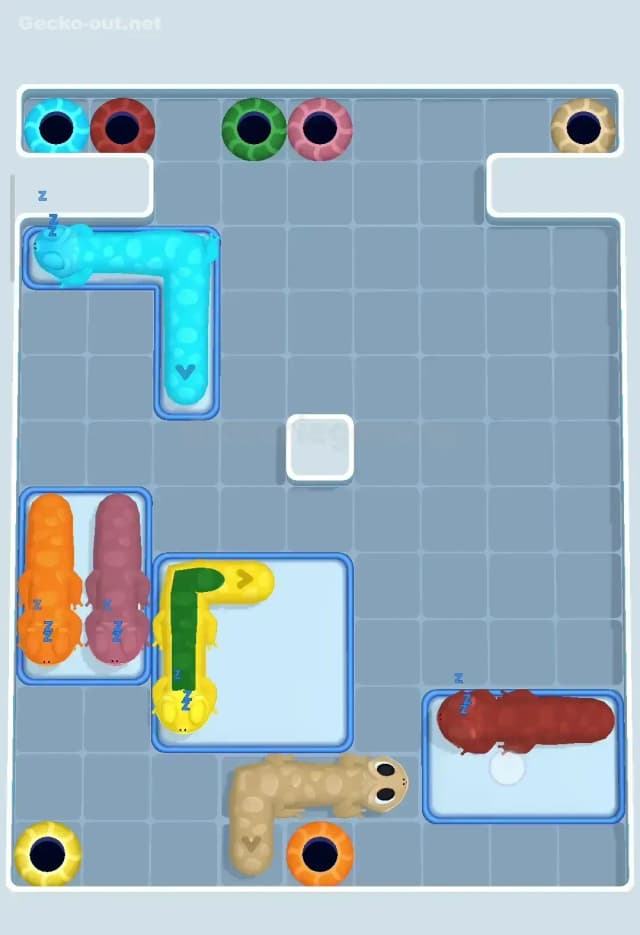
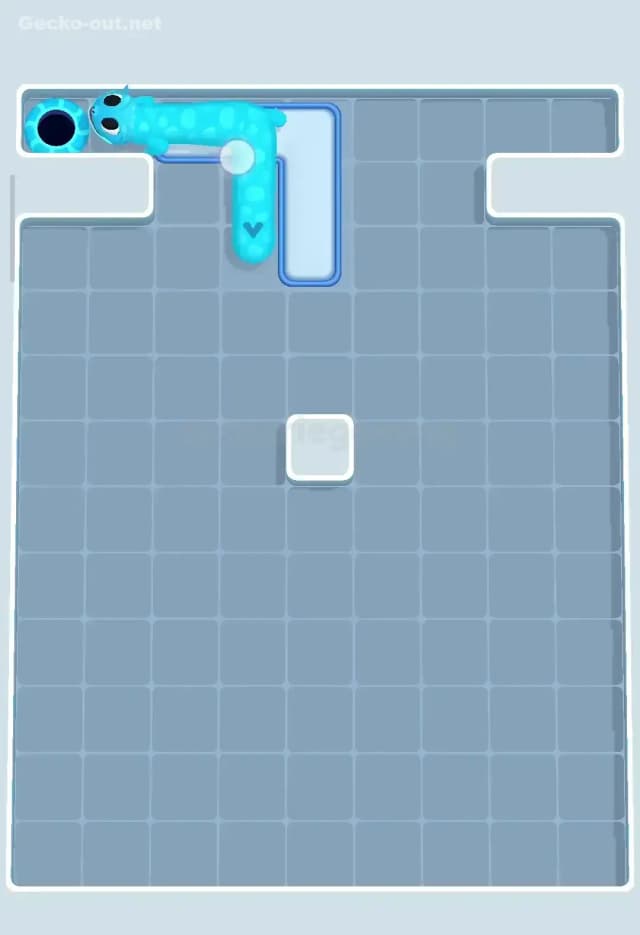
Gecko Out Level 281: Board Layout, Rules, and Win Condition
Starting board: a frozen knot with two active geckos
In Gecko Out Level 281 you start with a huge clump of sleeping geckos packed into icy trays in the middle and lower half of the board. Almost everything is frozen in place except:
- A red L‑shaped gecko on the upper left side.
- A tall purple gecko stretched along the upper right wall.
Between the frozen blocks you see two grey tiles with a “6” on them. Treat these as counter gates: each time a gecko escapes, the number drops, and when it hits zero the gate disappears. Those gates divide the board so the lower frozen pack can’t easily mingle with the upper area at the start.
There’s also a white button tile roughly in the center. That button is your key: once you path a gecko over it, the sleeping geckos thaw and become movable. Exits ring the top and bottom edges, each color‑matched to a gecko: red, purple, cyan, green, yellow, orange, pink, dark blue, black, etc. Because the geckos are long and coiled inside trays, getting them out without blocking those exits is the real puzzle of Gecko Out 281.
Win condition and how the timer changes the puzzle
To beat Gecko Out Level 281, every gecko has to slither into a hole of the same color before the timer hits zero. If one is still on the board when time runs out, you fail, even if it’s inches away from its exit.
Movement is drag‑based: you grab a head and draw a path. The body then traces that exact route. That means:
- Any detour you draw becomes a permanent snake of body segments.
- If you zigzag a long gecko through the middle, you might permanently block another gecko’s future path.
Because of the strict timer, you can’t brute‑force paths and undo constantly. You need a plan that minimizes unnecessary looping and keeps central corridors clean so you’re not wrestling with body traffic in the last seconds.
Why Gecko Out 281 feels so punishing
Gecko Out Level 281 stacks several mechanics at once:
- Long, awkward L‑ and U‑shaped geckos in tight ice trays.
- Counter gates that only open after multiple escapes.
- A central button that you must hit before most of the level even “starts.”
You’re juggling timing (for the gates and the overall timer), space (not blocking exits), and sequence (who escapes when). That’s why the level feels overwhelming at first glance—but once you respect those constraints, it becomes a very tidy logic puzzle.
Pathing Bottlenecks and Logical Traps in Gecko Out Level 281
The main bottleneck: the central corridor
The single biggest bottleneck in Gecko Out 281 is the narrow central corridor that runs around the white button and between the two “6” tiles. Almost every late‑game gecko needs to pass through that area to reach the correct exit.
If you let the red or purple gecko sprawl across this corridor early, the thawed middle and bottom geckos will have no clean line to the top exits. You’ll end up trying to thread long bodies through tiny gaps, and that’s how runs die with one gecko stuck.
So the rule: during the whole level, keep that central lane as straight and empty as possible.
Subtle traps that waste runs
I’ve seen Gecko Out Level 281 fall apart in a few sneaky ways:
-
Parking red in front of top exits. If you drag red horizontally under the top row, it blocks multiple holes that late‑game geckos need. It looks safe at first but becomes a disaster when you’re trying to send a thawed gecko up.
-
Spiraling purple around the button. It’s tempting to make purple do a big loop to hit the button then wrap back to its exit. That “pretty” path turns into a solid wall of purple body segments.
-
Exiting tiny geckos too late. The little yellow and green geckos in the center pack are perfect for threading through tight spots early. If you leave them for last, the long geckos will already be blocking the narrow routes they needed.
When the solution starts to make sense
For me, Gecko Out Level 281 clicked the moment I treated red and purple as temporary tools, not just “geckos I need to free.” Once I started:
- Using them to press the button quickly,
- Parking them along the outer edges,
- And saving the fattest middle geckos for last,
the chaos suddenly turned into a clean sequence of exits. You’ll feel that same shift once you look at every move as “Will this leave the center open later?” instead of “Can I reach my exit right now?”
Turn-by-Turn Path Strategy to Beat Gecko Out Level 281
Opening: first moves and safe parking
Use this opening every time you start Gecko Out 281:
-
Move purple to hit the button.
Drag purple left and slightly down so it passes over the central white button, then park it snug along the upper-right wall or down the right edge. Keep its body hugging the border; don’t snake it across the middle. -
Reposition red to the left wall.
Nudge red down and/or left so it lies mostly against the upper-left and left edges. You want red out of the way of the top exits. Avoid paths that run red horizontally across the board. -
Do NOT exit red or purple yet (unless they’re in the way).
Leaving them parked keeps options open and buys you time to plan how the newly thawed geckos will leave.
Once the button is pressed, all the sleeping geckos in the trays wake up, and Gecko Out Level 281 really begins.
Mid-game: opening lanes and working the counter gates
Now your goal is to clear space while ticking down those “6” gates:
-
Free the shortest geckos first.
Start with the tiny yellow and green geckos in the central tray. Thread them through the gaps to the nearest matching exits. Their bodies are small, so they won’t clog things. -
Use bottom exits early.
The orange and pink geckos in the lower-left tray, plus the blue/black pair in the lower-right tray, all have bottom exits nearby. Route them out with tight, direct paths. Each exit reduces the counters and empties the bottom zone. -
Keep the center corridor vertical.
When guiding these mid-game escapes, hug walls and tray edges. Try to draw paths that go straight up or straight down through the middle, avoiding sideways zigzags that carve wide purple/orange/yellow walls. -
Let the counter gates pop before moving the huge Ls.
As you free geckos, those “6” tiles drop. Once a gate disappears, you get a fresh route either between the middle and bottom or between the middle and right side. That’s when you start moving the long cyan, lime green, and burgundy L‑shaped geckos.
End-game: long geckos and exit order under pressure
The end-game of Gecko Out Level 281 is where most runs die, so follow a strict order:
-
Clear any gecko already aligned with its exit.
If a long gecko is basically pointing at its hole with just one clean path, take that exit immediately. Don’t overthink it. -
Handle the huge L‑shapes from outside in.
Usually the safest order is: cyan → lime green → burgundy/purple/red (whichever is still left). Each one should trace a path that hugs an outer border, leaving a central line free for whoever remains. -
Exit red and purple last if possible.
Because you parked them on the outer walls, they can usually slide into their top exits with one final simple path once everyone else is gone. -
Low on time? Go for the simplest success, not the prettiest path.
If the timer is flashing and you have two geckos left, pick the one with the cleanest, most direct route—even if that leaves a slightly ugly corridor for the final gecko. You only need one workable path, not a perfect pattern.
Why This Path Order Works in Gecko Out Level 281
Using body-follow to untangle instead of knotting up
Gecko Out Level 281 punishes unnecessary curves. By:
- Parking red and purple on the outside,
- Sending small geckos through tight spaces first,
- And saving large L‑shapes for when the gates are gone,
you’re always drawing the shortest possible lines. That means fewer body tiles occupy the center, so every new gecko still has at least one clean route. You’re systematically peeling layers off the knot rather than twisting them tighter.
Timer management: when to think vs. when to move
Here’s how I handle the clock in Gecko Out 281:
- Early: Take 10–15 seconds just reading the board and setting up red/purple. Those opening placements matter more than seconds on the clock.
- Mid-game: Move briskly on the short geckos. They’re low-risk; you can drag confidently as long as you respect the central corridor.
- End-game: Pause for a breath before each long L‑shaped move. Visualize the whole path to the exit before you drag. One bad zigzag here costs more time than the few seconds you save by rushing.
Boosters: nice to have, not required
You don’t need boosters to beat Gecko Out Level 281, but if you’re stuck:
- An extra time booster is best used right before the end-game, when only the long geckos remain and paths are mentally heavier.
- A hammer/clear tile style booster (if available in your version) is overkill here; I’d save it for levels where a single wall ruins everything.
- Hints can be useful just once to see the general exit order. After that, try to replicate the logic rather than copying the exact lines.
Mistakes, Fixes, and Logic You Can Reuse in Other Gecko Out Levels
Common mistakes in Gecko Out Level 281 (and how to fix them)
-
Blocking top exits with red early.
Fix: Always park red along the left wall, not under the exit row. -
Drawing decorative loops.
Fix: Every path should have a purpose. If it doesn’t clearly dodge an obstacle, make it straighter. -
Forgetting the counter gates.
Fix: Prioritize quick, nearby exits early to knock the “6” tiles down fast, then deal with the big L‑shapes. -
Leaving small geckos for last.
Fix: Use the tiniest bodies (yellow/green) first to thread tight routes while the board is crowded. -
Rushing the end-game.
Fix: Spend two seconds visualizing each final path. One careful plan beats three panicked mis-drags.
Reusing this logic on other tough levels
The approach that beats Gecko Out Level 281 works anywhere you see:
- Frozen packs that wake from a button.
- Long, bendy “gang” geckos trapped in trays.
- Counter or toll gates that clear after a set number of exits.
Think in phases: wake → clear small pieces → open gates → move big bodies. Keep central lanes straight and park early geckos on the outer edges. Once you start viewing every move as “Am I freeing space for later?” you’ll crush a lot of knot-heavy Gecko Out levels.
Final encouragement: tough but absolutely beatable
Gecko Out Level 281 looks like a hopeless hairball the first time you see it, but it’s completely fair once you respect the bottlenecks and path order. Take your time with the opener, use the little geckos as scouts, and keep that central corridor clean. After a couple of tries, you’ll feel the whole thing flow—and you’ll wonder how this nasty tangle ever felt impossible.