Gecko Out Level 737 Solution Walkthrough | Gecko Out 737 Answer
How to solve Gecko Out level 737? Get step by step solution & cheat for Gecko Out level 737. Solve Gecko Out 737 easily with the answers & video walkthrough.
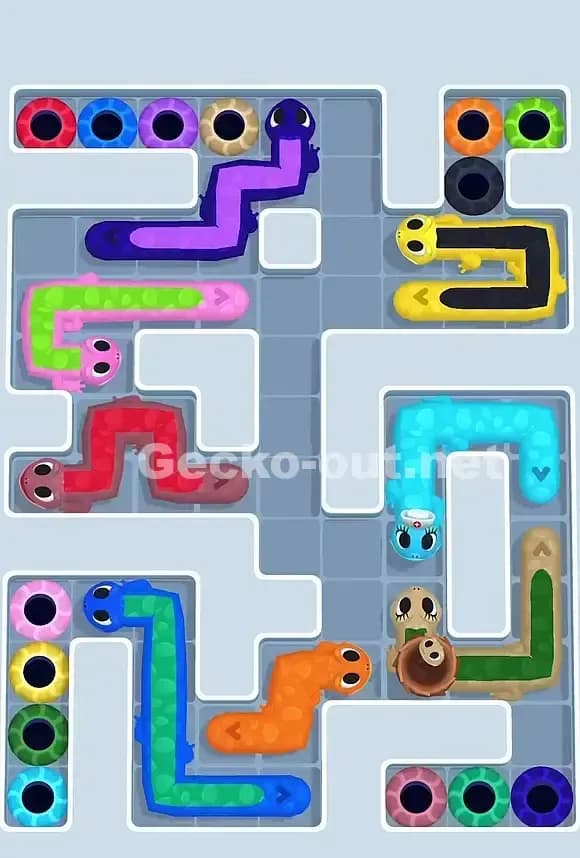
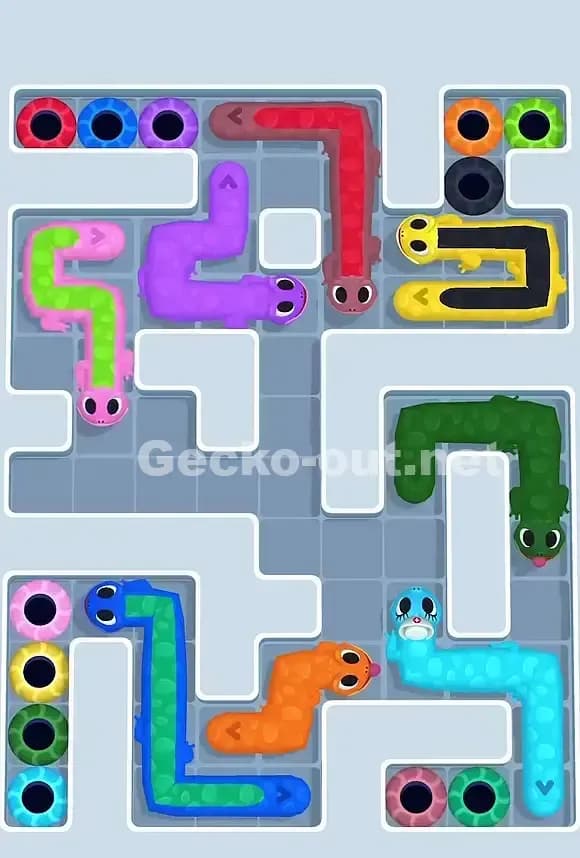
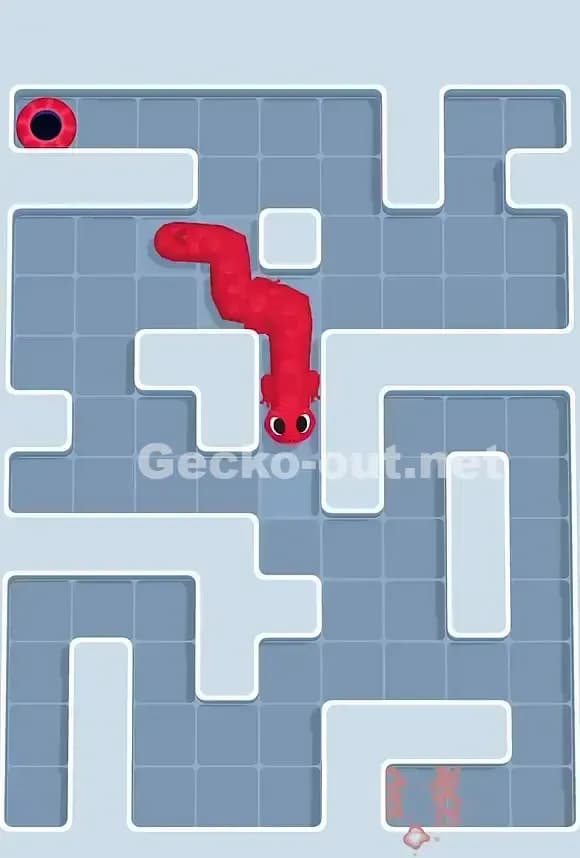
Gecko Out Level 737: Board Layout, Rules, and Win Condition
Starting Board: Geckos, Colors, and Major Obstacles
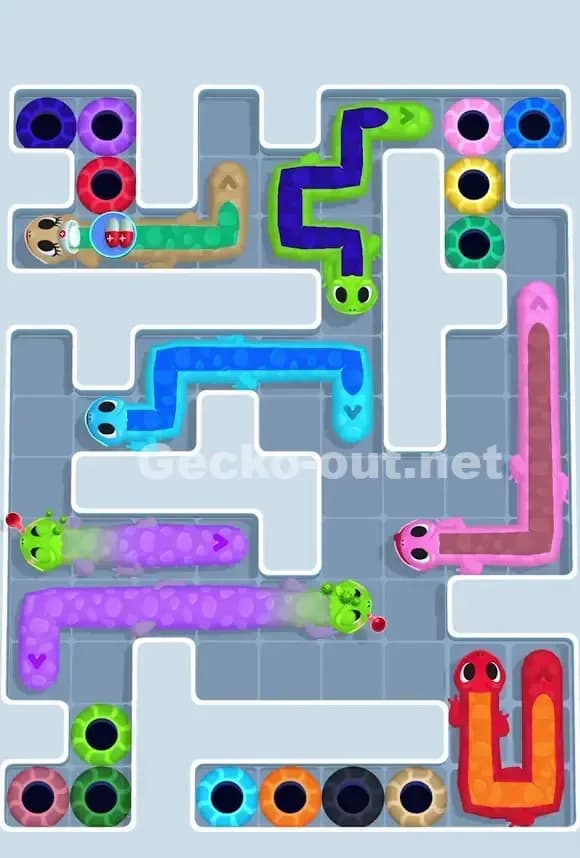
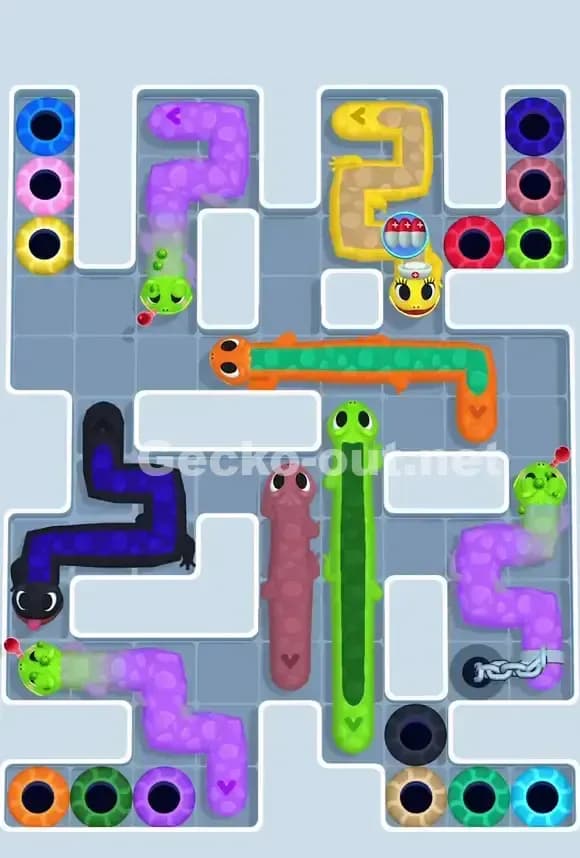
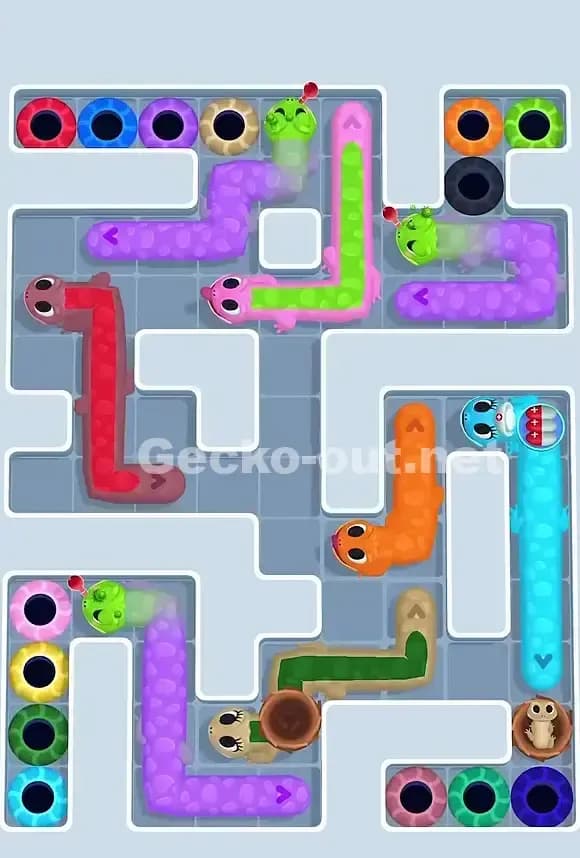
Gecko Out Level 737 is a puzzle that demands careful observation and methodical planning. You're looking at a board packed with six geckos in different colors—red, blue, purple, yellow, orange, and green—each with their own matching exit hole waiting somewhere on the grid. The board layout is dense and maze-like, with multiple white wall barriers creating narrow corridors and choke points that'll test your dragging precision. What makes Gecko Out 737 particularly tricky is that several geckos are positioned in tight clusters near the top and sides of the board, while their matching exit holes are scattered across different regions. This means you can't just rush; you need to choreograph every head-drag movement to avoid creating bottlenecks.
The most immediately visible challenge in Gecko Out Level 737 is the purple gecko gang in the upper-left area. These geckos are already grouped together and their bodies are intertwined, which means their paths will interfere with each other unless you solve them in exactly the right order. On the right side, you'll see more geckos crammed near colored exit holes, but there's a cyan (icy-blue) column that extends down from the top—this is likely a frozen exit or restricted zone that you can't use as a direct path. The board also features several empty chambers (white spaces) that function as "parking lots" where you can temporarily stash a gecko's body while you work on freeing up space for another.
Win Condition and Timer Pressure
To beat Gecko Out 737, all six geckos must reach their matching colored exit holes before the timer runs out. The timer isn't forgiving on this level; you probably have somewhere between 60 and 90 seconds depending on your difficulty setting. This means you can't afford to make trial-and-error moves or waste time dragging a gecko halfway, then undoing it. Every path you draw with your finger must count. The body-follows-head rule is your lifeline here: when you drag a gecko's head along a specific route, its body snakes behind in that exact pattern. If you drag the head through a corridor that's later blocked by another gecko's body, you're stuck. That's why the order of exits matters enormously in Gecko Out 737.
Pathing Bottlenecks and Logical Traps in Gecko Out Level 737
The Critical Bottleneck: The Purple Corridor
The single biggest chokepoint in Gecko Out Level 737 is the purple-bodied gecko gang clustered in the upper-center area. These geckos are essentially tangled together, and they all need to exit through a narrower corridor than their combined body length. If you try to drag them out simultaneously or in the wrong order, their bodies will overlap and jam the entire upper section, making it impossible to route the other geckos. The purple exit hole appears to be located to the left, which means you need to drag the purple gecko heads in a way that winds them backward and out without colliding with the red gecko (which is positioned below and will also need space to move).
The real trap here is assuming you can solve geckos independently. You can't. In Gecko Out 737, every gecko's path affects the available space for the next one. If you drag the top-right green gecko first without thinking about where its body will rest, you might accidentally block the red gecko's only safe exit route. This is what separates casual players from people who ace the level—understanding that the board is a puzzle where each piece moves and locks in, not a bunch of separate challenges.
Subtle Problem Spots
Watch out for the cyan (icy) vertical column on the right side of Gecko Out 737. It looks like it might be a shortcut to the exit on the far right, but it's frozen or blocked—you can't drag gecko heads through it. Many players waste precious seconds trying to route a gecko through that column before realizing it's a dead zone. Plan your paths around it, not through it.
The second sneaky trap is the red gecko in the left-center area. Its body is quite long and curly, and if you drag it too early without clearing the path below it, you'll lock it into a position where it can't reach its exit hole. The white walls around it create a maze, and you need to pre-clear the route before committing the head-drag.
The third problem spot is timing the exit of the smaller geckos (orange and green) from the right side. They're near their holes, so you might think they're easy, but the angles are tight and their bodies will swing through spaces occupied by other gecko bodies if you're not careful. Rushing these near the end is how people fail Gecko Out 737 with just seconds left.
My Reaction to the Challenge
Honestly, Gecko Out 737 frustrated me for the first three attempts because I was dragging geckos without a plan, treating it like a straightforward puzzle where each gecko is independent. It wasn't until I paused, studied the board for 10 seconds, and realized the purple geckos were the bottleneck that everything clicked. That's when I understood I needed to reverse-engineer the solution: start with which gecko must exit last (the one farthest from its hole or most tangled), then work backward to figure out the clearing order. Once I had that framework, Gecko Out 737 went from impossible to merely challenging, and I cleared it on the next try with about 8 seconds left on the timer.
Turn-by-Turn Path Strategy to Beat Gecko Out Level 737
Opening: Secure the Bottleneck
Start Gecko Out 737 by immediately handling the purple gecko cluster. Don't touch anything else yet. Drag the topmost purple gecko head downward and to the left, routing it through the narrower corridor toward its exit hole (which should be in the upper-left area). Keep the path tight and deliberate; this gecko is your pathfinder. Once its body is fully out of the main board or safely parked in a clearing, it opens up space for the other geckos to move.
Next, tackle the red gecko below the purple cluster. Drag its head in a path that avoids the purple body you just cleared. The red gecko's exit hole should be in the lower-left region, so map a route that winds through the available white-wall corridors. Again, keep this gecko's body parked or exited so it doesn't block lanes. As you complete these first two geckos in Gecko Out 737, you'll notice the board suddenly feels less cramped—that's the opening working.
Mid-Game: Managing Long Bodies and Keeping Lanes Open
Once the initial bottleneck is cleared, shift your attention to the yellow gecko at the top (if it's not already out). Drag it across the top corridor toward its matching exit. Don't rush; trace the path carefully with your finger so the body follows exactly where you need it.
Now you can safely move the green gecko on the right side of Gecko Out 737. Its body is moderately long, and its exit hole is nearby, but you need to make sure the path doesn't intersect with any remaining geckos. Drag the head in a smooth arc around any obstacles, and park the body in an empty space or directly out. This is when you can also start clearing the blue gecko from the top-left corner—its path should thread between the already-cleared spots and lead to its exit in the upper region.
The critical rule for mid-game in Gecko Out 737: never drag a gecko head through a space where another gecko's body currently rests. If you see a body in the way, you must first remove that gecko (drag it to its exit or a safe parking space) before routing the new gecko through that corridor.
End-Game: Final Geckos and Clock Management
With most of the board clear, you're left with the orange gecko and the cyan gecko (or whatever your final two are). By this point in Gecko Out 737, the board should feel spacious, and their paths should be obvious. Drag the orange gecko to its hole—it's likely near the bottom-right, so a simple curved path down and around will work. Then handle the cyan gecko last; its long body should have plenty of room to snake to its exit without interference.
If you're running low on time (say, 15 seconds or fewer in Gecko Out 737), commit to moves rather than hesitating. Dragging slowly and carefully is good, but pausing to think about each micro-decision burns clock. If you've followed the strategy above, the final geckos should have straightforward paths, so execute them with confidence. If you do find yourself with 5 seconds left and one gecko still on the board in Gecko Out 737, use a booster if available (see the next section), or accept the loss and restart with a faster execution of the opening strategy.
Why This Path Order Works in Gecko Out Level 737
Head-Drag and Body-Follow Logic
This strategy works because it respects the fundamental rule of Gecko Out 737: the body always follows the head's path exactly. By clearing the purple bottleneck first, you eliminate the biggest spatial constraint on the board. The purple geckos are the "load-bearing walls" of the puzzle; once they're gone (or safely parked), every other gecko can move with fewer collisions. The red gecko comes next because it's the second most tangled group. By solving them in dependency order rather than arbitrary order, you avoid the trap of creating new bottlenecks.
The reason the right-side geckos (green, orange, cyan) are solved last is because they're already relatively close to their exits and don't block other geckos as much. By the time you reach them in Gecko Out 737, the board is so clear that their paths are almost straight lines. This is efficient pathing: solve constraints first, coast through easy moves last.
Pausing vs. Committing: Reading the Board
Here's the balance: pause for 10–15 seconds at the very start of Gecko Out 737 to map the big picture (which gecko is most tangled, where the exits are, which corridors are shared). Then commit to dragging without second-guessing yourself. Each gecko's path in Gecko Out 737 should take about 3–5 seconds to drag once you know the route. If you're taking 10+ seconds to drag a single gecko, you're overthinking it or the route isn't clear, which means you need to clear a blocking gecko first.
A useful mental trick: imagine the board state after you complete each gecko. Before dragging the purple gecko in Gecko Out 737, visualize where its body will end up. If you see that it'll block the red gecko's path, reroute. This mental preview costs nothing (you're not dragging yet) but saves huge amounts of time and frustration.
Booster Decisions for Gecko Out Level 737
Boosters on Gecko Out 737 should be treated as insurance, not solutions. The level is solvable without boosters if you follow the strategy above and execute cleanly. However, if you hit a snag—say you misrouted a gecko and it's blocking multiple exits with only 20 seconds left—an extra-time booster is your lifeline. A hammer or "unstuck" booster can teleport a stuck gecko away, but it's wasteful if you've got a clear path available. Don't activate boosters preemptively; use them only if you genuinely feel the solution slipping away. The goal is to beat Gecko Out 737 clean, which builds your skills for even harder levels ahead.
Mistakes, Fixes, and Logic You Can Reuse in Other Gecko Out Levels
Common Mistakes on Gecko Out Level 737
Mistake ##1: Dragging geckos in order of color or entry position instead of dependency.
Fix: Always identify which geckos are blocking others (tangled clusters, long bodies in narrow corridors) and solve those first, even if they're less convenient to reach. In Gecko Out 737, the purple cluster must go before the red gecko, even though red is lower on the board.
Mistake ##2: Dragging a gecko head through a corridor without pre-clearing the blocking gecko's body.
Fix: Before you drag a head, visually trace the intended path and ask: "Are there other gecko bodies in the way?" If yes, remove them first. In Gecko Out 737, this mistake happens constantly when players try to route the green gecko without first exiting the purple geckos.
Mistake ##3: Trying to use the frozen/icy cyan column as a shortcut.
Fix: Recognize visual cues for blocked paths—icy textures, grayed-out holes, or distinct coloring usually signal "don't go here." Plan around them, not through them.
Mistake ##4: Parking a gecko's body in the middle of a corridor instead of a dead-end chamber.
Fix: When you've exited a gecko in Gecko Out 737, don't let its body rest in a shared lane. Drag its head just far enough that the body settles in an empty white chamber or completely off the board. This prevents surprise collisions later.
Mistake ##5: Rushing the final geckos and dragging imprecisely, causing bodies to overlap.
Fix: Even if the timer is low, take 2–3 extra seconds to drag accurately. A collision near the end of Gecko Out 737 forces you to undo and re-drag, which wastes more time than precision would have cost.
Reusing This Approach on Similar Levels
This strategy—identify bottlenecks, solve in dependency order, keep lanes clear, execute the final moves precisely—applies to any Gecko Out level with gang geckos (multiple geckos of the same color or tangled together), frozen exits, or tight corridors. The key insight is that not all geckos are created equal on the board; some are constraints on others. Levels like Gecko Out 736 (if it has a gang) or any high-numbered level with frozen sections will respond to this same "clear the biggest knot first" approach.
When you encounter a level with multiple intertwined geckos, take a breath and think backwards: which gecko can move freely right now without hitting anything, and which ones are locked in by others? Solve for freedom first, and the path unfolds naturally.
The Encouraging Takeaway
Gecko Out Level 737 is genuinely tough, but it's absolutely beatable with a clear plan and calm execution. The moment you stop treating it as six independent puzzles and start seeing it as one tangled knot to unwind—bottleneck first, easy geckos last—the level goes from frustrating to manageable. You've got this, and every level you clear builds your intuition for the next. Keep dragging, trust your strategy, and watch Gecko Out 737 fall.