Gecko Out Level 809 Solution Walkthrough | Gecko Out 809 Answer
How to solve Gecko Out level 809? Get step by step solution & cheat for Gecko Out level 809. Solve Gecko Out 809 easily with the answers & video walkthrough.
Gecko Out Level 809: Board Layout, Rules, and Win Condition
Starting Board Overview
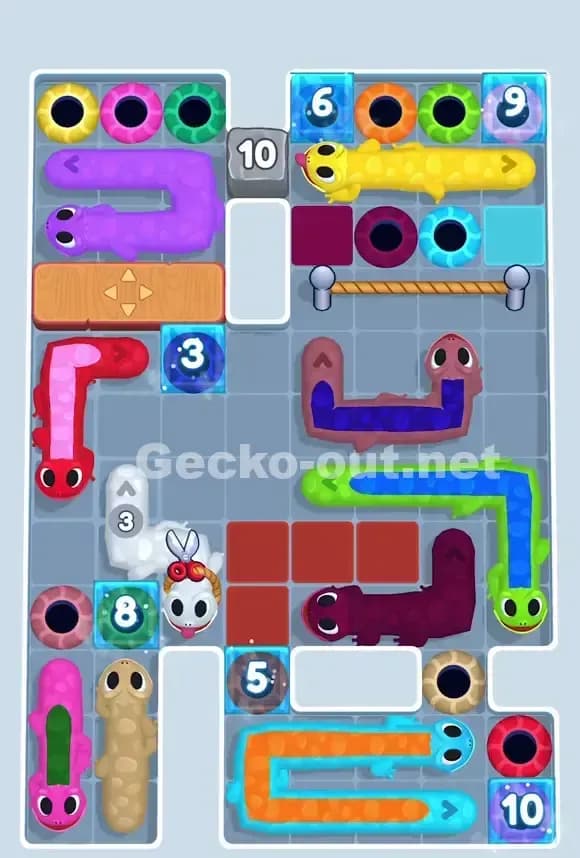
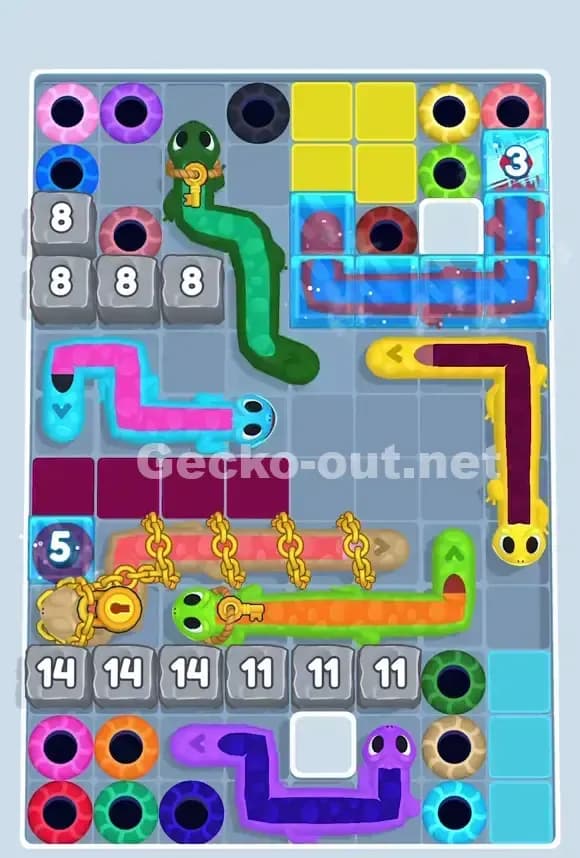
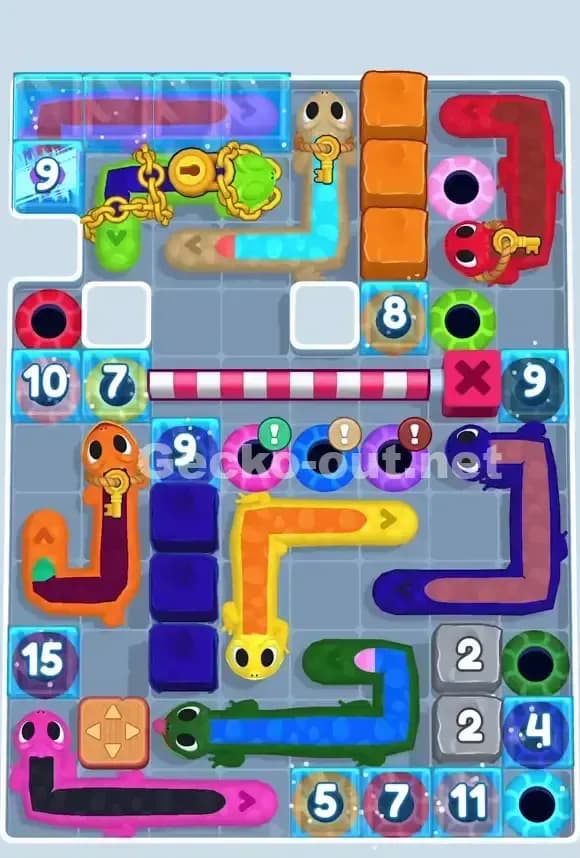
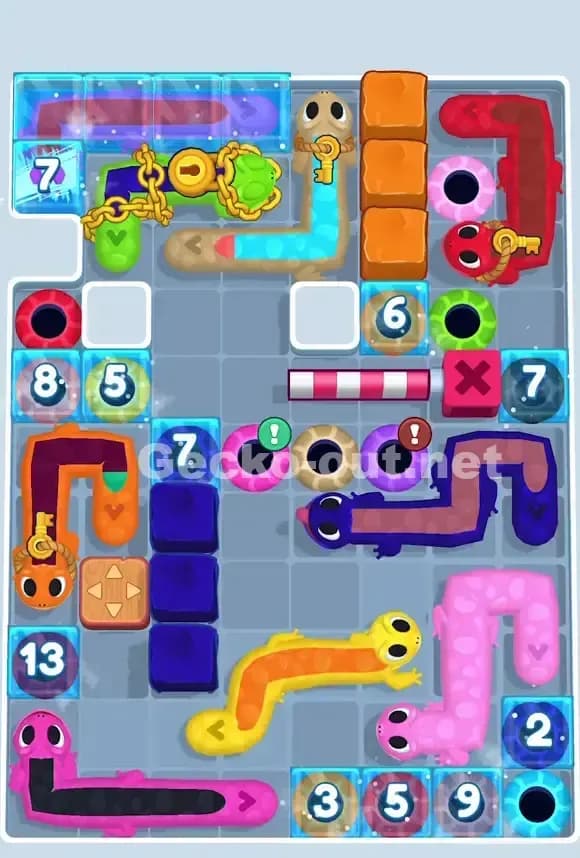
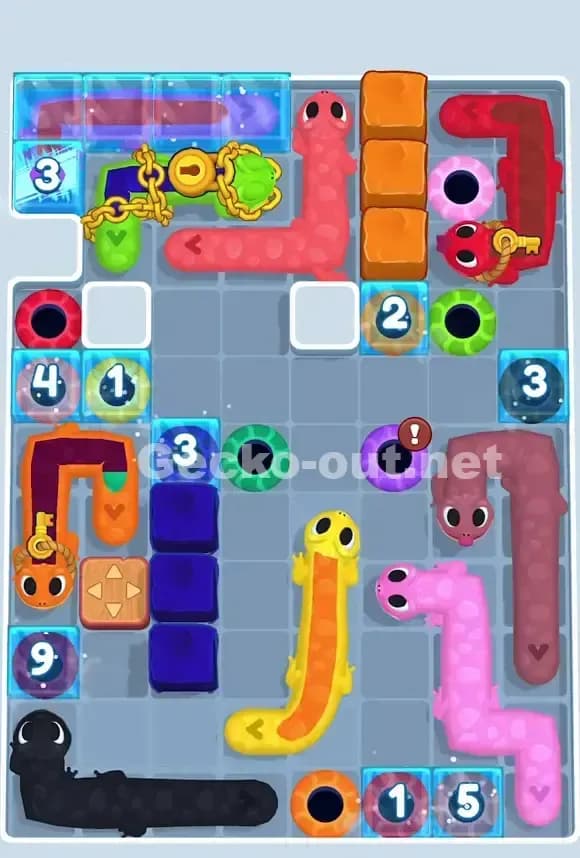
Gecko Out Level 809 is a beast of a puzzle—you're working with a densely packed 6×8 grid jam-packed with at least nine separate geckos in different colors: red, orange, green, blue, purple, and pink. The board is split into several distinct zones by walls and obstacles. You'll notice a gang of three linked yellow geckos (marked with chain icons) clumped in the upper-left area, which immediately signals that you're dealing with synchronized movement. There's also a vertical stack of three blue blocked geckos in the middle-left section that can't move until their constraints are resolved. On the right side, you've got a red gecko and an orange multi-segment structure that takes up valuable real estate. The bottom half features long, winding paths that serve as the escape routes—a magenta gecko curves along the left edge, a yellow L-shaped gecko occupies the lower-middle zone, a green gecko snakes through the center-bottom, and a blue gecko twists through the right-bottom corridor.
Win Condition and Timer Pressure
Your goal is to drag each gecko's head along an open path so its body follows, eventually reaching and exiting through a matching-colored hole. You've got a timer—marked as 9 on the board—that counts down relentlessly. If even one gecko is still on the board when the timer hits zero, you lose. What makes this challenge brutal is that every gecko's path is pre-determined the moment you start dragging: if you create a route that leaves a gap or snakes awkwardly, the body commits to that exact path, and you can't edit it mid-drag. This means poor planning early on can lock you into dead ends or create cascading traffic jams that waste precious seconds.
Pathing Bottlenecks and Logical Traps in Gecko Out Level 809
The Critical Choke Point: The Central Corridor
The single biggest bottleneck in Gecko Out Level 809 is the narrow vertical and horizontal corridor that runs through the middle of the board. This is where the yellow L-shaped gecko, the green snake gecko, and the blue winding gecko all need to squeeze through to reach their respective holes. If you move the yellow gecko first and it occupies the corridor inefficiently—say, taking up extra grid squares with a sloppy path—then the green and blue geckos will have nowhere to go. They'll be stuck waiting, and you'll burn through your timer while shuffling them around. The trick is ensuring that long geckos exit in a sequence that opens lanes rather than clogging them.
The Gang Chain Problem
The three linked yellow geckos in the upper-left area move as a single unit. You can't separate them; their bodies are chained together, so when you drag one head, all three move in unison. This sounds simple until you realize that three chained segments take up a lot of board space, and they need a clear, wide path to the exit. If you move them before clearing adjacent areas, they'll collide with other geckos or walls and you'll waste time backtracking. It's tempting to move them early to "clear" that zone, but you'll regret it if the path they take blocks the escape route for smaller, more nimble geckos later.
Subtle Problem Spot: The Orange and Red Tangle
On the upper-right side, the orange and red geckos form a tight, interlocking knot. The orange gecko stacks vertically (three segments), and the red gecko curves horizontally above it. They're not linked like the yellow gang, but their paths are so close that a single misstep—dragging one head too far left or right—will cause a collision, and you'll have to restart. The wall structure around them is also confusing; it's easy to think you have more room than you actually do.
Subtle Problem Spot: Blocked Blue Geckos
The three blue geckos stacked vertically in the middle-left are visually trapped. They can't move until other geckos clear the paths adjacent to them. If you forget they're there and focus on the outer geckos first, you'll find yourself in a time crunch realizing you still have three blue bodies to extract from a now-crowded board.
When I First Tackled Gecko Out Level 809
Honestly? I panicked. I looked at this board and saw seventeen different paths all competing for the same three corridors, and my gut reaction was to just start dragging geckos toward their holes as fast as possible. That lasted about thirty seconds before everything jammed up like rush-hour traffic. The moment it clicked was when I stopped thinking about where each gecko needed to go and started thinking about when to move it. The solution isn't about being fast—it's about being surgical: move one gecko out completely, verify the board has opened up for the next one, then commit.
Turn-by-Turn Path Strategy to Beat Gecko Out Level 809
Opening: Clear the Edges First
Start with the magenta gecko on the bottom-left edge. This gecko has a long, winding path, but it's relatively isolated from others. Drag its head down and around the outer edge toward its matching magenta hole. Getting this gecko out first doesn't remove a critical bottleneck, but it does two things: it gives you a confidence boost (you landed one!), and it clears the left edge of the board, which opens up lateral movement space for mid-game geckos. Next, move the pink gecko from the bottom. It also has a long path, but once it's gone, the bottom-left zone is completely clear, and you've created a "safe zone" where you can reposition other geckos without collision risk.
Opening: Deal with the Linked Yellow Gang
Before tackling the orange and red knot, move the yellow gang geckos. Drag their collective heads upward and to the left, threading them through the available space toward the yellow exit hole in the upper-left area. Because they're chained, their path must be wide enough for three segments side-by-side. Don't try to squeeze them through narrow corridors—it won't work, and you'll waste time. Once they're out, you've freed up the upper-left zone and reduced overall board density.
Mid-Game: Untangle Orange and Red
With the left side cleared, focus on the orange and red geckos on the right. Move the orange gecko (the vertical one) first. Drag its head carefully upward and to the right, ensuring its three-segment body doesn't clip the red gecko above it. Once orange is safely exiting through its hole, the red gecko has breathing room. Move red next, curving its head around the now-empty orange space. This pair takes precision, but the previous clears have given you the luxury of time to be careful.
Mid-Game: Extract the Trapped Blue Geckos
Now the three blue geckos in the middle-left can move. They were waiting for the yellow gang to exit. Move the topmost blue gecko first, dragging its head to the right and down toward the blue exit hole (marked "8" on the board). The middle blue gecko follows, then the bottom blue gecko. Each one should exit in sequence without collision because adjacent spaces are now empty.
Mid-Game: Manage the Central Corridor
This is where concentration matters. You've got the yellow L-shaped gecko, the green snake gecko, and the blue winding gecko all competing for the central corridor and lower-right exits. Move the yellow L-gecko first: drag its head to the right and downward, ensuring its angular body fits through the corridor without overlapping walls. Yellow should exit through its designated hole on the lower-right. Now green: drag its head downward through the corridor, but take a slightly different path than yellow used—perhaps curving it left earlier to access its hole without retracing yellow's exact route. Finally, blue: the winding blue gecko on the bottom-right should have a clear lane by now. Drag its head through the remaining open space toward the blue exit hole (marked "4" on the board).
End-Game: The Final Three
By this point, you should have most geckos gone. If there are still geckos on the board—perhaps the green gecko in the middle-bottom, the purple gecko, or any others I haven't mentioned—move them in order of spatial isolation. Prioritize whichever gecko has the most direct, unobstructed path to its hole. Avoid moving a gecko that would require it to wind through tight spaces where other geckos are still sitting. In the last 2–3 seconds, if you're still above the timer threshold, you can afford to be slightly less precise, but don't get sloppy: a wrong turn now is a failed run.
Why This Path Order Works in Gecko Out Level 809
Body-Follow Pathing Logic
When you drag a gecko's head, its body segment-by-segment retraces that exact path. This isn't a physics simulation; it's deterministic. So when you move the magenta and pink geckos first, you're not just removing two bodies—you're carving out lanes that later geckos can safely occupy without overlapping. Once magenta is gone, that curving left-edge space is unusable by any other gecko, but it's cleanly removed from the puzzle. When you move the yellow gang next, their chained structure occupies a predictable footprint, and exiting them early prevents them from ever becoming an obstacle to the central corridor geckos. The key insight is this: long geckos and gang geckos move before short, nimble geckos. A five-segment gecko needs more planning than a two-segment gecko, so you commit it early, remove it completely, and then work with the smaller remaining puzzle.
Timer Management: Pause to Read, Then Commit
Don't rush. At the start of Gecko Out Level 809, take five full seconds to map out your first three moves mentally. Ask yourself: which gecko, if moved first, leaves the board in the simplest state? Which move opens the most lanes for subsequent geckos? Once you've decided, execute that move fluidly—don't hesitate mid-drag. Hesitation wastes time because you're not moving; you're overthinking. But between moves, pause for one breath. Look at what's changed. Adjust your next move if necessary. This rhythm—commit, execute, pause, reassess—keeps you moving at the right speed: fast enough to beat the timer, but slow enough to avoid collisions.
Booster Consideration
If you run this strategy and still hit the timer with one or two geckos remaining, a Time Booster (usually marked with a clock icon or available as an in-game purchase) would extend the countdown by 30 seconds. However, Gecko Out Level 809 is absolutely solvable without boosters if you follow the turn-by-turn plan outlined above. That said, if you've attempted the level 3–4 times and keep choking in the end-game corridor crunch, spending a booster on a final attempt is fair—it lets you execute the central-corridor section without panic. A Hint Booster is unnecessary here; the puzzle's structure is logical, not obscure. Skip it and save your currency.
Mistakes, Fixes, and Logic You Can Reuse in Other Gecko Out Levels
Mistake 1: Moving the Yellow Gang Too Late
Many players ignore the linked yellow geckos until mid-game, thinking "they're just chained, I'll deal with them when I have space." Wrong. The yellow gang occupies a large footprint and needs to exit early so its space can be reclaimed. If you move them late, they'll compete with other geckos for the same lanes, creating deadlock.
Fix: Move the yellow gang in your first three actions. Period.
Mistake 2: Forcing Geckos Through Narrow Corridors Without Testing
It's tempting to drag a gecko's head in a straight line toward its hole, assuming the path is clear. But if walls or other gecko bodies are in the way, the drag will fail or the body will overlap an obstacle, and you'll waste a move.
Fix: Before dragging, visually trace the path your gecko's head will take. Count grid squares. Ensure no walls or bodies are in the way. If you're unsure, drag a short distance first to confirm, then extend.
Mistake 3: Not Pausing Between Moves
Once you complete a move, the board changes. A gecko that was blocking a lane is now gone, and a new lane is open. If you immediately drag the next gecko without re-reading the board, you might send it along a path that made sense 5 seconds ago but is now suboptimal.
Fix: After each gecko exits, take a one-second breath. Look at the board. Ask, "What's the most isolated gecko left?" Move that one next.
Mistake 4: Trying to Save Time by Moving Multiple Geckos Simultaneously
You can't drag two geckos at the same time in Gecko Out Level 809. Each action is sequential. Trying to rush by not thinking clearly about the sequence actually costs you time because you'll create collisions and have to restart.
Fix: Accept that Gecko Out Level 809 requires multiple deliberate moves. Use that deliberation to avoid mistakes, and the timer will take care of itself.
Mistake 5: Ignoring Trapped Geckos Until They're Critical
The three blue geckos stacked vertically are waiting for adjacent space to open up. If you forget they exist and focus only on geckos that are "active," you'll suddenly remember them with 2 seconds left and panic.
Fix: When opening the board, mentally note which geckos are blocked and why. Once you unblock them (by moving an adjacent gecko out), add them to your move sequence immediately.
Reusing This Logic Elsewhere
This strategy scales to other Gecko Out levels with similar structures:
- Gang-heavy levels: Always move linked geckos early and as a single unit. Don't split your attention.
- Frozen or locked geckos: Identify what's blocking them (a wall, a key, another gecko). Clear the blocker first, then move the frozen gecko.
- Tight corridor levels: Map the corridor entrance, middle, and exit. Move long geckos through it first, shorter geckos after. Never reverse a gecko's direction mid-corridor.
- Choke-point levels: Identify the single narrowest point. Move geckos with the lowest maneuverability through it first, flexible geckos last.
Final Encouragement
Gecko Out Level 809 is legitimately tough—it's a level that demands planning, precision, and the ability to hold multiple spatial relationships in your head at once. But it's not a luck puzzle. It's not a trial-and-error slog. It's a logic puzzle, and logic puzzles always have a clean, efficient solution. The plan above is that solution. Bookmark it, run through it methodically, and you'll beat Gecko Out Level 809 on your next attempt. Every gecko on that board has a path to safety; you just have to find the sequence that lets them all use it without stepping on each other. You've got this.