Gecko Out Level 260 Solution Walkthrough | Gecko Out 260 Answer
How to solve Gecko Out level 260? Get step by step solution & cheat for Gecko Out level 260. Solve Gecko Out 260 easily with the answers & video walkthrough.
Gecko Out Level 260: Board Layout, Rules, and Win Condition
What You’re Dealing With On The Board
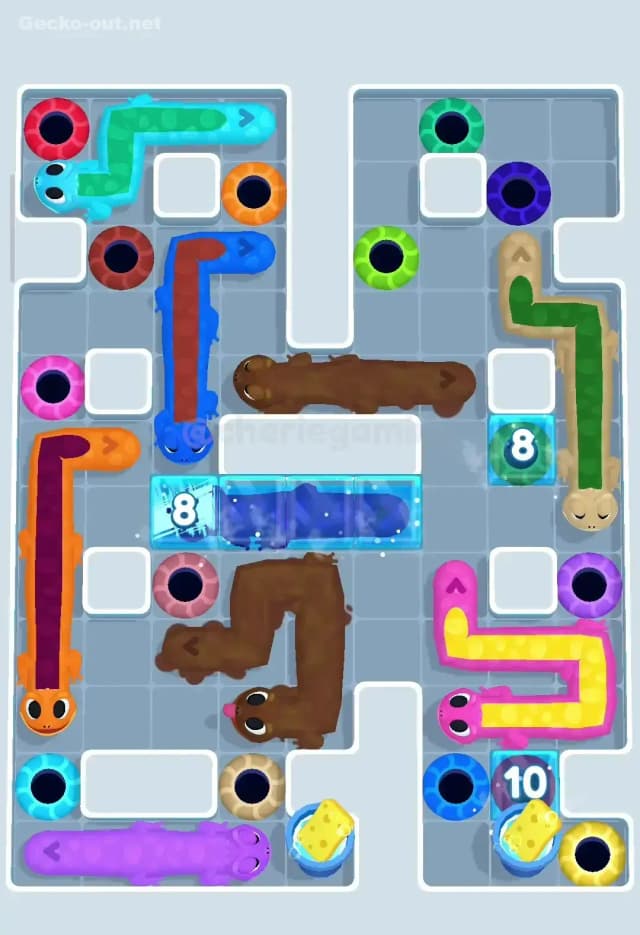
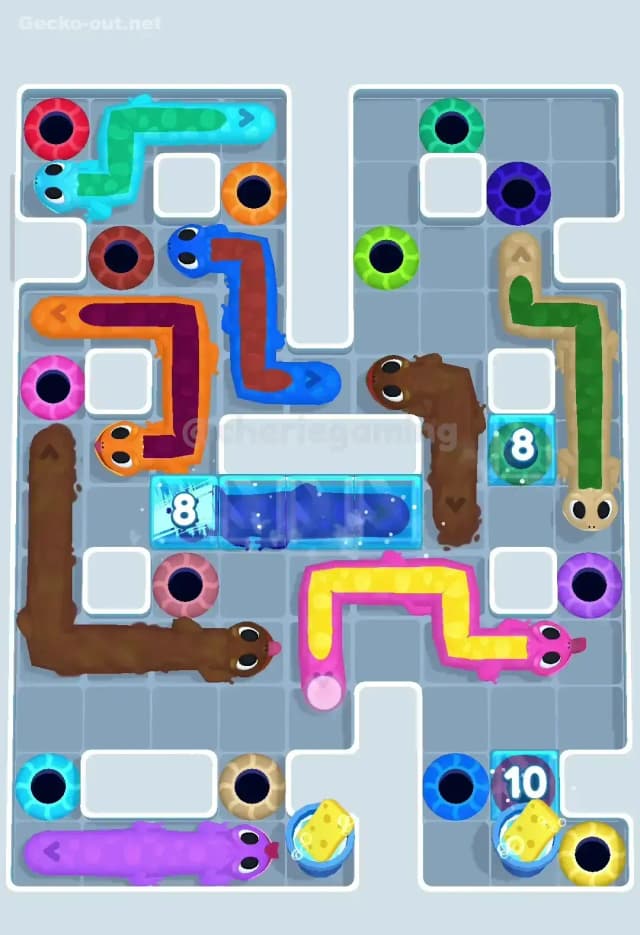
Gecko Out Level 260 throws a lot at you at once. You’ve got a packed grid with long, twisty geckos in almost every lane: a short light‑blue gecko wedged in the upper‑left, a tall orange gecko running down the left side, a long blue gecko whose middle is frozen in the center, two chunky brown “gang” geckos curling through the middle and lower area, a tan‑and‑green gecko on the right wall, a pink‑and‑yellow zig‑zag gecko in the lower‑right, and a purple gecko parked along the bottom. Almost every color of hole is present, so it’s easy to send a gecko toward the wrong exit if you rush.
The main gimmicks in Gecko Out 260 are the frozen strip across the center (locking part of the blue gecko in ice with an “8” counter on it) and the numbered gates on the right side (like the “10” by the blue and yellow holes). Those numbers act as time gates: they don’t open until the counter has ticked down, so you can’t just sprint a gecko in that direction from the start. On top of that, there are several 1‑tile choke points where only a single body can pass at a time, which means you must treat them like one‑way bridges and plan who crosses them first.
Why The Timer And Drag Paths Matter
As always in Gecko Out Level 260, you win by getting every gecko into a hole of the matching color before the timer hits zero. The tricky part is that you don’t move tile by tile; you draw the entire path with the head, and the body faithfully traces it. That’s powerful, but it also means a sloppy squiggle can wrap a gecko around key gaps and seal them off for everyone else.
The timer pushes you to drag quickly, but on Gecko Out 260 you really can’t mindlessly scribble. Every time you redraw a path to fix a mistake, you burn precious seconds and often have to unwind the mess you just created. The sweet spot is to pause briefly, visualize two or three moves ahead, and then commit to confident, clean paths.
Pathing Bottlenecks and Logical Traps in Gecko Out Level 260
The Central Freeze-Lane Bottleneck
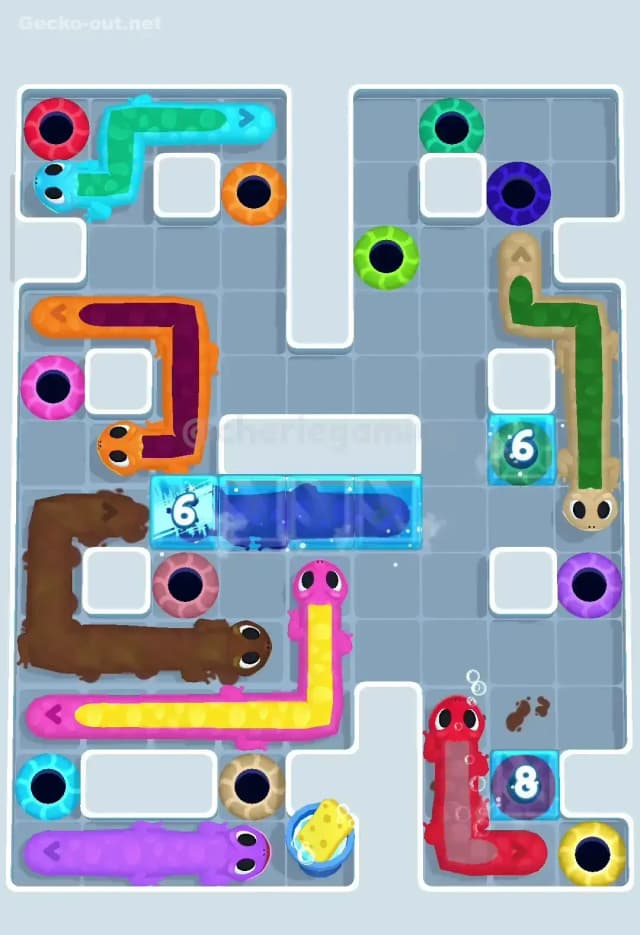
The single biggest bottleneck in Gecko Out 260 is the frozen section in the middle of the board that locks the blue gecko. That frozen strip runs horizontally and cuts the board into a top half and a bottom half. Until it thaws, the left‑side geckos and the right‑side geckos are effectively playing in separate arenas. When the ice finally breaks, you suddenly get a wide highway across the board—but if other bodies are already sprawled there, you can’t actually use it.
Because of that, the blue gecko itself is a bottleneck. Its vertical portion on the left blocks access to several holes and parking spots. If you unfreeze it and then drag it carelessly, you’ll snake it through the center and instantly block half your exits.
Sneaky Trouble Spots You’ll Feel Later
There are a few subtle traps in Gecko Out Level 260:
- The tight left column where the orange gecko and blue gecko stack on top of each other. If you exit one without considering the other’s path, you can leave a body that permanently seals the corner holes.
- The little white parking bays in the middle and right. They look like free space, but if you park a long brown gecko there with extra loops, its tail can block the only way for the tan‑green or pink‑yellow gecko to turn toward their exits.
- The right‑side numeric gate near the yellow exit. If you rush the pink‑yellow gecko toward that area before the gate is open, its body will sit in front of multiple holes and force late‑game rewrites exactly when the timer’s almost done.
When Gecko Out 260 Finally “Clicks”
Personally, Gecko Out Level 260 annoyed me at first because it feels like there’s no room. Every time I thought I made space, a long brown or blue body ended up clogging the exact corridor I needed. The “aha” moment came when I realized I didn’t need to solve both halves of the board at once. Treating the left side as a preparation zone while I waited for the central ice and the right‑side gates to open made everything click: clear and park smart on the left, then use the thawed center as a clean highway for the end‑game.
Turn-by-Turn Path Strategy to Beat Gecko Out Level 260
Opening: Clear The Left Column And Prep The Center
At the start of Gecko Out 260, ignore the frozen middle and locked gates; you can’t do anything meaningful with them yet. Your first priority is the left side:
- Tidy up the short light‑blue gecko and the orange gecko. Exit whichever one has the clearer route to its hole first, then reroute the other using the space that opens. Keep their bodies hugging the outer wall so you don’t fill central lanes.
- Reshape the vertical blue gecko so it’s straight and compact, with its head near open space but not yet crossing the future thaw line. You’re essentially staging it so that when the ice melts, you only need a simple, direct drag to reach its blue hole.
- Use the bottom‑left area (near the purple gecko) as a parking lot, not an early exit zone. Slide the purple into a neat horizontal or curved shape that stays low and doesn’t creep into the central lanes.
By the time you’ve done this, the timer has ticked down a bit and you’ve transformed the left half from a mess into a set of short, neat snakes ready to pounce.
Mid-game: Rotate The Browns And Free The Frozen
Once Gecko Out 260’s ice starts to crack, you want the central area as empty as possible.
- Focus on the two brown “gang” geckos in the middle and lower area. Your goal is to rotate them so they’re curled near their own holes without stretching sideways across the board. Draw tight, almost rectangular paths that keep them low and slightly to the right, leaving a clear horizontal lane for the blue gecko and other colors to cross later.
- As soon as the blue gecko is fully unfrozen, send it directly toward its blue hole using the newly opened middle lane. Don’t swirl it around for fun; every extra bend increases the risk of blocking someone else.
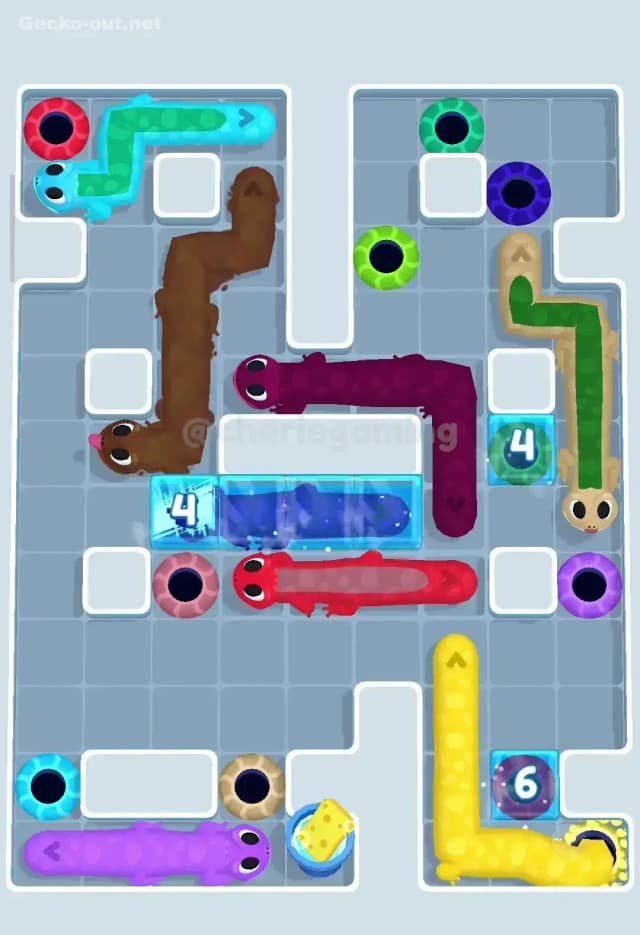
- With the blue gone, re‑check how much room you’ve got. Often you can now reposition one brown gecko to exit immediately, while leaving the other parked neatly so the right‑side geckos can travel behind it.
This mid‑game is the real puzzle of Gecko Out Level 260: you’re not just escaping geckos; you’re sculpting the entire board so the final paths are almost trivial.
End-game: Right-Side Exits And Final Clean-Up
In the late phase of Gecko Out 260, the right‑side becomes the star. The timer on the tan‑green gecko’s exit and the “10” gate near the yellow hole should be open or close to open.
- First, route the tan‑green gecko straight up or down into its matching hole, keeping its path tight to the right wall so it doesn’t protrude into the central lane.
- Next, handle the pink‑and‑yellow gecko. By now the gate by the yellow exit should be open, so draw a clean, angular path that loops it through the gate and into the yellow rim without swinging its body in front of other holes.
- Finally, exit the purple gecko and any remaining brown. At this point the board should feel strangely empty compared to the start. Use the wide open middle and bottom to give them comfortable curves into their holes, watching the timer but not panicking—your heavy thinking is already done.
If you’re low on time here, prioritize the shortest paths, even if they aren’t perfectly pretty. As long as bodies don’t block each other, a slightly messy path is fine in the last few seconds.
Why This Path Order Works in Gecko Out Level 260
Using Body-Follow Rules To Untie The Knot
The path order above works in Gecko Out Level 260 because it respects the body‑follow rule. By clearing and compacting the left side first, you make sure that when the blue gecko’s frozen section opens, its body has a straight highway and won’t swing wildly across the center. Rotating the brown geckos into small loops ensures that every future path crosses behind or around them instead of through them.
In other words, you’re always dragging heads in ways that pull bodies out of the way, not into the way. That’s the main mindset shift you need for Gecko Out 260: you’re not just solving for the current move, you’re solving for the shape the body will leave behind.
Balancing Thinking Time With Fast Execution
On Gecko Out Level 260, I like to take a 3–5 second “read” at the start: identify which exits are gated, which geckos share color, and where my parking bays are. After that, I move quickly during the opening and mid‑game, because those paths are mostly about cleaning and compacting. The only moments worth pausing again are right before releasing the blue gecko from the ice and right before committing to the pink‑yellow route through the right‑side gate.
If you’re losing to the timer, don’t think less—just batch your thinking into short pauses and then execute two or three moves in a row with confidence.
Boosters: Nice-To-Have, Not Mandatory
You absolutely can beat Gecko Out Level 260 without boosters, but they can smooth a shaky run. An extra‑time booster helps if you’re still learning the order and keep hesitating near the end. A hammer‑style tool is best saved for a single over‑long gecko that you consistently misplace (usually one of the browns), letting you redraw it without undoing your whole setup. I’d avoid using hints here; they often show only one path and don’t teach you the overall board logic that carries over to other levels.
Mistakes, Fixes, and Logic You Can Reuse in Other Gecko Out Levels
Common Gecko Out 260 Misplays And How To Fix Them
Here are the big errors I see on Gecko Out Level 260:
- Exiting the blue gecko too early and sprawling it across the center. Fix: compact the left side first and wait for the ice to open before drawing one clean, horizontal path.
- Parking browns in the middle lanes. Fix: always curl them low or slightly right, leaving a clear center corridor from left to right.
- Rushing the pink‑yellow gecko into the locked gate. Fix: keep it curled in the lower‑right corner until the “10” gate is open, then send it in one decisive move.
- Forgetting about the timer and redrawing paths repeatedly. Fix: if a path isn’t obviously fatal, live with it; don’t chase perfection at the cost of 5–10 seconds.
- Ignoring color matching and sliding into the wrong hole under pressure. Fix: before each move, do a quick “color check”—head, hole, path, then drag.
Reusing This Logic On Other Knot-Heavy Levels
The strategy behind Gecko Out 260 is reusable on lots of later Gecko Out levels: identify the global bottleneck (frozen gecko, gate, or narrow bridge), prep both sides of it first, then exploit it hard once it opens. Parking compact loops in dead‑end bays, keeping a central highway clear, and respecting how bodies trail behind heads will help on gang‑gecko stages and frozen‑exit puzzles alike. Whenever a level feels chaotic, think “prep, then cross” instead of trying to solve everything simultaneously.
Yes, Gecko Out 260 Is Tough — But You’ve Got This
Gecko Out Level 260 looks brutal at first glance, with frozen strips, numbered gates, and a swarm of long bodies. Once you break it into phases—left‑side cleanup, brown rotation and blue release, then right‑side exits—it becomes a satisfying, almost choreographed escape. Stick to the path order, keep your bodies compact, and treat the center lane like gold. With that mindset, Gecko Out 260 stops being a brick wall and turns into one of those levels you beat and immediately think, “Why did that feel so impossible before?”