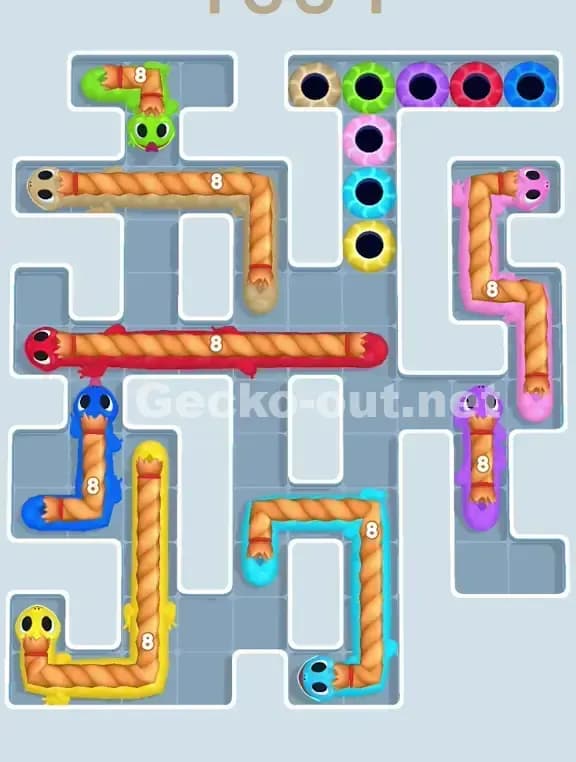
Gecko Out Level 1005 Solution Walkthrough | Gecko Out 1005 Answer
How to solve Gecko Out level 1005? Get step by step solution & cheat for Gecko Out level 1005. Solve Gecko Out 1005 easily with the answers & video walkthrough.
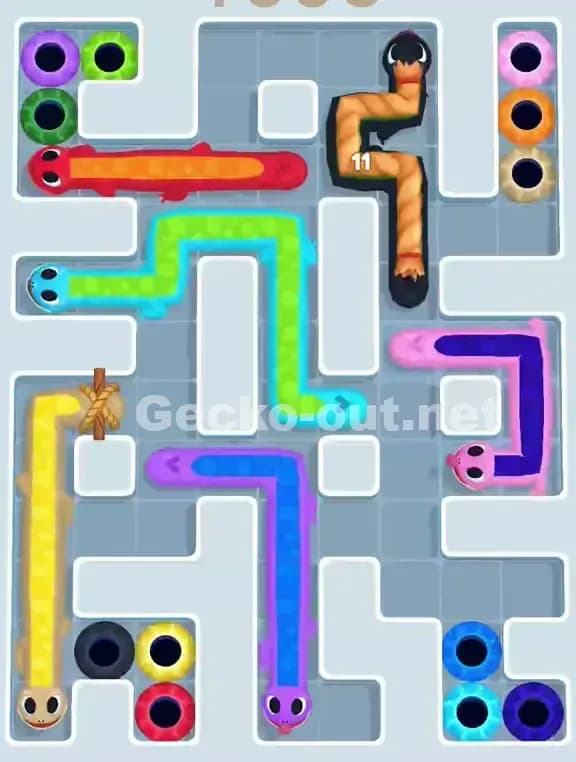



Gecko Out Level 1005: Board Layout, Rules, and Win Condition
Starting Board: Five Geckos, Long Bodies, and Tight Corridors
Gecko Out Level 1005 throws a lot at you right from the start. You're managing five geckos of different colors—red, cyan, yellow, magenta, and blue—and each one is significantly longer than a typical puzzle gecko. The board itself is a maze of white walls creating narrow corridors and dead ends, which means there's almost no room to maneuver. On the left side, you'll find a stack of three colored holes (purple, green, and black rings) that serve as exit points for some of your geckos. The right side mirrors this with another set of colored exit holes. The orange/tan gecko is positioned prominently in the center-right area, while the red gecko occupies the top-left corridor with a long horizontal body stretching across the board. What makes this particularly tricky is that several geckos are "gang" geckos—meaning they're linked together and move as a unit—so moving one affects the path of another. The timer is unforgiving, giving you roughly 60–90 seconds to get everyone out, which means slow, hesitant dragging will eat up your time fast.
Win Condition: All Geckos Out Before Time Expires
To win Gecko Out Level 1005, you need every single gecko to reach a hole matching its color before the countdown hits zero. Here's the core tension: because the geckos are long and the board is cramped, the path you drag for one gecko's head directly determines where its body will sit on the grid for the next 5–10 seconds. If you're not thinking two or three moves ahead, you'll paint yourself into a corner where the last gecko has no legal route to its hole. The drag-path mechanic is your only tool, so precision and planning matter more than speed—though speed still matters because the clock won't wait. You can't pick up a gecko and reposition it; once you drag it, that's the path its body follows. This means Gecko Out Level 1005 punishes improvisation and rewards methodical thinking.
Pathing Bottlenecks and Logical Traps in Gecko Out Level 1005
The Central Corridor Choke Point
The biggest bottleneck in Gecko Out Level 1005 is the narrow vertical corridor running through the center-bottom of the board. This corridor is where multiple geckos need to pass through to reach their exits, but it's only wide enough for one gecko body at a time. The magenta and blue geckos both have long bodies that want to use this space, and if you're not careful about the order in which you extract them, one will block the other's path entirely. I found myself stuck here multiple times—I'd drag the magenta gecko down thinking it could thread around, only to realize its tail was still sprawled across the corridor, completely blocking the blue gecko's only viable route. The solution is to map out which gecko should use the corridor first, and that's usually the one with the most flexible alternate routing. In Gecko Out Level 1005, that's typically the blue gecko, since it has a slightly longer body that can wrap around the outside edges if you're creative with your drag path.
The Red Gecko's Horizontal Sprawl
The red gecko at the top of Gecko Out Level 1005 is a monster—it's stretched horizontally across almost the entire upper half of the board, leaving almost no room for other geckos to slip past above it. If you move the red gecko too late, you're essentially blocking access to the upper-left hole stack, which might be the only viable exit for one of your other geckos. Conversely, if you move it too early without a clear exit path prepared, its long body will swing around and create new blockages lower down. This gecko is a pressure point: moving it early feels premature, but moving it late feels like panic. The trick is to move it second or third, after you've cleared a clean path to one of the left-side holes, so its body doesn't create secondary jams.
The Orange Gecko's Awkward Positioning
The orange gecko in the center-right is positioned in what feels like a dead end. It's facing inward, and its body is already somewhat coiled, which limits how far you can drag its head before the body snags on walls. Getting this gecko out requires a very specific, careful path that basically hugs the walls on the right side of the board and loops down toward the right-side hole stack. If you misjudge the drag and pull the head too far to the left, the body will collide with the adjacent wall, and you'll have to redo the move, burning precious seconds. I'll admit, the first time I played Gecko Out Level 1005, I got frustrated here—I kept overshooting the orange gecko's head and watching it bounce off walls. Then I realized I needed to drag more slowly and deliberately, aiming for a specific corner of the exit hole rather than the hole itself, and suddenly the path opened up. That's when the level clicked for me: precision over speed.
Turn-by-Turn Path Strategy to Beat Gecko Out Level 1005
Opening: Start With the Cyan Gecko
Begin Gecko Out Level 1005 by dragging the cyan gecko from its starting position on the left side toward the nearest hole on the left-side stack. The cyan gecko is relatively compact and has a clear path, so getting it out of the way immediately opens up space on the left side of the board and removes one variable from the rest of your puzzle. Don't rush this move, but don't overthink it either—a 2–3 second careful drag will get cyan to safety and give you breathing room. Once cyan is out, the left corridor opens up, and you can begin thinking about the red gecko's path without worrying about collisions. Parking that first gecko out of the way is psychologically important too; it's a quick win that builds confidence and confirms you understand the board.
Mid-Game: Sequence the Red and Orange Geckos
After cyan is gone, drag the red gecko from the top-left toward the now-clear left-side holes. The red gecko's long horizontal body will swing down and around; you want to drag its head down and to the left in a smooth, continuous motion, allowing the body to follow the natural corridor contours. This should take about 4–5 seconds of deliberate dragging. Once the red gecko is exiting, you've cleared the upper-left area entirely. Now it's time to tackle the orange gecko in the center-right. Drag its head carefully to the right, looping it down toward the right-side hole stack. This move is slower and more precise—expect it to take 5–7 seconds because you need to avoid wall snags. The key is to aim the head toward a specific grid position just before the hole, not directly at the hole, so the body has a natural uncoiling path. After the orange gecko is out, you're left with the two gang geckos—the magenta and blue pair—which now have much more space to maneuver.
End-Game: Extract Magenta and Blue in the Right Order
With three geckos already out, Gecko Out Level 1005 becomes much simpler. However, you're now down to 20–30 seconds on the timer, so you need to move decisively. Drag the magenta gecko toward its hole first, which should be accessible via the right-side stack. Magenta's body is long, but now that the board is mostly clear, you have room to spiral it down and around. This should take about 4–5 seconds. Finally, drag the blue gecko into the central corridor and loop it down to its hole on the right-side stack. The blue gecko is the last piece, and because it's the final move, you don't need to worry about its body blocking anyone else. If you're running very low on time—under 10 seconds—you can afford to drag slightly faster here, even if your path isn't perfectly optimized, because there's no gecko left to block.
Why This Path Order Works in Gecko Out Level 1005
The Head-Drag Body-Follow Logic Prevents Cascading Blockages
Gecko Out Level 1005's core mechanic is that the gecko's body follows the exact path its head takes, and that body occupies grid space for several seconds. By extracting geckos in the order cyan → red → orange → magenta → blue, you're always clearing a major corridor or open space before the next gecko needs to use it. This order prevents what I call "cascading blockages"—where one gecko's body position forces you into an awkward detour for the next gecko, which in turn creates problems for the gecko after that. When you extract cyan first, you open the left side. When you extract red next, you open the upper-left corner. When you extract orange, you clear the center-right area, and so on. Each extraction makes the next one easier, not harder. This is the opposite of what happens if you try to extract the long geckos (red, orange, magenta) first—you'd create knots instead of untangling them.
Pacing: When to Pause and When to Commit
Gecko Out Level 1005 demands that you balance quick execution with careful planning. Here's my honest take: spend the first 15 seconds of the level just looking. Don't drag anything. Trace the path for cyan in your mind, identify where the red gecko will need to go, and spot the bottleneck around the central corridor. Once you've spent that time reading the board, you can commit to moves with confidence. Each individual gecko drag should take 3–7 seconds, depending on how many walls it has to navigate. If a drag is taking longer than 7 seconds, you're either being too cautious or you're dragging into a wall repeatedly—stop, release, and re-plan. The timer is strict enough that you can't afford 10-second second-guesses, so committing to a well-planned path is more important than achieving perfection on every drag.
Boosters: Optional But Not Necessary
In Gecko Out Level 1005, boosters like extra time or hint tools can help if you're stuck, but they're not required if you follow this strategy. The extra-time booster is tempting—it'd give you another 30 seconds—but using it is a sign that your path order isn't optimal. If you're consistently running out of time, it's not the timer that's the problem; it's that you're extracting geckos in a less-efficient sequence. That said, if you've tried this strategy 2–3 times and still can't make it work, a 30-second time booster could be the difference between a clear and a failure. I'd recommend attempting Gecko Out Level 1005 without boosters first; they're insurance, not the solution.
Mistakes, Fixes, and Logic You Can Reuse in Other Gecko Out Levels
Mistake 1: Extracting Long Geckos Early
The most common error on Gecko Out Level 1005 is pulling out the red or orange gecko first because they're visually prominent and it feels like you're making progress. The fix: long geckos should almost always go out second, third, or later, once shorter geckos have cleared the board and given you room to maneuver. This principle applies to any Gecko Out level with multiple long geckos. The long body is an asset for wrapping around corners, but only if you've already made space.
Mistake 2: Not Accounting for Body Swing Space
Players often drag a gecko's head toward a hole but forget that the gecko's body is still trailing behind, and that body will swing through intermediate grid spaces. On Gecko Out Level 1005, this means dragging the red gecko's head down without realizing its tail is still occupying the upper corridor, blocking cyan's exit. The fix: before you drag, mentally trace where the entire body will be, not just the head. Imagine the body as a rope that must fit through every corridor it passes through.
Mistake 3: Rushing the Orange Gecko
The orange gecko's odd positioning makes it feel like an emergency, so players often drag it carelessly and then have to restart when the body clips a wall. The fix: the orange gecko should be handled deliberately, not quickly. Give yourself permission to spend 6–7 seconds on this one drag, and you'll nail it. Speed isn't the goal; a clean path is.
Mistake 4: Forgetting That Gang Geckos Move Together
If Gecko Out Level 1005 includes linked gang geckos, they move as one unit. Moving one doesn't free up the other—they're still occupying shared space. The fix: treat gang geckos as a single larger body, not two separate puzzles. Plan their exit as one move, not two.
Mistake 5: Leaving Too Little Time for Final Geckos
Players sometimes extract the first three geckos in 40 seconds, then realize they have only 20 seconds left for two long geckos and one narrow corridor. The fix: aim to have 3–4 geckos out in the first 45 seconds, so you have 15–20 seconds of buffer time for the final, trickiest extractions.
Reusing This Logic on Similar Levels
This strategy works across any Gecko Out level that features:
- Multiple geckos of varying lengths on a cramped board.
- A central bottleneck corridor that forces extraction order.
- Long geckos that create secondary blockages if extracted too early.
- Tight timer pressure that punishes indecision.
On any such level, start by identifying the shortest, most mobile gecko (like cyan on Gecko Out Level 1005) and extract it first to open space. Then identify the longest gecko with the clearest existing path and extract it next. Work your way through the rest in order of length and corridor impact. This greedy approach—always removing the gecko that frees the most space—is a reliable heuristic that beats random extraction orders almost every time.
Final Thoughts on Gecko Out Level 1005
Gecko Out Level 1005 is tough, no doubt about it. The long geckos, the narrow corridors, and the tight timer create genuine tension. But it's not unfair—it's a puzzle that rewards planning and systematic thinking. Once you understand that you're not racing against the clock; you're untangling a knot in a specific order, the level stops feeling impossible and starts feeling like a satisfying logic challenge. Cyan out, then red, then orange, then magenta, then blue. Clear the board methodically, drag with purpose, and you'll beat Gecko Out Level 1005 comfortably. Good luck, and enjoy the moment when everything clicks into place.