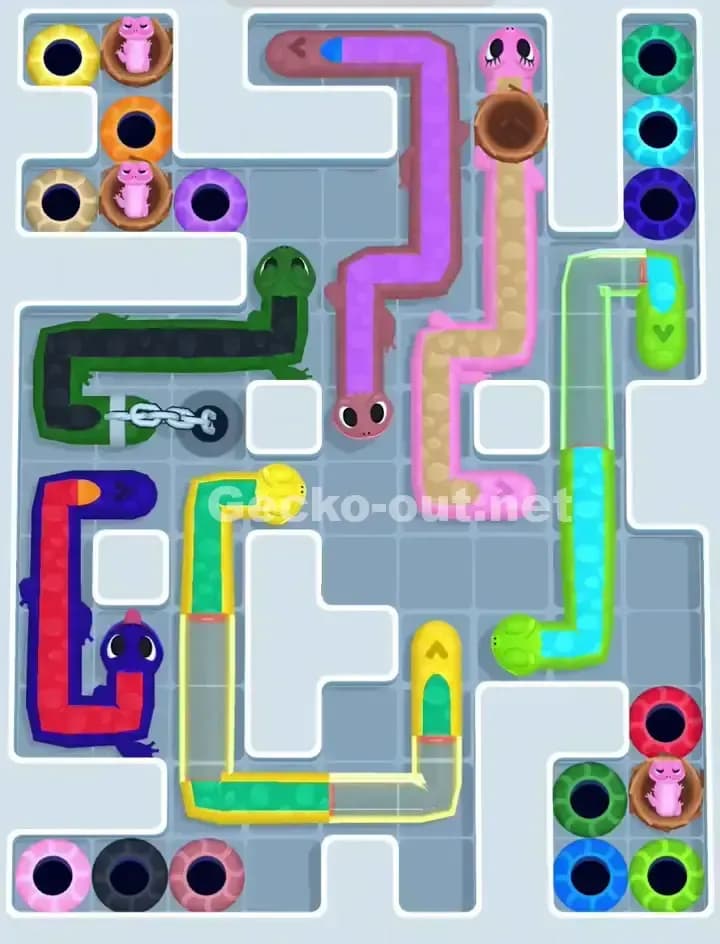
Gecko Out Level 1135 Solution Walkthrough | Gecko Out 1135 Answer
How to solve Gecko Out level 1135? Get step by step solution & cheat for Gecko Out level 1135. Solve Gecko Out 1135 easily with the answers & video walkthrough.

Gecko Out Level 1135: Board Layout, Rules, and Win Condition
The Starting Board and Your Gecko Lineup
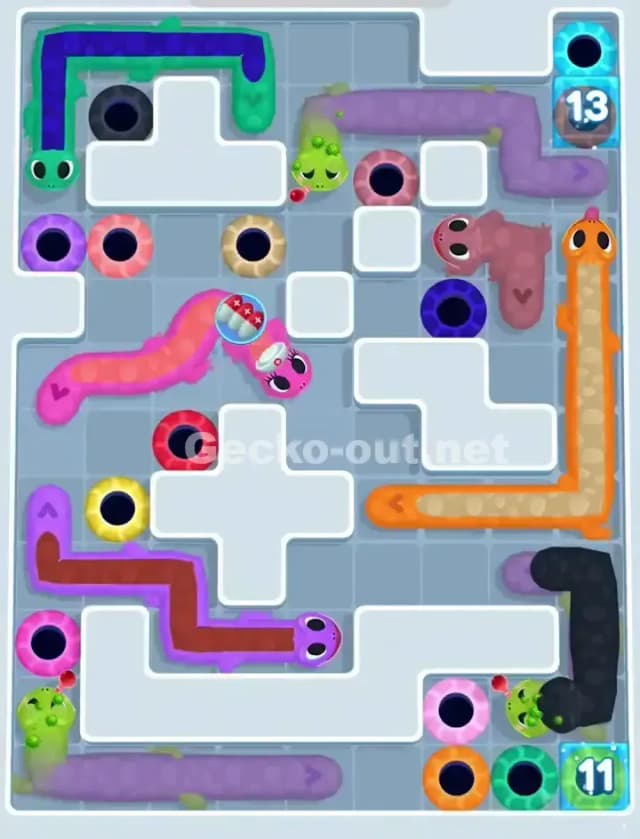
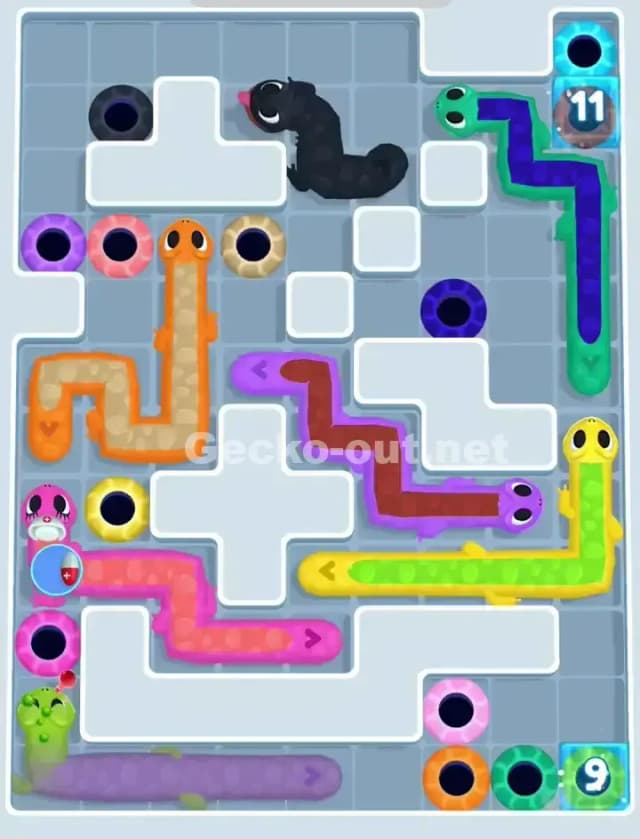
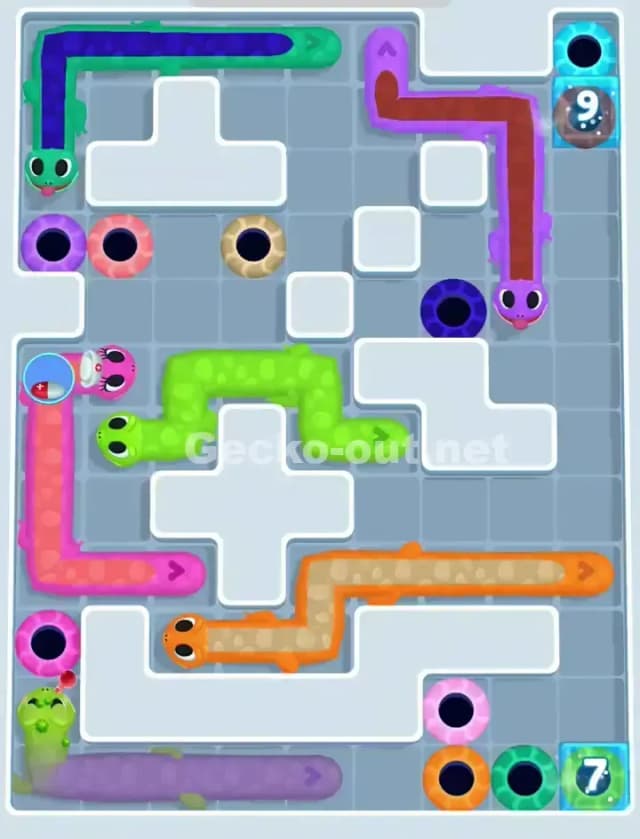
Gecko Out Level 1135 is a densely packed puzzle with nine geckos spread across the grid, each demanding careful navigation to their matching exit holes. You've got a mix of colors: green, blue, purple, pink, red, orange, and yellow geckos all competing for space in a tight, maze-like arena. The board itself is a labyrinth of white walls forming an intricate pattern, leaving only narrow corridors and strategic gaps for movement. What makes this level particularly gnarly is that several geckos are linked together as "gangs"—meaning when you drag one head, multiple bodies move as a unit. This constraint forces you to think ahead about where a gang will land and whether it blocks critical escape routes for other colors.
The timer sits at 13 moves, which sounds generous until you realize how many geckos need to escape and how tangled they all are. You're not racing against a countdown clock in seconds; instead, you have exactly 13 drags to guide every single gecko into its matching hole. That's roughly one move per gecko, with almost no room for mistakes or repositioning fumbles.
The Win Condition and Path-Based Movement Rules
To beat Gecko Out Level 1135, all nine geckos must reach their color-matched exit holes before you exhaust your 13 moves. Each drag is a discrete move—one head drag counts as one, regardless of distance or complexity. The movement mechanic works by dragging a gecko's head along any valid path, and the body automatically follows that exact route. Critically, the body can't pass through walls or overlap other geckos mid-travel. This means if you drag a head through a tight choke point and another gecko's body is already occupying that space, the drag fails or gets blocked. The puzzle demands that you orchestrate geckos in an order that keeps lanes open and prevents gridlock. You win only when the last gecko disappears into its hole before the move counter hits zero.
Pathing Bottlenecks and Logical Traps in Gecko Out Level 1135
The Critical Bottleneck: The Central Corridor
The single biggest traffic jam in Gecko Out Level 1135 centers on the middle area of the board, where a narrow horizontal-vertical passage connects most of the left and right sides. Multiple geckos from the left (including the purple gang linked to the lower-left region) need to traverse this bottleneck to reach exits on the right and upper areas. If you're not careful, you'll send a long gecko body through this corridor and accidentally wall off shorter geckos that also need the same path. The orange gecko on the right side, in particular, is trapped behind this potential logjam. If the pink gang or the yellow-purple gang snakes through the center without planning, the orange gecko becomes completely unreachable, and you'll run out of moves before escaping everyone.
Subtle Trap #1: The Linked Gang Movement
The pink gang gecko is a two-headed unit, meaning when you drag one head, both bodies move together as a single mass. This gang takes up far more board real estate than individual geckos, and its movement is inflexible—you can't separate the heads or send them different ways. If you drag this gang carelessly toward the center, it will wedge itself in a position where it blocks both the central corridor and the upper route, trapping at least two other geckos. The trick is to route the gang carefully around the perimeter or through a very specific sequence that doesn't interfere with later moves.
Subtle Trap #2: The Upper-Right Dead End
The blue gecko in the upper-left region and the green geckos scattered around the board all have exits, but some are tucked into corners or dead-end corridors. If you move a long gecko through an upper passage too early, it can physically block a shorter gecko from reaching its nearby exit. For instance, if you drag the blue gecko straight toward its exit without routing it perfectly, its body might coil around and occupy the space another gecko needs. Tunnel vision is your enemy here—you have to trace not just the head's destination but the entire body's path.
Personal Reaction: The Moment It Clicked
Honestly, my first attempt at Gecko Out Level 1135 felt overwhelming. I had nine geckos and 13 moves, and I kept hitting dead ends where I'd trapped half the board by move seven. But then I realized I was thinking about this wrong—instead of asking "how do I move this gecko out fast?" I started asking "which gecko's removal opens up the most space for others?" That shift in perspective made everything snap into focus. Once I identified that moving the isolated yellow gecko first would free up a critical path, the rest of the puzzle felt solvable. It's that "aha" moment that makes Gecko Out Level 1135 so satisfying.
Turn-by-Turn Path Strategy to Beat Gecko Out Level 1135
Opening: Set Up the Board by Freeing Key Isolated Geckos
Start with the isolated yellow gecko in the lower-left area. Drag its head carefully upward through the left-side corridor toward its yellow exit hole, which is positioned in the lower-middle zone. This first move doesn't directly unblock anyone else, but it removes one gecko from the board entirely and opens up the left corridor for subsequent moves. Next, target the green geckos that are scattered but relatively independent. Move one of the greens toward its exit in the upper-center area, keeping the drag path clear of the central bottleneck. By clearing these independent geckos early, you're shrinking the total number of bodies on the board and creating "parking spaces" where longer, more complicated geckos can later maneuver without overlapping.
Mid-Game: Strategic Repositioning and Untangling the Gangs
Once you've freed two or three independent geckos, you have just enough breathing room to tackle the pink gang. Don't drag it straight down the center; instead, route its head along the right-side perimeter, snaking it around obstacles in a way that keeps the center lane open. This might feel like a longer path, but it's the only way to prevent catastrophic gridlock. After the gang is clear, move the purple geckos and any remaining red or blue geckos in a careful sequence. The key principle here is: move longer geckos first, and always plan their exit routes before dragging. If a gecko's body will take up critical shared space, move it early when you have more options. Save the shortest, most agile geckos for last, since they're easiest to squeeze through tight gaps.
End-Game: Last Few Geckos and Final Escape
By move nine or ten, you should have five or fewer geckos left on the board, and the remaining lanes should be much clearer. This is where precision matters most. The orange gecko on the right, for example, should be one of your final moves—it has a straightforward path once everything else is out of the way. Spend a move or two parking any remaining medium-length geckos in "safe zones" (empty grid areas far from exits) so they don't inadvertently block your last few escapes. In your final two moves, route the last geckos directly to their exits without any fancy maneuvers. If you're cutting it close on the move counter (say, you're on move 12 with one gecko left), make absolutely sure that gecko's exit is unobstructed and that dragging it won't cause a collision. If there's any doubt, take a second to study the path before committing.
Why This Path Order Works in Gecko Out Level 1135
Head-Drag Pathing and the Body-Follow Rule Untangle Instead of Tighten
The genius of this strategy is that it respects the body-follow mechanic. When you drag a head, the body traces that exact path behind it—it doesn't teleport or take shortcuts. By moving independent and shorter geckos first, you're ensuring their bodies won't later coil around and block critical passages. Each subsequent gecko's path benefits from the cleared space left behind. The gang gecko, which would normally occupy massive board space, is routed through the perimeter last (or early, depending on your sequence) in a way that avoids the center corridor. This ensures the central bottleneck remains open for geckos that absolutely depend on it. You're not fighting against the physics of the puzzle; you're using the body-follow rule to your advantage.
Timing Your Pauses Versus Committed Moves
With 13 moves, you don't have unlimited time to deliberate, but you do have a little breathing room. Spend your first 30 seconds analyzing the board: identify the gang geckos, locate the isolation points, and mentally trace one or two moves ahead. Make your first 2–3 moves confidently and fairly quickly; they're usually straightforward. Pause again around move four or five, re-examine the board state, and adjust your plan if a gecko got stuck or took up more space than expected. From move seven onward, slow down and trace each path carefully with your finger or cursor before dragging. Rushing through move ten or eleven is how you accidentally block an exit with a stray body coil.
Booster Strategy: When to Use the Hint or Extra Moves
Gecko Out Level 1135 is tough but absolutely solvable without boosters if you follow the opening-to-end-game sequence outlined above. However, if you find yourself in a state where four geckos remain and you're already on move 12, deploying an extra-move booster (if available) is reasonable and won't diminish your sense of accomplishment. The hint booster is less useful here because the puzzle doesn't have a single "secret path"; it's about execution and sequencing. Skip the hint and rely on the logic above. Hammer-style tools (if present in your version) can destroy blocking walls, but Gecko Out Level 1135 doesn't have removable walls, so those are irrelevant.
Mistakes, Fixes, and Logic You Can Reuse in Other Gecko Out Levels
Mistake #1: Moving Gang Geckos Without a Clear Exit Route
Many players drag a gang gecko in a direction that seems logical but doesn't account for the full body path. The gang wedges itself mid-board, takes up enormous space, and suddenly four other geckos are boxed in. Fix: Before dragging any gang gecko, trace its entire body path from head to tail and ensure that path doesn't intersect with any exit you'll need later. Draw a mental line across the board showing where that gecko's body will occupy space.
Mistake #2: Prioritizing Exit Proximity Over Logical Sequencing
A gecko might be physically close to its exit, but if moving it immediately blocks a critical corridor, it's the wrong move. Fix: Ignore distance. Instead, ask: "If I move this gecko now, what paths become blocked?" and "What gecko's removal would open up the most options?" Move to maximize board freedom, not to minimize individual gecko travel time.
Mistake #3: Forgetting That Bodies Can Coil Behind Tight Corners
When you drag a head through a tight L-shaped or U-shaped corridor, the body doesn't take a shortcut; it follows the exact path. This can cause the body to occupy grid squares behind the head that you didn't intend. Fix: Always trace the body path, not just the head destination. If the corridor is narrow and L-shaped, account for the fact that the body will loop around the corners too.
Mistake #4: Leaving Isolated Geckos for Last
Some players assume isolated geckos (far from the main knot) should be moved last. This is backwards. Isolated geckos are easiest to move and don't interact with the congested center. Fix: Move isolated geckos first to shrink the total gecko count and create psychological calm. It makes the remaining puzzle feel less overwhelming.
Mistake #5: Not Parking Geckos in Safe Zones
Once a gecko has been moved, it's sitting somewhere on the board, potentially blocking future moves. Fix: When you move a gecko partway toward its exit, park its body in an empty area (not on a critical path or corridor) so it doesn't interfere with other geckos you need to move later.
Reusing This Logic on Similar Levels
Any Gecko Out level with gang geckos, narrow corridors, and a multi-gecko mix benefits from this approach. The core principle—move in an order that maximizes future freedom rather than minimize immediate distance—applies universally. Levels with frozen exits or toll gates add complexity, but the sequencing logic remains the same: identify bottlenecks, move to unblock them, and save the easiest geckos for last. If you encounter a level with linked gang geckos and a central corridor (like Gecko Out Level 1135), you now have a proven strategy template.
Final Encouragement
Gecko Out Level 1135 is legitimately tough. Nine geckos, 13 moves, a gang element, and a nightmare of a central corridor make it feel insurmountable at first. But it's absolutely beatable, and the satisfaction of untangling that knot and watching all nine geckos vanish into their holes is unbeatable. Trust the sequencing strategy above, take your time on the mid-game positioning, and remember that every gecko removed is one less thing to think about. You've got this.