Gecko Out Level 233 Solution Walkthrough | Gecko Out 233 Answer
How to solve Gecko Out level 233? Get step by step solution & cheat for Gecko Out level 233. Solve Gecko Out 233 easily with the answers & video walkthrough.
Gecko Out Level 233: Board Layout, Rules, and Win Condition
How the board starts
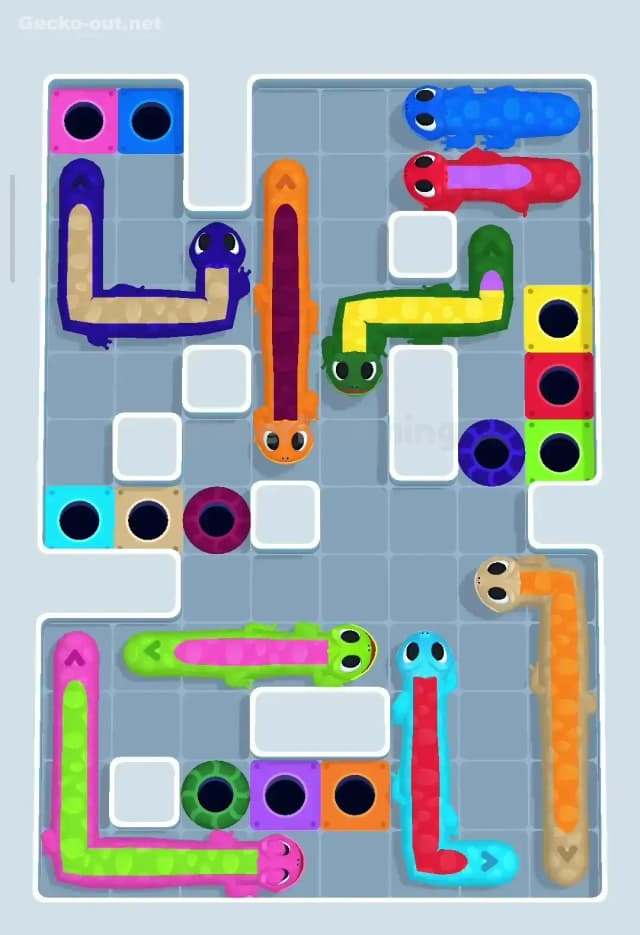
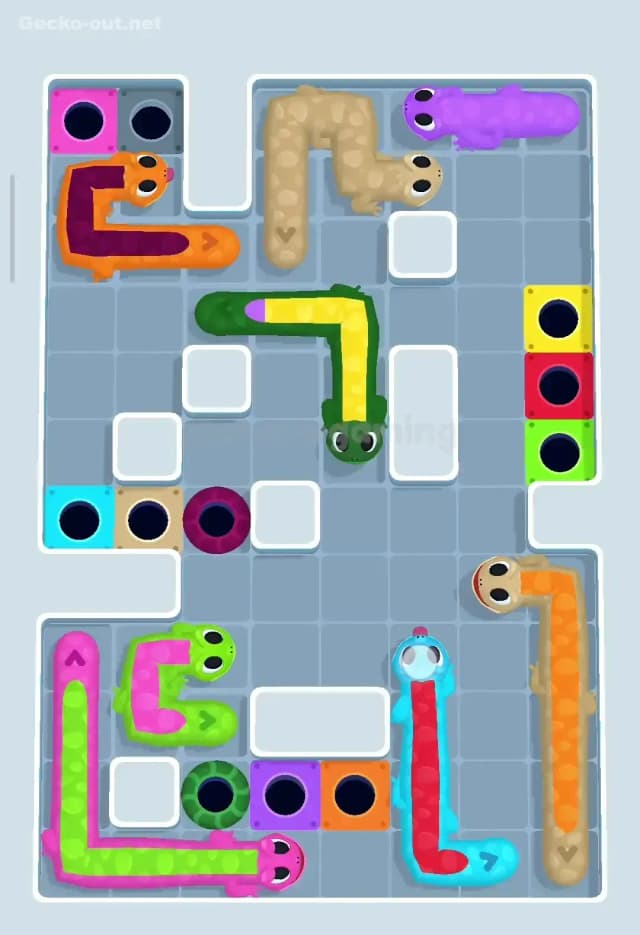
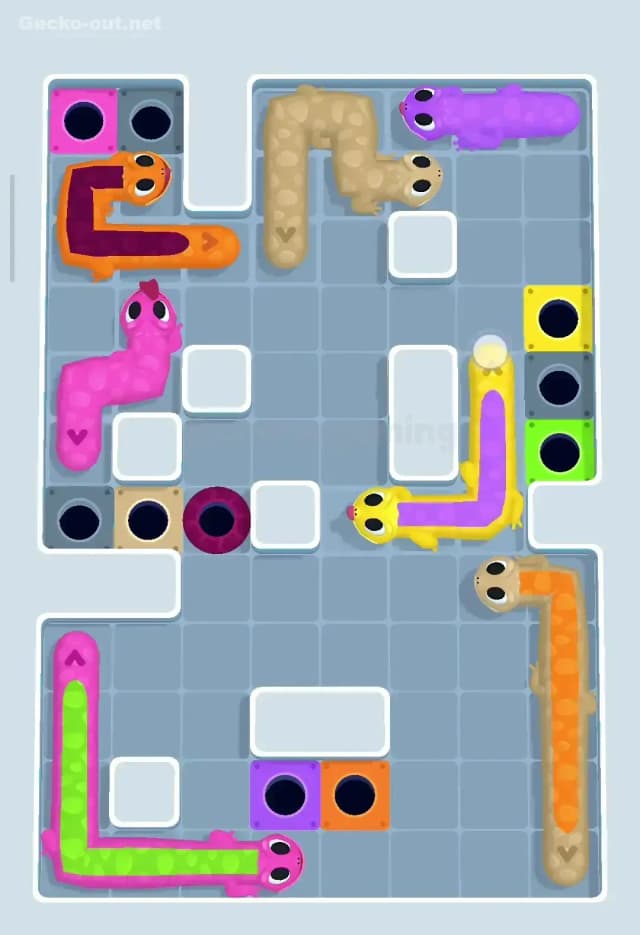
In Gecko Out Level 233 you’re dropped into a really cramped layout with a ton of long bodies and barely any open floor. You’ve got:
- A “gang” gecko in the upper‑left: two heads sharing one thick body, wedged into a U‑shaped corner.
- Two short geckos sleeping in the top‑right, red and blue, both pointing toward the center.
- A tall orange gecko standing almost straight down the middle column.
- A long green–yellow gecko that bends around the center, half horizontal, half vertical.
- A huge L‑shaped pink–green gecko filling most of the bottom‑left.
- A short bright green gecko in the lower center, plus a cyan/red vertical gecko and a tall beige/orange gecko on the right side.
Exits are scattered in clusters: a double gang exit up top, a multi‑color exit strip on the right edge, and more holes packed into the lower‑left corridor. On Gecko Out 233 there are also several solid white blocks forming choke points so only one body segment can pass at a time.
The net feel: the grid looks almost full, and anything you move risks sealing a corridor you’ll need later.
Win condition and why the timer hurts here
The win condition is the usual: in Gecko Out Level 233 every gecko has to slither into a hole with the matching border color before the timer hits zero. Their bodies trace the exact path you draw from the head, and they can’t overlap walls, other geckos, or exits that don’t match them.
Two things make Gecko Out 233 tricky:
- Path memory: a sloppy curve means the whole body occupies more tiles and blocks lanes you’ll need for other geckos.
- Short timer: you don’t get enough time to brute‑force. If you waste half the clock on a bad route for one long gecko, you’ll run out while untangling the rest.
So the whole level is about planning clean, straight routes and moving geckos in an order that gradually opens the board instead of knotting it further.
Pathing Bottlenecks and Logical Traps in Gecko Out Level 233
The main bottleneck lane
The single biggest bottleneck in Gecko Out Level 233 is the central vertical corridor running from the upper middle down to the lower middle. The tall orange gecko and the curved green–yellow gecko both lean into it, and several exits effectively sit “behind” that column.
If you drag the orange gecko or the green–yellow one into a loose zigzag, they’ll stretch across that lane and block:
- Red and blue leaving from the top‑right area.
- The short center geckos trying to cross toward their exits.
- The right‑hand exit strip for the long beige/orange gecko.
That’s why you want the orange and green–yellow geckos to move early, in tight, mostly straight lines.
Subtle problem spots you might not notice
There are a few nastier traps in Gecko Out 233:
- Parking in dead corners: The little alcoves near the left‑middle and lower‑middle are tempting parking spots. If you leave a head there pointing the wrong way, the tail sticks out and bricks the central lane.
- Crossing under exit clusters: It’s easy to drag a gecko under the right‑side exit strip, only to realize its body now blocks those exits from below. The path looked safe, but the tail turns that tunnel into a permanent wall.
- Gang gecko timing: The upper‑left gang gecko looks like it should go first because it’s dramatic, but if you move it too early you stretch its shared body across the mid‑left corridor. That makes it much harder for the bottom‑left L‑gecko and the little center gecko to reach their holes later.
When Gecko Out 233 “clicked” for me
The first few times I played Gecko Out Level 233 I kept doing the same thing: clearing the small, easy geckos and then getting completely stuck with a giant knot in the middle. It felt unfair, like there just wasn’t enough space.
The moment it started to make sense was when I flipped the logic: instead of “who can I finish quickly?” I asked “who is blocking the most real estate?” Once I treated the tall orange gecko and the beige/orange right‑side gecko as keys, not victims, the pattern appeared. You clear straight lines for them, use them as moving walls, and everyone else falls into place.
Turn-by-Turn Path Strategy to Beat Gecko Out Level 233
Opening: Clearing space without jamming yourself
In Gecko Out Level 233, your opening should focus on freeing the central lane and right edge:
- Straighten the tall orange gecko. Drag its head in a clean, mostly vertical line so it either:
- Drops down into its matching exit if it’s directly below, or
- Parks neatly against a wall where its body forms a straight column, not a sideways barrier.
- Shift the beige/orange right‑side gecko. Pull it down into the lower‑right pocket, hugging the right wall. Keep that path straight so the body doesn’t drift into the middle.
- Nudge the cyan/red vertical gecko. Slide it slightly up and left so it rests under the central white block, keeping a gap open for others to pass around it.
- Do not move the gang gecko yet. Leave the upper‑left shared body where it is; it’s harmless for now and becomes much easier to route once the middle is open.
Your “parking” goal in the opening is simple: create a clean vertical line in the middle and enough air on the right that the central geckos can start exiting.
Mid-game: Protecting lanes and repositioning long bodies
Once the right and middle are less crowded, Gecko Out 233 shifts into lane management:
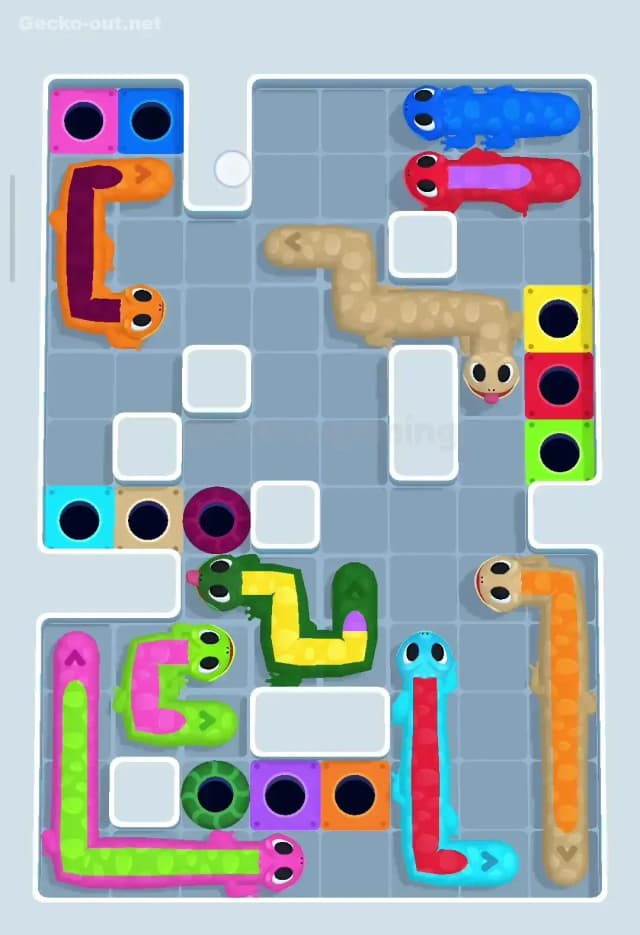
- Route the green–yellow gecko. Use the now‑clear middle to bend it toward its matching hole (usually near the right‑side strip). Draw the path as a tight L or U shape; avoid extra loops.
- Exit red and blue from the top‑right. With the center cleared, you can:
- Pull red down through the middle, then over to its exit.
- Immediately follow with blue along almost the same path. Make sure you don’t leave either body sprawled sideways in the middle; send them directly into their holes rather than “parking”.
- Free the small center gecko. The bright green short gecko in the lower center can now cross through the middle to its nearby exit. Because it’s short, you can use it to probe paths without clogging the board.
During this phase, every path you draw should have a single question in mind: “Will any later gecko need to cross this row or column?” If yes, you either finish the gecko into its exit or park it flush against a wall so the lane stays usable.
End-game: Exit order and dealing with low time
The end-game of Gecko Out Level 233 is mostly about the left side:
- Solve the bottom‑left L‑gecko. With the middle free, drag the big pink–green L‑gecko along the bottom corridor and then up into its exit. Keep it hugging boundaries so it doesn’t reach into the center.
- Finish the gang gecko last or second‑last. Move one head at a time, steering the shared body along the outer edge of the board toward the double gang exit. Avoid cutting across center tiles you still need.
- Clean up any remaining short gecko (like cyan/red). At this point, there should be a clear lane from its parking spot straight into its exit.
If you’re low on time:
- Prioritize any gecko that’s already half‑aligned with its hole; don’t over‑optimize the perfect curve.
- Use simple straight‑line paths, even if they’re a tile longer; thinking time matters more than a tiny distance.
Why This Path Order Works in Gecko Out Level 233
Using body-follow rules to untangle the knot
The path order above works in Gecko Out Level 233 because it respects how bodies follow heads:
- Long geckos (orange, beige/orange, L‑shaped pink) move first and park on edges so their long trailing bodies become walls instead of random snakes.
- Mid‑length geckos (green–yellow, red, blue) then weave through the fixed “wall” pattern and go straight into exits.
- Short geckos and the gang gecko exploit the final open corridors without needing big turns.
You’re basically “drawing” a good maze with the early geckos and then threading the rest through that maze.
Timer management: when to think and when to commit
On Gecko Out 233, I like this rhythm:
- Spend the first 3–5 seconds just reading the board and mentally deciding the first three moves (orange, beige/orange, cyan/red).
- While the timer is still comfortable, draw careful, tight paths for the long geckos.
- Once only short or mid‑length geckos are left, speed up. Their paths are forgiving and rarely ruin the board.
If you find yourself staring too long at the gang gecko, back up and ask: “Which exit am I actually aiming for right now?” Commit to one head’s route first, then the other.
Are boosters needed on Gecko Out 233?
Boosters are optional in Gecko Out Level 233:
- A +time booster helps if you’re still learning the route, but once you know the order, you won’t need it.
- Hammer/undo‑style tools are nice if you mis‑drag a long gecko and sprawl its body across the middle, but that’s more of a safety net than part of the plan.
- Hints usually nudge you toward moving the central geckos early, which matches this strategy anyway.
I’d treat boosters as backup for practice attempts, not the normal solution.
Mistakes, Fixes, and Logic You Can Reuse in Other Gecko Out Levels
Common mistakes on Gecko Out Level 233 (and how to fix them)
-
Exiting the easy small geckos first.
Fix: Always prioritize the long central geckos. Small ones are your “cleanup crew”, not the openers. -
Drawing wavy paths.
Fix: Force yourself to draw only straight segments and right‑angle turns. Think “minimal corners”. -
Parking in the central lane.
Fix: Whenever you stop a gecko before an exit, park it flush against the outer border or behind a white block. -
Moving the gang gecko too early.
Fix: Leave the upper‑left gang alone until the middle and right are mostly solved. It’s much easier when more holes are already occupied. -
Panicking when the timer turns red.
Fix: Commit to simple, direct routes. Don’t try to salvage a perfect setup in the last two seconds—just get bodies into holes.
Reusing this logic in other Gecko Out levels
The pattern you learn in Gecko Out Level 233 carries over really well:
- On other knot‑heavy levels, identify the gecko that blocks the most lanes and route it first, even if its exit looks far away.
- On gang‑gecko stages, delay moving shared bodies until the board is partially cleared, so you don’t drag a huge multi‑head snake through clutter.
- On frozen exit or toll‑gate levels, use long geckos as temporary walls to guide short ones through specific gates, then unspool them later.
Thinking in terms of “who shapes the maze” versus “who just passes through” makes a huge difference.
Final encouragement for Gecko Out Level 233
Gecko Out Level 233 feels brutal at first because every move looks like it makes things worse. Once you respect the central bottleneck and move the long geckos in tight, straight paths, the level suddenly becomes logical—and honestly pretty satisfying.
Stick to the order: open the middle and right, thread the mid‑length geckos, then clean up the left side and the gang. With that game plan, Gecko Out 233 is absolutely beatable without burning boosters, and you’ll come out of it much stronger for the later, even knottier puzzles.