Gecko Out Level 703 Solution Walkthrough | Gecko Out 703 Answer
How to solve Gecko Out level 703? Get step by step solution & cheat for Gecko Out level 703. Solve Gecko Out 703 easily with the answers & video walkthrough.
Gecko Out Level 703: Board Layout, Rules, and Win Condition
The Starting Board and Major Obstacles
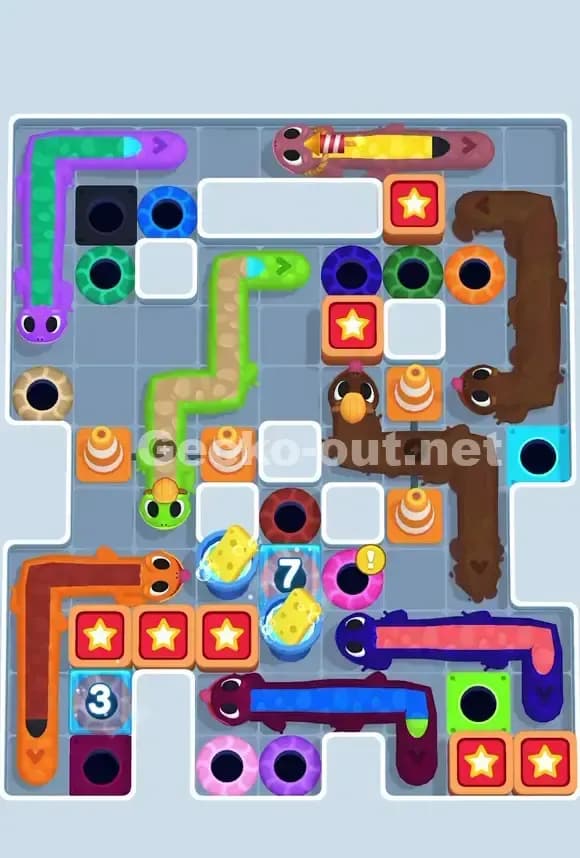
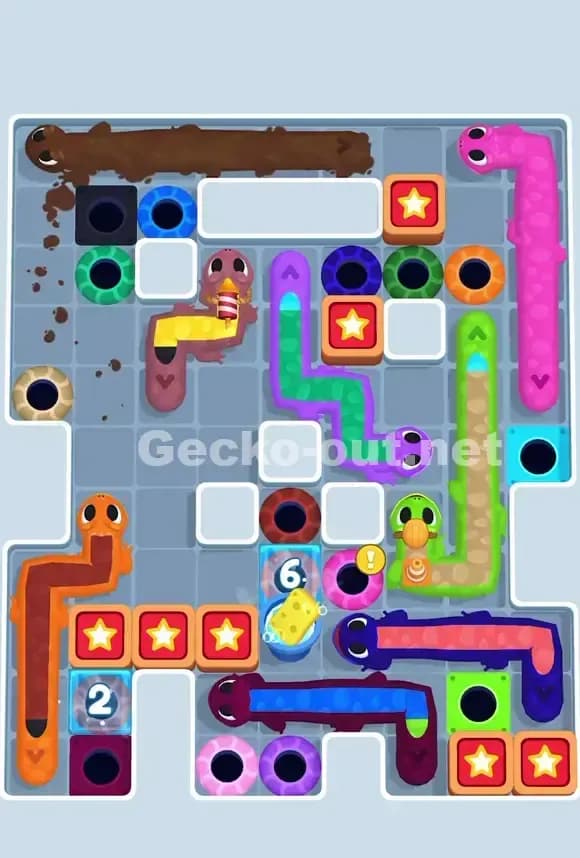
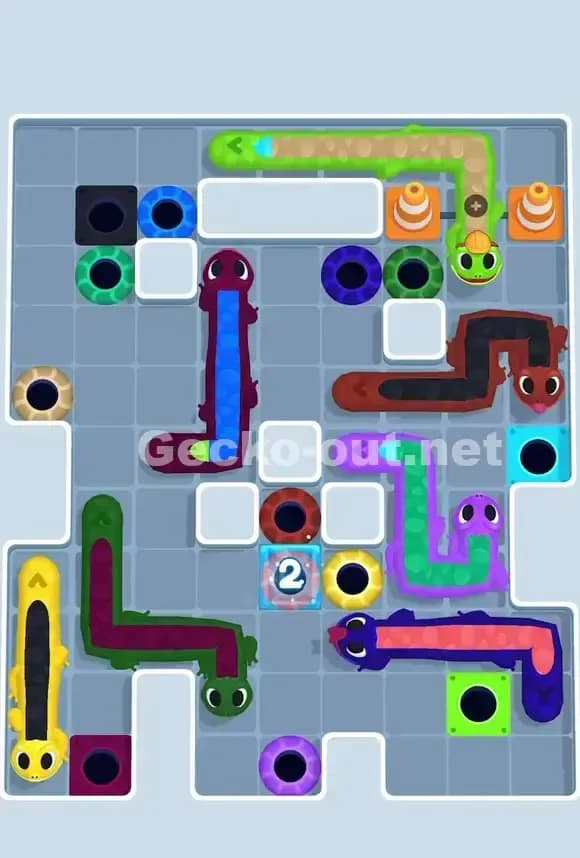
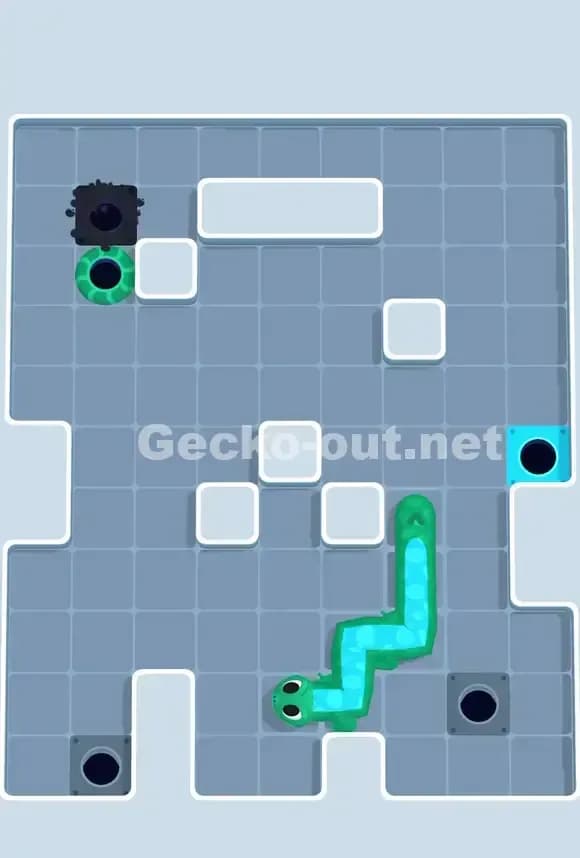
Gecko Out Level 703 is a sprawling, multi-colored puzzle with eight geckos spread across a dense grid crammed with walls, locked exits, and gang geckos. You'll find a purple gecko in the top left, a yellow gecko at the top center, an orange gecko on the right flank, and a cluster of four geckos (blue, green, pink, and red) dominating the center and lower sections. Two brown gang geckos are linked together on the right side, meaning they move as a single unit and both must reach their exit holes without breaking apart. The board is choked with white walls and blank spaces that funnel movement into tight corridors, while a series of star-marked locked exits (in the center and lower-left area) add an extra layer of complexity. The timer sits at 7 moves—yes, only seven—which means you cannot afford wasted turns or messy repositioning.
The win condition is straightforward: drag each gecko head along a valid path to guide its body to a hole of matching color before the timer reaches zero. All eight geckos must escape, including the two-headed brown gang, or you fail. The challenge isn't just finding exits; it's choreographing a sequence that keeps the board unblocked so later geckos can actually move without colliding with stationary bodies already in place.
Understanding the Timer and Drag-Path Mechanics
The timer is your silent pressure. With only seven moves, you're not replaying the level cautiously; you're committing to a deliberate sequence from turn one. The drag-path mechanic amplifies this tension: when you drag a gecko head, its body follows every pixel of the route, so a winding path eats up grid space and can accidentally trap a second gecko if you're not careful. This isn't a puzzle where you nudge pieces gently; it's one where the order and shape of every drag matters enormously. A well-placed gecko clears a corridor; a careless one becomes a permanent roadblock.
Pathing Bottlenecks and Logical Traps in Gecko Out Level 703
The Central Corridor Choke Point
The single biggest bottleneck in Gecko Out Level 703 is the central vertical corridor running down the middle of the board. This narrow passage is the only viable exit route for at least three geckos (the green, blue, and one of the center gang members), yet the corridor is barely wider than two gecko bodies side by side. If you drag a long gecko—say, the blue gecko with its extended body—through this space first without a clear exit strategy, you'll block the corridor for everyone else behind it. I found myself stuck here on my first three attempts, realizing too late that I'd painted myself into a corner by letting the blue gecko sprawl across the very lane everyone else needed. The moment it clicked was when I realized the blue gecko had to exit before the green gecko entered the corridor, not after.
Subtle Traps: The Gang Gecko Tangling Risk
The two brown gang geckos linked on the right side are deceptively dangerous. Because they move as one unit, their combined length is roughly twice a single gecko, which means finding a path that accommodates both heads without their bodies wrapping around walls or other geckos is fiendishly hard. Many players try to thread the gang geckos through the center corridor too early, only to discover the path is too winding and their bodies overlap a wall, causing an instant fail. The gang geckos need their own dedicated exit route—or they need to move so early that the board is completely clear for their two-headed escape. This is counterintuitive because you'd normally save the hardest puzzle pieces for last; here, the gang geckos often need to go first or second to prevent a gridlock disaster.
The Locked Exit Trap
Gecko Out Level 703 includes several star-marked locked exits, which means certain geckos cannot use those holes. If you misread which gecko is supposed to exit where, you'll drag a gecko's head toward a locked hole, waste precious moves backtracking, and lose your narrow time window. The locked exits also sit in high-traffic areas, so they clutter the board without being usable, which further restricts pathing for geckos that can use the remaining open exits.
A Moment of Frustration and Breakthrough
I'll be honest: my first five attempts felt like flailing. The timer was so tight, and the board so convoluted, that I kept moving geckos in an order that seemed logical at the time but left later geckos stranded. The breakthrough came when I stopped trying to push geckos toward exits and instead asked myself, "Which gecko is blocking everyone else?" The answer was always the brown gang. By committing to their exit first, I cleared the right side of the board and opened a domino effect: the orange gecko could then move, the green could follow, and suddenly the center corridor wasn't a parking lot anymore. It's not a complicated realization, but under timer pressure, it's easy to miss.
Turn-by-Turn Path Strategy to Beat Gecko Out Level 703
Opening: The Gang Gecko Commitment
Start by exiting the brown gang geckos. These two linked heads occupy too much real estate, and their body path is long and winding. Drag the gang gecko heads along the right-side corridor toward their exit holes on the far right. This move, despite seeming wasteful (you're "only" exiting two geckos), clears a massive zone and prevents their bodies from fouling later paths. Don't try to be clever by dragging them through the center; trust the right-side route even if it looks longer. The psychological win here is that you've solved your biggest obstacle and proven to yourself that the level is solvable. Park nothing; your first move should be a clean exit, not a repositioning maneuver.
Mid-Game: Clearing the Right Flank and Center Lanes
Once the gang geckos are out, move the orange gecko next. The orange gecko is on the right side and, now that the gang is gone, has a clear path to its exit hole. Exit it immediately; this further depressurizes the board. Now tackle the yellow gecko at the top center. Don't overthink its path; drag it downward and around the white walls, aiming for the yellow exit hole in the center-right area. The yellow gecko's body is compact, so it won't clog corridors the way longer geckos do.
After these three, the center corridor is starting to open. Now address the blue and green geckos, which are clustered near each other. Here's the critical sequence: exit the blue gecko before the green gecko. The blue gecko's path should curve downward through the right side of the board or around the white wall clusters, eventually reaching the blue exit hole. Its body will be stretched, but now that the right side is clear, this elongated path won't jam anyone. Immediately after, drag the green gecko along the central corridor (now unobstructed) toward its green exit.
End-Game: The Final Sprint
You should now have four geckos exited and three remaining: the purple, the pink, and the red. The purple gecko is on the left; drag it downward along the left corridor toward the purple exit hole in the lower-left area. The path here is relatively straightforward because you've already cleared the center and right, so the purple has its own lane.
For the pink and red geckos in the lower center area, exit whichever is closest to its matching exit hole first—typically the red gecko, whose exit is marked with a star and lies in the center-lower region. Drag its head toward that hole, curving around any remaining white walls. Finally, drag the pink gecko toward its pink exit on the right-lower section.
By the time you've reached this sequence, you should have one or two moves left on the timer. If you're running low, move decisively; don't pause to second-guess. The board is uncluttered, and straightforward paths are available.
Why This Path Order Works in Gecko Out Level 703
How Head-Drag Pathing Avoids Tangling
The key insight is that every gecko you exit removes a potential collision hazard for the next gecko. By exiting the gang geckos first—despite their complexity—you eliminate the most space-hungry piece from the board. This creates a cascading effect where each subsequent gecko has more room to maneuver. The drag-path mechanic rewards this because a gecko dragged through an open, empty board can take a curved or wound path without fear of overlapping another gecko's resting position. If you tried to exit geckos in a random order, you'd eventually drag a head and realize its body collides with a gecko you'd placed moments ago, and you'd waste turns undoing the move.
The purple gecko is saved for later not because it's hard, but because its left-side route doesn't compete with the central and right corridors, so it can exit whenever the board has any free space at all.
Managing the Timer: When to Pause and When to Commit
With only seven moves, you cannot afford a full pause-and-analyze moment between every turn. Instead, pause before your first move for about 20 seconds and map out the entire sequence in your head: gang geckos → orange → yellow → blue → green → purple → pink/red. Once you've locked in this order, move quickly. Each move should take 3–5 seconds: drag the head, trace the path to the exit hole, and release. Hesitation in the middle is your enemy.
That said, if you catch yourself mid-drag about to collide with another gecko, don't be afraid to cancel the move and reconsider. A single canceled move is less costly than committing to a collision and wasting a turn recovering. The timer rewards speed, not recklessness.
Boosters: Optional, Not Necessary
Gecko Out Level 703 does not require boosters to beat. The level is designed so that the optimal sequence—gang geckos, then right flank, then center, then left—fits comfortably within the seven-move limit. However, if you've failed three or four times and are frustrated, a booster that adds extra time (say, +2 moves) can ease the pressure and let you move more deliberately. A hint booster is less useful here because the puzzle is more about execution than discovery; you already know what the exits are and where the geckos are. Save boosters for when you're truly stuck, not for your first attempt.
Mistakes, Fixes, and Logic You Can Reuse in Other Gecko Out Levels
Common Pitfall #1: Exiting Geckos in Color-Matched Isolation
Many players try to exit the purple gecko first because it's on the left edge, assuming edge geckos are "free." Gecko Out Level 703 punishes this by leaving the brown gang and orange gecko untouched, so they clog the board as you struggle to reach less obvious exits. Fix: Prioritize geckos that are physically large or occupy high-traffic areas, not geckos that happen to be easy.
Common Pitfall #2: Attempting a "Perfect Route" for Every Gecko
Some players get stuck trying to find the shortest or most elegant path for each gecko, dragging and re-dragging the head to optimize. This wastes timer moves. Fix: Any path that reaches the exit without collision is valid. Speed matters more than elegance under timer pressure.
Common Pitfall #3: Not Reading the Locked Exits
A surprising number of players drag a gecko toward a star-marked hole, only to realize it's locked and their gecko bounces back. This costs a move and derails the sequence. Fix: Before you move, glance at the exit holes and confirm which geckos can use which exits. Spend 10 seconds on this upfront to save 2+ moves later.
Common Pitfall #4: Dragging the Gang Geckos Through the Center Corridor
The gang geckos' combined length makes them seem like they should take the "main highway" through the center. Instead, they almost always jam it. Fix: Route the gang geckos along the perimeter (right side, for instance) or in a path that's clear before other geckos move.
Common Pitfall #5: Forgetting That Positioned Geckos Block Everything
Players sometimes drag a gecko 90% toward an exit, realize the path is wrong, and try to reposition by dragging it sideways. But its body is now splayed across a corridor, and that sideways drag fails because the body overlaps a wall. Fix: Commit fully to a drag direction. If a path is wrong, cancel entirely, wait a moment, and start a new drag from the gecko's current head position, not from mid-motion.
Reusing This Logic on Similar Levels
Gecko Out Level 703's lesson—prioritize space-heavy geckos first, then work systematically through color-matched exits—applies to any level with gang geckos, locked exits, or tight corridors. If you see a level with two linked geckos, exit the gang first. If you see a level with more exits than geckos, read the locks carefully. If the timer is tight (under ten moves), map the full sequence before you touch anything. This disciplined approach transforms chaotic levels into solvable puzzles.
Final Encouragement
Gecko Out Level 703 is genuinely tough—the timer, the gang geckos, and the locked exits combine to create real puzzle tension. But it is absolutely, 100% beatable with a clear plan and decisive execution. The level doesn't require luck or a booster; it requires you to see the board's biggest bottleneck, exit it decisively, and trust that the remaining geckos will fall into place. Once you've beaten it, you'll have the confidence to tackle even knottier levels ahead.