Gecko Out Level 1150 Solution Walkthrough | Gecko Out 1150 Answer
How to solve Gecko Out level 1150? Get step by step solution & cheat for Gecko Out level 1150. Solve Gecko Out 1150 easily with the answers & video walkthrough.



Gecko Out Level 1150: Board Layout, Rules, and Win Condition
Starting Board: Geckos, Colors, and Obstacles
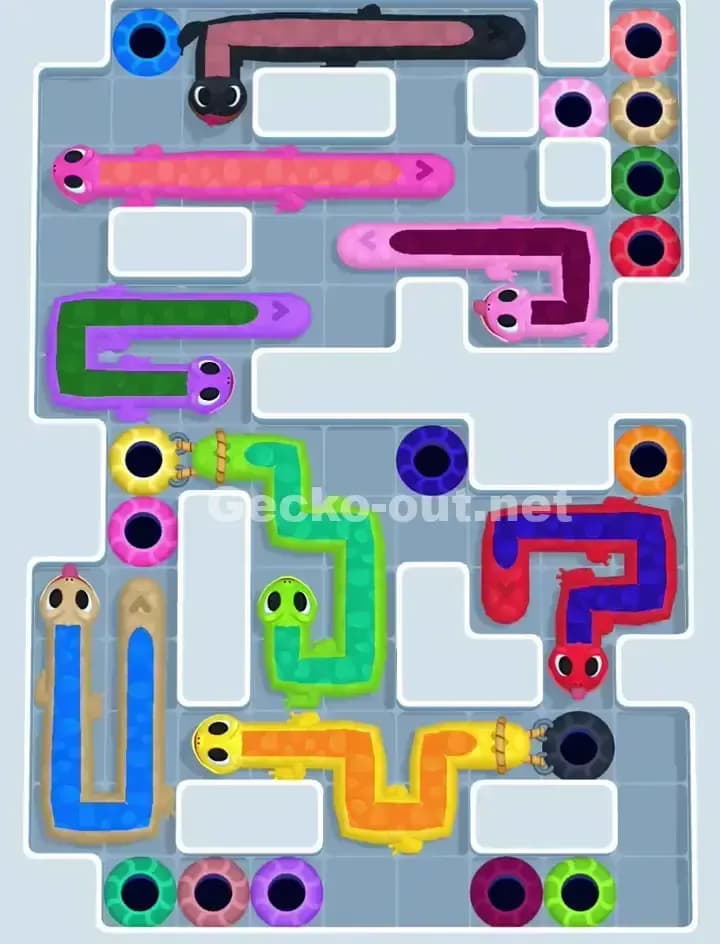
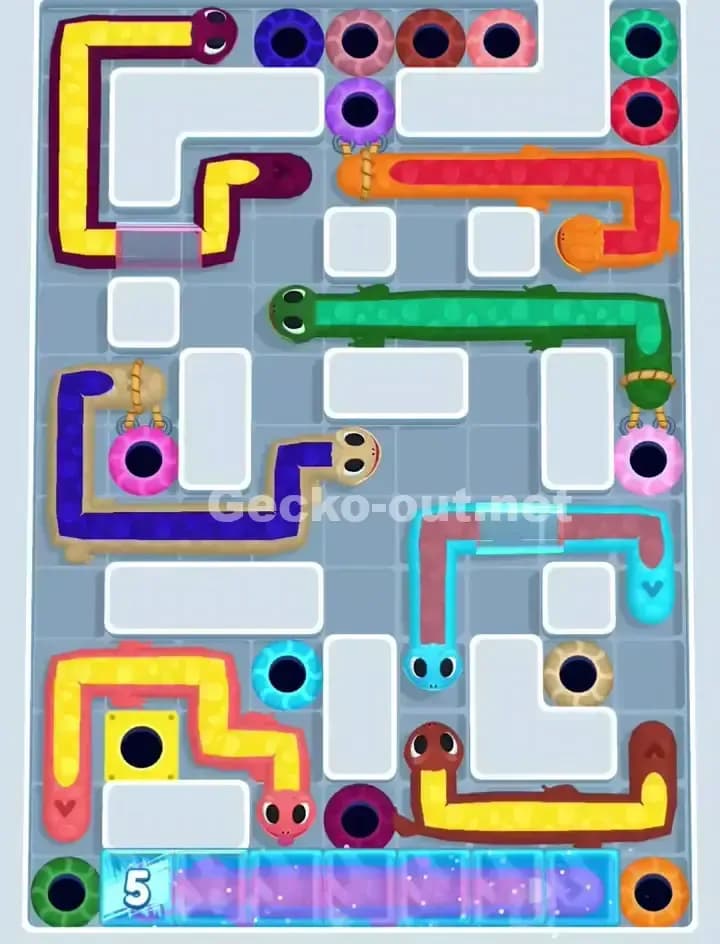
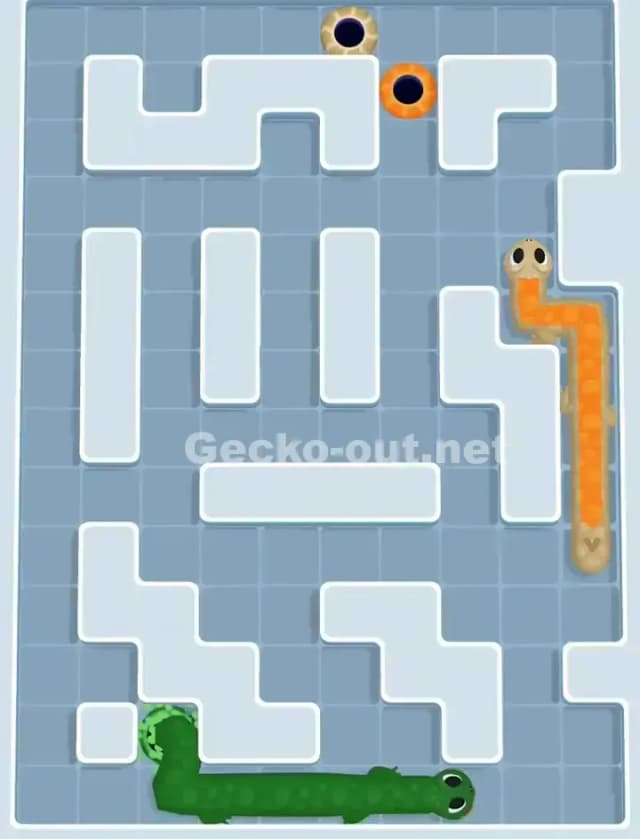
Gecko Out Level 1150 is a dense, multi-color puzzle that demands careful sequencing and spatial awareness. You're facing at least eight geckos spread across the board in different colors: pink, red, yellow, green, cyan, blue, orange, and purple. Each gecko's head starts in a distinct zone, and their bodies stretch across the board like tangled yarn. The walls form a tight maze of white corridors with colored gang paths (linked walls that move together) running through the middle sections. There are multiple exit holes positioned around the perimeter, each matching a specific gecko color, and you'll notice frozen or locked exits that can't accept certain geckos until conditions are met. The board feels cramped, and that's intentional—the puzzle wants you to think about order, not just individual paths.
Win Condition and Timer Pressure
To beat Gecko Out Level 1150, every gecko must reach its matching-colored hole before the timer expires. The timer is typically generous enough if you move decisively, but it's not forgiving if you waste moves or create deadlocks. Because movement is path-based (the gecko's body follows the exact route you drag the head), one wrong drag can trap another gecko or block a critical exit lane. This is where Gecko Out Level 1150 gets its teeth—you can't just move fast; you have to move smart. The pressure isn't just the clock; it's the puzzle itself resisting bad decisions. Every gecko you move either opens or closes options for the next one.
Pathing Bottlenecks and Logical Traps in Gecko Out Level 1150
The Central Choke Point: The Cyan Gecko's Long Body
The biggest bottleneck in Gecko Out Level 1150 is the cyan gecko, which has an unusually long body that cuts diagonally across the middle of the board. This gecko occupies space that other geckos need to traverse to reach their exits. If you move the cyan gecko carelessly, its body will block multiple escape routes simultaneously. Conversely, if you route it too late, you'll find the board so congested that there's no safe path left. The cyan gecko is your pivot point—move it early and decisively, but plan its exit carefully so its body doesn't slam shut the corridors others depend on.
Subtle Traps: Gang Walls and the Red-Green Linkage
Watch out for the colored gang paths running through the middle. In Gecko Out Level 1150, the red and green linked walls move as a unit, which means dragging a gecko through that zone can trigger unexpected wall shifts if another gecko interacts with the gang. This isn't obvious at first glance, and many players accidentally jam a gecko into a wall that suddenly retracts or blocks. Test your understanding: if you move a red gecko through the gang area, does a linked green wall shift? Yes, it does. Plan accordingly by moving gang-dependent geckos in a sequence that prevents collision traps.
The Orange Gecko and the Right-Side Overflow
The orange gecko occupies the right side of the board and has a moderate-length body. The problem? Its exit hole is tucked into the far right corner, and the corridor leading there is narrow. If you move other geckos into that area first, the orange gecko will have nowhere to go, and you'll be forced to backtrack and reroute. This is a classic "order matters" trap that catches players who don't preview the entire exit chain before moving.
Personal Reaction: The Frustration Breakthrough Moment
I'll be honest—Gecko Out Level 1150 frustrated me for a few attempts because I kept thinking about individual gecko paths instead of the board as a choreography. It felt like herding cats that were also on fire. But then I realized: the cyan gecko's long body wasn't my enemy; it was my guide. Once I committed to routing it out first, the rest of the board suddenly felt spacious. That's when Gecko Out Level 1150 clicked—it's not a puzzle about finding paths; it's a puzzle about sequencing which gecko to unblock to open space for the next one. The breakthrough came when I stopped panicking and started planning backward from the exits.
Turn-by-Turn Path Strategy to Beat Gecko Out Level 1150
Opening: Park the Long Geckos Safely
Start by identifying which geckos have the longest bodies. In Gecko Out Level 1150, your first move should be the cyan gecko. Drag its head toward its exit hole (positioned on the left-center area), but move it in a slow arc that avoids the central gang wall zone initially. Your goal is to clear that body off the middle of the board so other geckos have breathing room. Don't rush the cyan gecko all the way out yet—instead, position it in a "holding zone" where its body doesn't block future paths. This might mean leaving it coiled near its exit but not committed, so you can still adjust if needed.
Next, tackle the pink gecko on the left side. Its body is also moderately long and runs vertically. Drag it upward toward the pink exit hole at the top-left. Again, move it methodically so its body doesn't wrap around and block the cyan gecko's planned exit route. The key to the opening phase is layering exits: move the longest geckos first, but leave them in safe holding zones so they don't create new jams.
Mid-Game: Maintain Open Lanes and Reposition Gang-Adjacent Geckos
Once the cyan and pink geckos are staged, you have two parallel tasks. First, begin routing the red gecko through the gang wall corridor. The red gecko should move before the green gecko because the gang linkage means moving red can shift green, and you want to control that interaction. Drag the red gecko's head carefully along the gang path, watching for the moment when the green wall shifts. Then, pause and assess: does your next move depend on that wall position? If yes, commit. If no, reconsider the sequence.
Second, start moving the smaller, more mobile geckos (like the blue and orange ones) into intermediate zones that keep them out of the path of the big players. The blue gecko should skirt around the bottom of the board, away from the cyan gecko's holding zone. The orange gecko should stay in the right-side corridor for now, waiting for its moment.
During this phase, you're essentially playing 3D chess in 2D: every move opens one lane and closes another. Move deliberately, and when you feel the board tightening, pause and re-examine the exit hierarchy. Which gecko must go next to keep options alive for the others?
End-Game: Sequence the Final Exits and Avoid Last-Second Deadlocks
By the end-game phase of Gecko Out Level 1150, you should have three to four geckos left on the board, and the remaining space should feel spacious compared to the opening. Now comes the critical sequence. Exit the cyan gecko fully—it's served its purpose as the board-opener, and its long body is no longer needed. Immediately route the yellow gecko (typically positioned in the center-top) toward its yellow exit hole. The yellow gecko usually has a straightforward path once the cyan gecko is gone.
Next, commit the red and green geckos to their exits in quick succession. Since they're gang-linked, moving one might shift the other slightly, but at this stage, you have enough space to absorb that. Finally, push the blue, orange, and any remaining geckos toward their exits in order of proximity to their holes. If the timer is ticking below 20 seconds and you have two geckos left, don't panic—just commit to a path for each. Gecko Out Level 1150 usually has enough time if you haven't created deadlocks earlier.
Why This Path Order Works in Gecko Out Level 1150
The Head-Drag Method and Body-Follow Logic
Gecko Out Level 1150 rewards this strategy because the body-follow mechanic means the path you draw is fixed. If you drag the cyan gecko through a tight corridor first, its body occupies that space and can't be "un-drawn." By moving it early, you're pre-committing to a permanent path, but you're doing it when the board is spacious and you can see all your options. Later moves become easier because the big obstacles are already positioned and won't move again. This is the inverse of traditional puzzle logic—you want to nail down the hardest, longest pieces first, not last.
Timer Management: When to Pause and When to Commit
On Gecko Out Level 1150, pause after every third gecko to reassess the remaining board. Ask yourself: "Are the remaining geckos closer to their exits or further away than before?" If closer, you're on pace. If further, you've likely made a sequencing error and need to rethink. Don't pause constantly—that burns time—but strategic pauses (three to five in a full run) let you catch mistakes before they cascade. Commitment comes once you've mentally verified that a gecko's path doesn't create a new bottleneck. Drag decisively then, don't hesitate mid-path.
Booster Strategy: When (or If) to Use Them
Gecko Out Level 1150 is solvable without boosters if you execute the strategy correctly, but if you're at 10 seconds and two geckos remain with no clear exits, using an extra-time booster is justified. A hammer-style tool (if available) can clear a particularly nasty wall, and hints can reveal the intended exit order if you're truly stuck. However, treat boosters as emergency brakes, not cruise control. The real solution is the plan: cyan first, pink second, gang geckos third, then the smaller geckos. Stick to that, and you won't need help.
Mistakes, Fixes, and Logic You Can Reuse in Other Gecko Out Levels
Common Mistake #1: Moving Short Geckos Before Long Ones
Many players move the blue or orange gecko first because they feel quick and easy. This is a trap. Short geckos should go last because they're flexible—they can navigate tight remaining spaces that long geckos can't. Moving them early wastes their advantage and leaves long geckos with no room. Fix: Always prioritize geckos by body length, not by perceived ease.
Common Mistake #2: Ignoring Gang Wall Interactions
Players often move a red gecko without considering that the linked green wall will shift. Then, suddenly, an exit that was open is blocked. Fix: Before moving any gecko adjacent to a gang zone, trace what wall movements will occur and verify that your next planned move still has a path afterward.
Common Mistake #3: Routing a Gecko to Its Exit Too Early
You move the cyan gecko all the way to its exit hole on turn two, thinking you've cleared it. But then, two geckos later, its body is blocking the only remaining path for another gecko, and you're stuck. Fix: Use "holding zones"—stage geckos near their exits but not fully committed, so you can abort and reroute if the board tightens unexpectedly.
Common Mistake #4: Underestimating Corridor Width
The corridors in Gecko Out Level 1150 look wider than they are because of the visual styling. You misjudge and drag a gecko through a path that clips a wall. Fix: Always drag slightly off-center in corridors; give your gecko a margin of error.
Common Mistake #5: Panic-Moving When the Timer Is Low
With 15 seconds left, you rush and make two bad moves in a row, creating a deadlock that didn't exist before. Fix: Even under time pressure, stick to your plan. If the plan is sound, fast execution beats panicked improvisation every times.
Reusing This Logic on Similar Levels
This sequencing strategy—"longest geckos first, shortest last"—applies to any Gecko Out level with multiple geckos and gang walls or frozen exits. Whenever you see a long gecko body occupying central board space, it's your opening move. Whenever you see linked gang walls, plan the interaction before moving anything near them. Whenever you see exits clustered in one zone, route geckos to spread-out exits first, then converge on the cluster at the end. Gecko Out Level 1150 is teaching you a meta-skill: read the board as a system, not as isolated puzzles.
Final Encouragement
Gecko Out Level 1150 is genuinely tough, but it's not unfair. It's a level designed to reward planning and punish hasty moves—which is exactly what makes it solvable and satisfying. Once you've beaten Gecko Out Level 1150, you'll have the confidence and pattern recognition to handle similar density and complexity in later levels. You've got this. Start with cyan, sequence deliberately, and watch the board open up.