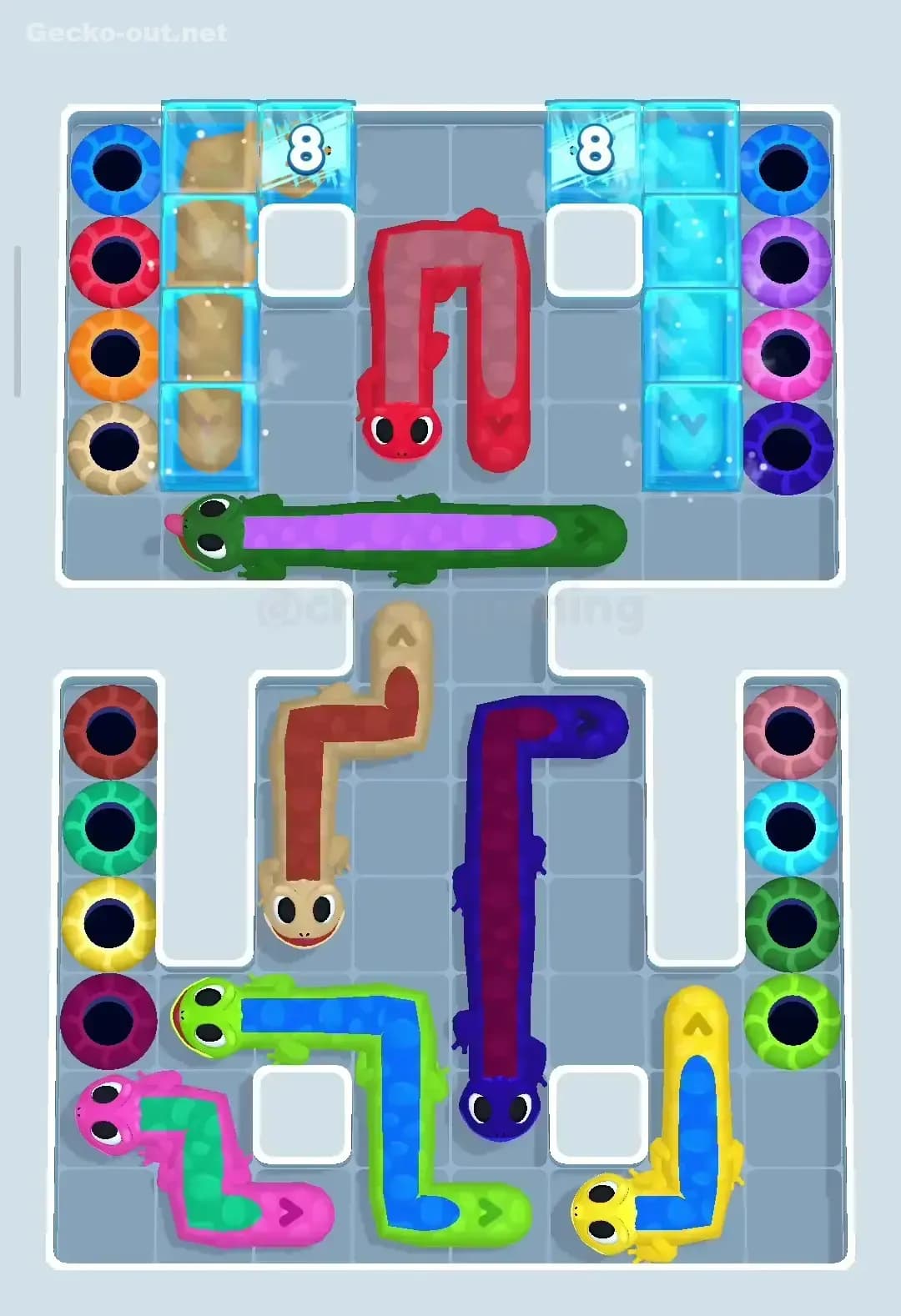
Gecko Out Level 116 Solution Walkthrough | Gecko Out 116 Answer
How to solve Gecko Out level 116? Get step by step solution & cheat for Gecko Out level 116. Solve Gecko Out 116 easily with the answers & video walkthrough.
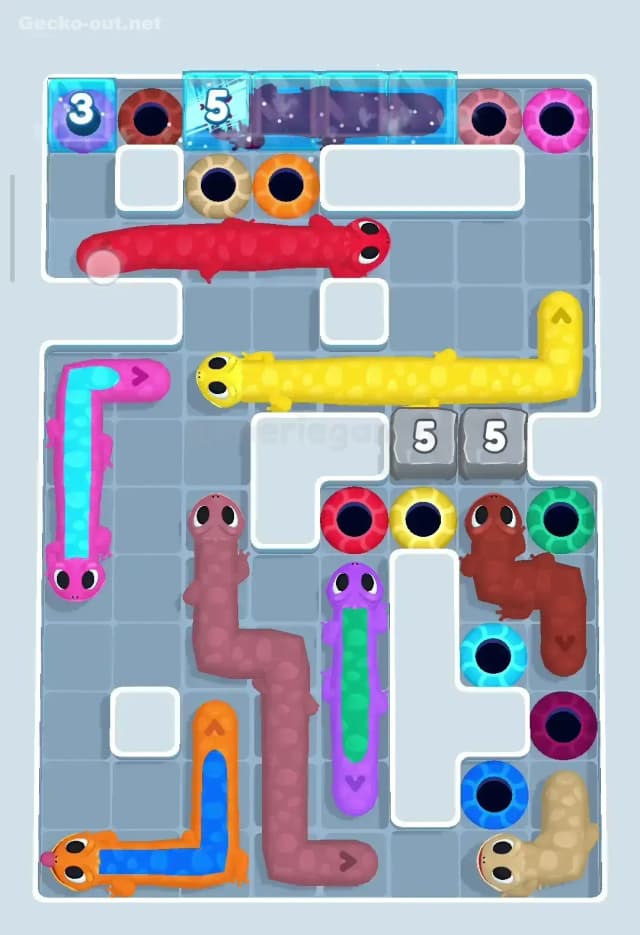
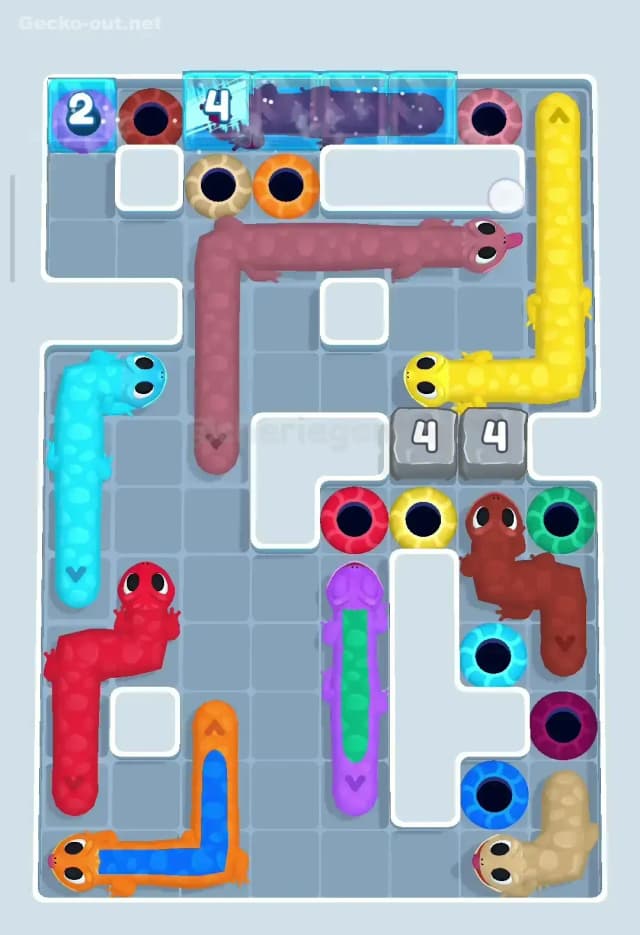
Gecko Out Level 116: Board Layout, Rules, and Win Condition
How the board is set up
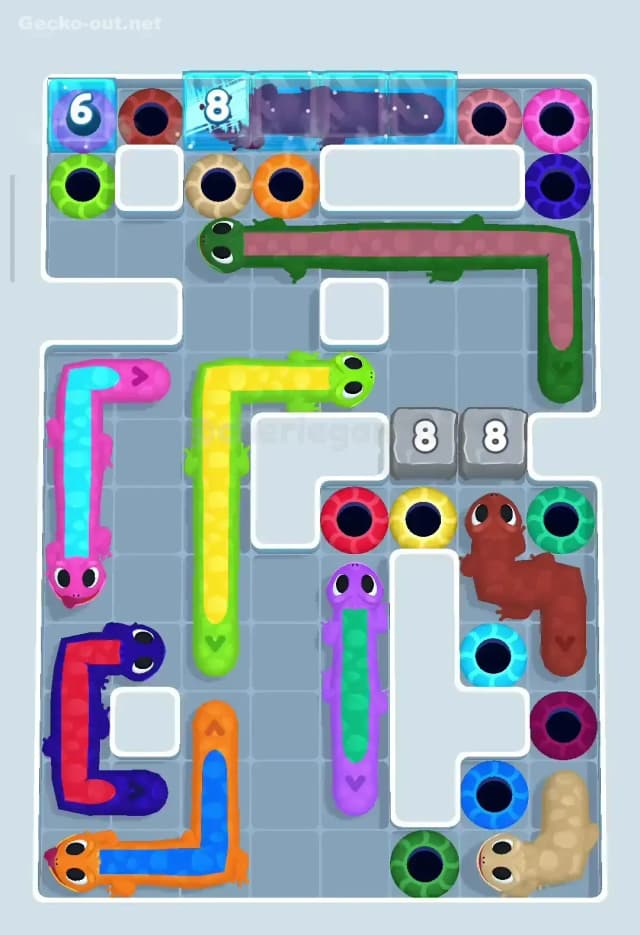
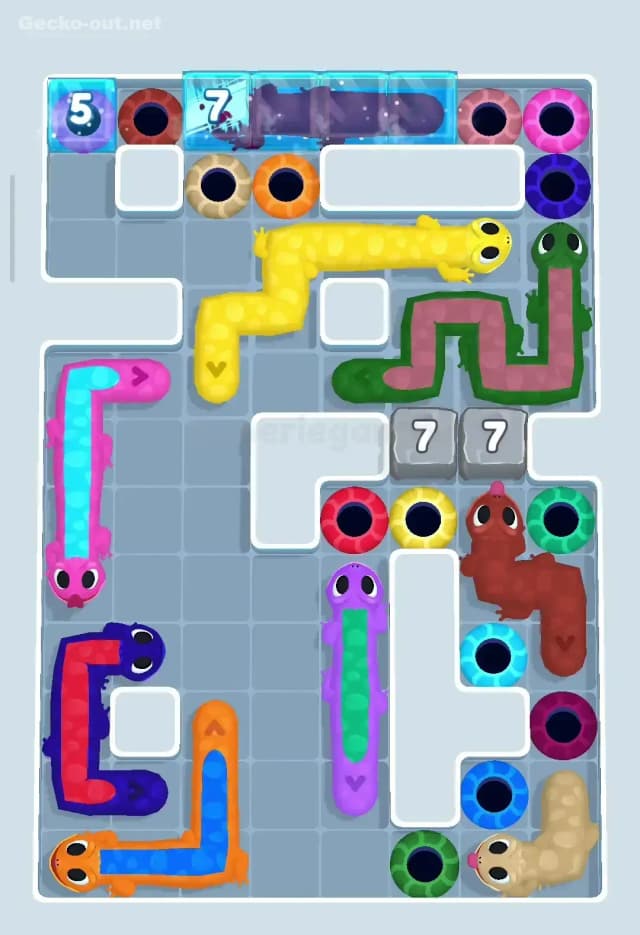
In Gecko Out Level 116 you’re looking at a crowded, almost maze‑like grid packed with geckos of different lengths and colors. There are a few key features to notice before you drag anything:
- A long green gecko stretches across the upper half of the board, hugging the right wall and acting like a sliding gate for the entire level.
- Several L‑shaped geckos sit in the lower left: an orange‑and‑blue one in the corner and a dark blue one just above it, plus a tall pink/cyan “gang” gecko along the left edge.
- The middle of the board is broken up by white wall blocks that create narrow corridors and two or three small “parking bays.”
- On the right side and top edge there’s a dense cluster of colored holes, including multiple exits jammed together and some icy/frozen tiles and numbered blocks (extra time and/or frozen lanes).
- A thick brown gecko and a beige gecko live in the lower‑right quadrant, practically on top of a stack of exits.
- A vertical purple gecko and an L‑shaped yellow/green gecko occupy the center, pointing toward the right‑side exits but with almost no wiggle room.
You’ve got lots of geckos, but just a handful of usable lanes. Gecko Out 116 is really about turning those lanes into a sequence rather than trying to brute‑force everyone out at once.
What you need to win (and why the timer matters)
The win condition in Gecko Out Level 116 is the same as always: drag each gecko’s head so its body traces a path to the matching‑color hole without overlapping walls, other bodies, or locked/icy exits. Every segment of the body follows exactly where you drag the head, so every extra bend costs you both space and time.
The level’s strict timer is the second constraint. Because you’re dragging long, twisty paths through narrow corridors, you don’t have time to experiment wildly once the clock starts. Long, loopy detours around the board basically equal failure. You need:
- Short, efficient paths.
- A clear order of operations so you aren’t dragging one gecko back and forth to unblock another.
- A mental note of one or two safe “parking zones” where you can stash bodies briefly.
If you treat Gecko Out 116 like a speed puzzle rather than a logic puzzle, it feels impossible. But once you see the structure, you can run it in smooth, quick motions.
Pathing Bottlenecks and Logical Traps in Gecko Out Level 116
The main bottleneck that controls the board
The biggest bottleneck in Gecko Out Level 116 is the central‑right corridor leading to the cluster of holes next to the grey “8” blocks and the brown gecko. Almost every gecko in the middle wants to pass through this one‑tile‑wide lane:
- The vertical purple gecko.
- The yellow/green L‑shaped gecko.
- The brown and beige geckos near the exits.
- Eventually, the long green gecko up top.
If you park anything long in that lane—even for a second—you block the rest of the board. The whole strategy revolves around feeding geckos through that corridor one at a time while holding the others in staging areas.
Subtle problem spots that ruin otherwise good runs
There are a few nasty traps that keep Gecko Out 116 from being a simple “clear from bottom to top” level:
- The long green gecko at the top can easily seal off the upper exits or trap other geckos under it if you drag it sideways without thinking. If you bend it down in the wrong place, it becomes a permanent wall.
- The yellow gecko in the center is tempting to exit early because it looks straightforward. But exiting it through the middle too soon can box in the purple gecko and block paths for the brown one.
- The bottom‑left L‑shaped geckos look “free,” yet those squares are actually your best early parking zone. If you rush them out first, you lose flexible space to store bodies while the right side untangles.
Each of these mistakes feels fine in the moment, but you’ll notice you suddenly have one gecko with no possible line to its hole.
When the level finally clicks
For me, Gecko Out Level 116 felt unfair at first. I’d get six or seven geckos out, then hit a completely blocked exit with seconds left. The turning point was when I stopped trying to solve “who can exit now?” and flipped it: “who must NOT move yet?”
Once I treated the long green gecko and the right‑side corridor as resources I had to protect, the solution started to make sense. I realized I should:
- Open space in the middle.
- Use bottom‑left as a temporary garage.
- Save the long, top and right‑side paths for late, clean exits.
After that, it became a repeatable route instead of a lucky scramble.
Turn-by-Turn Path Strategy to Beat Gecko Out Level 116
Opening: create space and pick your parking zones
In the opening of Gecko Out 116, you’re not trying to exit anyone immediately. You’re carving out room:
- Nudge the tall pink/cyan gang gecko on the left straight up or slightly into the top‑left area. Keep its path tight so it hugs the left wall; this frees the central column.
- Gently shift the long green gecko so it’s not clamping down on the top middle. Park it in a tidy horizontal/vertical shape that stays near the top and right walls, not dangling into the central corridor.
- Slide the lower‑left blue and orange L‑shaped geckos into more compact shapes while keeping that bottom‑left quadrant as your main parking zone. Don’t send them to their exits yet; you want those bodies available to act as “temporary walls” that other geckos can slide around.
When you’ve done this correctly, the middle of the board opens up and the one‑tile lanes near the grey “8” blocks are visible and accessible.
Mid-game: thread the central geckos through the right lane
Mid‑game in Gecko Out Level 116 is about feeding the middle geckos through the right corridor in a safe order:
- Use the newfound middle space to route the vertical purple gecko toward its matching hole on the right side. Drag the head in a smooth curve that hugs the central wall, avoiding loops that would later block the brown or beige gecko.
- Next, guide the yellow/green L‑shaped gecko across the middle and out to its hole. Again, think “short and tight”: you want its body to lie flush against walls, not sprawling into open squares.
- As you clear these, adjust your parking in the lower left if needed—shuffle the blue/orange geckos slightly but keep them out of the right lane.
Once the central geckos are out, the right‑side cluster looks much less scary. You’ll see a mostly clear vertical lane running from mid‑board down to the brown and beige geckos and their exits.
End-game: clean exits and timer management
The end‑game sequence usually looks like this:
- Exit the brown gecko through the right‑side cluster first. It’s thick and awkward, so you want maximum space for its path. Drag its head in a gentle S‑curve that slips past the grey blocks and directly into its hole.
- Follow with the beige gecko, using almost the same lane. Because the brown gecko is gone, you can take an even shorter route.
- Now clear the bottom‑left blue and orange geckos. With the right side empty, you can angle them up and across without worrying about blocking others.
- Finish with the long green gecko at the top. Drag its head along the cleaned‑up corridors to its exit in a single smooth motion, using the empty central spaces to avoid kinking the body.
If you’re low on time at this stage, prioritize straight, direct lines. Don’t chase every extra‑time number if it forces a huge detour; the short path is usually faster than a time bonus that adds distance.
Why This Path Order Works in Gecko Out Level 116
Using body-follow rules to untangle instead of tighten
The whole plan for Gecko Out 116 revolves around the body‑follow rule. By moving geckos in an order that keeps their bodies tight against walls and in parking zones, you:
- Avoid creating new “soft walls” in the only viable corridors.
- Let later geckos reuse the same empty lanes, especially on the right.
- Prevent long geckos (green and brown) from snaking through the middle too early and cutting off everyone else.
You’re essentially drawing invisible rails that later geckos ride on, instead of leaving random curves all over the board.
Balancing thinking time versus fast execution
On a fresh attempt at Gecko Out Level 116, I’d recommend:
- First run: don’t worry about the timer; just experiment and observe which moves cause irreparable blocks.
- Next runs: follow the order above and commit. Make decisive, continuous drags instead of micro‑adjusting each gecko.
Most of your “thinking time” should happen before you touch the long green gecko or send anyone through the right corridor. Once that lane is open and you know the order, you want to execute almost in one flow.
Boosters: helpful, but not required
Boosters in Gecko Out 116 are nice but optional:
- Extra time: useful if you’re consistently timing out with one gecko left. Use it early so you don’t rush the mid‑game threading.
- Hammer/unlock tools: only consider them if you absolutely can’t manage the frozen or blocked sections. With the path order above, you shouldn’t need them.
- Hints: if you’re stuck on which gecko to move first, a single hint can confirm the opening, then you can finish the rest yourself.
The level is fully beatable without burning any boosters once you understand the bottlenecks.
Mistakes, Fixes, and Logic You Can Reuse in Other Gecko Out Levels
Common mistakes in Gecko Out Level 116 (and how to fix them)
-
Exiting the “easy” bottom‑left geckos first
Fix: treat that corner as a parking zone. Leave blue/orange for late‑game after the central and right corridors are clear. -
Over‑dragging the long green gecko
Fix: only move it enough to free space, and keep its body tight to the top and right edges until it’s the final or near‑final exit. -
Blocking the right corridor with a mid‑length gecko
Fix: mentally draw a “no‑parking” line through that lane. Geckos should pass through and exit, not sit there. -
Drawing big decorative loops
Fix: always aim for the shortest route that still avoids collisions. Every bend costs time and creates potential traps for later geckos. -
Chasing time tiles with slow, winding paths
Fix: compare the detour to the bonus. In Gecko Out Level 116, most long detours are not worth it; you’re better off keeping paths compact.
Reusing this logic in other knot-heavy Gecko Out levels
The strategy that works in Gecko Out Level 116 carries over to many later levels:
- Identify bottleneck corridors first, then plan your exit order around them.
- Designate parking zones early—areas where bodies can sit without affecting the critical lanes.
- Move from inside out: clear central blockers and path‑critical geckos before the “easy edges.”
- For gang geckos or frozen exits, always think about the state of the board after they thaw or move, not just the immediate move.
That mindset turns chaotic boards into structured puzzles instead of trial‑and‑error nightmares.
Final encouragement for Gecko Out Level 116
Gecko Out 116 looks brutal: long bodies, crowded exits, and that unforgiving timer. But once you respect the right‑side bottleneck and delay the flashy exits until the board is staged correctly, the level becomes surprisingly clean.
Give yourself one or two “learning runs” to map the lanes, then follow the order: open space, thread the center, clear the right cluster, and let the long green gecko glide out last. With that plan, Gecko Out Level 116 goes from frustrating to incredibly satisfying to beat.