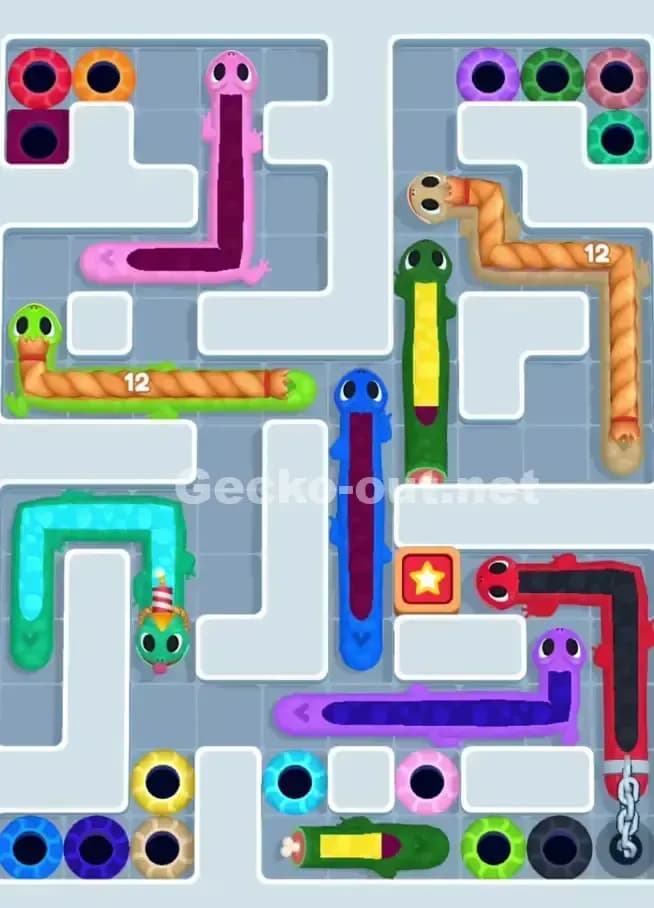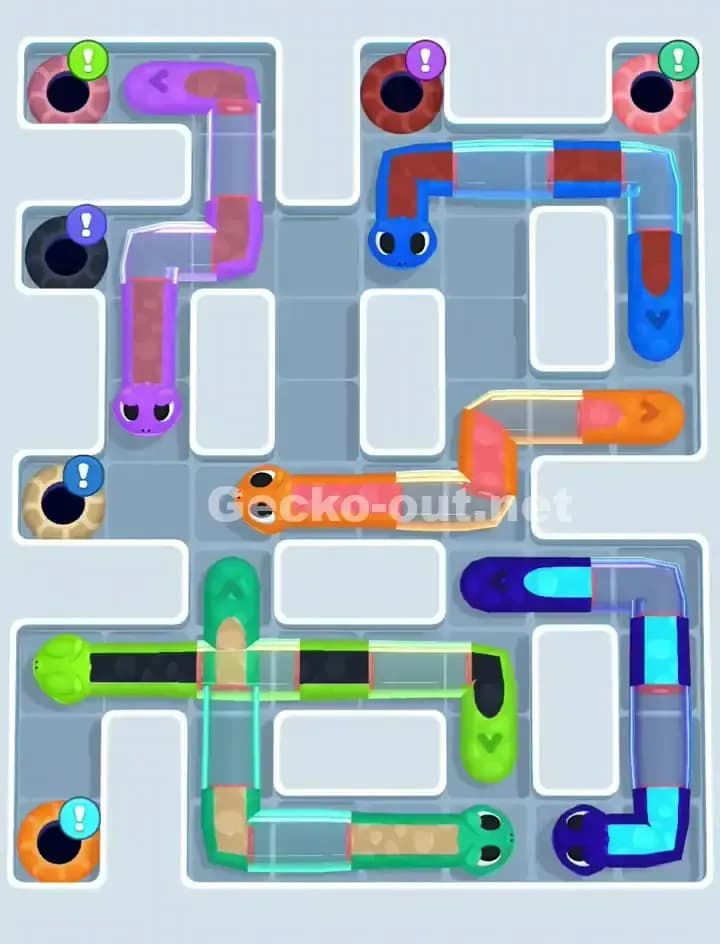
Gecko Out Level 1027 Solution Walkthrough | Gecko Out 1027 Answer
How to solve Gecko Out level 1027? Get step by step solution & cheat for Gecko Out level 1027. Solve Gecko Out 1027 easily with the answers & video walkthrough.
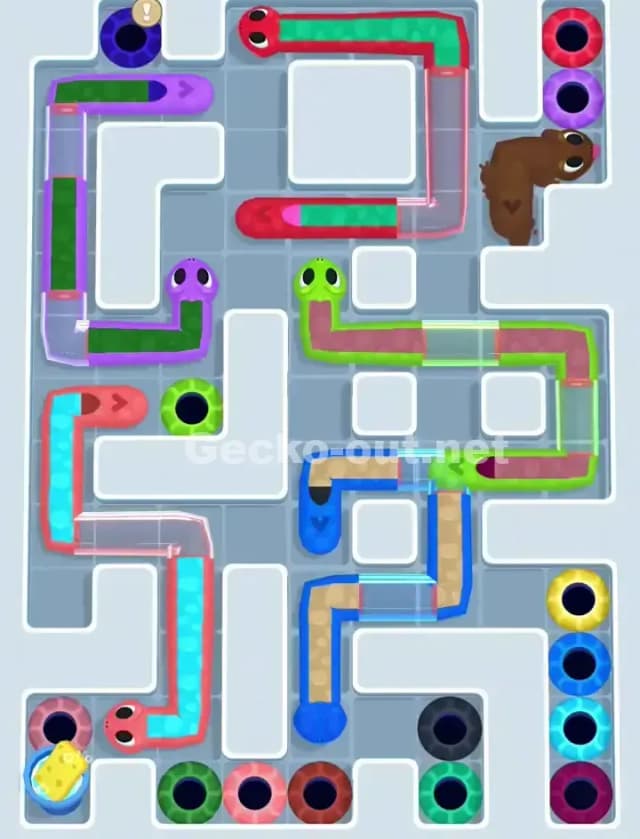
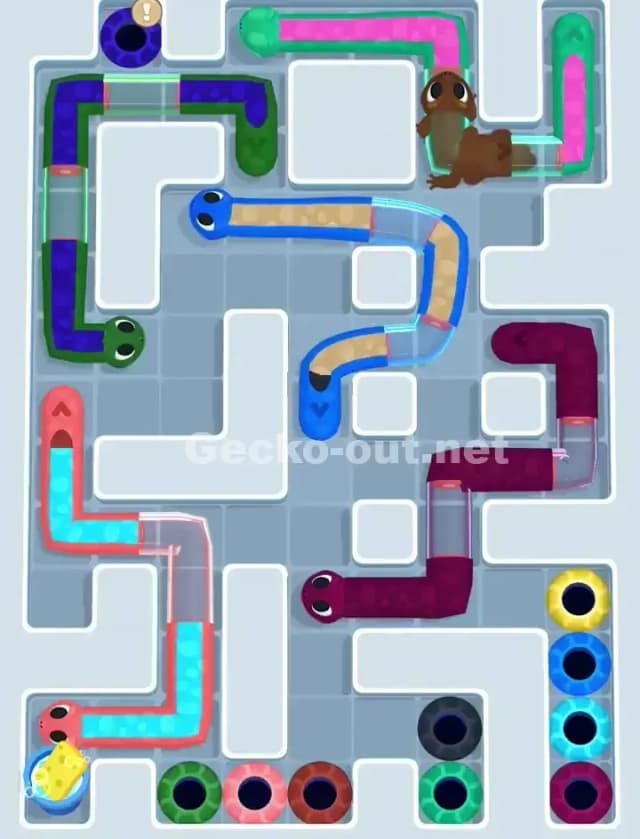
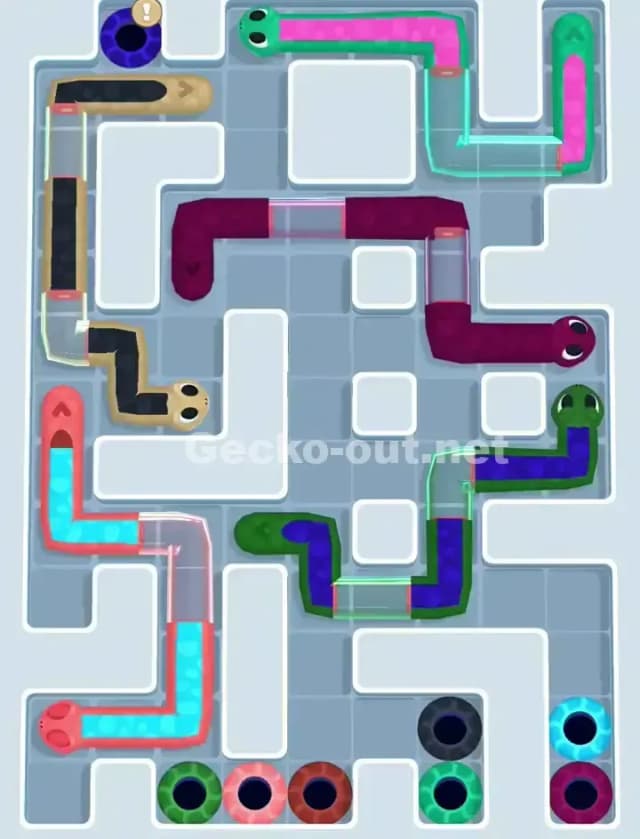
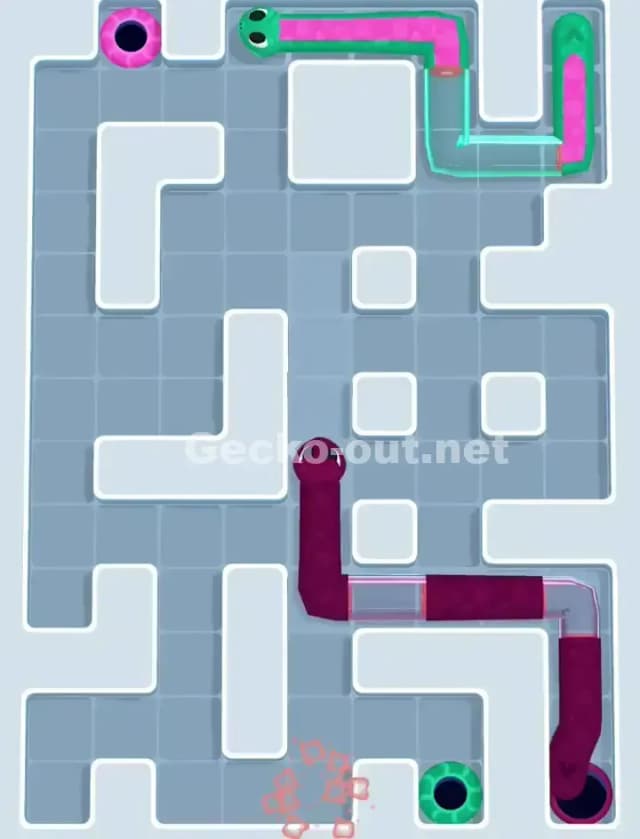
Gecko Out Level 1027: Board Layout, Rules, and Win Condition
Understanding the Starting Board
Gecko Out Level 1027 is a dense, multi-color puzzle with seven geckos that need to escape through matching-colored holes scattered across a tightly woven board. You've got a purple gecko in the upper left, two red geckos (one at the top center, one in the middle), a green gecko near the center, a brown gecko on the right side, a blue gecko in the lower middle area, and a cyan gecko on the left. Each gecko is already locked into a colored pathway that matches its exit hole, but here's the catch: those pathways overlap and intertwine in ways that create serious gridlock. The board is packed with white wall obstacles that fragment movement, and several geckos are positioned in spots where moving one will immediately block another's escape route. This level demands surgical precision—you can't just drag geckos to their holes; you have to choreograph the entire escape so no gecko traps another mid-path.
The Win Condition and Timer Pressure
Your goal in Gecko Out Level 1027 is to guide all seven geckos to their matching-colored holes before the timer runs out. Unlike some levels where you can take your time, this one gives you a moderately tight window—probably around 90–120 seconds depending on your device. Every second counts because the paths are long and interconnected; a single wrong drag can force you to restart. The timer doesn't just challenge your speed; it forces you to think ahead. If you hesitate too long or make one gecko's journey inefficient, you might find yourself with five geckos out and two still stuck on the board as the clock hits zero. The real win condition, then, is not just getting everyone out—it's getting everyone out in the right order, using a sequence that keeps lanes open and minimizes backtracking or body collisions.
Pathing Bottlenecks and Logical Traps in Gecko Out Level 1027
The Critical Bottleneck: The Central Corridor
The single biggest bottleneck in Gecko Out Level 1027 is the central horizontal corridor that runs through the middle of the board. The green gecko, the blue gecko, and parts of the red gecko's path all need to pass through or near this zone to reach their holes. If you send the green gecko through first without a clear plan, its long body will stretch across the corridor and essentially lock the blue and red geckos out of their routes. The corridor is narrow—maybe three or four grid units wide—and the moment one gecko's body occupies it, the others have no room to maneuver. This is the puzzle's main knot, and untangling it requires you to either route one gecko completely out of the way before using the corridor, or to move geckos in a very specific sequence so their bodies don't overlap mid-journey. I found this was the moment I realized I couldn't just improvise; I had to map out the whole escape mentally before dragging anything.
Subtle Problem Spots That Catch Players
Watch out for the purple gecko's path on the left side. It's a long gecko, and its body curves in a way that can accidentally block the cyan gecko's escape if you're not careful with your drag angle. A tiny miscalculation—dragging the purple head even one grid square to the right—means the purple body swings into the cyan gecko's lane and suddenly you've got a collision that forces a restart. Another trap is the red gecko at the top of the board. That one has a tricky turn near some walls, and if you drag too aggressively or at the wrong angle, the head overshoots the turn and the body bunches up against the wall, leaving the gecko stuck. Finally, the brown gecko on the right looks isolated and safe, but it's actually dependent on the red gecko clearing a nearby corridor first. If you move the brown gecko too early, you've blocked the red gecko's final exit, creating a deadlock that's invisible until you try to finish the red gecko last.
The Moment It Clicked
Honestly, Gecko Out Level 1027 frustrated me for a few attempts because I kept trying to brute-force exits—just drag each gecko as soon as I saw a path. But after two failed runs, I realized the puzzle was teaching me something: order matters more than speed. Once I stopped and actually traced each gecko's full path with my eyes, color by color, I saw the dependency chain. The cyan gecko had to go first to open the corridor. Then the green gecko could move without blocking blue. Then blue could exit. Suddenly the level went from chaotic to logical, and I finished with seconds to spare. That shift from "I'll figure it out as I go" to "I'll plan the whole escape first" is what makes Gecko Out Level 1027 genuinely clever.
Turn-by-Turn Path Strategy to Beat Gecko Out Level 1027
Opening: Clear the Left Side First
Start by dragging the cyan gecko out through its exit on the lower left. This gecko has a relatively straightforward path, and moving it first clears the left corridor so the purple gecko won't be squeezed later. Next, move the purple gecko upward and to the right toward its exit at the top left. With the cyan gecko gone, there's room for the purple body to stretch without collision. By clearing the left side of the board first, you've removed two of your seven puzzle pieces and created breathing room for the more complex middle-section geckos. The opening should take about 20–25 seconds and should feel almost relaxing compared to what's coming.
Mid-Game: Navigate the Central Knot
Once the left side is clear, turn your attention to the green gecko near the center. Trace its path carefully—it curves down and to the right toward its exit hole on the right side. Drag the green head along that path deliberately, being careful not to swing the body into the corridor where blue needs to travel. The green gecko should exit cleanly, giving you access to the corridor. Now move the blue gecko, which starts in the lower middle. Its path curves upward, crosses part of the central corridor, and exits on the right side (into the blue hole). With green out of the way, blue has a clear lane. This is where you need to be patient and deliberate with your drag—blue is a moderately long gecko, and one sloppy drag will send it into a wall or into overlap with the red gecko's path. After blue exits, the board opens up significantly.
End-Game: Red, Brown, and Final Exits
With the center clear, tackle the red geckos. Start with the red gecko in the lower middle area (the one closer to the bottom)—it has a slightly more direct route to its exit and won't interfere with the brown gecko. Drag it carefully through its path and out. Then move the red gecko at the top; it has a longer, more angular path, so take your time and keep the head-drag smooth and deliberate. Once both reds are out, the brown gecko on the right becomes your penultimate move—it's relatively short and straightforward, so it should exit without drama. Finally, address any remaining gecko and make sure it has a clear shot to its hole. In Gecko Out Level 1027, the final gecko should always feel like the easiest move because all the obstacles have cleared.
Why This Path Order Works in Gecko Out Level 1027
Using the Head-Drag Rule to Untangle
The reason the cyan-purple-green-blue-red-brown sequence works is because it respects the fundamental body-follow rule of Gecko Out Level 1027. When you drag a head, the body traces the exact path your head traveled—it doesn't cut corners or compress. By moving geckos in this order, you're ensuring that each gecko's body exits the board completely before the next gecko's body needs to occupy that same space. The cyan and purple geckos are on the periphery; moving them first removes the outer pieces of the puzzle. The green and blue geckos are the central knot; moving them in the right order ensures their bodies don't tangle. The reds are long and angular but don't directly block each other if you're careful. By the time you reach brown and the final gecko, there's so much empty space that even if you make a small mistake, you can usually recover. The path order isn't arbitrary—it's designed to progressively simplify the board.
Balancing Speed with Deliberation
Gecko Out Level 1027 gives you enough time to succeed if you move with purpose, but not so much that you can afford to dilly-dally. The strategy here is to pause for 5–10 seconds at the start and visually trace each gecko's full route from head to hole. Don't memorize it, but get a clear sense of which geckos will cross which corridors and in what order you need to move to avoid collisions. Then commit. Once you start moving, maintain steady momentum. Don't drag super fast (that invites mistakes), but don't hesitate between moves either. Aim for smooth, deliberate drags that take about 2–3 seconds per gecko. If you time it right, the entire level should take 60–80 seconds, leaving 20–30 seconds as a buffer in case you need to restart one gecko's path.
Booster Use: Optional, Not Required
Gecko Out Level 1027 can be beaten without boosters if you execute the path order correctly. However, if you're on your third or fourth attempt and the timer is psyching you out, the "extra time" booster is a reasonable safety valve—it gives you another 30 seconds to work with and removes a lot of the stress. Avoid the hammer or other destructive tools; they don't help here because the puzzle isn't about breaking obstacles, it's about navigating them cleanly. If you're confident in your pathing, skip boosters and treat beating Gecko Out Level 1027 as a pure logic challenge. The satisfaction of clearing it without assistance is worth the extra focus.
Mistakes, Fixes, and Logic You Can Reuse in Other Gecko Out Levels
Common Mistakes and How to Correct Them
Mistake 1: Moving the green gecko too early. Players often see green in the center and assume it should go first. But green is a long gecko, and dragging it without having cleared cyan or purple first means its body blocks critical corridors. Fix: Always clear the periphery before the center. Mistake 2: Dragging too fast and overshooting turns. Gecko Out Level 1027 has several sharp turns near walls. If you drag the head quickly, momentum can cause it to overshoot the turn, and the body gets stuck. Fix: Slow down on turns. Pause briefly at the corner, then continue. Your drag speed doesn't have to be constant. Mistake 3: Not accounting for the brown gecko's dependency. Brown looks safe on the right, but its exit corridor is also used by the red gecko. Moving brown before red is cleared means red gets blocked at the end. Fix: Read the full board and identify which geckos share corridors. Plan accordingly. Mistake 4: Panicking when you have 10 seconds left and two geckos still on the board. This usually means you made a mistake earlier, and panic leads to hasty drags that create new mistakes. Fix: If you're low on time, restart immediately rather than rushing. A restart takes 5 seconds; a panic-driven failure takes 5 seconds and wastes your attempt. Mistake 5: Dragging in the wrong direction at the start. Some players drag the cyan gecko down when it should go left, or the purple gecko right when it should go up. This costs precious seconds. Fix: Before each drag, pause and look at the color of the target hole. Orient your drag direction toward that hole, even if it seems counterintuitive.
Reusing This Logic on Similar Levels
Gecko Out Level 1027's approach—clear periphery, untangle center, avoid gridlock—is a template you can apply to any level with overlapping gecko paths and shared corridors. Whenever you see a board with 6+ geckos and narrow corridors, apply this priority: identify the critical bottleneck (the corridor or area where multiple geckos need to pass), then figure out which geckos don't use that bottleneck and move them first. This creates space for the complex middle moves. Gang geckos (linked geckos that move together) follow the same principle—move independent geckos first to reduce the board's complexity. Frozen exits and icy zones are static obstacles, so they don't change your path logic, but they do constrain which geckos can use which routes. Always map those constraints before moving. Toll gates (if Gecko Out Level 1027 had them, which it doesn't) would be handled by calculating time and making sure you have enough seconds after paying the toll to reach the exit.
Final Encouragement
Gecko Out Level 1027 is genuinely tough—I won't sugarcoat it. It's the kind of level that makes you feel dumb for a moment when you fail, and then brilliant when you finally see the solution. But it's not impossible, and it's not random. Every gecko has a logical path, and every deadlock has a reason. The puzzle is solvable with a clear head, a steady hand, and a deliberate approach. Once you beat Gecko Out Level 1027, you'll have the confidence to tackle even more complex levels, because you'll understand that these puzzles reward planning over speed, logic over luck. You've got this. Take a breath, trace the paths, and execute the sequence. Gecko Out Level 1027 is waiting for you to solve it.