Gecko Out Level 902 Solution Walkthrough | Gecko Out 902 Answer
How to solve Gecko Out level 902? Get step by step solution & cheat for Gecko Out level 902. Solve Gecko Out 902 easily with the answers & video walkthrough.


Gecko Out Level 902: Board Layout, Rules, and Win Condition
Starting Board and Gecko Roster
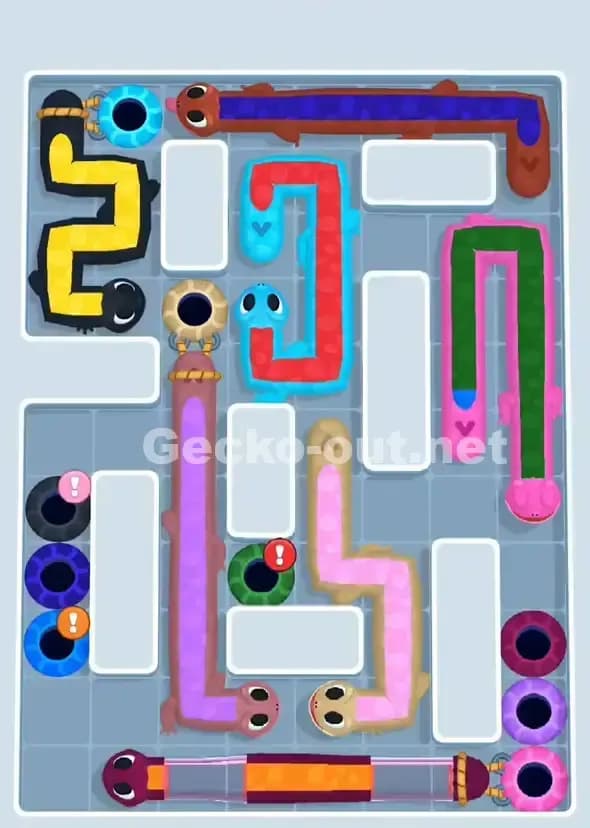
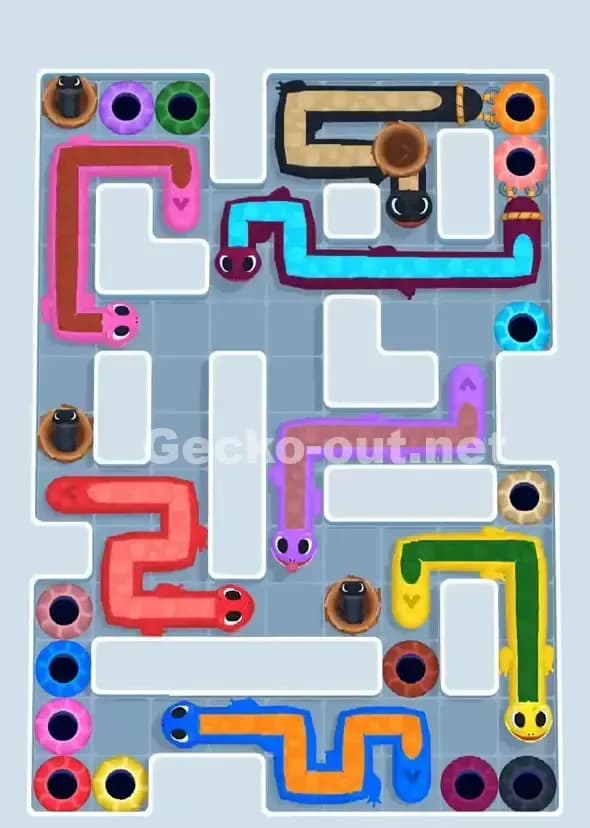
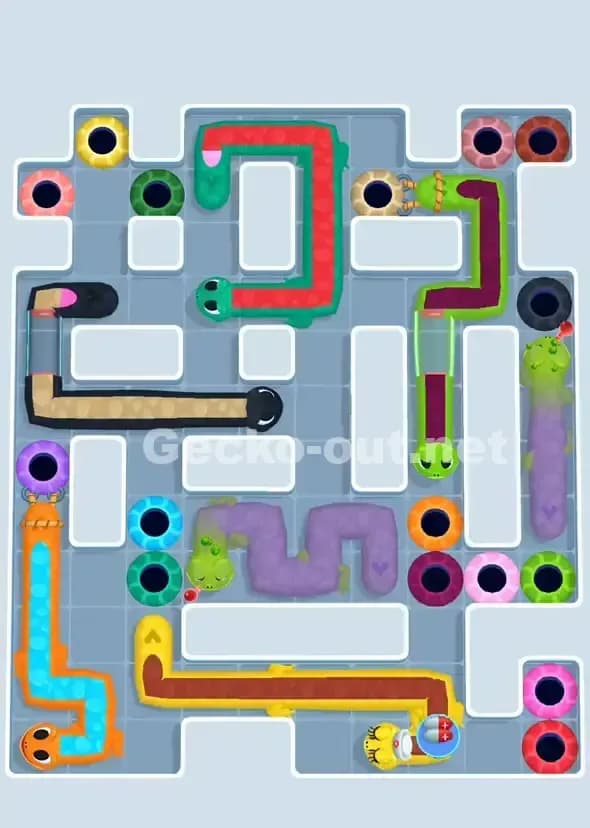
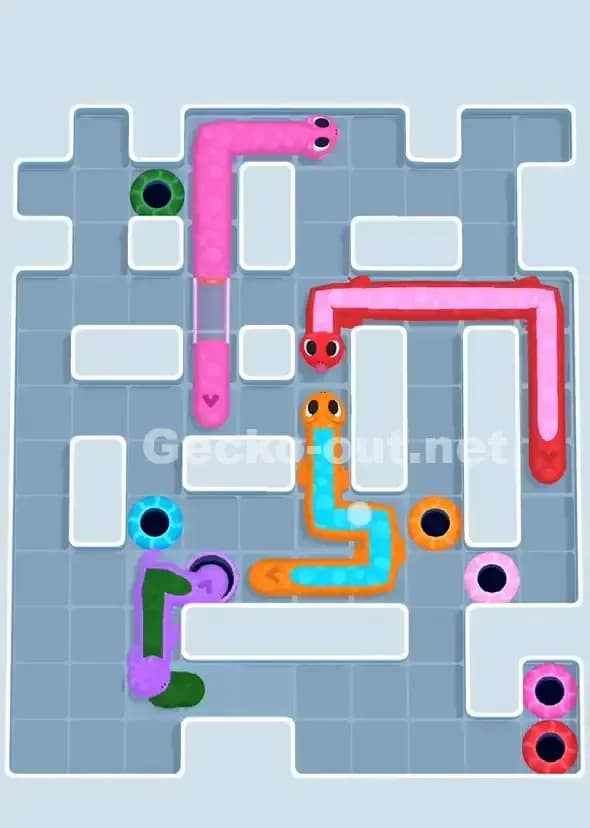
Gecko Out Level 902 throws a lot at you right from the start. You're looking at a dense, multi-colored grid with nine geckos scattered across the board—pink, yellow, green, red, blue, orange, and purple varieties all competing for space. The board itself is a maze of white walls creating tight corridors and dead ends, with holes positioned at the periphery and a few tucked into trickier spots in the middle. What makes Gecko Out 902 particularly gnarly is how several geckos are naturally positioned in cramped clusters, which means you'll need to thread them out one at a time without causing pile-ups.
The most immediately obvious challenge? Two gang-linked geckos are stuck near the center, and a couple of longer-bodied geckos take up serious real estate on the left and bottom portions of the board. Their exits aren't blocked, but the paths to those exits wind through narrow choke points that only one gecko can traverse at a time. If you're not strategic about sequencing, you'll find yourself with three geckos waiting for one corridor to clear.
Win Condition and Timer Pressure
Your goal in Gecko Out Level 902 is straightforward: every single gecko must reach a hole of matching color before the timer runs dry. Unlike easier levels, you don't get a ton of breathing room—the clock is ticking hard, and each second you spend second-guessing a path is a second you're not moving. The timer forces you to commit to decisions and move with purpose, but it also punishes wild, untested dragging. You need a plan before you start pulling gecko heads.
Because body-follow mechanics mean each gecko traces an exact path where its head goes, poorly planned routes don't just slow you down—they can block exits or lock other geckos into impossible angles. That's why Gecko Out Level 902 demands you map out the exit order mentally before touching anything.
Pathing Bottlenecks and Logical Traps in Gecko Out Level 902
The Critical Choke Point
The single biggest bottleneck in Gecko Out Level 902 is the left-center corridor that feeds toward the bottom-left exit area. Two geckos need to use portions of this lane to escape, and the passage is narrow enough that once one gecko's body is snaking through, the other is completely locked out. If you send the wrong gecko first, the second one gets trapped waiting, and your timer starts evaporating. The trick is identifying which gecko must go first to give the other enough space to follow without overlap.
Similarly, the upper-right zone has a gang-linked pair that shares a dependency on a tight turn—they're not technically touching yet, but their natural exit paths would cause them to collide if you're not careful about timing and head-drag precision.
Subtle Problem Spots
First, there's the center-right purple and pink cluster. These holes are positioned close together, which seems helpful until you realize the walls around them create a "last-in, first-out" bottleneck. If you send the purple gecko in first, its body blocks the path to the pink hole, leaving you stranded. You must route the pink gecko out of that zone first, even though it feels counterintuitive.
Second, the yellow gecko at the top has a deceptively long body relative to its exit lane. A careless drag will loop it back on itself, wasting precious seconds and potentially locking it behind its own coils. You need to trace a smooth, wide arc—not the shortest line, but the most elegant one.
Third, the orange and blue geckos on the left form a visual pair, but they're actually competing for the same exit corridor. Many players assume they can drag them both in sequence and finish strong, but the corridor is so tight that the second gecko's entry angle matters enormously. Get the angle wrong, and you're stuck rotating and redoing.
Personal Moment of Clarity
Honestly, Gecko Out Level 902 frustrated me for my first two attempts. I kept dragging geckos in color order or shortest-body-first, which felt logical but was completely wrong. The moment it clicked was when I stopped thinking "which gecko should I move?" and started thinking "which gecko is blocking everyone else?" Once I identified the left-side long gecko as the primary traffic jam, everything else fell into place. That shift in perspective—from gecko-centric to path-centric—is what makes Gecko Out 902 suddenly feel solvable instead of chaotic.
Turn-by-Turn Path Strategy to Beat Gecko Out Level 902
Opening: Clear the Left Side First
Start by routing the long tan-and-black gecko on the left side of the board. This gecko is your biggest traffic controller, and it's occupying valuable corridor space that other geckos will need. Drag its head downward and slightly rightward toward its black hole exit at the bottom-left. The body will curve along the western wall, and once it's safely gone, you've freed up the entire left lane for the orange and blue geckos waiting behind it.
Next, send the orange gecko. It's shorter and more agile, so route it quickly through the now-clear left corridor to its orange hole. Don't park it midway—commit to a complete path straight through. This keeps momentum going and prevents accidental overlaps.
While those are exiting, keep an eye on the upper geckos. Don't touch them yet; you're building space, not filling it.
Mid-Game: Manage the Center Knot Carefully
Once the left side clears, you'll have more board visibility, but now the real puzzle emerges: the center-right gang pair and the cluster of purple, pink, and blue options. This is where Gecko Out Level 902 gets genuinely tricky.
Route the pink gecko first from the center-right cluster, even though there's a purple gecko closer to its hole. The pink's exit path is the most direct and doesn't interfere with the purple's route. Drag it with a clean, confident arc—no hesitation, no backtracking. Once pink is safe, the purple gecko has clear passage.
Next, handle the green gecko in the upper-left area. It doesn't seem urgent, but it's actually blocking a subtle lane that'll matter in three moves. Get it out quickly.
Now tackle the yellow gecko at the top. This one demands precision: drag its head in a wide, generous arc toward its yellow hole. The body is long, so the path needs room to breathe. Don't try to shortcut it—the longer, smoother curve actually saves time because it avoids tangling.
By mid-game, you should have five or six geckos safely in their holes, and the board should feel significantly less congested. If you're feeling rushed, take a half-second to pause and visually confirm the remaining geckos' positions before continuing.
End-Game: Exit Order and Last-Second Precision
You're down to the final three or four geckos, probably some combination of red, blue, and the gang-linked pair. Here's the critical sequence: exit the red gecko first. It's a medium-length gecko with a straightforward path, and getting it out opens a vital lane for the blue gecko.
Then route the blue gecko. By now, its corridor is clear, and you can drag it decisively toward its blue hole without worrying about interference.
Finally, handle the gang-linked pair. These two move as a unit (or nearly so), so dragging one affects spatial awareness for the other. Route the first linked gecko carefully—wide arcs, no sharp angles—then immediately pull the second one. The timer is probably flashing yellow or red by now, so speed matters, but precision matters more. A botched path now means failure after all that planning.
If you're genuinely low on time and one gecko is still stuck, consider a booster—specifically, the extra-time booster. Use it here, not at the start, because you'll have a clearer picture of exactly how much more time you need.
Why This Path Order Works in Gecko Out Level 902
Head-Drag Logic and Body Untangling
The brilliance of Gecko Out Level 902's difficulty comes down to the body-follow mechanic. Every gecko's body must trace the exact path its head takes, which means overlapping is literally impossible—you can't squeeze a gecko through a gap its body can't physically fit through. This makes the puzzle feel constrained, but it also means there's a logical solution, not a lucky one.
By clearing the left side first, you're not just removing geckos—you're erasing spatial obstacles that would force later geckos into awkward angles. The tan gecko's exit isn't inherently "first," but it becomes first because it's the biggest space-hog. This is the core strategy: identify mass, not urgency. Get the bulky geckos out, and the delicate ones suddenly have room to move.
The center-right sequencing works because pink's hole is geometrically furthest from purple's, so their exit paths diverge cleanly. If you reversed it, purple's body would snake across pink's exit lane, locking pink in place. This is pure geometry, and Gecko Out 902 is all about geometry.
Timer Management: Pause Versus Commit
Don't fall into the trap of moving constantly out of panic. The timer in Gecko Out Level 902 is generous enough that a ten-second pause to mentally trace a path is fine—it saves you from redoing a botched drag. However, once you've identified a path, commit fully. Hesitant, jerky dragging wastes time and leaves geckos half-positioned, which creates new bottlenecks.
A useful rhythm: assess one gecko, drag it fully, watch it complete, assess the next one. This keeps you locked in without creating decision paralysis.
Booster Strategy: Optional, Not Required
Gecko Out Level 902 can be beaten cleanly without boosters if you nail the sequencing. However, the extra-time booster is genuinely useful as an insurance policy if you're within 20–30 seconds of failure on your first or second attempt. The path-hint booster is less valuable here because the puzzle is more about order than direction—hints can't tell you which gecko to move first, only where to drag a head once you've chosen.
Skip boosters entirely on your opening attempt. If you fail, you'll have clearer data about where your timing broke down, and you can adjust. Boosters shine when you're 90% correct and just need a nudge.
Mistakes, Fixes, and Logic You Can Reuse in Other Gecko Out Levels
Common Pitfalls
Mistake 1: Moving geckos in color order. This feels neat and organized, but Gecko Out Level 902 doesn't reward neat—it rewards strategic. A red gecko might need to wait while the green one exits first, even though red was closer to its hole. Always ask: "Which gecko is stopping others?" not "Which gecko is ready?"
Fix: Map out which exit lanes overlap before dragging anything. Identify the gecko using the most-shared corridor, and move it first.
Mistake 2: Dragging short paths instead of long arcs. Players often try to minimize the distance they drag, but a cramped path can tangle the body or create unnecessary angles. Gecko Out Level 902 rewards spacious, flowing drags.
Fix: When dragging, imagine the gecko's entire body as a rope. Will it lie flat along your intended path, or will it coil awkwardly? If the latter, lengthen the arc.
*Mistake 3: Parking geckos mid-board to "get them out of the way." * Gecko Out 902 is small enough that there's no safe parking spot. A gecko parked in the middle is still blocking potential exit routes for others. Either move a gecko fully to its hole or don't move it at all.
Fix: Commit to full paths only. Every drag should end at a hole.
Mistake 4: Ignoring the gang-linked pair until the end. These two feel like bonus complexity, but they're easier to route when the board is less crowded. Delaying them into end-game turns a solvable puzzle into a frantic scramble.
Fix: Route gang-linked geckos during mid-game, when you have space to maneuver them without overlapping other bodies.
Mistake 5: Misjudging the yellow gecko's body length. It's easy to underestimate how much space it needs. A careless drag loops it into impossible tangles.
Fix: Trace the yellow gecko's path on your first attempt with exaggerated care. Give it space. Speed comes on subsequent attempts once you've internalized its dimensions.
Reusable Logic for Similar Levels
Gecko Out Level 902's core lesson applies to any level with gang-linked geckos, long bodies, or shared exit corridors: *prioritize spatial liberation over gecko diversity. * Rather than rotating through different colors, focus on removing space-blockers. This strategy transfers perfectly to other complex, high-gecko-count puzzles.
The yellow gecko precision technique—using wide arcs instead of direct lines—is gold for any level with a notably long gecko. Speed comes after you've learned the path's geometry.
The center-right sequencing logic (exit the one whose path doesn't interfere with others first) is a universal principle for untangling clusters.
Final Encouragement
Gecko Out Level 902 is genuinely tough, and that's okay. It demands planning, geometry sense, and calm decision-making under timer pressure. But it's absolutely, 100% beatable with a clear head and a strategic approach. Every player who's mastered it has had that frustrating moment before the clarity hit. You're not stuck—you're learning. Map the board, prioritize the bottlenecks, and commit to full paths. Gecko Out 902 will fall, and you'll be stronger for it.