Gecko Out Level 1133 Solution Walkthrough | Gecko Out 1133 Answer
How to solve Gecko Out level 1133? Get step by step solution & cheat for Gecko Out level 1133. Solve Gecko Out 1133 easily with the answers & video walkthrough.


Gecko Out Level 1133: Board Layout, Rules, and Win Condition
Starting Board and Gecko Lineup
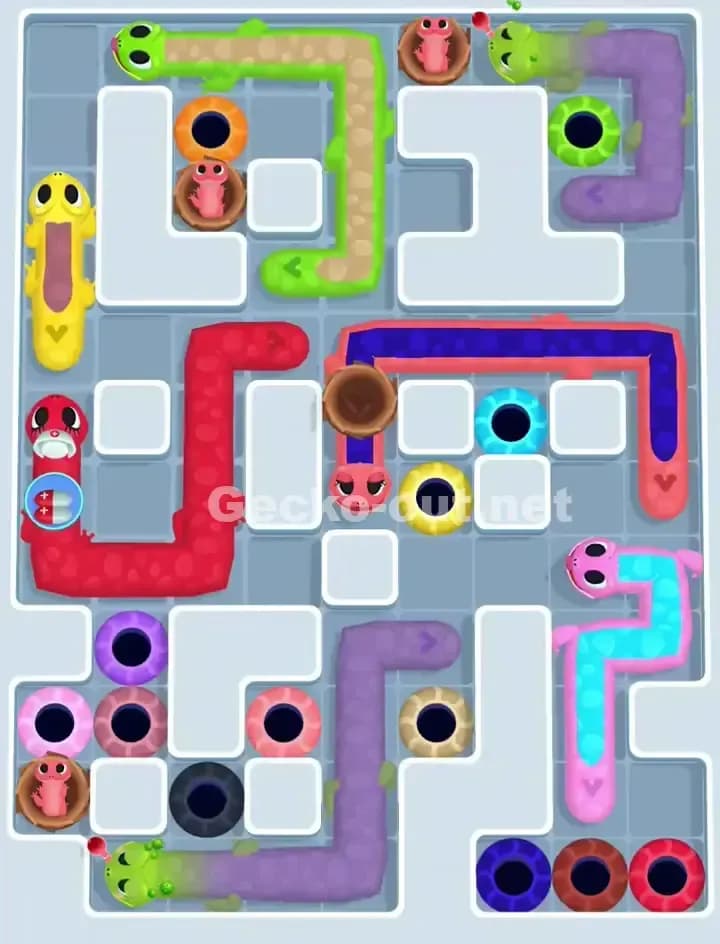
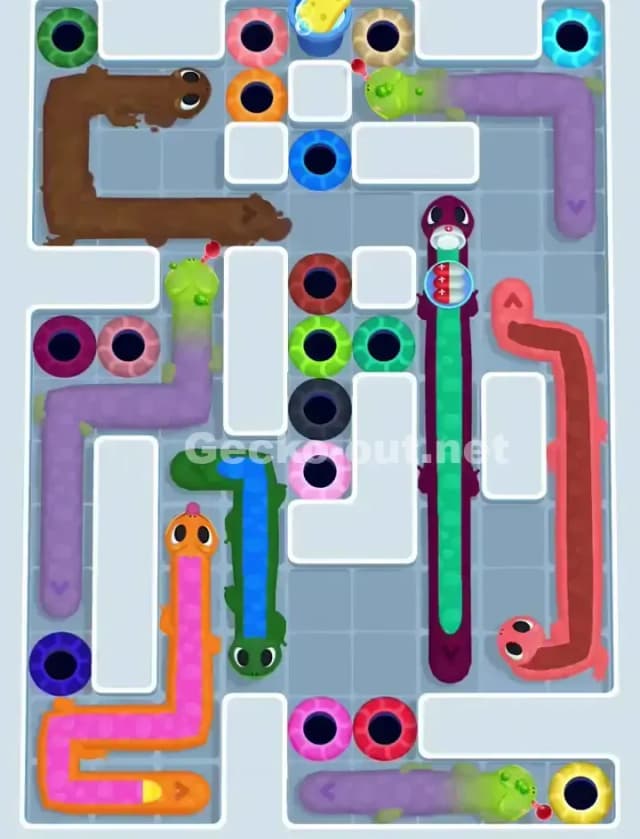
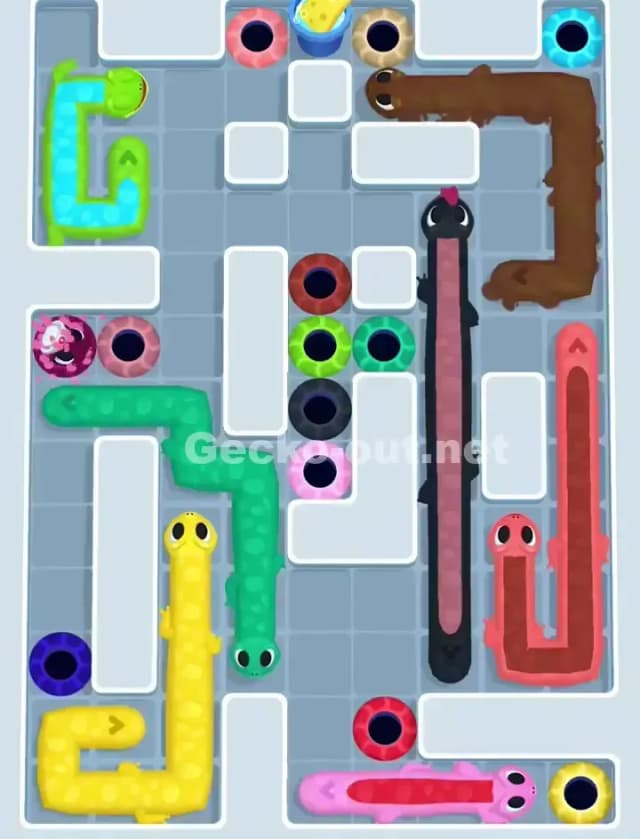
Gecko Out Level 1133 is a dense, multi-color puzzle that throws a lot at you right from the start. You're looking at approximately 12–14 geckos scattered across a complex, L-shaped board with multiple corridors, choke points, and interconnected pathways. The geckos come in at least eight different colors: green, pink, orange, blue, cyan, red, purple, and yellow. Each gecko has a corresponding exit hole of the same color somewhere on the board—and that's where the real challenge begins. The board itself is cramped with white wall obstacles forming a maze-like structure that forces every gecko's path into tight spaces where collisions become almost inevitable if you're not strategic about sequencing.
What makes Gecko Out Level 1133 particularly tricky is that several geckos are long or multi-segmented bodies, which means dragging them takes up precious real estate on the board. You'll notice that some geckos are even linked as "gangs"—two or three connected bodies that must move together as one unit. This adds a layer of complexity because repositioning one gecko in a gang automatically repositions its partner, and if you're not careful, you'll accidentally block an exit or trap another gecko mid-puzzle.
Win Condition and Timer Pressure
To win Gecko Out Level 1133, you must guide every single gecko into its matching-colored hole before the timer reaches zero. The timer is genuinely tight—you're not getting extra seconds for partial success or clever plays. The moment one gecko fails to escape, or time runs out with even one gecko still on the board, you lose and have to restart. This means you can't afford to be indecisive or to make random drag movements hoping something works out. Every path you draw with your finger or mouse must be intentional, efficient, and part of a larger exit strategy.
The movement system itself is path-based: when you drag a gecko's head toward a hole, its body follows the exact line you trace. If your path crosses a wall, another gecko, or an obstacle, the drag fails and you waste precious seconds. If your path accidentally leads into a wrong-colored hole or a locked/frozen exit, that gecko gets stuck and you've just created a hard-fail scenario. Understanding this body-follow mechanic is critical because it means you're not just moving individual pieces around a board—you're choreographing a sequence of precise, non-overlapping movements that must resolve within the time limit.
Pathing Bottlenecks and Logical Traps in Gecko Out Level 1133
The Central Corridor Bottleneck
The single biggest choke point in Gecko Out Level 1133 is the central vertical corridor that connects the upper half of the board to the lower half. Multiple geckos need to pass through this narrow lane to reach their exits, and if you send them through in the wrong order, you'll create a gridlock where one gecko's body blocks another gecko's head from moving. I'd identify the blue gecko as the most critical bottleneck trigger—it's one of the longer bodies and its natural path toward its exit forces it through that central passage. If you don't move the blue gecko early and position it in a "safe parking spot" off to the side, you'll find yourself unable to move other geckos without immediately colliding with it.
The solution is counterintuitive: you sometimes need to move the blue gecko partway through its exit sequence and then pause it in a neutral zone while you clear other geckos out of the way. This requires forward planning because you have to mentally model where you can "park" a gecko temporarily without it blocking future paths.
Subtle Problem Spot #1: The Pink-Red Gang Overlap
Watch out for the pink and red geckos clustered in the lower-right quadrant. These two are positioned dangerously close to each other, and their exit holes are on opposite sides of a narrow corridor. If you drag the red gecko first without carefully plotting its exact path, its body will coil around and physically prevent the pink gecko from accessing its own exit. The trap here is that it looks like there's plenty of space, but once you commit to a drag path, the gecko's body occupies every single square it traverses, and you realize too late that you've created an impassable knot.
Subtle Problem Spot #2: The Upper-Left Green-Yellow Jam
The upper-left area has a green gecko and a yellow gecko with their exits positioned such that their natural paths cross each other. The yellow exit is in the top-middle area, and the green exit is to the far left. If you rush to move the green gecko without first clearing a safe corridor, it will inevitably collide with the yellow gecko's body, and you'll waste time undoing the failed drag and rethinking your approach.
Subtle Problem Spot #3: The Frozen or Locked Exit Trap
Some exits in Gecko Out Level 1133 might be temporarily frozen or locked, meaning certain geckos can't enter their holes immediately. If you're not paying attention to which exits are active, you might waste precious seconds dragging a gecko toward a frozen hole only to discover it can't enter. This is a psychological trap as much as a mechanical one—your brain wants to move every gecko in color order, but the level punishes that impulse.
Personal Reaction: Where It All Clicked
I'll be honest: my first three attempts at Gecko Out Level 1133 felt like controlled chaos. The board is so visually busy and the paths so interlocking that I kept trying to solve it like a traditional puzzle—methodically, systematically, color by color. But around attempt four, I stopped trying to "solve" the board and started thinking about it as a choreography problem. I realized that I wasn't failing because I didn't know which gecko to move; I was failing because I was moving geckos in the wrong order. The moment I started prioritizing "which gecko's exit will unlock space for the others?" instead of "which gecko is closest to its hole?", the entire puzzle snapped into focus. Gecko Out Level 1133 went from frustrating to satisfying in that one mental shift.
Turn-by-Turn Path Strategy to Beat Gecko Out Level 1133
Opening: Clearing the High-Value Gecko First
Start by moving the blue gecko—not all the way to its exit, but far enough into a safe holding zone. The blue gecko is your board's tension lever because it's long and central. By moving it early and parking it in a neutral corridor where it won't block other paths, you buy yourself freedom for the mid-game. Drag the blue gecko head downward into the central lane, but stop just before its body would block any other gecko's natural exit route. This is a deliberate "partial move" that sounds wasteful but is actually strategic.
Next, handle the cyan gecko in the top-right. Its exit is close and its path is relatively clear. Moving it early removes one color from the board and opens up spatial breathing room. Don't overthink this one—a straightforward diagonal or downward path should work. Once the cyan gecko is out, you've established a rhythm and freed up the upper-right quadrant for repositioning other geckos if needed.
Mid-Game: Keeping Lanes Open and Untangling the Knots
Now comes the delicate part. You need to move the pink and red geckos without having them tangle with each other. Move the pink gecko first if its path doesn't cross the red gecko's body. Drag pink downward and to the right, tracing a wide arc around any obstacles. The key here is to avoid the temptation to take a "direct" path if that direct path means threading between two other geckos.
While you're working on the lower half, don't forget the orange and yellow geckos in the upper area. These two need to exit without colliding mid-path. My recommendation: move the orange gecko first toward its exit at the bottom-left, since its path is longer and more convoluted. Once orange is clear, the yellow gecko has a straight shot to the top-middle hole.
The green gecko is a wildcard that requires careful timing. Depending on which other geckos are still on the board, you might need to move green early or late. Generally, wait until the blue gecko is safely parked before committing to green's path, since green's most direct exit route passes through the central corridor where blue might still be lurking.
End-Game: The Final Sequence and Time Management
By the time you reach the final three or four geckos, you should be able to see clear corridors on the board. Don't rush—take a breath and trace each remaining path mentally before you drag. A single mistake now means restarting the entire level. Move the remaining geckos in an order that continues to "unlock" space: if one gecko's body is blocking another's path, move the blocking gecko first.
If you're running low on time with just one or two geckos left, stay calm and execute clean drags. A clean, slightly longer path that avoids collisions beats a rushed attempt that clips another gecko and fails. If you're in genuine danger of timing out, this is where a time-booster becomes worthwhile—activating an extra 30 seconds is far better than restarting from the beginning.
Why This Path Order Works in Gecko Out Level 1133
The Body-Follow Mechanic and Untangling Logic
The genius—and the frustration—of Gecko Out Level 1133 lies in how the body-follow system actually prevents tangling if you use it correctly. By moving geckos in a sequence that prioritizes "the gecko whose body blocks the most other paths," you're essentially peeling away layers of the knot rather than tightening it further. When you move the blue gecko partway through the board, you're not solving its exit; you're solving the board's geometry. You're creating space and pathways that didn't exist before.
This order works because it respects the physics of the system: a gecko's body occupies every square it crosses, so your job is to position bodies in such a way that remaining geckos have unobstructed corridors to their exits. The moment you think about Gecko Out Level 1133 as "move the longest gecko first, then the next longest" instead of "move the gecko closest to its exit first," you've found the key.
Timer Management: Pause, Plan, Commit
Here's a pro tip for Gecko Out Level 1133: don't be afraid to pause briefly between drags. Even though there's a timer, a two-second pause to mentally trace the next path is infinitely better than a three-second failed drag that forces you to restart. Use your pause time to ask yourself: "Does this path cross any gecko bodies? Does it lead to the correct hole? Will moving this gecko open up the board or lock it down further?" If you answer yes to all three questions, commit to the drag decisively. Hesitation during the actual drag attempt is where most failures come from.
The timer isn't actually as tight as it feels once you've planned out the sequence. If you move methodically, in the right order, without any collision failures, you'll have time to spare. Most players fail Gecko Out Level 1133 because they restart multiple times due to bad sequencing, not because they run out of time on a perfect run.
Boosters: Optional, Not Essential
Gecko Out Level 1133 doesn't require boosters if you execute the strategy correctly. However, if you're consistently timing out in the final seconds even with perfect sequencing, an extra-time booster is worth activating in your next attempt—just pop it once you've got two or three geckos left, giving yourself that cushion to finish cleanly. A "hint" booster isn't particularly useful here since the level's challenge is sequencing and pathing, not identifying which gecko to move. Skip the hint and save your coins.
Mistakes, Fixes, and Logic You Can Reuse in Other Gecko Out Levels
Common Mistakes and How to Correct Them
Mistake #1: Moving Geckos in Color Order
Players often try to solve Gecko Out Level 1133 by moving red first, then pink, then orange, et cetera. This almost never works because color order has nothing to do with board geometry. Fix: Prioritize by gecko length and centrality instead. Move the longest geckos and the most-central geckos first, regardless of color.
Mistake #2: Dragging All the Way to the Exit on the First Move
You assume every gecko should go straight from its starting position to its exit hole in one drag. But Gecko Out Level 1133 requires intermediate parking—moving a gecko partway, leaving it there while you clear other geckos, then finishing its path later. Fix: Embrace partial moves as a legitimate strategy. Think of the board as a two-phase system: first, reposition long geckos to neutral zones; second, execute final exits.
Mistake #3: Ignoring Other Gecko Bodies When Plotting Your Path
You trace a path to a gecko's exit without accounting for other geckos' positions. Then you drag and collide immediately. Fix: Always scan the board for other gecko bodies before you start your drag. If a body is in the way, either move that blocking gecko first or find an alternate path around it.
Mistake #4: Panicking When the Board Looks Full
You see a crowded board and assume you're stuck. But with careful sequencing, there's almost always a legal move available. Fix: Take a breath, identify the gecko that's blocking the most paths, and move that one first. Watch the board open up in real time.
Mistake #5: Miscalculating Frozen or Locked Exits
You drag a gecko toward an exit that looks open but is actually frozen, wasting time and motion. Fix: Glance at all exit holes at the start of the level and note which ones have visual indicators (frost, locks, warnings). Plan your gecko movements to avoid frozen exits until they unlock.
Reusing This Logic on Similar Levels
Gecko Out Level 1133's sequencing strategy applies directly to other gang-gecko levels, long-gecko levels, and levels with tight central corridors. Whenever you see a board where multiple geckos need to pass through a single chokepoint, remember the lesson: move the most-central gecko first, park it safely, and let other geckos have their turn. If a level has frozen exits or linked gangs, the same principle holds—plan for geometry before color, and always move the gecko that unlocks the most space first.
The body-follow mechanic is universal across all Gecko Out levels, so any skill you develop in understanding how a gecko's body occupies space will pay dividends across the entire game. Gecko Out Level 1133 is a masterclass in that mechanic, so treat it as a teaching moment, not just a puzzle to brute-force.
Final Encouragement
Gecko Out Level 1133 is genuinely tough—it's a level that punishes indecision and rewards careful planning. But it's absolutely, unquestionably beatable once you stop thinking of it as "move all these geckos to their holes" and start thinking of it as "orchestrate a sequence of moves that opens up the board." You've got this. Take the strategy above, move the long geckos and central geckos first, park them strategically, and execute clean drags for the exits. You'll beat Gecko Out Level 1133, and you'll feel like a puzzle master when you do.