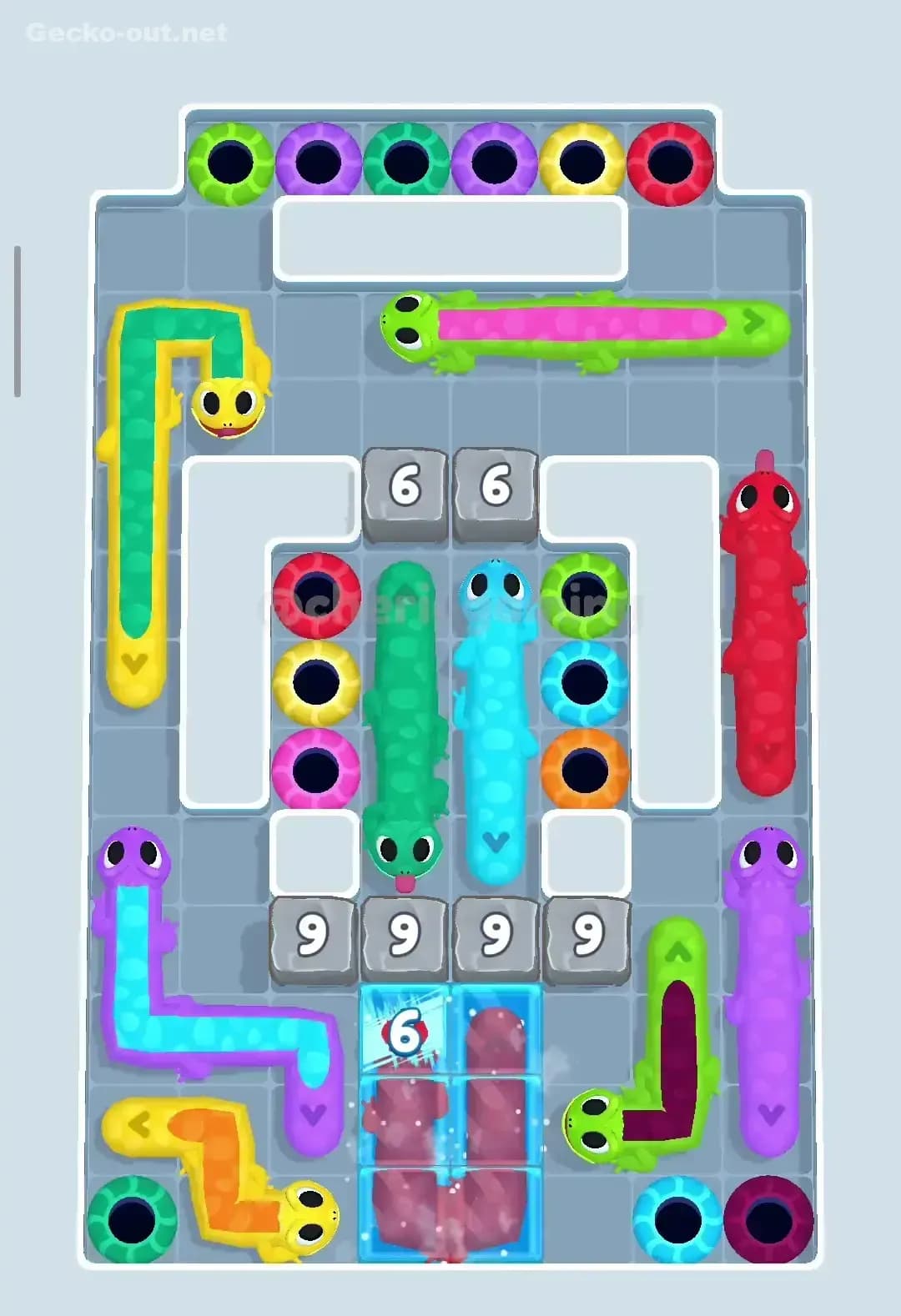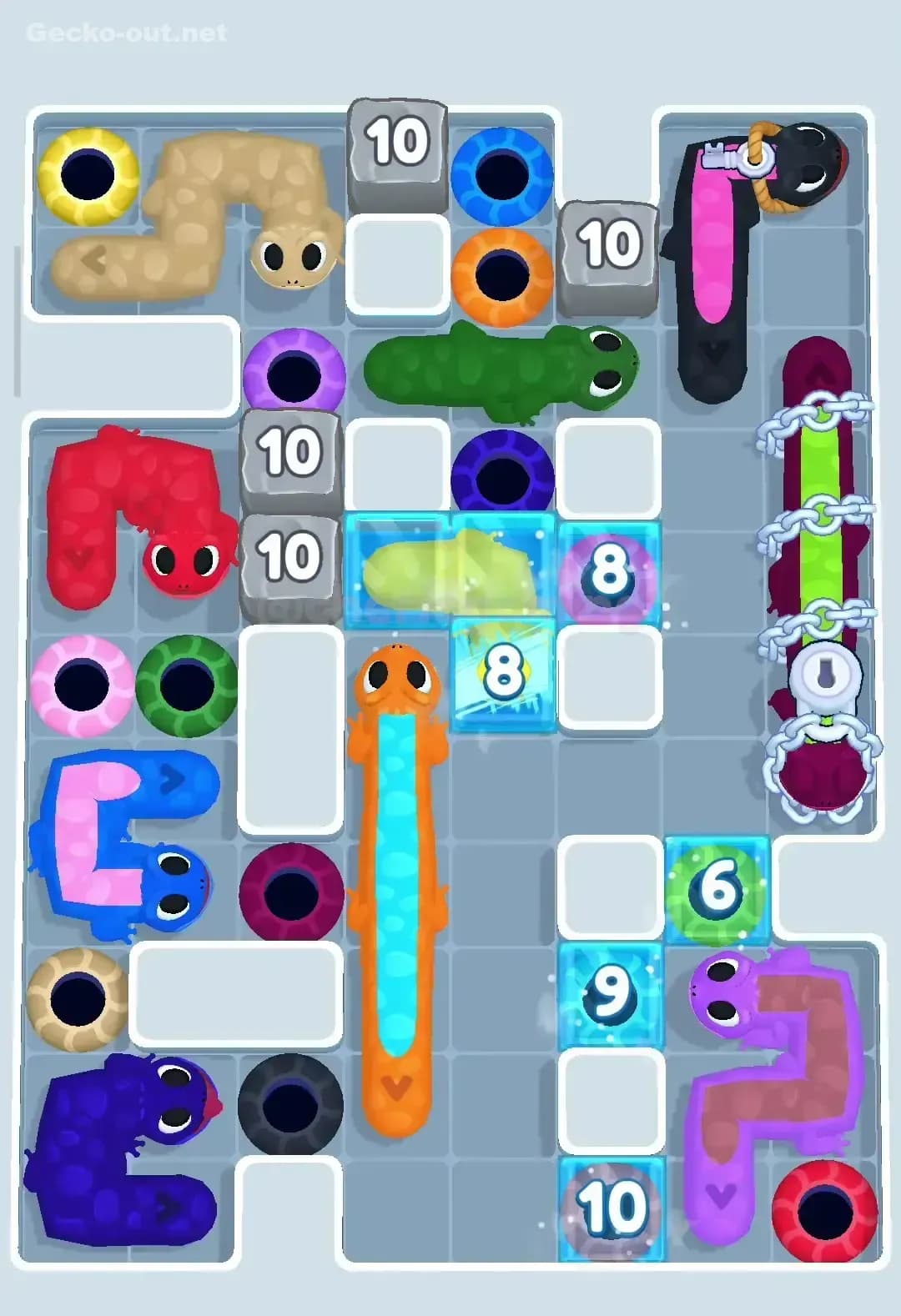
Gecko Out Level 43 Solution Walkthrough | Gecko Out 43 Answer
How to solve Gecko Out level 43? Get step by step solution & cheat for Gecko Out level 43. Solve Gecko Out 43 easily with the answers & video walkthrough.
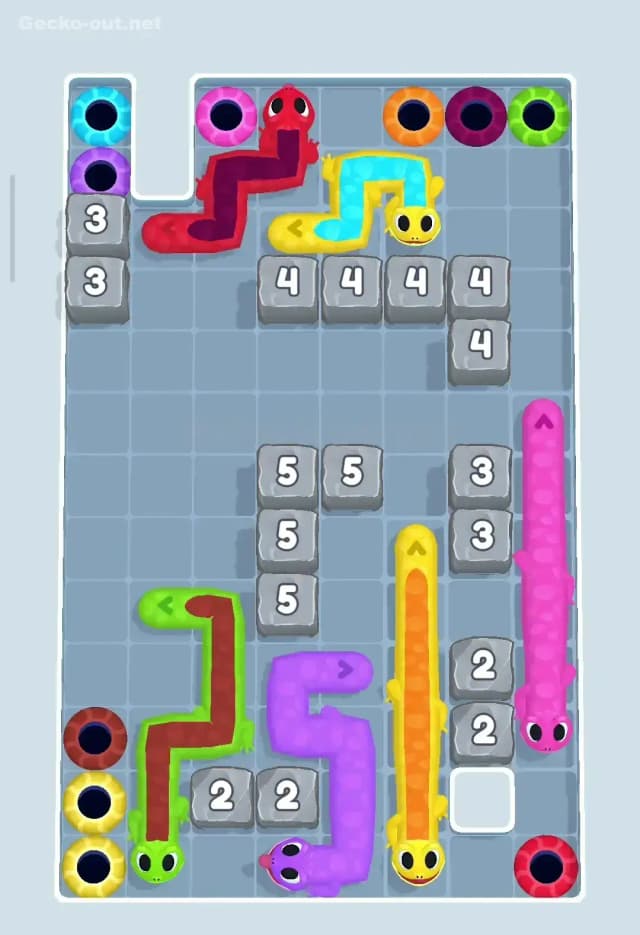
Gecko Out Level 43: Board Layout, Rules, and Win Condition
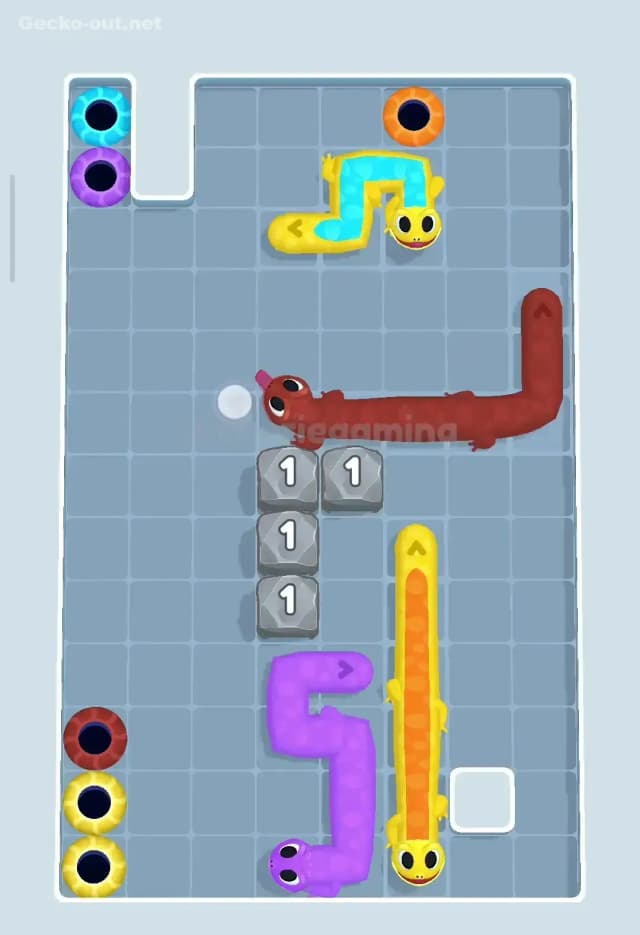
Starting Board: Who’s Where And What’s In The Way
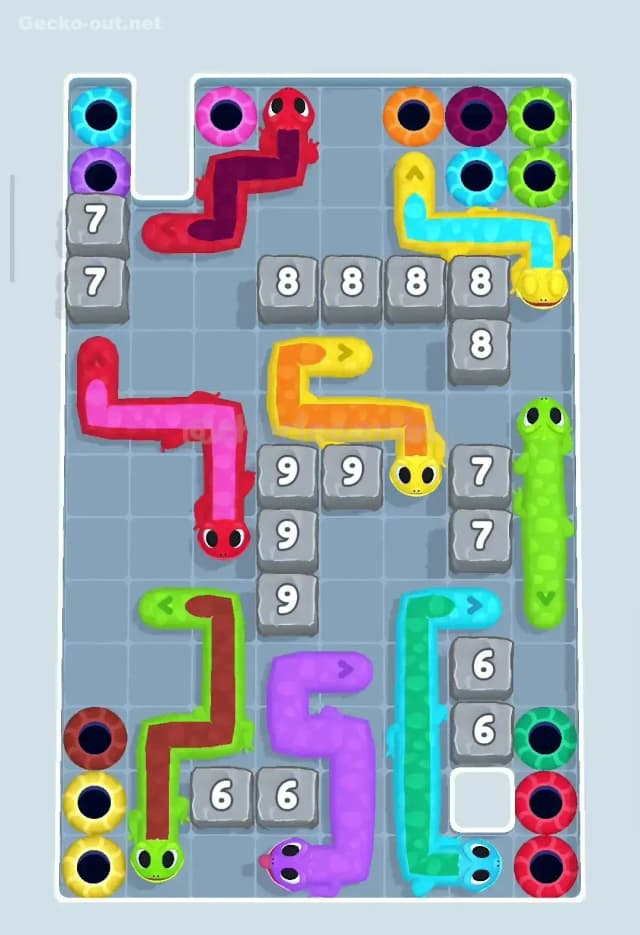
When Gecko Out Level 43 loads, you’re looking at a tall, cramped board with nine geckos and almost no open floor. Color-wise, you’ve got:
- A red gecko near the top-left, zig‑zagging beside the upper exits.
- A small orange and a small yellow gecko tangled in the upper-middle, just above a wall of “8” blocks.
- A long pink gecko running down the left side of the center.
- A big vertical green gecko on the right-middle, acting like a sliding door.
- A long cyan gecko hugging the lower-right wall.
- A long purple gecko bent around the lower center.
- A linked pair at the bottom-left: a lime green gecko wrapped around a short brown gecko (“gang” style, they effectively move as one unit).
Stone blocks marked 6, 7, 8, and 9 carve the board into narrow corridors. They behave like hard walls in Gecko Out 43, so you’re really playing in several thin lanes:
- A left lane split by 7s and 6s.
- A central knot between the 8s and 9s.
- A right lane squeezed between 7s and 6s.
Exits ring the top and bottom edges: matching holes for each color sit in small clusters. Most exits are tucked right against the walls, so if you clog a lane with a long body, you can easily block two or three exits at once.
Win Condition And Why The Timer Hurts More Here
The win condition in Gecko Out Level 43 is simple on paper: drag each gecko head along a path so its body follows and it slides into the same‑colored hole. You fail if:
- Any gecko’s path crosses a wall, another gecko, or a closed/icy exit.
- You run out of time before all geckos reach their holes.
The catch in Gecko Out 43 is that the body follows the exact route you draw. If you snake a long body through a tight corridor “just for now,” you may discover there’s no clean way to unwind it later without refilling the same bottleneck.
The timer makes this worse: you don’t have time to experiment freely. You need one solid plan, executed smoothly, rather than a bunch of half‑tries where you drag, undo, drag, undo. This guide focuses on an order and path style that keeps lanes open and avoids repainting the same corridor over and over.
Pathing Bottlenecks and Logical Traps in Gecko Out Level 43
The Biggest Bottleneck: The Right Lane And Central Wall
The single nastiest choke point in Gecko Out Level 43 is the right side: the tall green gecko and the long cyan gecko share a narrow lane boxed in by 7 and 6 blocks. Every time one of them steps into the center, it blocks traffic in both directions.
Think of that lane as a sliding door between “upper puzzle” and “lower puzzle.” If you leave the green or cyan gecko half‑way across, you cut the board in two and strand the other colors. That’s why the solution revolves around:
- Quickly moving the green gecko either fully to its exit or fully parked against a wall.
- Using the cyan gecko as a temporary barrier only when you’re sure you won’t need to cross that lane again.
Clear decisions about those two geckos open everything else up.
Subtle Problem Spots You Don’t Notice At First
There are a few quieter traps in Gecko Out 43:
- The pink gecko in the mid‑left – If you drag it straight toward its exit too early, its body creates an L‑shaped wall that blocks paths coming down from the top and up from the bottom. It’s better as a “living divider” you reposition late.
- The orange and yellow pair near the 8‑block wall – Their short bodies look harmless, but the tiles they occupy are the only clean curves that let you cross from left to right above the 9s. Exit them in the wrong order and you’ll have to route long geckos through tiny zig‑zags under time pressure.
- The gang pair at the bottom-left – The lime and brown geckos behave like a bulky L‑shaped piece. If you swing them out into the center without a plan, they wall off the purple gecko and cut off access to several bottom exits.
Those aren’t instant failures, but they create “soft locks” where you technically can still move, but no route remains that clears every color.
When The Level Starts To Make Sense
I’ll be honest: Gecko Out Level 43 feels chaotic on the first few tries. For me it clicked when I stopped thinking “Which gecko exits next?” and started thinking “Which lane do I want open for the next 10 seconds?”
Once I treated the central area like a rotating door—green and cyan controlling the right, pink controlling the left, purple and the gang pair controlling the bottom—the solution turned into a sequence of lane swaps rather than random drags. That mindset makes Gecko Out 43 much less frustrating.
Turn-by-Turn Path Strategy to Beat Gecko Out Level 43
Opening: Clear The Right Side First And Park Smart
For the opening in Gecko Out Level 43, you want to free up the right lane and top exits:
- Nudge the green vertical gecko upward into a temporary parking spot near its exit, but don’t commit it all the way unless the route is clean. The goal is to free a couple of central tiles without blocking the top‑right cluster of holes.
- Slide the cyan gecko left, then up, using the small gap beside the 6 blocks. Keep its body hugging the right wall as much as possible. If its exit is on the bottom-right row, don’t take it yet; just get it out of the way of the central corridor.
- Use the new space to untangle the orange and yellow geckos. Bring each one around the 8‑block wall and into its matching top exit. Their exits are relatively close; you can score two quick completions and massively reduce clutter near the center.
During this opening, “parking” means laying a body flat against a wall or tight corner where it won’t interfere with future routes. Avoid S‑shaped parking in the middle of the board; those are the shapes that turn into accidental barricades later.
Mid-game: Rotate Through The Center Without Sealing Lanes
The mid‑game of Gecko Out 43 is about rotating the remaining long bodies through the central channels:
- Exit or fully park the green gecko. Once orange and yellow are gone, you can usually route green straight up (or down, depending on its hole) in a simple curve. The key is to ensure its final path doesn’t cross a future route the cyan or purple geckos will need.
- Bring the purple gecko through the gap between the 9 blocks and the 6 blocks. Keep its path smooth and close to the middle. I like to draft its path once slowly, then undo and redraw faster so I don’t forget the turns when the timer’s ticking.
- Move the gang pair (lime + brown) just enough to open the bottom exits. Swing them outward along the left wall, then either exit them immediately (if their holes are ready) or park them flat at the very bottom. The mistake is dragging them high into the central grid, where their bulky shape blocks everything.
Meanwhile, keep the pink gecko flexible. Don’t route it to its hole yet; instead, use it like a sliding vertical or horizontal bar that temporarily closes off one lane while opening another. When you finish moving purple and the gang pair, you’ll see a clear, simple route for pink that doesn’t cross anything.
End-game: Exit Order, Choke Points, And Low-Time Recovery
In the final phase of Gecko Out Level 43, you should have only a few geckos left: usually pink, cyan, and possibly green if you kept it as a door for longer.
Aim for this rough exit order:
- Green (if not already out). Once you no longer need to cross the right lane, send it straight home.
- Cyan. With the center mostly clear, it can travel in a smooth line around the 6 blocks to its exit without trapping anyone.
- Pink last. By saving pink for the end, you avoid the early‑game risk of its long body cutting the board into two unreachable halves.
If you’re low on time, commit. Don’t redraw paths unless they’re obviously illegal. The board should now be open enough that any clean, non‑crossing line to the right color works.
Why This Path Order Works in Gecko Out Level 43
Using Head-Drag Pathing To Untangle Instead Of Tighten
This plan for Gecko Out 43 uses the body-follow rule in your favor:
- You exit short geckos (orange, yellow) early because their bodies don’t create long-term walls.
- You park long geckos (pink, cyan, purple) flat against edges so their bodies form predictable, easy-to-route boundaries.
- You keep gang geckos away from the middle until the board is sparse, so their awkward combined shape never tightens the knot.
By clearing the right side first and then rotating through the central lanes, each new path replaces a wall instead of adding an extra one.
Managing The Timer: When To Plan, When To Move
For Gecko Out Level 43, I recommend a rhythm:
- First 5–10 seconds: don’t move anything. Just trace with your eyes how each long gecko will exit.
- Next phase: draw each planned path once slowly as a rehearsal, undo, then redraw quickly. Your muscle memory will be fresh, and you won’t lose precious seconds hesitating.
- Final phase: stop overthinking. If the lane is clear and the exit is reachable, send the gecko.
This mix of early planning and late commitment is what makes the tight timer in Gecko Out 43 manageable.
Boosters: Optional, And Best Used Late
You can absolutely beat Gecko Out Level 43 without boosters. If you do want safety nets:
- A time booster is best used right after you clear the first two or three geckos, when you know the layout but still have some complexity left.
- A hammer/clear tool is overkill here; the board is designed to be solved cleanly with correct path order.
- Hints usually just highlight obvious exits; they don’t really teach you the lane logic that wins this stage.
Think of boosters as backup for a final clean‑up run once you’ve already understood the strategy.
Mistakes, Fixes, and Logic You Can Reuse in Other Gecko Out Levels
Common Gecko Out Level 43 Misplays
Here are the big errors I see (and made myself) on Gecko Out 43:
- Exiting pink too early. Fix: keep pink as a movable divider until the end; don’t turn it into a permanent wall.
- Parking green or cyan in the middle of the right lane. Fix: either fully commit them to an exit or park them flush against a wall so they don’t bisect the board.
- Dragging the gang pair high into the center. Fix: keep lime + brown low and left; exit them only when the bottom lanes are clear.
- Snaking long, fancy paths “just because they fit.” Fix: favor straight lines and simple curves, even if they’re a tile or two longer. Simple shapes leave more options later.
- Panicking when the timer turns red. Fix: trust your earlier planning. At that point, a fast imperfect route is better than freezing and timing out.
Reusing This Approach On Other Knot-Heavy Levels
The logic you use in Gecko Out Level 43 works great on other tough stages:
- Identify lane controllers (long geckos or gang chains) and decide early which side they’ll live on.
- Exit short geckos in crowded junctions first; they’re cheap wins that free crucial curves.
- Treat the board as a series of doors and hallways, not individual tiles. Ask, “If I draw this path, which hallways stay open?”
Once you start thinking in lanes instead of just colors, other gang‑gecko or frozen‑exit levels feel much less random.
Yes, Gecko Out Level 43 Is Beat-With-A-Plan Hard
Gecko Out Level 43 is one of those stages that looks impossible until it suddenly feels orderly. When you respect the right‑side bottleneck, delay committing your longest bodies, and use clean, wall‑hugging paths, the whole level falls into place.
Stick to the lane-focused strategy, don’t rush your first look at the board, and you’ll clear Gecko Out 43 without burning through boosters—and you’ll be in great shape for the even knot‑heavier puzzles that come after it.