Gecko Out Level 350 Solution Walkthrough | Gecko Out 350 Answer
How to solve Gecko Out level 350? Get step by step solution & cheat for Gecko Out level 350. Solve Gecko Out 350 easily with the answers & video walkthrough.
Gecko Out Level 350: Board Layout, Rules, and Win Condition
Starting Layout: Packed Center, Tricky Edges
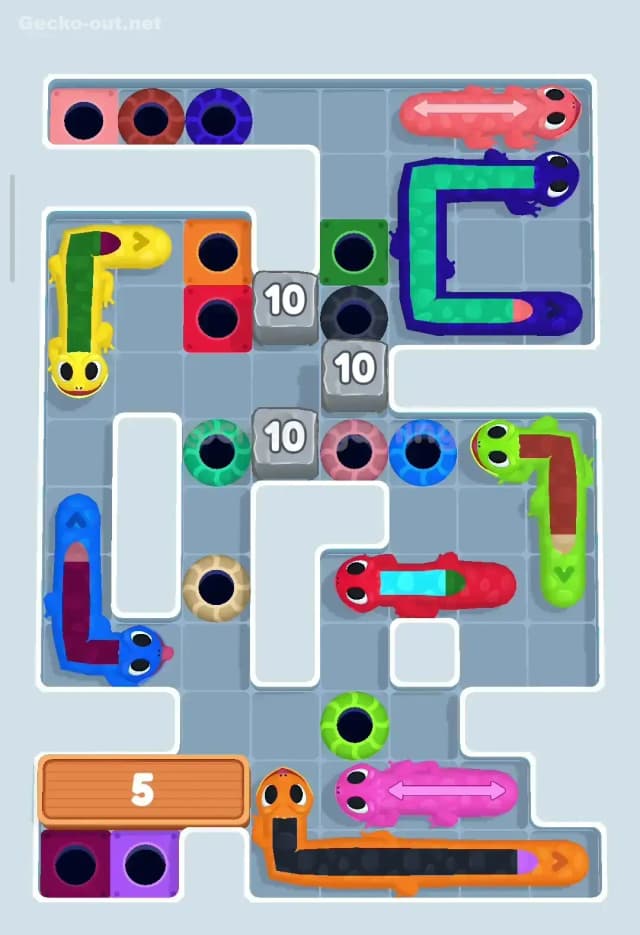
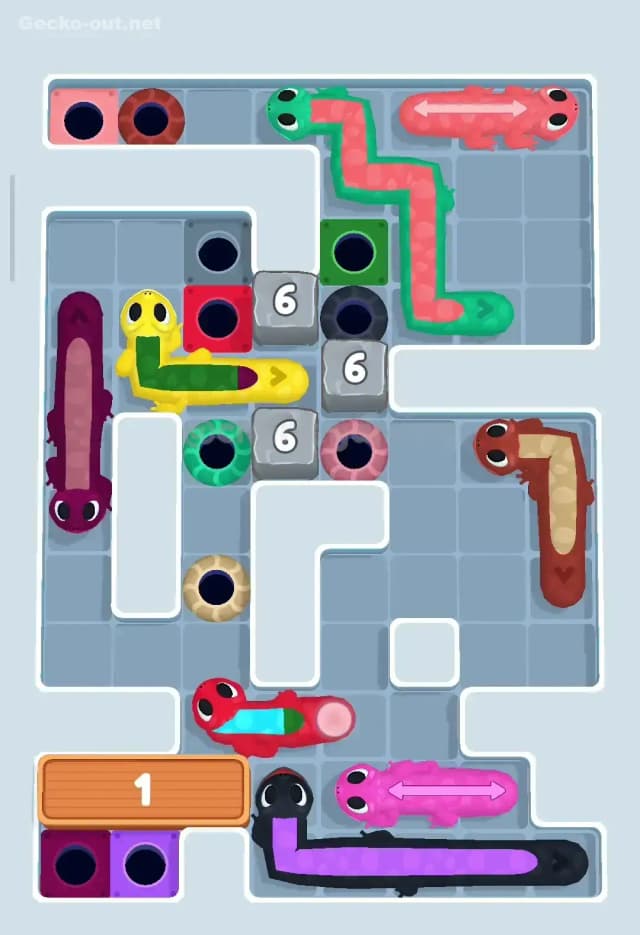
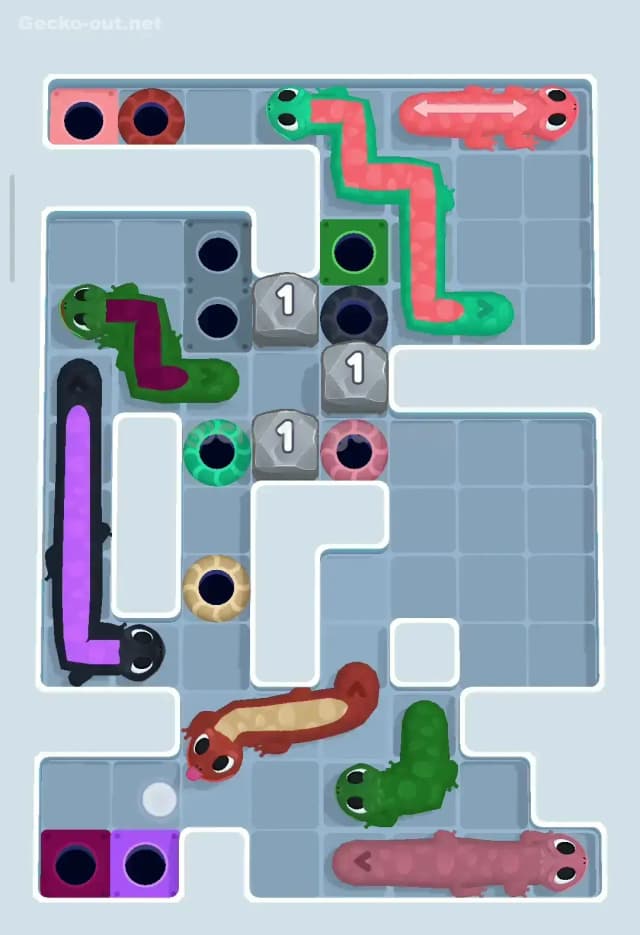
Gecko Out Level 350 throws you onto a very cramped board with almost every lane already occupied. You’ve got a full rainbow of geckos: yellow, blue, green, red, pink, orange, and a long dark-blue gecko that loops around itself. Most of them are already bent into L or C shapes, which means tiny choices in your pathing either free a whole side of the board…or lock everything down.
The exits are scattered around the edges and in the middle. You’ll notice:
- Multiple colored exits grouped near the center, wrapped around a cluster of grey blocks marked “10”.
- Several exits along the left and top walls that are easy to miss because geckos are already pressed right up against them.
- A bottom area where three geckos (orange, pink, and red) are crammed into a narrow lane with a single green exit just above them.
Those grey “10” blocks work like toll gates: crossing them shaves a big chunk off your timer. In Gecko Out 350, you want to minimize how many geckos pass through them and only use them when they open a crucial shortcut.
Timer, Pathing, and What Counts as a Win
The win condition is classic Gecko Out: every gecko must reach a hole that matches its body color. They can’t overlap walls, each other, or closed/frozen exits. The twist is the path-drag system: wherever you drag the head, the body will follow that exact route, square for square.
Because the timer is strict here, Gecko Out Level 350 punishes two things:
- Long, wiggly paths that waste time and space.
- Re-drawing routes because a previous gecko blocked a corridor.
To win, you need to plan the sequence so:
- The first few geckos open lanes instead of clogging them.
- Only 1–2 geckos ever need to cross the “10” toll blocks.
- You use as many straight, short runs to exits as possible.
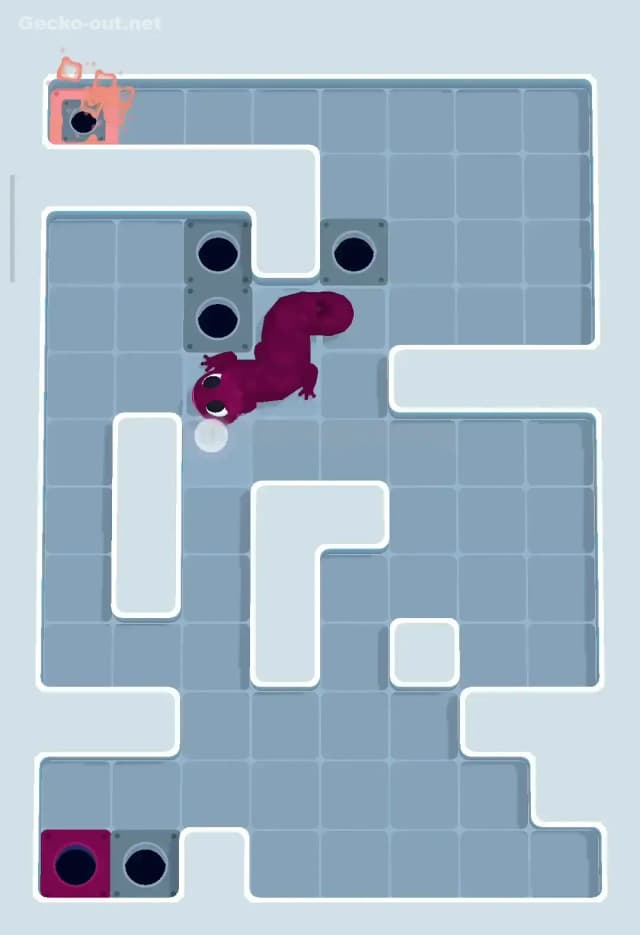
Once the last gecko fully disappears into its matching hole before the timer hits zero, you’re done.
Pathing Bottlenecks and Logical Traps in Gecko Out Level 350
The Central Toll-Gate Cluster Is the Real Boss
The biggest bottleneck in Gecko Out 350 is the central cluster: several colored exits ringed by those “10” blocks and narrow corridors. The long dark-blue gecko and the red one both want access to that region, but if you send the wrong gecko through first, their bodies snake around and block key gaps.
Think of the center as a one-lane roundabout. Once a long gecko wraps through it, the others either:
- Have no room to pass, or
- Are forced to cross extra toll blocks, burning huge chunks of time.
That’s why the level only really opens up once you clear the long blue gecko and one of the central exits early.
Subtle Traps That Ruin Good Runs
A few tricky spots catch people over and over:
- The left-side vertical corridor with the blue L-shaped gecko looks harmless, but if you exit it too early, you block the route other geckos need to swing into the middle safely.
- The bottom cluster (orange, pink, and red) is easy to panic-move. If you drag the orange gecko first, you often strand the pink one behind its long body, forcing a messy, time-wasting reroute.
- The top corridor where yellow and pink exits live can become a dead strip. Pathing a gecko through there in a loop might feel clever, but it chews up both space and timer.
Each of these isn’t an instant fail, but they gradually tighten the knot until no clean path remains.
When Gecko Out 350 Finally Clicks
My first attempts on Gecko Out Level 350 were chaos. I’d rush to free whatever head looked closest to an exit, and about halfway through, I’d notice one lonely gecko trapped behind a wall of bodies with two seconds left on the clock.
The “aha” moment was realizing this level is about lane management, not color matching. Once I thought of the board as:
- Top/left early-clear lanes,
- Central toll-ring, and
- Bottom final cluster,
the whole thing snapped into place. You clear top and left to create elbow room, use that room to navigate one long gecko through the core, then clean up the bottom in a specific order.
Turn-by-Turn Path Strategy to Beat Gecko Out Level 350
Opening: Clear Top and Left Without Touching the Timer Blocks
In Gecko Out Level 350, your opening moves decide everything. Here’s a reliable start:
- Free the short pink gecko near the top-right. Drag it along the top corridor straight into its matching pink exit on the upper edge. Keep the path tight to the wall so the center lanes stay untouched.
- Exit the long dark-blue gecko next. Curl its head through the central ring toward the dark-blue exit (just above the grey toll blocks). Draw the shortest possible curve: don’t loop around extra exits, and cross only one “10” block if you must. Once this gecko leaves, the middle area becomes much safer.
- Handle the yellow gecko on the top-left. Guide it horizontally to its yellow exit on the top edge, staying away from the central toll cluster.
During this opening, you’re “parking” everyone else. Don’t nudge the bottom or right-side geckos yet; any random wiggle can accidentally occupy the very corridor you’ll need later.
Mid-game: Rotate Through the Center Safely
With the top corridor clearer and the long blue gone, you can focus on the left and central geckos:
- Move the blue L-shaped gecko on the left. Thread it upward or sideways into its blue exit (near the central ring). Keep the path hugging the left wall and avoid crossing the toll blocks unless there’s absolutely no alternative.
- Route the green gecko on the right side. Drag it in a simple curve into the green exit close to the central cluster. Because other long bodies are gone, you can make a direct, compact path that doesn’t choke the middle.
- Check that the central toll zone is now mostly empty. At this point, only the red gecko should still need access to the central exits. Everyone else either lives on the bottom or has already escaped.
The goal of this mid-game phase is to finish all non-bottom geckos while leaving clean vertical and horizontal lanes for the final trio.
End-game: Bottom Cluster and Final Exits
Now you’re staring at the tightest part of Gecko Out Level 350: the orange, pink, and red geckos at the bottom plus a green exit nearby.
Use this order to avoid a disastrous tangle:
- Red gecko first. It usually needs to pass through or near the central toll area to reach its red exit. Draw a quick, clean route that uses any remaining free space in the middle. Because everything else is gone, you can afford to cross a “10” block here if needed.
- Pink gecko second. With the red body gone, you can pull the pink gecko through the gap toward its pink exit along the lower or side edge. Keep its body tight so you don’t close off the lane the orange one needs.
- Orange gecko last. The orange gecko is long and wants to sweep through the space emptied by the first two. Draw the most direct path from its starting spot to the orange exit on the lower-left side, hugging walls and ignoring the center entirely if possible.
If you’re low on time in this phase, prioritize straight lines over perfection. As long as you don’t clip another gecko or a blocked exit, a slightly inefficient route is better than running out of timer while trying to be fancy.
Why This Path Order Works in Gecko Out Level 350
Using Body-Follow Pathing to Untie the Knot
Gecko Out Level 350 punishes random experimentation because every drag leaves a full body trail. This plan works because:
- Long geckos (dark blue, orange, red) travel when the board is either very open (early) or very empty (late).
- Shorter geckos clear first, so they never become moving walls later.
- You deliberately avoid drawing “loops” that cut the board into smaller compartments.
By respecting the body-follow rule, you’re always using a gecko to open space, never to shrink it.
Balancing Thinking Time vs. Fast Drawing
The timer is scary, but pure speed won’t beat Gecko Out 350. The best rhythm is:
- Pause for a few seconds at the start to visualize the exit order and lanes.
- Draw the first 3–4 paths calmly but decisively, focusing on straight or gently curved lines.
- Only speed up in the end-game when there are fewer choices and you’re just executing the plan.
If you ever find yourself redrawing a path mid-move, back out and restart the level; that’s usually a sign the lanes are already doomed.
Boosters: When (and If) You Actually Need Them
For Gecko Out Level 350, boosters are optional but can help while you’re learning:
- An extra time booster is the most useful, giving you breathing room while you practice the path order.
- A hammer-style blocker remover isn’t essential; the “10” toll blocks are meant to be played around, not smashed.
- Hints can nudge you toward the correct early exits, but once you understand the order (top/left → center → bottom), you won’t need them.
If you want a clean, no-booster clear, stick to the sequence above and focus on crisp, minimal paths.
Mistakes, Fixes, and Logic You Can Reuse in Other Gecko Out Levels
Common Errors on Gecko Out 350 and How to Fix Them
-
Exiting the bottom orange gecko too early.
Fix: Leave orange for last so its long body doesn’t trap pink and red. -
Sending multiple geckos through the “10” blocks.
Fix: Plan routes that only require one or two geckos to pay the toll. Everyone else should skirt around the edges. -
Looping geckos around the center exits.
Fix: Aim for direct shots: head → corner → exit. No decorative circles. -
Ignoring the top corridor until late.
Fix: Clear the small pink and yellow geckos early so their space becomes a staging area for central moves. -
Over-correcting mid-move.
Fix: If a path feels wrong, restart fast. Trying to “fix” it with extra curves just eats timer and space.
Recycling This Logic on Other Knot-Heavy Levels
The habits you build on Gecko Out Level 350 apply to a lot of tricky stages:
- Tackle lane-openers first. Identify which geckos will increase usable space when they leave, and prioritize them.
- Delay long-body geckos until the board is empty, unless one of them is literally blocking everyone else.
- Minimize crossings of costly tiles like toll blocks or ice timers, treating them as last-resort shortcuts.
- Visualize final positions of bodies, not just heads; imagine the snake trailing behind before you draw.
Whenever you see a dense knot or “gang” of linked geckos, think in terms of clearing outer rings first, then working inward.
Yes, Gecko Out Level 350 Is Tough — But You’ve Got This
Gecko Out 350 feels brutal at first because every mistake echoes across the whole board. But once you understand that it’s really a lane-management puzzle, not just a color-matching race, it becomes surprisingly consistent.
Follow the plan—top and left first, then center, then the bottom trio in the right order—and you’ll start seeing clears instead of near-misses. Stick with it, keep your paths short and purposeful, and Gecko Out Level 350 turns from a wall into one of those satisfying “I can’t believe I used to fail this” levels.