Gecko Out Level 333 Solution Walkthrough | Gecko Out 333 Answer
How to solve Gecko Out level 333? Get step by step solution & cheat for Gecko Out level 333. Solve Gecko Out 333 easily with the answers & video walkthrough.



Gecko Out Level 333: Board Layout, Rules, and Win Condition
The Starting Board: Colors, Knots, and Obstacles
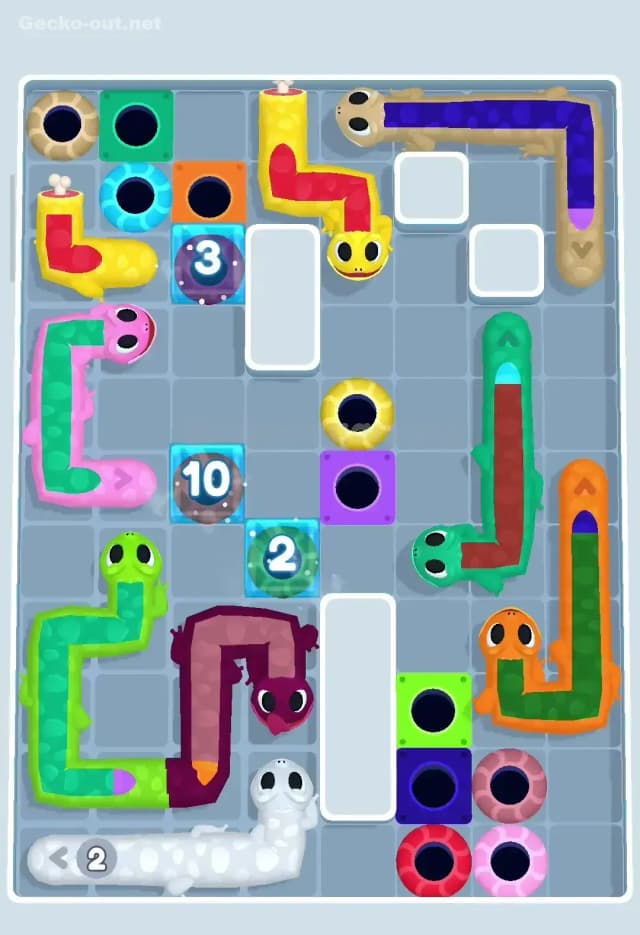
In Gecko Out Level 333 you’re thrown into a very packed board: long geckos everywhere, exits bunched into clusters, and several chunky white wall blocks carving the grid into narrow corridors.
You’ll see:
- A tall blue gecko climbing the left edge, with its head squeezed near the upper-left corner.
- A long green gecko running vertically just to the right of the blue one, turning left at the bottom.
- A red‑purple gecko and a white gecko forming an L‑shaped tangle near the bottom center.
- On the right side, a tall teal gecko and a shorter orange gecko stacked in a vertical column, both pointing toward the crowded exit cluster in the lower‑right.
- Up top, a yellow gecko and a long tan‑and‑purple “gang” gecko that stretches along the top row and then down the right side.
On top of that, Gecko Out 333 throws in numbered tiles and colored frames that act like toll gates or frozen floor spots, especially around the central area. Several exits sit right next to wrong‑colored holes, so it’s easy to mis-drop a head if you drag too fast. White rectangular blocks split the board into three main lanes: left, center, and right, with only a few narrow gaps between them.
Win Condition, Timer, and Path-Based Movement
The win condition on Gecko Out Level 333 is simple but unforgiving: every gecko has to reach its matching colored hole before the timer runs out. Because bodies follow the exact route you drag the head, every extra bend matters. A sloppy S‑curve can block the board just as effectively as a wall.
The strict timer changes how you think. You don’t have time to reroute a long gecko three times. You need a path order that:
- Clears the worst chokepoints early.
- Keeps at least one central corridor open at all times.
- Uses tight, wall‑hugging paths so the bodies don’t sprawl across key exits.
Once you see Gecko Out 333 as a “lane management” puzzle instead of just “get everybody out,” the layout stops feeling random and starts to make sense.
Pathing Bottlenecks and Logical Traps in Gecko Out Level 333
The Main Bottleneck Corridor
The single biggest bottleneck in Gecko Out Level 333 is the vertical corridor running through the middle-right of the board, between the central white block and the right wall. The teal and orange geckos share this lane with the tall tan‑purple gang gecko that drops down from the top.
Whoever owns that lane controls the entire right half of the puzzle. If you send a long gecko down the middle-right too early and park it badly, you’ll cut off exits for:
- The orange and teal geckos at the bottom-right.
- The tan‑purple gang gecko that needs to snake past them.
- Any late reroutes coming from the center.
So your plan has to revolve around clearing and reusing that lane in a specific order.
Subtle Problem Spots That Ruin Runs
There are a few less obvious traps in Gecko Out 333:
-
Left-side compression. The blue and green geckos on the left look free, but if you pull the blue one across the middle too early, its long body will wrap around the central walls and block routes to the numbered tiles and central exits.
-
The bottom-center knot. The red‑purple and white geckos form an L that looks harmless, but if you exit the white one first with a wide curve, you’ll strand the red‑purple body and lose access to the gap that connects the left and right halves.
-
Exit clusters with wrong holes. Several correct exits sit right next to different-colored “warning” holes. Under time pressure, it’s very easy to flick a head into the wrong one. Because you can’t overlap or back out once the body commits, one mis-drop essentially burns the run.
When The Level Finally Clicks
I’ll be honest: Gecko Out Level 333 feels chaotic on your first few attempts. My early runs all died the same way—everything looked fine until the last three geckos, when I suddenly realized the right-side lane was walled off by my own paths.
The moment it started to click was when I stopped thinking “which gecko can I free now?” and started thinking “which corridor do I need available later?” Once I decided that the central vertical lane must remain open until the very end, the correct exit order basically revealed itself.
Turn-by-Turn Path Strategy to Beat Gecko Out Level 333
Opening: Set Up Lanes and Safe Parking
Your opening in Gecko Out 333 is all about positioning, not speed.
-
Clear the top-middle first. Take the short yellow gecko near the top and draw a tight, L‑shaped path to its matching exit, hugging walls so it uses minimal space. This opens breathing room around the central numbered tiles.
-
Shift the tan‑purple gang gecko. Drag its head along the top edge and then down the right side, but don’t exit yet. Instead, park it snugly against the right wall so its body runs straight and doesn’t cross into the middle-right lane.
-
Tidy the left side. Nudge the blue gecko’s head up or along the left border so its body stays flush with the wall. This lets you maneuver the tall green gecko without them tangling.
-
Park the bottom-center pair. Move the white and red‑purple geckos just enough so they lie flush with the bottom edge and the side of the central white block. Think of them as flexible walls you’ll move later; for now, they shouldn’t intrude into the central vertical channel.
If you execute this opening cleanly, you’ll have three semi-clear lanes and no gecko body cutting across the board diagonally.
Mid-game: Weaving Long Bodies Without Blocking Exits
Mid-game in Gecko Out Level 333 is where most runs fail, because this is when you’re tempted to send big sweeping paths.
Here’s the safer pattern:
-
Left resolution. Use the space you created to route the tall green gecko to its exit first. Draw a mostly straight path, hugging the central wall, and avoid crossing in front of exits you’ll need later. Once green is gone, the blue gecko has enough room to turn and reach its hole without cutting into the center.
-
Open the central gap. With blue and green handled, you can gently lift the white and red‑purple geckos, using short, straight moves to create a clean vertical gap from the central area into the right side. Don’t exit them yet—they’re still your movable barriers.
-
Free the teal gecko on the right. Use the middle-right lane to send the tall teal gecko to its exit. Keep its body hugging the right wall as much as possible so the orange gecko still has room.
-
Then exit the tan‑purple gang gecko. Now that the teal is gone, you can drag the tan‑purple head down through that same lane and curl it into its matching hole. This is where the early parking pays off: its body will follow in a clean vertical line instead of a messy spiral.
End-game: Clean Exit Order and Panic Management
By end-game in Gecko Out 333, you should have just a handful of geckos left: usually the orange right-side gecko and your bottom-center pair.
-
Exit orange next. Use the freed lane on the right to send orange directly to its exit. Keep the path tight; don’t swing into the center if you don’t have to.
-
Finish with the red‑purple and white geckos. With almost everything else gone, you can now route these two without worrying about blocking anyone. I like to exit the red‑purple first, drawing its path along the central block, then wrap the white gecko through whatever space remains.
If you’re low on time at this stage, commit to the simplest, straightest path for each; don’t overthink optimal compactness when only one or two geckos remain.
Why This Path Order Works in Gecko Out Level 333
Using Head-Drag Pathing to Untangle, Not Tighten
This plan for Gecko Out Level 333 works because it treats every drag as laying down cable. Long, curvy routes are basically permanent walls. By exiting green, teal, and the tan‑purple gang gecko in the middle of the run—and always hugging borders—you’re removing the longest “cables” before they can trap others.
Parking geckos flush with walls turns them into predictable obstacles instead of wild snakes. When you finally move them (like the white and red‑purple pair), you’re doing it after most of the board is already clear.
Timer Management: Think First, Then Swipe Fast
The timer feels harsh, but you actually have enough time if you:
- Use your first attempt just to read the board and identify the main lanes.
- On your second attempt, mentally commit to the exit order: yellow → green/blue → teal → tan‑purple → orange → bottom pair.
- On the real “serious” attempt, pause briefly before each long drag to visualize where the body will lie.
You lose more time restarting failed runs than you do by spending half a second visualizing a path.
Boosters: Optional, Not Required
For Gecko Out Level 333, boosters are absolutely optional:
- An extra time booster can help while you’re still learning the exit order, especially for your first clear.
- A hammer/eraser-style booster that removes an obstacle or undoes a bad placement could recover a run where you mis-parked a long gecko, but it’s overkill once you know the plan.
- I wouldn’t burn a hint booster here; the core trick is lane discipline, which a single hint doesn’t really teach.
If you’re close to finishing and keep timing out with one gecko left, using an extra time booster just once to “feel” the successful flow of Gecko Out 333 can be worth it.
Mistakes, Fixes, and Logic You Can Reuse in Other Gecko Out Levels
Common Mistakes and How to Fix Them
Players tend to make the same errors on Gecko Out Level 333:
-
Exiting the wrong gecko first. If you start with orange or the bottom-center pair, you’ll almost always block the middle-right lane. Fix: commit to clearing yellow, green/blue, and teal before touching the others.
-
Drawing big, loopy paths. Curvy routes feel fun but they devour space. Fix: force yourself to trace along walls and corners whenever possible; imagine each gecko wants the shortest Manhattan path.
-
Ignoring the bottom-center pair until it’s too late. Leaving white and red‑purple in their starting tangle traps you when you need the central gap most. Fix: reposition them early into neat “parked” shapes along the bottom edge.
-
Dropping a head into a warning hole. Under pressure, colors blur. Fix: slow down near exit clusters and check the ring color before you commit the final tile.
Reusing This Logic on Similar Levels
The habits you build beating Gecko Out Level 333 carry over to lots of other Gecko Out levels:
- Identify the main lane (or two) that multiple geckos must share, and plan your exit order around keeping it open.
- Park non-critical geckos neatly against walls instead of exiting them in messy curves.
- Clear the longest bodies earlier, while there’s still room to pull straight paths.
- Treat countdown tiles or toll gates as part of your routing puzzle, not as decorations—plan who will step on them and when.
Whenever you see gang geckos, frozen exits, or heavy wall blocks, ask yourself: “If I draw this path, which future exits am I permanently closing?”
Gecko Out Level 333 Is Tough, But You’ve Got This
Gecko Out Level 333 looks brutal at first glance, but once you see it as a lane-management problem instead of a pure untangle, it becomes a really satisfying puzzle. You’re not just dragging cute lizards; you’re scheduling traffic through a few tight corridors.
Give yourself a couple of “learning” runs, lock in the exit order, and focus on straight, wall-hugging paths. With that mindset, Gecko Out 333 goes from frustrating to one of those levels you look back on and think, “Wow, that was actually clever.”