Gecko Out Level 1045 Solution Walkthrough | Gecko Out 1045 Answer
How to solve Gecko Out level 1045? Get step by step solution & cheat for Gecko Out level 1045. Solve Gecko Out 1045 easily with the answers & video walkthrough.



Gecko Out Level 1045: Board Layout, Rules, and Win Condition
The Starting Board and Gecko Placement
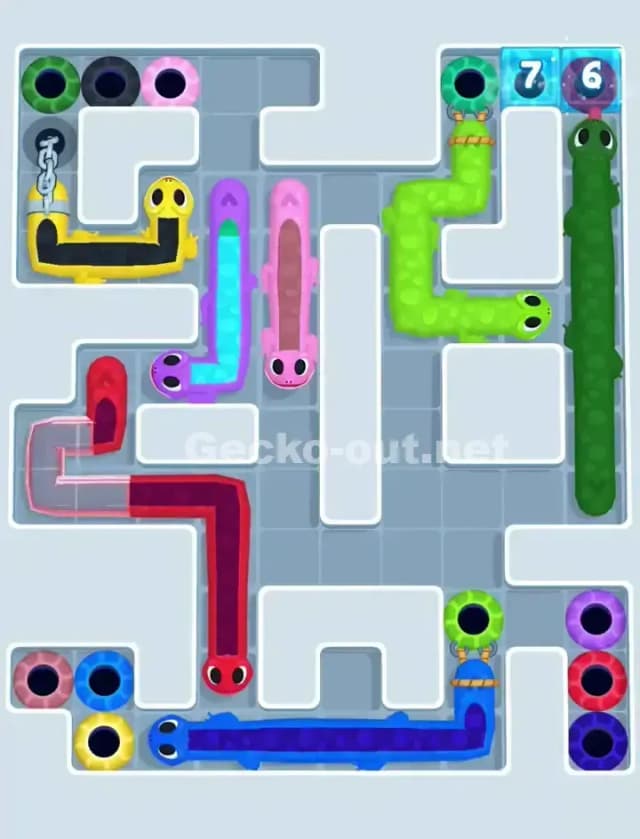
Gecko Out Level 1045 is a dense, multi-colored puzzle that'll test your spatial reasoning hard. You're working with seven geckos spread across the board: a green gecko in the top-left corner, a dark navy gecko next to it, a pink gecko, a cyan-and-magenta gang gecko (linked together as one unit), a yellow gecko, a purple gecko, a red gecko, and several more scattered throughout the lower and right sections of the board. Each gecko has a matching-colored hole it must reach to escape. The board itself is a maze of white walls creating tight corridors and compartments, which means there's almost zero room to maneuver carelessly.
What makes Gecko Out Level 1045 particularly tricky is the sheer number of geckos competing for limited pathways. You'll notice immediately that certain corridors are narrow choke points, and some geckos are positioned in corners that require careful, deliberate routing. The gang gecko (the cyan-magenta pair) is especially important to watch because it moves as a single unit and takes up considerable space on the board.
The Win Condition and Timer Pressure
Your goal in Gecko Out Level 1045 is straightforward: get every single gecko to its matching-colored exit hole before the timer runs out. The timer isn't forgiving—you've got a strict time limit, which means you can't afford to make multiple mistakes and restart individual geckos. The moment you fail to exit all geckos, you're sent back to the start. This timer pressure fundamentally changes how you approach the puzzle; you can't just wander and experiment like you might on easier levels.
The drag-path mechanic is critical here. When you drag a gecko's head, its body follows the exact path you traced, pixel by pixel. That means if you accidentally carve out a route that later blocks another gecko's exit, you've created an irreversible jam. Gecko Out Level 1045 forces you to think three or four moves ahead, mentally simulating how each path will impact the geckos waiting to move next.
Pathing Bottlenecks and Logical Traps in Gecko Out Level 1045
The Central Corridor Bottleneck
The biggest bottleneck in Gecko Out Level 1045 is the central vertical corridor that connects the left side of the board to the right side exits. This narrow lane is where multiple geckos need to pass through, and it's the source of most traffic jams. The cyan-magenta gang gecko and the red gecko both need to funnel through or near this space, and their long bodies can easily block shorter geckos trying to make their own escapes. If you're not careful about exit order, you'll find your fastest geckos completely trapped behind the slowest ones.
The key insight is that you need to clear the gang gecko and the red gecko out of the way before they become permanent obstacles. Parking them in their exit holes first—or at least routing them through the board in a way that doesn't leave their bodies draped across crucial pathways—is essential to keeping the bottleneck passable for everyone else.
Subtle Problem Spot #1: The Upper-Left Corner Entanglement
The top-left region of Gecko Out Level 1045 has three geckos (green, navy, and pink) crammed relatively close together with limited exit routes. If you route the green gecko along a path that crosses where the pink gecko needs to go, you've locked both of them into a waiting game. The trick here is to identify which of these three has the clearest, most direct route to its exit hole, and start with that one. Then, and only then, can the other two have breathing room to move without conflict.
Subtle Problem Spot #2: The Right-Side Staircase of Exits
On the right edge of the board, you'll see several exit holes stacked vertically. These holes have a limited approach corridor, and if you send two geckos toward them simultaneously without planning the exact sequence, they'll collide mid-path and jam each other. Gecko Out Level 1045 requires you to route these geckos one at a time, in a specific order, so that each one completes its exit before the next one begins its approach.
Subtle Problem Spot #3: The Lower-Center Crossroads
The lower-middle section of Gecko Out Level 1045 is where multiple pathways intersect. The blue gecko, the orange gecko, and at least one other gecko all have routes that funnel through this area. If you're not deliberate about sequencing, you'll create a four-way collision that doesn't resolve itself. The timer will tick, and you'll be stuck watching geckos pile up against each other, helpless.
The "Aha!" Moment
Honestly, my first attempt at Gecko Out Level 1045 felt overwhelming. Seven geckos, dozens of walls, a timer ticking away—I panicked and just started dragging heads in whatever direction seemed logical. The result? A complete mess within thirty seconds. But then I paused, zoomed out mentally, and realized that the puzzle wasn't about moving all the geckos simultaneously. It was about identifying the one gecko whose path would unlock everyone else. That moment—when I stopped treating Gecko Out Level 1045 like a race and started treating it like a logic puzzle—everything clicked. The solution became obvious: clear the biggest obstacles first, then let the remaining geckos flow through the newly opened pathways.
Turn-by-Turn Path Strategy to Beat Gecko Out Level 1045
Opening: The First Move Sets Everything Up
Start with the green gecko in the top-left corner. Its exit hole is relatively nearby, and clearing it immediately removes one body from the board, giving other geckos more room to maneuver. Drag its head down and along the left wall until it reaches its matching green exit hole. This move takes about five to ten seconds and accomplishes something important: it demonstrates that Gecko Out Level 1045 is solvable and builds confidence.
Next, move the navy gecko. Its path is straightforward too, and it's close enough to its exit that you can route it without overthinking. By clearing these two early, you're reducing visual clutter and freeing up the left side of the board. Now the yellow gecko, which also occupies the left-center area, has more space to work with.
Park the cyan-magenta gang gecko next. This is the longest, bulkiest gecko on the board, and it's a space-hog. Route it carefully toward its dual-colored exits (cyan and magenta holes on the board). The gang gecko takes a slightly more complex path, but because you've already cleared the other left-side geckos, you won't have collisions. Take your time here; a single misdrag means you've wasted precious seconds and potentially locked the gang gecko into an unusable position.
Mid-Game: Keeping Critical Lanes Open
Once the left side is mostly cleared, shift your focus to the red gecko. It's a long gecko with a body that can easily block the central corridor if positioned carelessly. Route it along the middle-right pathways toward its red exit holes on the right edge of the board. Be extremely deliberate: drag its head slowly, watching the body follow behind, ensuring it never crosses or blocks the paths you'll need for the remaining geckos.
Now tackle the pink gecko, which should have more room to work with thanks to your earlier moves. Its exit is on the left-middle area, and routing it should be straightforward now that its neighboring geckos are gone. Don't rush; one careful drag is better than three frantic mistakes.
At this point, you should have five geckos safely out. The purple gecko, blue gecko, orange gecko, and green gecko on the right side remain. These geckos have somewhat independent pathways, but they'll still converge near the central and lower corridors. Route them one at a time, prioritizing the ones whose exits are most accessible at that moment. Check the timer—you should have plenty of time remaining if you've followed this sequence without hesitation.
End-Game: The Final Three Geckos and No Room for Error
With five geckos down, Gecko Out Level 1045 shifts into its toughest phase. The remaining geckos don't have the luxury of empty pathways; they have to navigate a board with many of their colleagues' bodies still occupying space. This is where patience becomes crucial. Don't drag blindly. Trace each path with your finger or cursor first, mentally simulating how the gecko's body will follow, ensuring it doesn't collide with any walls or other geckos still on the board.
Exit order matters enormously here. If you've got a purple gecko and an orange gecko both needing to pass through the lower-center crossroads, choose the one whose exit is closest to its starting position or current location. That gecko should go first. The second gecko can then navigate around the now-freed space left by the first.
If the timer is getting dangerously low—say, fewer than fifteen seconds—and you've still got two or three geckos remaining, don't panic. Gecko Out Level 1045 is designed to be passable without boosters if you execute the correct sequence. Just keep your drags smooth and confident. Rush and you'll make errors. Stay calm, and the exit paths will become clear.
Why This Path Order Works in Gecko Out Level 1045
How Head-Drag Sequencing Untangles the Knot
The reason this strategy works is rooted in how the drag-path mechanic functions. Each gecko's body is "locked" into the exact path its head travels. By moving the bulkiest, most-space-consuming geckos first (the gang gecko and the red gecko), you're essentially clearing the board of the biggest obstacles. When smaller geckos move later, they encounter fewer bodies in their way, which means their paths are simpler, shorter, and less likely to create new jams.
Think of Gecko Out Level 1045 as a sliding-block puzzle, but with living creatures. You're not just moving geckos to their exits; you're reordering them so that each one leaves a clear lane for the next. The gang gecko and red gecko are the "big blocks"—they take up space and block progress. Once they're gone, the "small blocks" (the shorter geckos) can slip through the gaps that remain.
Timer Management: When to Pause Versus When to Commit
The timer in Gecko Out Level 1045 is a psychological test as much as a time limit. Many players make the mistake of rushing through their first three or four geckos just to "feel" like they're making progress, then they realize they've created a tangled mess and have to restart. Don't fall into that trap.
Spend the first thirty seconds of Gecko Out Level 1045 doing nothing but studying the board. Trace the paths in your mind. Identify which gecko is truly first, second, third, and so on. Then, execute those moves with deliberate, unhurried precision. A five-second move done correctly is worth more than a two-second move followed by a restart.
Once you've cleared the first four or five geckos, you can afford to move a bit faster because there's less complexity. The final geckos, paradoxically, often go quicker because there are fewer obstacles remaining. You're working against a clock, but the clock is lenient if you've planned well.
Boosters: Optional But Not Necessary
Gecko Out Level 1045 doesn't require boosters like time extensions or hint tools. If you follow this strategy, you'll have time to spare. However, if you're getting close and you've made one or two minor mistakes (an extra five to ten seconds spent repositioning), an extra-time booster can save a run that would otherwise fail. I'd recommend treating boosters as insurance, not crutches. Master Gecko Out Level 1045 without them first, and then use them only if you're truly stuck after multiple attempts.
Mistakes, Fixes, and Logic You Can Reuse in Other Gecko Out Levels
Common Mistake #1: Moving the Gang Gecko Too Late
The Mistake: Players often assume the gang gecko is "fine where it is" and prioritize smaller geckos first, thinking they'll deal with the big guy later. This usually means the gang gecko ends up blocking the central corridor just when you need it most.
The Fix: Move the gang gecko in the first three moves of Gecko Out Level 1045. It doesn't matter if it's not technically "first"—just get it out of the center of the board early. This clears the bottleneck and everything else becomes easier.
Common Mistake #2: Dragging Paths Too Slowly (or Too Quickly)
The Mistake: Some players drag gecko heads with extreme slowness, as if precision will prevent errors. Others drag so fast that they overshoot corners and have to backtrack. Both approaches waste time.
The Fix: Develop a consistent, moderate drag speed. Move at the same pace you'd use to draw a careful line on paper—deliberate but not glacial. This approach lets you maintain control while keeping timer pressure manageable in Gecko Out Level 1045.
Common Mistake #3: Not Accounting for Body Follow-Through
The Mistake: Players drag a head toward an exit hole, assuming the path is clear, only to realize mid-drag that the gecko's body is scraping against a wall or another gecko. By then, it's too late to correct.
The Fix: Before dragging, imagine the gecko's entire body following the path you're about to create. Trace it mentally. If your instinct says "that might not work," it probably won't. Spend an extra three seconds thinking, and you'll save thirty seconds in restart time.
Common Mistake #4: Ignoring the Right-Side Stacking Problem
The Mistake: Players assume that because multiple exit holes are on the right side, multiple geckos can approach them simultaneously. This creates collisions that jam the entire game.
The Fix: Identify every gecko heading toward the right-side exits in Gecko Out Level 1045. Commit them to a specific sequence: first gecko goes, exits, second gecko goes, exits, and so on. No overlaps, no simultaneous attempts.
Common Mistake #5: Panicking When the Timer Gets Low
The Mistake: With thirty seconds left and three geckos remaining, players start dragging erratically, creating new problems with each move.
The Fix: Take a breath. Check how many geckos are left. Odds are, Gecko Out Level 1045 is still solvable. Route the next gecko methodically. Often, you'll find that what looked like a jam is actually passable if you trace the correct path. Panic is your enemy; clarity is your ally.
Reusable Logic for Similar Levels
This strategy—clearing space-consuming geckos first, then routing smaller ones—is incredibly valuable for any Gecko Out level with gang geckos, frozen exits, or tight bottlenecks. Whenever you encounter a level where multiple geckos converge in a narrow area, apply Gecko Out Level 1045's core lesson: identify the biggest obstacle, move it first, then let everything else fall into place.
Final Encouragement
Gecko Out Level 1045 is genuinely challenging, but it's absolutely beatable. The difficulty isn't about reflexes or luck; it's about patience and planning. Once you understand the sequencing, you'll find that the puzzle almost solves itself. Stick with the strategy, trust the process, and you'll have all seven geckos safely escaped before you know it. You've got this.