Gecko Out Level 996 Solution Walkthrough | Gecko Out 996 Answer
How to solve Gecko Out level 996? Get step by step solution & cheat for Gecko Out level 996. Solve Gecko Out 996 easily with the answers & video walkthrough.
Gecko Out Level 996: Board Layout, Rules, and Win Condition
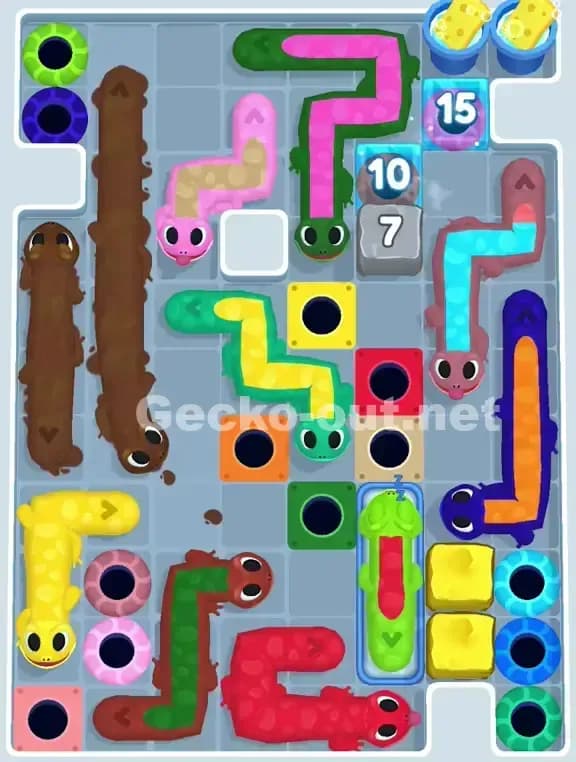
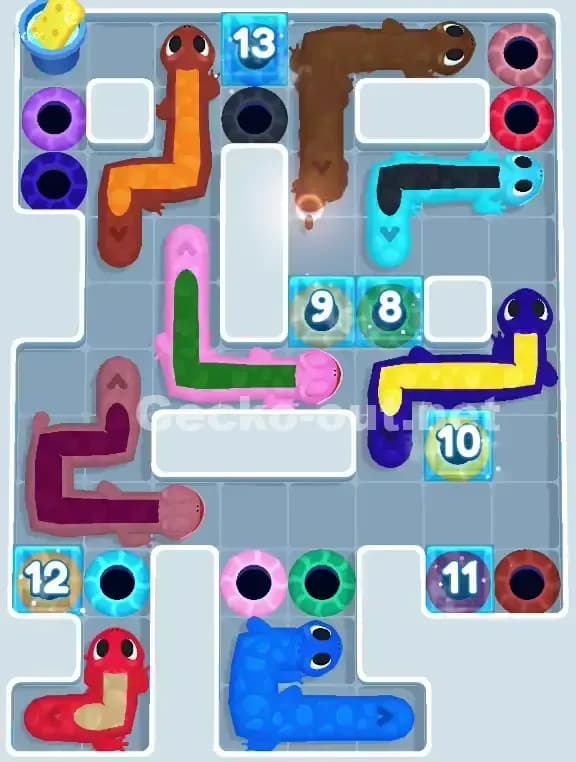
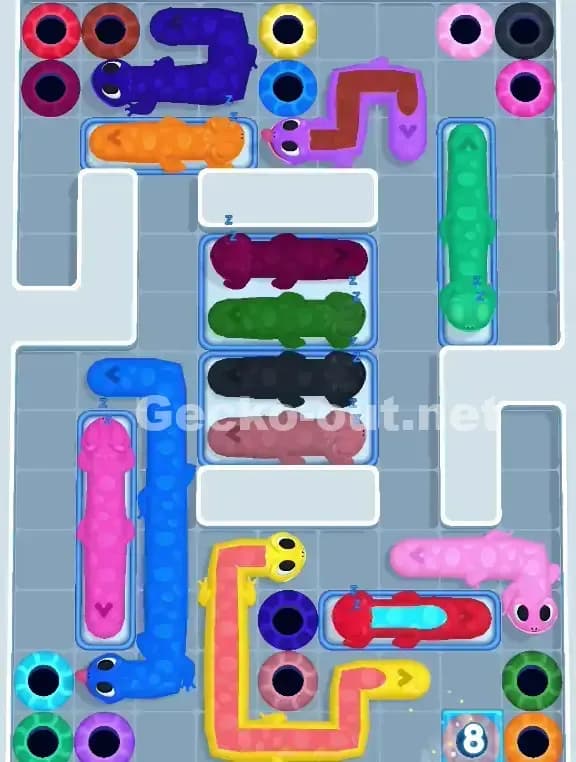
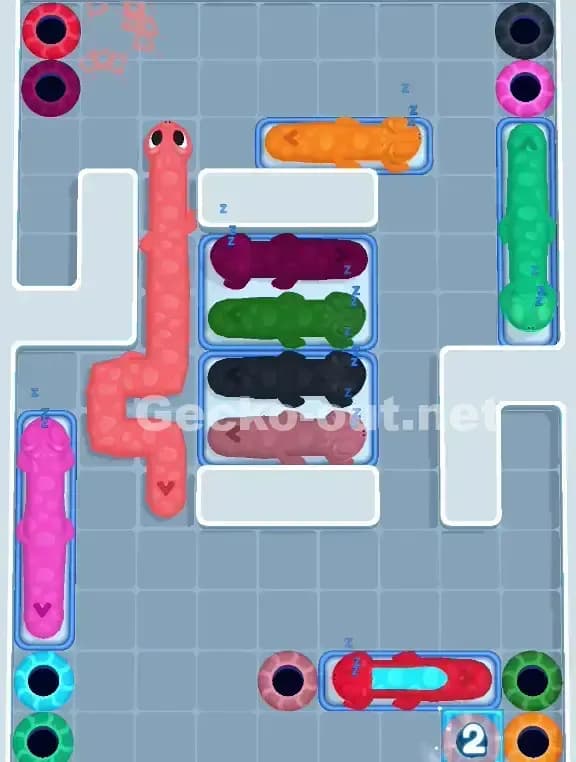
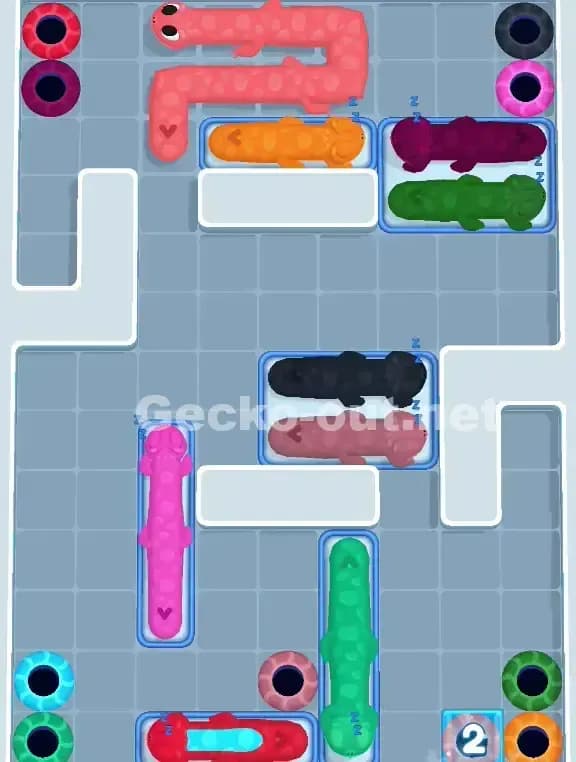
Gecko Out Level 996 is honestly one of the trickiest mid-tier puzzles you'll encounter. You're working with nine geckos across seven distinct colors: red (2), blue (2), orange (1), yellow (1), purple (1), green (1), pink (1), and black (1). Each gecko needs to find its matching colored hole to escape, and they're distributed all over the board in what initially looks like complete chaos. The board itself is a complex maze of white walls and tight corridors, with several geckos already boxed into confined spaces. What makes Gecko Out Level 996 uniquely brutal is that you've got multiple gang geckos—particularly the two reds and two blues—that are long and unwieldy, plus several geckos stuck in compartments that share only one or two exit routes. The timer is unforgiving; you'll need to work briskly but carefully to guide all nine geckos out before time runs out.
Win Condition and Timer Pressure
You win Gecko Out Level 996 by successfully dragging each gecko's head through the maze until its body follows and the tail reaches the matching colored hole. The critical twist? All nine must reach their holes before the timer hits zero. This isn't a "get one out and relax" scenario—the timer pressure forces you to plan the entire sequence upfront and move with confidence. Every wasted drag, every wrong turn, every moment spent second-guessing costs you precious seconds.
Pathing Bottlenecks and Logical Traps in Gecko Out Level 996
The Core Bottleneck: The Central Corridor Nightmare
The single biggest traffic jam in Gecko Out Level 996 is the central white-walled corridor that runs vertically through the middle of the board. At least three geckos—the black one, one of the blues, and the red gang—need to pass through or around this space to reach their exits. If you're not careful about the order in which you move them, you'll create a deadlock where one gecko's body blocks another's path, and you'll have no way to untangle them without restarting. I found this out the hard way on my first few attempts: I moved the blue gecko through the center before routing the black one, and suddenly the black gecko had no viable path. The black gecko's hole is in the bottom-right corner, and its only reasonable route goes directly through that central bottleneck. You must reserve this corridor for specific geckos and route others around the perimeter first.
Subtle Trap 1: The Trapped Red Gang in the Upper-Left
The two red geckos are confined to a small compartment in the upper-left corner with only one exit point. They're long, they're side-by-side, and their shared red hole is nowhere near them. Getting even one red gecko out requires a precise drag that winds it through a narrow opening without letting its body collide with the compartment wall. What's sneaky about Gecko Out Level 996 here is that if you route the first red incorrectly, the second red becomes even harder to extract because the first gecko's lingering body may still occupy the exit path momentarily.
Subtle Trap 2: The Orange and Yellow "Puzzle Within the Puzzle"
The orange gecko is tucked into a side chamber, and the yellow gecko is positioned near a multi-colored exit zone that looks like it might belong to multiple geckos. Yellow's hole is clearly marked, but the geometry of the walls around that zone is such that dragging yellow out before clearing nearby pink or red can cause a collision. On Gecko Out Level 996, I initially tried to move yellow early, thinking I was being efficient, and it created a blockage that trapped the pink gecko. The lesson? Just because a gecko is small or seems "easy" doesn't mean it should move first.
Subtle Trap 3: The Dual-Lane Left-Side Squeeze
On the left side of Gecko Out Level 996, you've got the pink and one of the blue geckos sharing what looks like two separate vertical lanes, but they're closer than they appear. The walls create an optical illusion of space; in reality, if you're not careful with your drag angle, one gecko's body can cross into the other's lane and jam both of them. This is especially maddening because both geckos are fairly long.
My Personal Aha Moment
Honestly, Gecko Out Level 996 frustrated me for several attempts. I kept thinking, "Just move them out in any order," and I'd get three or four geckos out before hitting a deadlock. Then it clicked: I needed to think of the board like a Jenga tower—every move affects the stability of the whole system. The real breakthrough came when I traced the path of every gecko simultaneously on paper before dragging anything. Suddenly, the order became obvious: clear the perimeter first, keep the center open, and route the gang geckos last when they have the most freedom of movement.
Turn-by-Turn Path Strategy to Beat Gecko Out Level 996
Opening: Establish Safe Parking Zones and Clear the Corners
Start by moving the yellow gecko (upper-middle area) directly to its hole. This isn't the most obvious first move, but it's smart because yellow is small, has a clear path, and removes one variable from the board immediately. Your confidence boost from a quick first success also helps mentally.
Next, tackle the purple gecko in the upper-center area. Its path is relatively straightforward—drag it down and to the right to its matching purple hole without intersecting the white walls. Purple out of the way creates breathing room.
Third, move the green gecko from the right side. It's in a vertical slot with a direct route to its green hole at the bottom-right. Dragging it now keeps the right edge of the board clear for later maneuvers.
By now, you've removed three geckos and established a feel for the board's geometry. You haven't touched any of the trapped or gang geckos yet, and you've created "parking zones"—empty spaces on the board where you can now move longer geckos without them colliding with static obstacles.
Mid-Game: Untangle the Left-Side Gang and Manage the Center
Now move the first red gecko from the upper-left compartment. Drag its head downward and to the right, weaving it around the white walls and into the central corridor. Park its body in a safe spot (typically along the left edge or in a corner) while you continue. Do not try to push it all the way to its hole yet—you're just clearing the compartment.
Move the second red gecko using the same corridor, immediately after the first one has exited the compartment. The key is to keep both reds' bodies in the mid-board area, not blocking any exit points.
Next, extract the orange gecko from its side chamber. Its path is short but critical—drag it carefully to its matching hole. Orange's hole is in a fairly accessible location, so this should be quick.
Now the two blue geckos need attention. They're on opposite sides of the board but both quite long. Move the first blue gecko (the one in the lower-left corner) upward and to the right, routing it through the central corridor toward its blue hole. Keep its body tight to the walls to avoid creating new blockages.
Move the second blue gecko (the upper-center area, dark blue) along the top portion of the board, avoiding the reds and orange you've already positioned. Route it down and around toward its blue hole.
End-Game: The Pink and Black Geckos—Precision Under Pressure
At this stage, your board should feel much less crowded. You've got the pink gecko and the black gecko left. Both are long, and both need to navigate through territory that's been carefully preserved for this exact moment.
Move the pink gecko first. It's long and needs to snake around several corners, but with the reds, blues, and orange already at their holes, the central and right-side paths are now open. Drag pink's head carefully, making sure its body doesn't clip any remaining walls. Route it to its pink hole.
Finally, move the black gecko—the last one standing. By now, you might be feeling time pressure, but resist the urge to panic-drag. Black is long, and its path is the most constrained because it must navigate through the now-empty central corridor. Drag black's head steadily through the maze, following the predetermined route you identified earlier, and guide its body straight into its black hole.
If you're running low on time (below 20 seconds), move briskly but don't sacrifice accuracy—a misplaced drag that requires a restart burns more time than a slow, careful drag.
Why This Path Order Works in Gecko Out Level 996
The Body-Follow Rule as Your Strategic Advantage
The genius of Gecko Out Level 996's solution lies in understanding that when you drag a gecko's head, its body is forced to follow the exact path you draw. This means the order in which you move geckos directly determines whether subsequent moves are even possible. By moving small, unobstructed geckos first (yellow, purple, green), you're not just scoring points—you're clearing space on the board grid itself. Each gecko that reaches its hole frees up cells that would otherwise be blocked by its body. The two red geckos and two blue geckos are incredibly long; if you moved them early, their bodies would occupy massive sections of the board, making it nearly impossible for other geckos to find alternate routes. This is why Gecko Out Level 996 rewards strategic patience over speed. You move the short geckos first to create highways for the long ones later.
Timer Management: Pause and Plan, Then Execute with Confidence
The timer on Gecko Out Level 996 is generous enough that you can spend 15–20 seconds planning before moving. I strongly recommend taking that time. Pause after you load the level, trace each gecko's optimal path mentally, and identify where potential collisions might occur. Once you start moving, commit fully. Hesitation—redoing a drag three times because you're unsure—costs more time than a single, confident move. The rhythm should be: pause for planning (15–20 seconds), then execute each gecko's exit in quick succession (8–12 seconds per gecko). If you follow the opening-mid-game-end-game sequence I outlined, you'll move nine geckos in roughly 90–100 seconds total, leaving a safety buffer.
Booster Recommendation: The Hint Tool, Not the Extra Time
Gecko Out Level 996 is not an impossible puzzle that requires the "extra time" booster. However, if you're stuck after two or three failed attempts and you're genuinely unsure about the second blue gecko's pathing, the hint booster can save you frustration by showing a single move. Avoid the "extra time" booster—it's a crutch that prevents you from learning the board's logic. The real victory comes from solving Gecko Out Level 996 cleanly on your own.
Mistakes, Fixes, and Logic You Can Reuse in Other Gecko Out Levels
Five Common Mistakes on Gecko Out Level 996 (and How to Fix Them)
Mistake 1: Moving Gang Geckos Too Early
Many players try to extract the red or blue geckos on their first or second move, thinking "get the hard stuff done." This backfires because their long bodies then occupy critical pathways. Fix: Always identify how many short, unobstructed geckos exist on the board (usually 3–5). Move those first, then tackle the gang geckos when the board is sparse.
Mistake 2: Dragging Geckos All the Way to Their Holes in One Move
Newer players often try to solve a gecko's journey in a single drag, which sometimes works but often creates collisions. Fix: For gang geckos especially, treat the board in zones. Move a gecko from its starting compartment to an intermediate "safe zone," then later move it from that zone to its hole. This modular approach gives you more control.
Mistake 3: Not Accounting for Wall Geometry Before Dragging
Gecko Out Level 996 has tricky wall angles. Dragging without mentally pre-tracing the path leads to body collisions with walls you didn't see. Fix: Zoom in or carefully study the walls around your gecko's starting position. Trace an invisible path from head to hole before you drag.
Mistake 4: Ignoring the Compartment Exits
Both red geckos are stuck in the upper-left compartment with one exit point. Many players realize too late that they need to move them sequentially (one at a time) and can't move both simultaneously. Fix: Before moving any compartment-trapped gecko, count the number of exits. If there's only one, and multiple geckos need it, plan the extraction order.
Mistake 5: Panicking and Rushing in the Final Seconds
With the timer under 10 seconds and the black or pink gecko still on the board, players often make careless drags that result in a restart. Fix: Stick to your planned sequence. If you've followed the strategy correctly, you'll have at least 15–20 seconds remaining when you reach the final gecko, plenty of time for a careful drag.
Reusing This Logic on Similar Levels
Gecko Out Level 996's core lesson—move small, free geckos first to create space for gang geckos—applies to nearly every puzzle where you have a mix of gecko sizes and compartment traps. On levels with frozen exits or toll gates, the same principle holds: clear the board of easy wins first, then navigate complex paths when you have maximum room. The "parking zones" concept is also universal: always think about where a gecko's body will rest after you move it, not just where its head is going. Finally, the timer-management strategy of planning upfront and then executing confidently is transferable to any grid-based puzzle game.
The Takeaway: Gecko Out Level 996 is Tough But Absolutely Beatable
Gecko Out Level 996 is one of those levels that feels impossible the first time you see it. Nine geckos, a maze of walls, a ticking timer, and no obvious solution—it's a lot. But here's the truth: it's not actually complicated once you internalize the order. By moving small geckos first, respecting the compartment exits, and reserving the central corridor for the gang geckos, you'll beat Gecko Out Level 996 consistently. The frustration you feel right now is a sign that the puzzle is teaching you something valuable—that planning and patience beat panic and speed. Stick with the strategy, trust the sequence, and you'll reach that victory screen. You've got this.