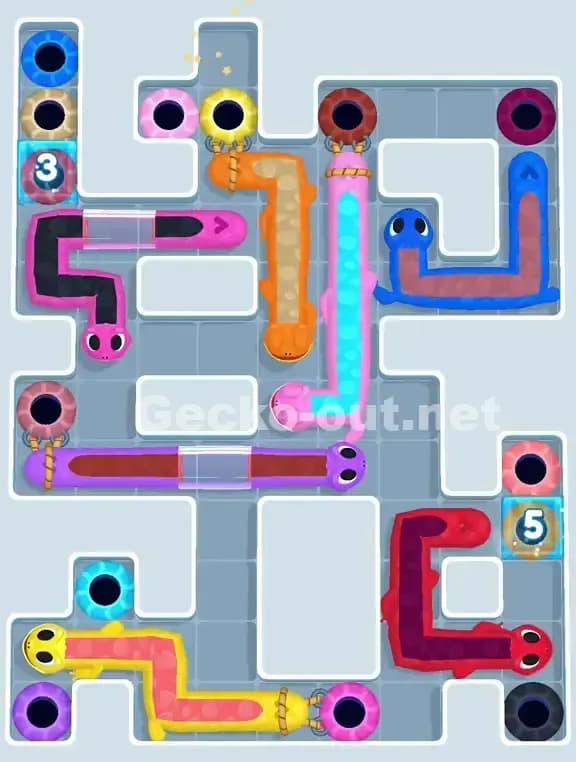
Gecko Out Level 943 Solution Walkthrough | Gecko Out 943 Answer
How to solve Gecko Out level 943? Get step by step solution & cheat for Gecko Out level 943. Solve Gecko Out 943 easily with the answers & video walkthrough.

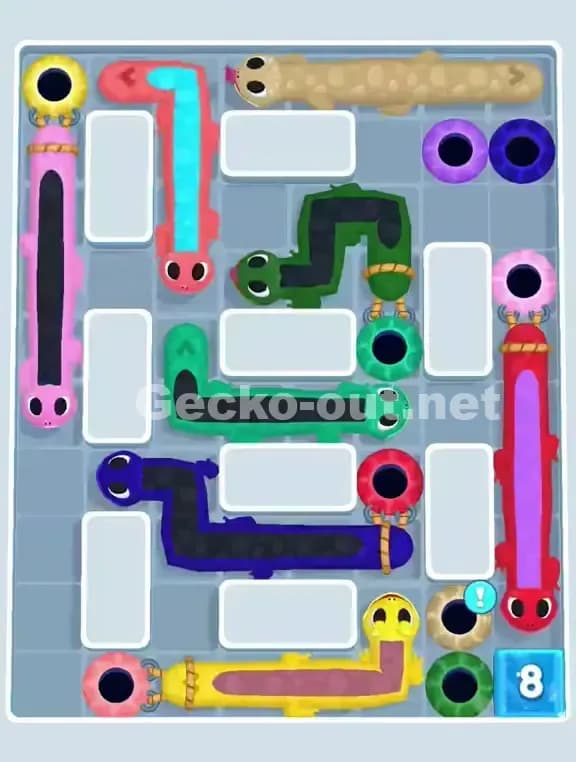
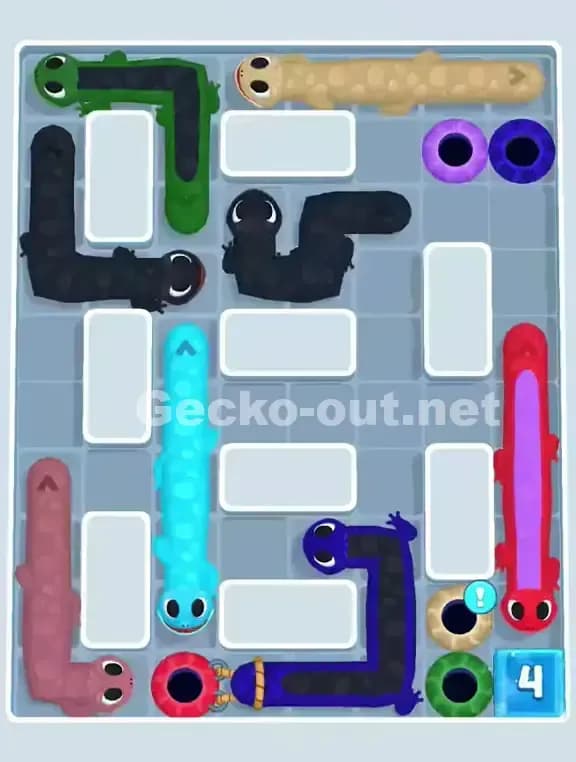
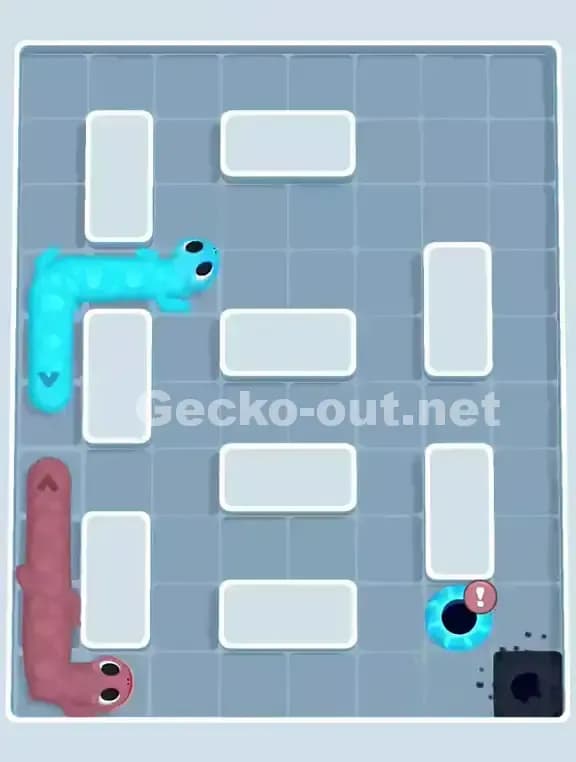
Gecko Out Level 943: Board Layout, Rules, and Win Condition
Starting Board: Geckos, Colors, and Key Obstacles
Gecko Out Level 943 is a densely packed puzzle featuring six geckos spread across the board in a tight, interlocking arrangement. You've got a pink gecko on the far left, a red gecko near the top-center, a green gecko in the middle zone, a blue gecko on the bottom-left, a yellow gecko at the bottom-center, and a final red gecko on the right side. Each gecko has a matching colored hole they need to reach—the pink hole is top-left, the red holes sit in the top-right and far right, the green hole is center-right, the blue hole is bottom-left, and the yellow hole is bottom-center. What makes Gecko Out Level 943 genuinely tricky is that nearly every gecko's body is wrapped or coiled, creating long path requirements, and many of their natural exit routes overlap with other geckos' starting positions or bodies. The board is filled with white walls that form a maze-like structure, forcing you to navigate carefully around obstacles rather than taking direct routes.
Win Condition and Timer Pressure
To beat Gecko Out Level 943, all six geckos must reach their matching-colored holes before the timer runs out. The timer is your real enemy here—it's not impossibly short, but it's tight enough that wasted moves or backtracking will cost you. The drag-path mechanic means every pixel of your mouse movement matters: once you drag a gecko's head, its body follows that exact route, so if you accidentally draw a path that tangles two geckos together, you've locked yourself into a jam that may take multiple undos to fix. This isn't a level where you can bumble through; you need a sequence that respects the physics of the body-follow rule and ensures no gecko blocks another gecko's exit during the critical final seconds.
Pathing Bottlenecks and Logical Traps in Gecko Out Level 943
The Critical Bottleneck: The Green Gecko and Center-Right Corridor
The biggest single bottleneck in Gecko Out Level 943 is the green gecko's position and body length. It's coiled in the center of the board, and its hole is directly to the right. However, the space between the green gecko's current position and its hole is constrained by walls and occupied by parts of other geckos' bodies. If you try to move the green gecko too early, you'll either have to drag it in a wide loop that consumes precious time, or you'll collide with the red gecko on the right or the yellow gecko below. The green gecko essentially acts as a gate: until it's out of the way, you can't freely maneuver the yellow or red geckos on the lower-right portion of the board. This is the moment where Gecko Out Level 943 stops being just puzzle-solving and becomes a sequencing puzzle.
Subtle Problem Spots
The first subtle trap is the pink gecko on the far left. Its hole is directly above its head, which seems simple, but its long body snakes downward and wraps around other geckos. If you move the pink gecko too early without repositioning the blue gecko below it, you'll end up with the pink gecko's body overlapping blue territory, and you'll get stuck. The second trap is the yellow gecko at the bottom. Its body is extremely long and coiled, and it needs to reach the hole at bottom-center. The catch is that there's a red gecko's body partially in the way, plus walls creating a narrow corridor. You need to clear the red gecko first, or you won't have enough space to slide yellow through. The third trap is the overlap of the two red gecko holes: one is at the top-right and one is on the far right. You might accidentally pull one red gecko toward the wrong hole if you're not paying attention to the exact position of each exit.
Personal Reaction and the "Aha" Moment
I'll be honest—Gecko Out Level 943 frustrated me on the first attempt. I spent about thirty seconds just trying to understand which gecko could move without immediately hitting another body, and I felt the timer ticking. But then I realized I'd been thinking about it backward. Instead of trying to solve the entire puzzle at once, I needed to identify which gecko was truly "free" to move first, move it all the way out, and use that space to unlock the next gecko. The moment I cleared the pink gecko (which was blocking blue), suddenly the bottom half of the board opened up, and the sequence became obvious. That's when Gecko Out Level 943 clicked for me.
Turn-by-Turn Path Strategy to Beat Gecko Out Level 943
Opening: The Pink Gecko and Securing Real Estate
Start by moving the pink gecko straight up to its hole. This is your opening move because the pink gecko is the most "free" gecko on the board—its head is exposed, its hole is directly above, and once it's gone, you immediately unlock space for the blue gecko to maneuver below. Drag the pink gecko's head upward in a smooth arc if needed to avoid the walls on the left side, and guide it into the pink hole at the top-left. This single move removes a long body from the puzzle and gives you breathing room. Park no other gecko yet; you need to see the board reconfigure before you commit to the next move.
Mid-Game: Clearing the Lower-Left and Center Zones
Once pink is out, immediately move the blue gecko. Its hole is at the bottom-left, and now that the pink gecko's body isn't in the way, you have a clear path downward and around. Drag the blue gecko's head down and slightly right, then curve it left to enter the blue hole. Next, tackle the red gecko at the top of the board. This gecko's hole is at the top-right, and it's relatively straightforward—drag its head to the right, avoiding the wall above it, and slide it into the red hole. With pink, blue, and one red out, you've removed three major bodies from the board, and the center zone is now much clearer. Now move the yellow gecko. Its path is at the bottom, and with the other geckos' bodies out of the way, you can drag yellow in a gentle arc from its current position, moving it right and slightly up if needed to navigate the walls, and guide it into the yellow hole at the bottom-center. Be patient with yellow's coiled body—make sure you're drawing a path that doesn't accidentally catch on the walls; use smooth, wide curves rather than sharp turns.
End-Game: The Green and Final Red Gecko
You're now in the final stretch with just two geckos left: green (in the center-right) and red (on the far right). Move green next. Its hole is directly to the right, so this should be a relatively short drag. Pull the green gecko's head to the right in a smooth motion, and let its body follow through the corridor into the green hole. Finally, tackle the last red gecko on the far right. Its hole is on the far right as well, usually slightly above or below its current position. This should be a simple maneuver—just drag the head into the hole directly. If you're low on time (say, under 10 seconds), don't second-guess yourself; commit to the drag and execute. If you're running out of time before the final gecko exits, you've either made a routing mistake earlier or you're moving too slowly. In that case, use a time booster if available, but you shouldn't need it if you follow this sequence.
Why This Path Order Works in Gecko Out Level 943
Using Head-Drag Physics to Untangle, Not Tighten
The reason this sequence works is that it respects the body-follow rule and uses it to your advantage. By moving geckos in an order that removes long bodies from the board first, you're progressively expanding the available space rather than compressing it. If you tried to move green or yellow first, their long coiled bodies would block other geckos and force you to draw incredibly convoluted paths. But by removing pink, blue, and the first red early, you've eliminated the physical barriers, and the remaining geckos have simple, direct paths to their holes. This is the key insight that makes Gecko Out Level 943 solvable without frustration.
Timer Management: When to Pause vs. When to Commit
Gecko Out Level 943 rewards a brief pause before you start moving. Spend 3–5 seconds reading the board, identifying which gecko is free, and planning your first two moves in your head. Once you start dragging, move with confidence and reasonable speed—you shouldn't be glacially slow, but you also shouldn't panic and make careless mistakes. If you hit an undo, use it without hesitation; one undo is faster than starting over. Generally, you want to keep a healthy buffer of 15+ seconds on the timer as you approach the final gecko. If you're down to under 10 seconds with one or two geckos still out, you're cutting it too close and may run out of time on a small positioning error.
Booster Recommendation
For Gecko Out Level 943, the time booster is optional but not necessary if you follow this sequence and move at a moderate pace. I'd recommend avoiding the hammer tool or hint boosters entirely—they don't address the real challenge, which is pathing, not obstacles. If you do fail once and want a safety net on your retry, grab the time booster before you start; it'll give you an extra 15–20 seconds, which is a comfortable cushion. However, if you execute the plan cleanly, you should finish with 5–10 seconds to spare without any boosters.
Mistakes, Fixes, and Logic You Can Reuse in Other Gecko Out Levels
Common Mistakes and Their Fixes
Mistake 1: Moving green or yellow too early. Players often try to solve the center of the board first, thinking it's the bottleneck. But in Gecko Out Level 943, green and yellow are actually blocked by the outer geckos. Fix: Always identify the outermost, freest gecko first, and clear it before moving inward. Mistake 2: Drawing paths that are too tight or angular. Tight, angular paths cause the gecko's body to clip against walls or other bodies. Fix: Use smooth, wide curves when dragging. Give yourself margin for error. Mistake 3: Underestimating the timer. Players rush and make mistakes, then have to undo, which wastes time. Fix: Plan your first move, execute it cleanly, and then assess the board before the next move. Confidence and cleanliness beat speed. Mistake 4: Forgetting which hole belongs to which gecko. With multiple red geckos, it's easy to drag a red gecko toward the wrong hole. Fix: Take a quick glance at the board before moving to confirm the exit color matches the gecko color. Mistake 5: Neglecting the pink gecko's long body. Players sometimes forget that pink wraps around other geckos and try to move blue or another gecko without clearing pink first. Fix: Always trace the full length of a gecko's body before committing to a path for another gecko.
Reusing This Strategy on Similar Levels
Gecko Out Level 943's core lesson—identify the freest gecko and clear it first, then expand your solution inward—applies directly to other gang-gecko, knot-heavy, or frozen-exit levels. Whenever you see a level with multiple interlocking geckos, resist the temptation to solve the center first. Instead, find the gecko with the most exposed head and the clearest path to its hole, and move it immediately. This opens up the board and makes the remaining moves obvious. The same principle works on levels with frozen exits or toll gates: remove the geckos that don't depend on unlocking anything else, and you'll naturally unlock the more constrained geckos as you go.
Final Encouragement
Gecko Out Level 943 is genuinely tough—it's not a beginner puzzle, and I won't pretend it is. But it's absolutely beatable with a clear head and a logical sequence. Once you move that pink gecko and realize how much space opens up, you'll feel the satisfaction that these puzzles are designed to deliver. Trust the plan, move with confidence, and you'll clear Gecko Out Level 943 with time to spare. You've got this!