Gecko Out Level 702 Solution Walkthrough | Gecko Out 702 Answer
How to solve Gecko Out level 702? Get step by step solution & cheat for Gecko Out level 702. Solve Gecko Out 702 easily with the answers & video walkthrough.
Gecko Out Level 702: Board Layout, Rules, and Win Condition
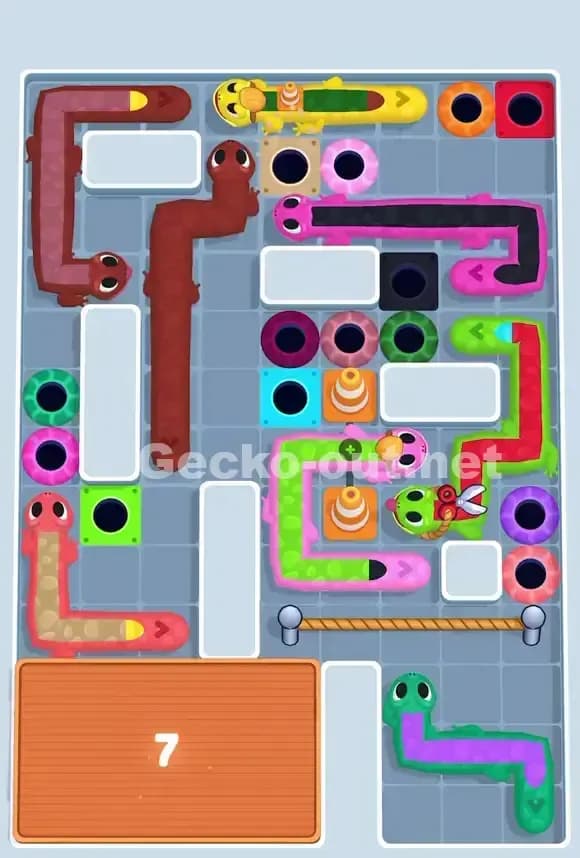
Starting Board: Geckos, Colors, and Obstacles
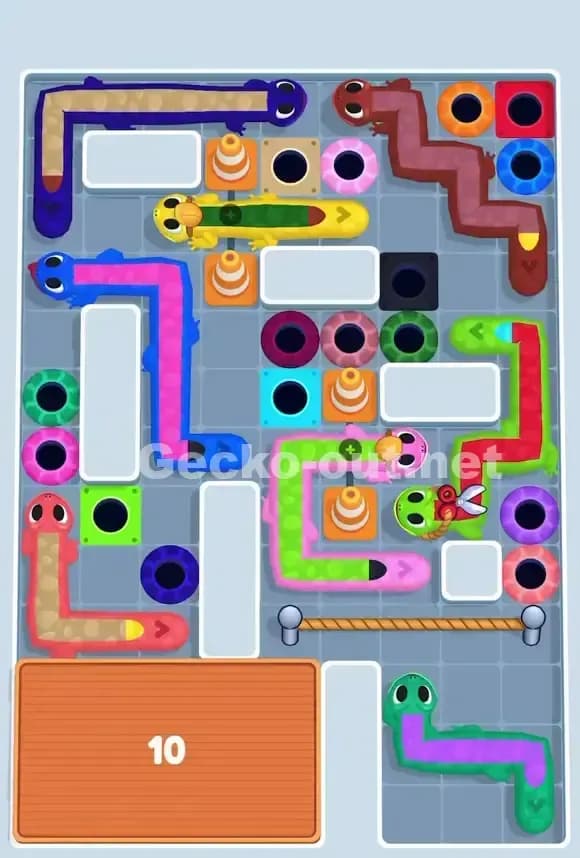
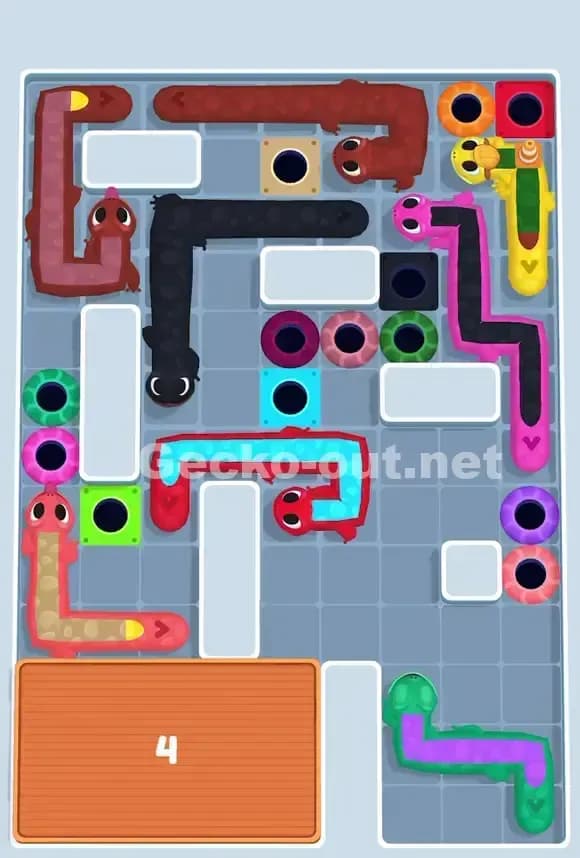
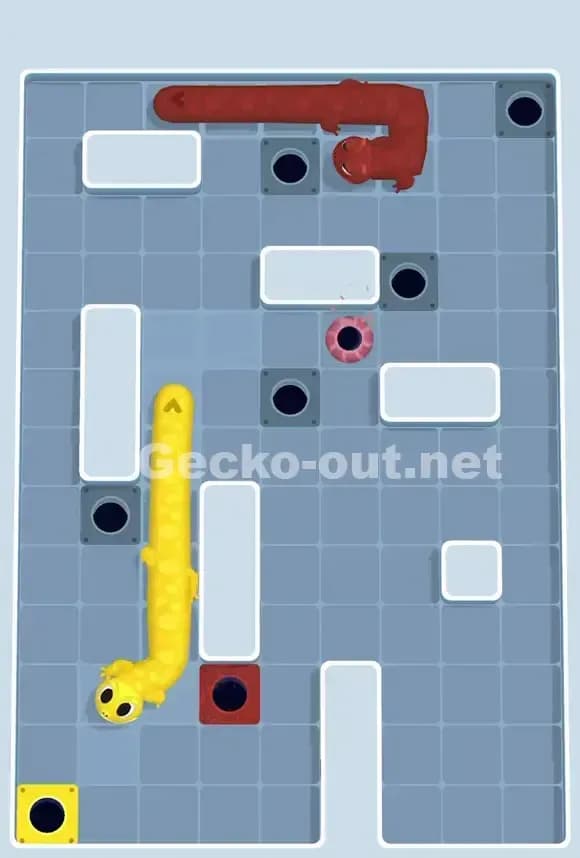
Gecko Out Level 702 is a sprawling, multi-colored puzzle packed with eight geckos scattered across a tight grid filled with white barrier blocks. You'll spot a purple L-shaped gecko in the top-left corner, a red stubby gecko near the top-center, a long yellow gecko stretching horizontally in the upper-middle area, a blue L-shaped gecko on the left side, a pink gecko weaving through the center-left, green and pink exit holes on the far left, a magenta exit hole in the center-right, and finally a green-and-magenta gecko coiled in the bottom-right corner. The board is absolutely crammed with white rectangular obstacles that create narrow corridors and dead-end spaces, making simple paths nearly impossible. Orange toll-gate circles dot the board at key junctions, and you'll need to thread each gecko's body through these tight passages without creating overlaps or blocking critical lanes.
Win Condition and Timer Pressure
Your goal is to guide every gecko head to its matching colored hole before the 10-second timer runs out. The catch? Each gecko's body must follow the exact path you drag its head along, and no gecko body can pass through walls, overlap another gecko, or squeeze into a space already occupied by another body. This means your first move can either open up the board beautifully or lock everyone into a gridlock nightmare. The 10-second timer is tight enough that you can't afford to undo bad moves; you need a clear plan before you start dragging. Success hinges on finding the right sequence that unpacks the knot instead of tightening it.
Pathing Bottlenecks and Logical Traps in Gecko Out Level 702
The Central Corridor Crisis
The biggest bottleneck in Gecko Out Level 702 is the vertical corridor running through the center of the board. Multiple geckos need to navigate through or around this narrow space, but once one gecko commits its body to that lane, it blocks everyone else. The yellow gecko and the pink gecko both have routes that naturally funnel toward this choke point, and if you're not careful, one will trap the other inside. The real trap is that this central corridor is also the shortest path for at least two geckos, so skipping it entirely means taking longer, more complicated detours that eat into your timer. You have to find a way to sequence the exits so one gecko clears the corridor before the next one attempts it.
Subtle Problem Spot #1: The Yellow Gecko's Length
The yellow gecko is deceptively long and its horizontal orientation makes it a space-hog. Even though its exit is relatively nearby, dragging it there requires a smooth, unobstructed path—and Gecko Out Level 702 doesn't offer many smooth paths. If you move other geckos first and they leave their bodies in the yellow gecko's natural route, you'll be forced to take a much longer, serpentine path that consumes precious seconds. The yellow gecko should probably move early, but not so early that it blocks someone else's critical exit lane.
Subtle Problem Spot #2: The Purple Gecko's L-Shape
The purple L-shaped gecko at the top-left sits in a corner that seems isolated, so you might think it's safe to leave for last. However, its body will naturally extend rightward and downward once you start dragging it, and this extension can easily collide with the red gecko or block the path for the blue gecko. You need to clear it decisively on your first or second move, not in the middle of your sequence when the board is already crowded.
Subtle Problem Spot #3: The Green-Magenta Gecko in the Bottom-Right
This gecko is long and coiled, and its exit hole is relatively close—but the path to it winds through a maze of obstacles and toll gates. If you wait too long to move it, you'll find that the surrounding lanes are packed with other gecko bodies, and you'll run out of time trying to find a clear route. Plus, its position at the board's edge means one mistake in pathing sends it into a dead-end corner.
Personal Reflection: The Aha Moment
I won't lie—my first three attempts at Gecko Out Level 702 left me frustrated. I kept moving the closest geckos first, thinking I was being efficient, and then I'd hit a wall (literally) when a gecko body I'd already placed blocked a later gecko's exit. The breakthrough came when I stepped back and asked myself: "Which gecko, if moved first, will actually open up space for the others?" That perspective shift turned chaos into clarity, and suddenly the level felt solvable.
Turn-by-Turn Path Strategy to Beat Gecko Out Level 702
Opening: Clear the Yellow Gecko and Purple Gecko
Start by moving the yellow gecko to its exit. This long horizontal gecko is a space-hog, and the sooner you get its body off the board, the fewer obstacles block everyone else. Drag its head carefully down and to the right, navigating around the white barriers until it reaches its orange exit circle. The path isn't complicated, and removing this gecko opens up valuable real estate in the center-upper area.
Next, tackle the purple L-shaped gecko in the top-left. Its exit hole is on the far left, and you need to drag its head downward and then rightward (or vice versa, depending on the exact hole placement) to match its body to the exit. Move it quickly and decisively, because once it's gone, you've freed up the top-left corner and reduced the traffic jam in the upper lanes.
Mid-Game: Sequence the Red, Blue, and Pink Geckos Without Creating Gridlock
Now focus on the red gecko near the top-center. Its exit is somewhere in the upper-right area, and the path involves navigating around several white barriers and toll gates. Drag its head carefully, and watch for any overlap with the yellow gecko's body (which should now be gone) or the purple gecko's space (also cleared). Red should take a relatively direct route to its exit.
Move the blue L-shaped gecko next. It's on the left side and needs to reach one of the left-side exit holes (probably green or pink). Its body will extend both downward and rightward, so make sure you're dragging it along a path that doesn't collide with the pink gecko's body. If the pink gecko hasn't moved yet, be extra cautious here; you might need to park the blue gecko's body in a safe spot briefly before continuing with other moves.
The pink gecko is trickier because it's in a central location and other geckos are still moving around it. If possible, wait until you've cleared the yellow, purple, red, and blue geckos before moving the pink one. This gives you the maximum amount of open space to work with. Drag its head to its magenta exit hole, following the path that avoids all the remaining gecko bodies and white barriers.
End-Game: Race Against the Clock with the Last Geckos
As you approach the final geckos (likely the green-magenta gecko at the bottom-right and any others still on the board), the timer will be counting down rapidly. You should have about 2–3 seconds left, so move with confidence but not recklessness. Dragging the green-magenta gecko to its green exit hole requires careful navigation through the bottom-right maze, but by now the board should be mostly clear, giving you a straight shot. Don't second-guess yourself; commit to the path and execute it smoothly.
If you're down to a single gecko with less than 2 seconds left, don't panic—you've likely got enough time. Drag its head directly toward its exit hole, trusting that the rest of the board is now clear enough for its body to follow without obstruction.
Why This Path Order Works in Gecko Out Level 702
Untangling the Knot by Releasing Space, Not Adding Clutter
This strategy works because it prioritizes removing the biggest space-hogs and obstacles first, which creates a cascading effect of freedom for the remaining geckos. By moving the yellow and purple geckos early, you're not just removing two geckos; you're eliminating the spatial constraints that would later force other geckos into long, time-consuming detours. The body-follow rule means every pixel of path you drag matters, so the fewer obstacles on the board, the shorter and faster each subsequent path can be.
The mid-game sequence (red, blue, pink) follows a similar logic: move the geckos that have simpler, more direct exits first, and save the complex ones for when the board is less crowded. This isn't arbitrary randomness; it's a deliberate unpacking of the puzzle, from simplest to hardest.
Managing the Timer: Pause and Read vs. Commit and Move
With only 10 seconds, you don't have time to second-guess every move, but you also can't afford to make careless mistakes. The best approach is to spend the first 1–2 seconds scanning the entire board and mentally mapping out the exit sequence, then commit fully to executing it. Once you start moving geckos, move quickly and smoothly; hesitation and micro-adjustments eat up precious seconds. If you hit a snag mid-game (like a gecko body blocking an exit you didn't expect), don't restart—instead, quickly pivot to moving a different gecko first and come back to the problematic one when you have more space.
Boosters: Optional, Not Essential
Gecko Out Level 702 doesn't strictly require boosters like extra time or hints, but the extra-time booster can be a lifesaver if you're cutting it close. If you're consistently running out of time by 1–2 seconds, grab the extra-time booster on your next attempt and use it to move more deliberately. However, if you execute the strategy above cleanly, you should finish with 2–3 seconds to spare, making boosters unnecessary. A hint might be useful if you're stuck understanding why a particular path isn't working, but the core strategy laid out here should eliminate that need.
Mistakes, Fixes, and Logic You Can Reuse in Other Gecko Out Levels
Mistake #1: Moving Every Gecko in Its Natural Order
Players often move geckos in the order they appear on the board (top to bottom, left to right), assuming this is the intended sequence. This almost always backfires because the geckos that appear first are often the most problematic for others. Fix: Always identify the gecko that, if moved first, will create the most space and freedom for the rest. Usually, this is the longest or most centrally located gecko.
Mistake #2: Forcing Geckos Down Their Obvious Paths
Every gecko has an "obvious" short path to its exit, but on crowded boards like Gecko Out Level 702, that obvious path is often blocked. Players waste time trying to navigate it, then realize they need a detour. Fix: Before you drag, always scan the entire board for obstructions (other geckos, walls, toll gates) along that obvious path. If the path is blocked, mentally pre-route a detour before you start dragging. This saves seconds and reduces frustration.
Mistake #3: Parking Gecko Bodies in Active Zones
After moving one gecko, players often leave its body in a high-traffic area because they were focused on the exit and didn't think about future geckos. Fix: If a gecko's body naturally extends into a lane that other geckos will need to use later, immediately plan to move those other geckos first, or find a path for your current gecko that "parks" its body safely to the side of future traffic.
Mistake #4: Ignoring Toll Gates Until the Last Second
Toll-gate circles on Gecko Out Level 702 mark critical decision points where gecko paths converge or split. Players sometimes miss these and try to path geckos through toll gates in the wrong order, causing collisions. Fix: Mentally label each toll gate as "for gecko A" or "for gecko B" before you start moving any geckos. Make sure your path sequence respects this allocation.
Mistake #5: Panicking When the Timer Gets Low
With only a few seconds left, players often make hasty, poorly thought-out drags that send a gecko into a dead end. Fix: Trust your setup. If you've cleared the board correctly, the last gecko's path should be straightforward. Take a breath, find its exit hole, and drag confidently. Hesitation kills more runs than speed does.
Reusing This Logic on Similar Levels
The strategy here works brilliantly for any Gecko Out level with multiple geckos, a crowded board, and a tight timer. Whenever you see a level that's packed with white barriers and toll gates, apply the same logic: identify the biggest space-hog, move it first, and work downward in complexity. For gang-gecko levels (where multiple geckos are locked together), prioritize freeing the gang by moving them as a unit to a safe area before separating them. For frozen-exit levels, move the geckos that don't require frozen exits first, giving you time to figure out the frozen-exit puzzle without time pressure.
Final Thoughts on Gecko Out Level 702
Gecko Out Level 702 is genuinely tough—the combination of eight geckos, a crammed board, and a 10-second timer creates a puzzle that feels impossible until you understand the unlock sequence. But it's absolutely beatable with a clear plan. The key is recognizing that this isn't a level about finding secret shortcuts; it's about releasing pressure in the right order. Once you move the yellow and purple geckos early and sequence the rest deliberately, the puzzle unfolds like a gift. You've got this, and Gecko Out 702 will feel triumphant when you nail it. Good luck!