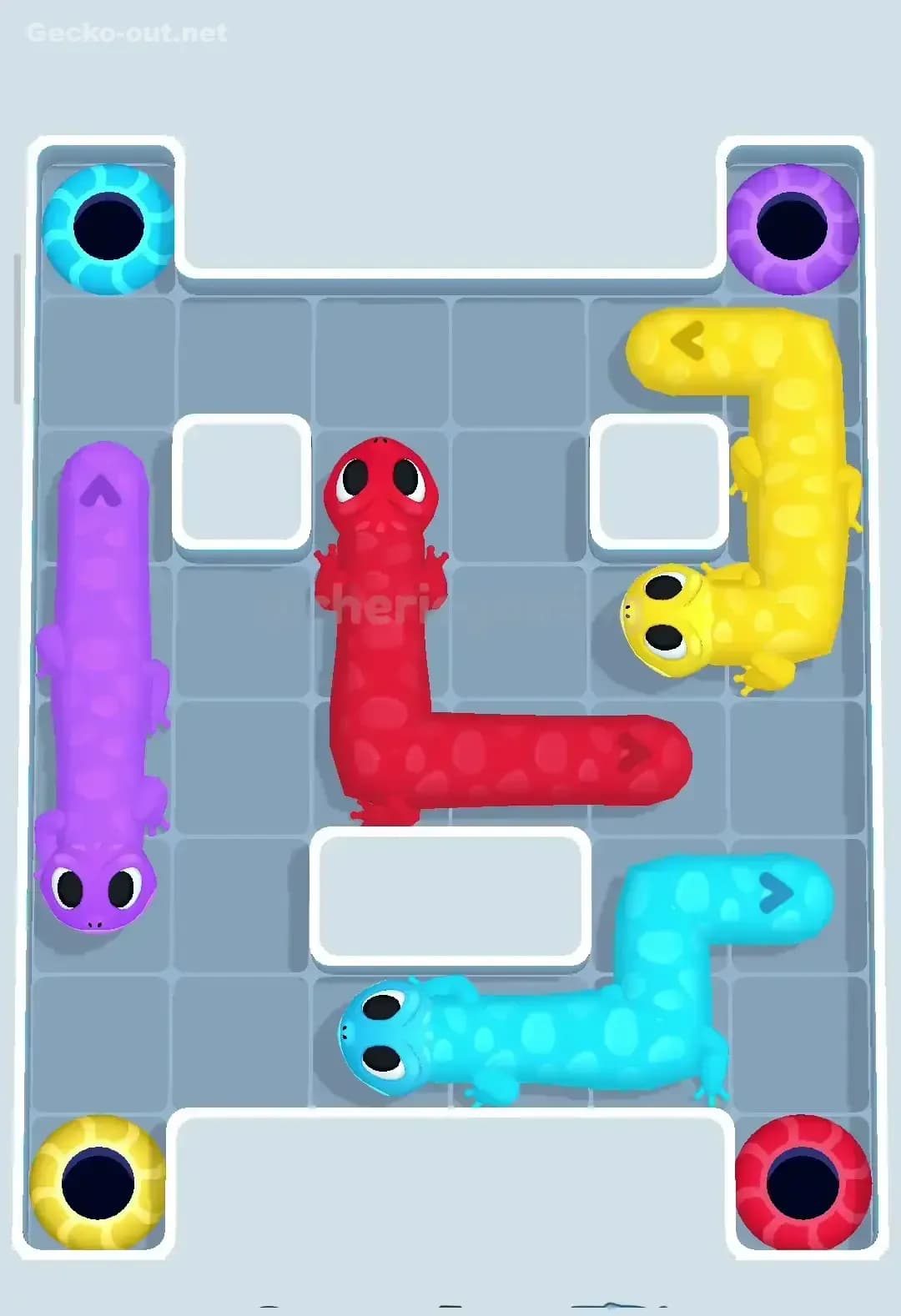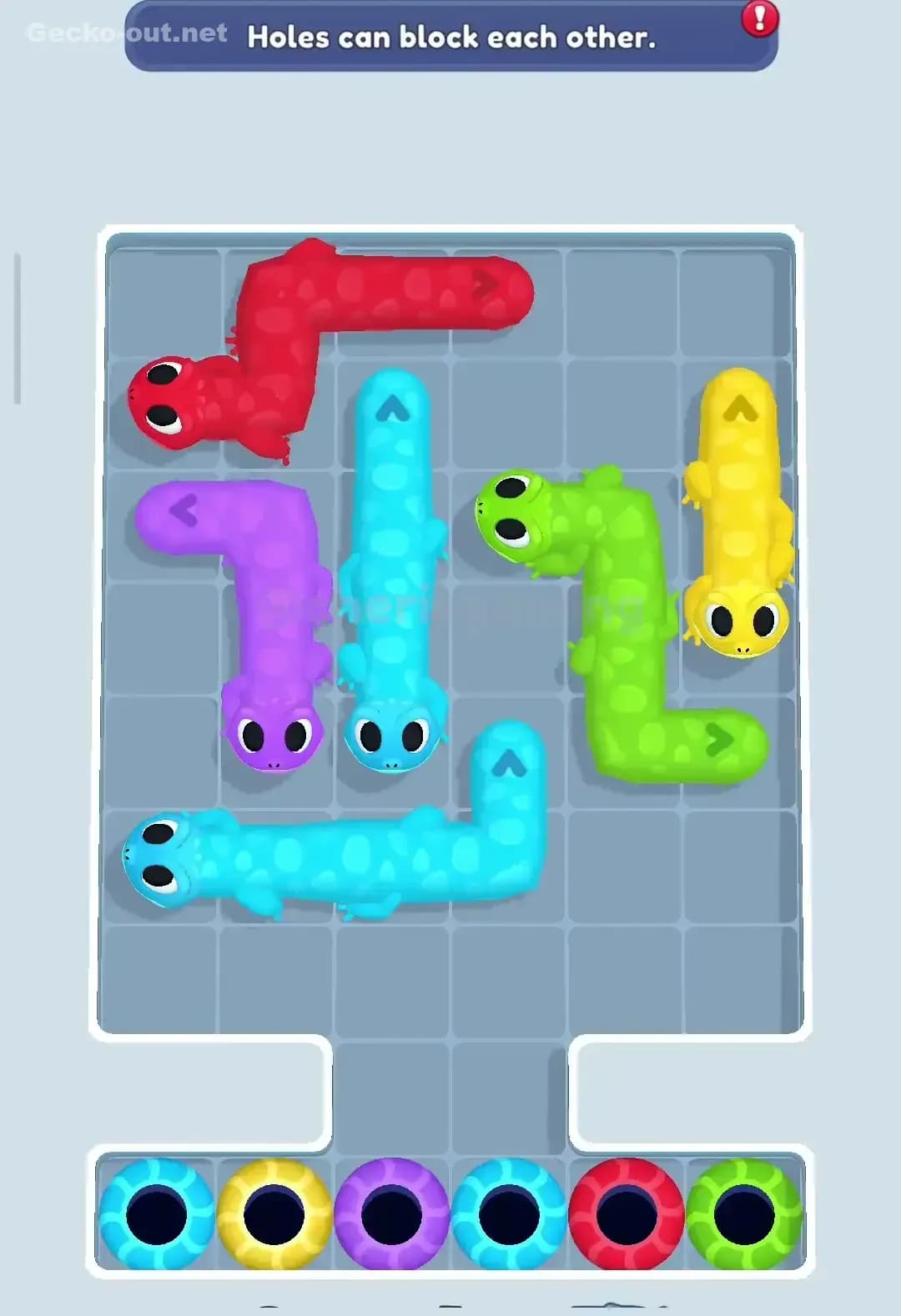
Gecko Out Level 6 Solution Walkthrough | Gecko Out 6 Answer
How to solve Gecko Out level 6? Get step by step solution & cheat for Gecko Out level 6. Solve Gecko Out 6 easily with the answers & video walkthrough.
Gecko Out Level 6: Board Layout, Rules, and Win Condition
Understanding the Starting Configuration
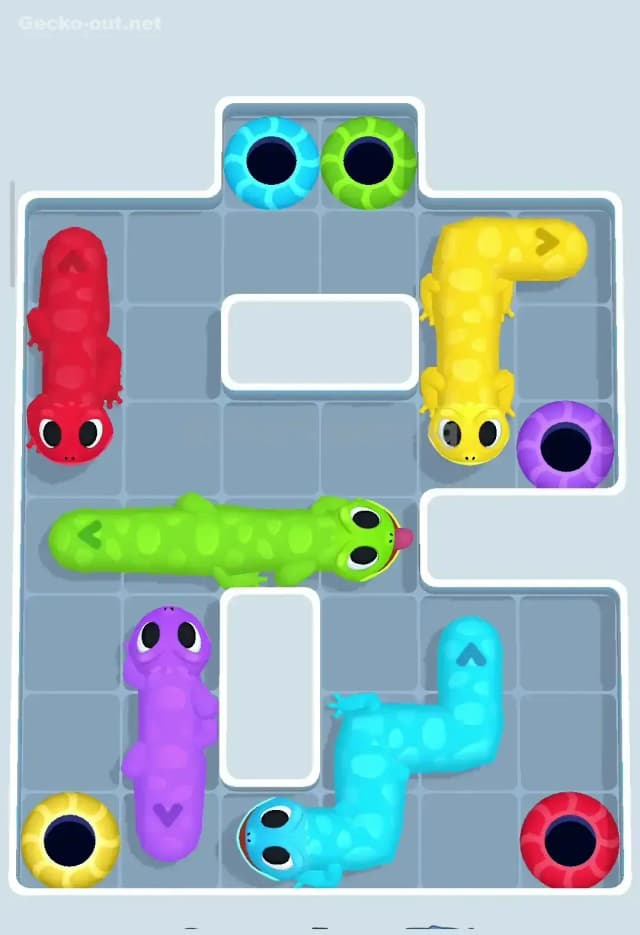
Gecko Out Level 6 throws you into one of the tightest board configurations you've faced so far. You're working with four geckos spread across a cramped, irregularly shaped grid that forces every single move to matter. The red gecko sits in the upper-left corner, stretched vertically down the left edge. The yellow gecko occupies the right side, also vertical but with a bend that creates an L-shape. The green gecko sprawls horizontally across the middle-left area, and the purple gecko is positioned in the lower-left, running vertically. Each gecko needs to reach a matching colored hole—red to red, yellow to yellow, and so on—but those holes are scattered in positions that seem specifically designed to create maximum interference.
The board itself has two white rectangular obstacles that act as immovable walls, plus the irregularly shaped perimeter that creates natural choke points. What makes Gecko Out Level 6 particularly challenging is that almost every gecko blocks the path to at least two other exits. The yellow gecko's current position blocks the purple hole in the right-center area, while the green gecko's horizontal stretch prevents easy access to the lower exits. The red gecko locks down the entire left column, and the purple gecko sits right where you need space to maneuver everyone else.
The Win Condition and Time Pressure Dynamic
You win Gecko Out Level 6 by dragging each gecko's head along a path to its matching colored hole before the timer runs out. The body follows your exact drag route, which means you can't just teleport a gecko from point A to point B—you have to physically snake it through the available space without crossing other geckos, walls, or occupied holes. This path-based movement is the core mechanic that transforms what looks like a simple matching puzzle into a spatial reasoning nightmare.
The timer adds legitimate pressure here. Gecko Out Level 6 doesn't give you unlimited thinking time, so you need a plan before you start moving pieces. Every second you spend undoing a bad path or repositioning a gecko you moved too early eats into your margin for error. The win condition isn't just about getting geckos out—it's about getting them out in a sequence that never creates a deadlock where one gecko's body physically prevents another from reaching its hole.
Pathing Bottlenecks and Logical Traps in Gecko Out Level 6
The Green Gecko is Your Critical Blocker
The single biggest obstacle in Gecko Out Level 6 is the green gecko in the middle-left area. Its horizontal position cuts the board almost in half, blocking vertical movement between the upper and lower sections. Until you move this gecko, you can't efficiently access the holes in the bottom half of the board, and you can't reposition the purple gecko without creating new tangles. The green gecko's hole is positioned in the upper-middle area, which means extracting it requires threading it upward and slightly right—but that path crosses through space currently occupied by the red and yellow geckos' bodies.
This creates the central puzzle of Gecko Out Level 6: you need to clear space for the green gecko before you can move most other pieces, but clearing that space requires moving other geckos first. It's a dependency chain, and breaking it in the wrong order guarantees failure. I must have restarted this level a dozen times before I realized the green gecko isn't your first move—it's your third or fourth, after you've created the lane it needs.
Subtle Problem Spots That Catch Players Off-Guard
The yellow gecko's L-shape is deceptively problematic. Its head is near the top-right, but its body bends downward, occupying the exact column where the purple hole sits. If you try to move the purple gecko to its hole too early, you'll have to route it around the yellow gecko's body, which adds length to the purple gecko and creates new blockages. The right approach involves moving the yellow gecko toward its hole first—but you can't do that until the red gecko stops blocking the upper area.
The red hole placement in the lower-right corner is another trap. It looks accessible, but getting the long red gecko from the upper-left to the lower-right requires routing it through almost the entire board. If you attempt this move too early, the red gecko's body will sprawl across the grid and lock every other gecko in place. The purple gecko also sits in a position where moving it carelessly creates a diagonal barrier that blocks multiple exit paths simultaneously.
When the Solution Finally Clicked
I spent way too long on Gecko Out Level 6 trying to solve it like earlier levels—moving whichever gecko seemed "easiest" first. That approach creates beautiful chaos where you're constantly undoing moves because you've accidentally blocked yourself. The breakthrough came when I stopped thinking about individual geckos and started thinking about negative space: where on the board do I need empty columns and rows to exist in order for later moves to work? Once you see Gecko Out Level 6 as a sequence of "create this open lane, then use it, then create the next lane," the solution becomes mechanical rather than random.
Turn-by-Turn Path Strategy to Beat Gecko Out Level 6
Opening Moves: Create Vertical Space in the Right Column
Start Gecko Out Level 6 by moving the yellow gecko first. Drag its head upward and slightly left, routing it toward the yellow hole in the upper-right area. The key is keeping the path tight against the right edge so the yellow gecko's body doesn't sprawl into the center of the board. This move serves two purposes: it clears the right column where the purple gecko needs to go, and it removes the yellow gecko from play before it can complicate later moves. Getting the yellow gecko out early is non-negotiable because its L-shaped body occupies premium real estate that multiple other geckos need to pass through.
Next, shift your attention to the red gecko in the upper-left. You're not sending it to its hole yet—that comes much later. Instead, drag the red gecko's head slightly downward and to the right, compacting it into the left-center area. This "parking" move is crucial because it vacates the upper-left corner and creates vertical space along the left edge. You're essentially coiling the red gecko into a temporary holding position where it's out of everyone's way but still close to the paths you'll need in the next phase. Don't rush this move; if the red gecko's body extends too far right, it will block the green gecko's exit path.
Mid-Game: Extract the Green Gecko and Reposition Purple
With the yellow gecko out and the red gecko parked, you now have the space to tackle the green gecko. Drag the green gecko's head upward toward its hole in the upper-middle section. The path should arc slightly to avoid the red gecko's parked body, threading through the narrow gap between the red gecko and the right edge of the board. This is the most spatially complex move in Gecko Out Level 6 because you're navigating a long gecko through a corridor that seems one square too narrow. Take your time drawing the path—if the green gecko's body crosses into the lower-left area, it will trap the purple gecko and force a restart.
Once the green gecko is out, the board suddenly feels spacious. Now move the purple gecko to its hole in the right-center area. This should be a straightforward vertical-then-horizontal path since the yellow gecko already cleared the right column. The purple gecko's hole is usually accessible via a simple upward movement followed by a right turn. Keep the path efficient because you're racing the clock at this point, and you still have the red gecko to extract.
End-Game: Final Exit Order and Time Management
The red gecko is your final piece in Gecko Out Level 6, and its path to the lower-right red hole is now clear. From its parked position in the left-center area, drag the red gecko's head downward, then arc it right along the bottom edge of the board toward its hole. The body will snake along behind, occupying previously cleared space. This is where players often fail by going too fast and drawing a sloppy path that crosses through areas where other geckos' bodies technically still exist for a frame or two. Move deliberately: down first, then a smooth rightward curve along the bottom.
If you're running low on time by the final gecko, resist the urge to panic-draw a path. A failed path costs more time than a careful one. You should have 15-20 seconds remaining when you start moving the red gecko if you've executed the earlier moves efficiently. If you're under 10 seconds, consider whether you can still complete the path—sometimes it's better to restart immediately rather than waste time on a doomed attempt.
Why This Path Order Works in Gecko Out Level 6
Exploiting Body-Follow Mechanics to Avoid Deadlocks
The solution to Gecko Out Level 6 succeeds because it respects the fundamental body-follow rule that trips up most players. When you drag a gecko's head, the body doesn't teleport—it slides along the exact path you drew, occupying every square along that route in sequence. This means a gecko's body can temporarily block exits and paths even after its head has moved away. The yellow-first strategy works because the yellow gecko's exit path is relatively isolated; moving it doesn't require other geckos to be in specific positions first. By removing it immediately, you eliminate a long, oddly-shaped body that would otherwise cut the board into unusable sections during later moves.
The red gecko parking maneuver is the move most guides miss. Players instinctively want to complete geckos one at a time—move red all the way out, then move yellow, etc. But in Gecko Out Level 6, moving the red gecko to its hole first requires routing it through space occupied by three other geckos. By parking it instead, you compress its body into a predictable, out-of-the-way position that doesn't interfere with the green and purple geckos' paths. This technique—temporarily repositioning a gecko without exiting it—is essential for knot-heavy levels and becomes a core strategy in later Gecko Out stages.
Timer Management: When to Think Versus When to Execute
Gecko Out Level 6 rewards front-loaded planning. You should spend the first 10-15 seconds of the level not moving any geckos, but instead visually tracing potential paths and identifying the dependency chain. Which gecko blocks which hole? Which gecko can move first without needing others to move? Once you've identified the sequence (yellow, red-park, green, purple, red-exit), you can execute moves quickly and confidently. The timer becomes manageable when you're not stopping mid-level to figure out what went wrong.
That said, the mid-game green gecko move is where you should slow down even if time is ticking. A bad green gecko path will force a restart no matter what, so investing an extra five seconds to draw a clean path through the upper corridor is worth it. Fast execution matters most for the purple and final red moves, which are straightforward once the green gecko is clear.
Booster Usage: Optional But Strategic
Gecko Out Level 6 is entirely solvable without boosters if you follow the path order outlined above. However, if you've attempted the level multiple times and keep failing at the green gecko move, consider using a hint booster right before that step. The hint should show you the exact arc needed to thread the green gecko through the upper area without crossing other bodies. Alternatively, if you're consistently running out of time during the final red gecko exit, a time-extension booster used when you have 10-15 seconds left can give you the breathing room to draw a careful final path.
I don't recommend using the hammer tool to remove a gecko from play in Gecko Out Level 6 because all four geckos are solvable with proper sequencing. Removing a gecko essentially admits defeat on the puzzle's core challenge, and you won't learn the spatial reasoning skills needed for upcoming levels.
Mistakes, Fixes, and Logic You Can Reuse in Other Gecko Out Levels
Common Errors and How to Correct Them
The biggest mistake players make on Gecko Out Level 6 is moving the green gecko first or second. It seems logical because the green gecko is centrally positioned and blocks multiple paths, so clearing it should open up the board, right? Wrong. Moving the green gecko early requires routing it through space occupied by other geckos, which forces you to draw an extremely long, winding path that creates new blockages. The fix is counterintuitive: move the perimeter geckos (yellow and red) first to create negative space, then extract the central green gecko through that cleared area.
Another frequent error is drawing overly complex paths to avoid current obstacles instead of repositioning those obstacles first. For example, trying to route the purple gecko around the yellow gecko's body creates a sprawling purple path that blocks the red gecko's eventual exit. The better fix is spending one extra move to get the yellow gecko out first, which makes the purple gecko's path short and simple. Gecko Out Level 6 punishes clever-looking workarounds and rewards straightforward sequencing.
Players also commonly fail the level by rushing the final red gecko move and drawing a path that cuts corners or crosses through spaces that haven't fully cleared yet. The fix is simple: wait one extra second after the purple gecko exits to ensure its body has fully disappeared from the board, then draw the red gecko's path with deliberate down-then-right strokes instead of a panicked diagonal slash.
Applying This Logic to Similar Levels
The techniques that beat Gecko Out Level 6—perimeter-first clearing, parking geckos temporarily, and respecting body-follow pathing—are essential for any Gecko Out level with four or more geckos in a confined space. Levels with irregular board shapes or multiple white obstacle blocks use the same negative-space logic: you need to create open lanes before you can use them, and creating those lanes usually means moving geckos in an order that feels backward at first.
The parking technique is especially useful in later levels with five or six geckos. You'll often need to move a gecko partially toward its exit, then leave it in a temporary position while you clear other geckos, then complete its exit as a final move. Gecko Out Level 6 teaches this concept with the red gecko, and mastering it here makes levels 8-12 significantly easier.
You've Got This—Gecko Out Level 6 is Tough But Beatable
Gecko Out Level 6 deserves its reputation as one of the harder early-game puzzles, but it's absolutely conquerable once you understand the yellow-red-green-purple-red sequence. The level forces you to think about gecko bodies as dynamic obstacles rather than static pieces, and it punishes random experimentation in favor of planned execution. If you've been stuck here, don't feel bad—this is the level where the game shifts from casual to genuinely challenging. But with the path strategy outlined above and a little practice on the green gecko's mid-game extraction, you'll clear Gecko Out Level 6 and carry those spatial reasoning skills into every level that follows. Take a breath, visualize the sequence, and commit to the moves. You've absolutely got this.