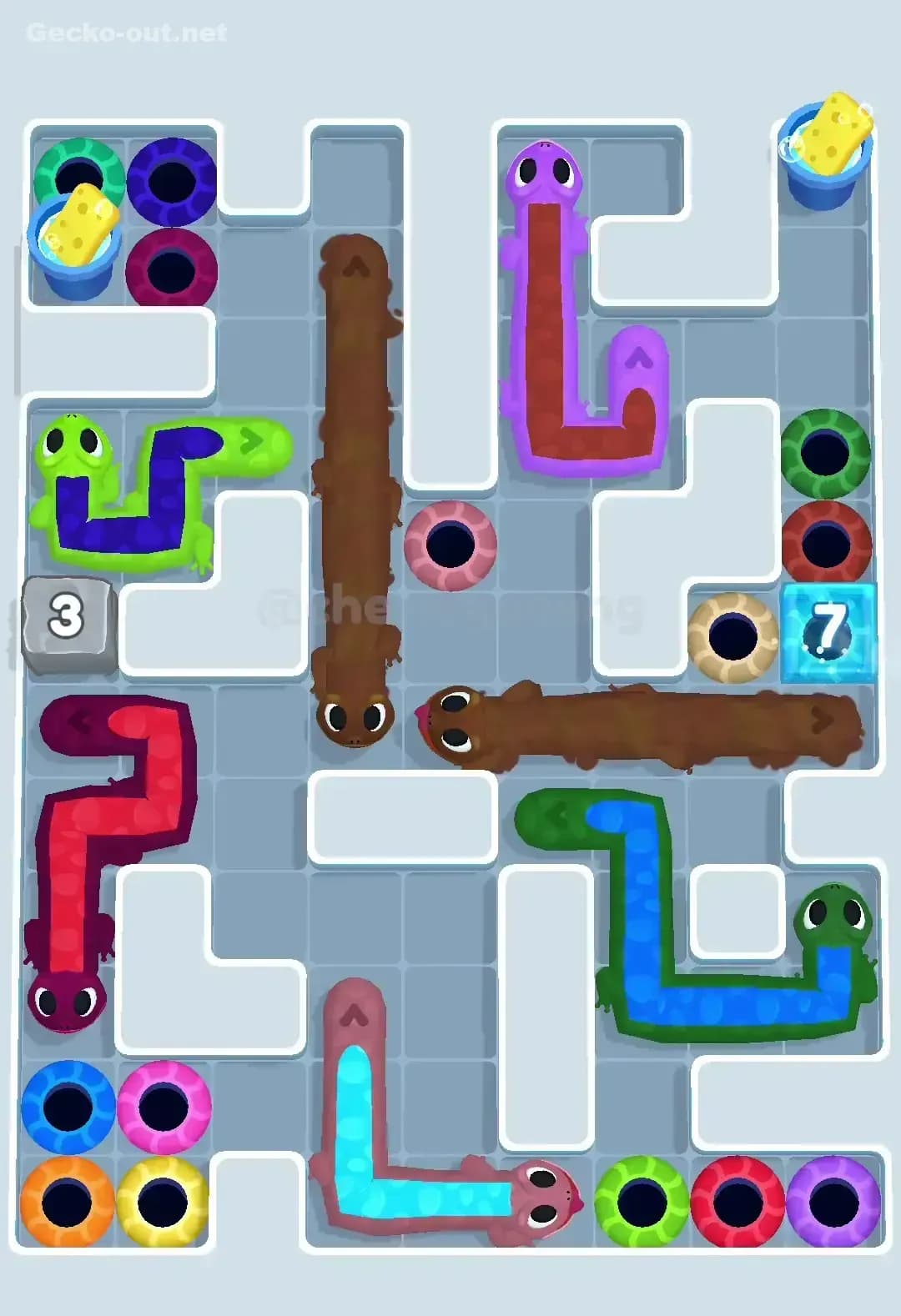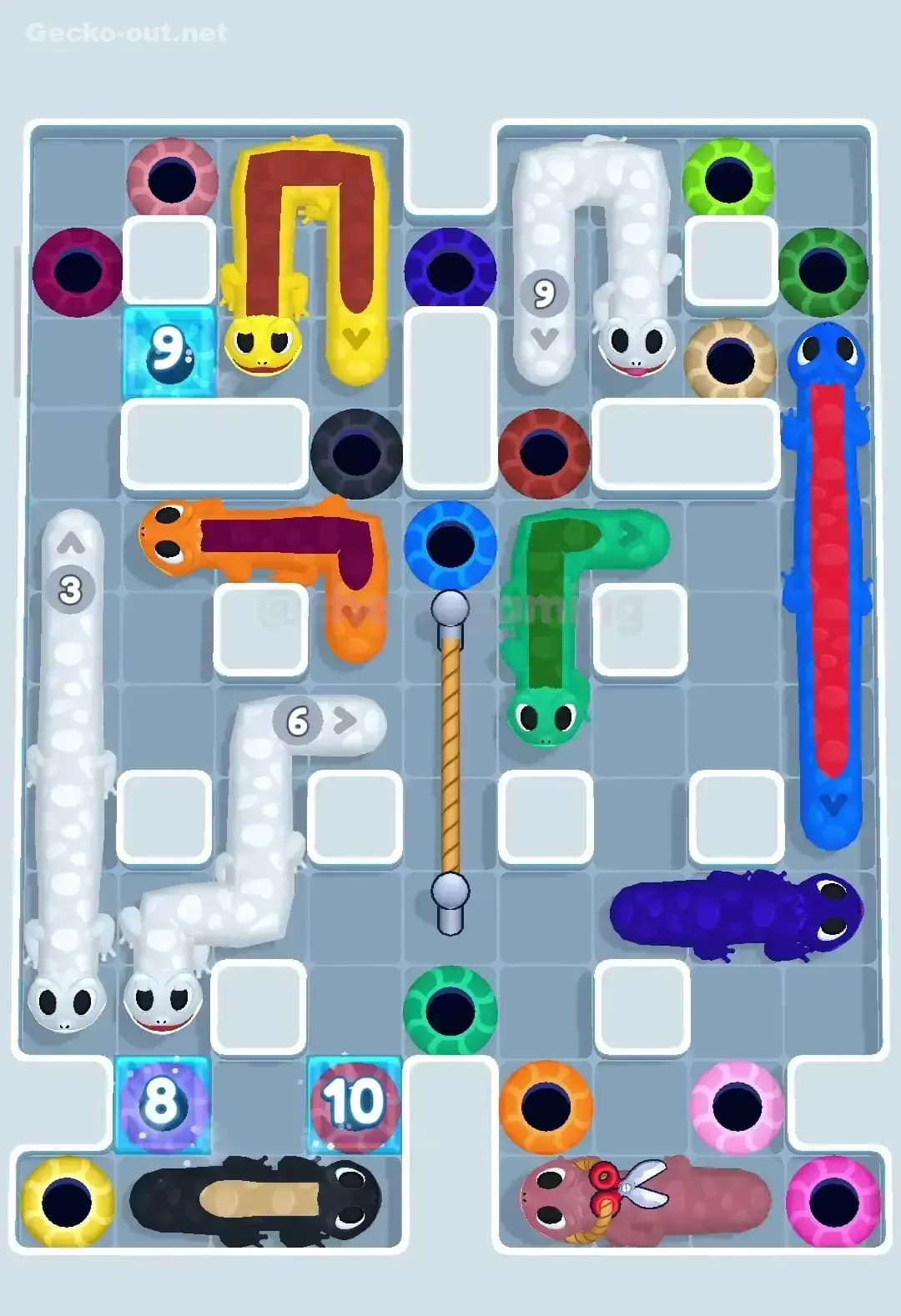
Gecko Out Level 256 Solution Walkthrough | Gecko Out 256 Answer
How to solve Gecko Out level 256? Get step by step solution & cheat for Gecko Out level 256. Solve Gecko Out 256 easily with the answers & video walkthrough.
Gecko Out Level 256: Board Layout, Rules, and Win Condition
Starting Board: Colors, Knots, and Obstacles
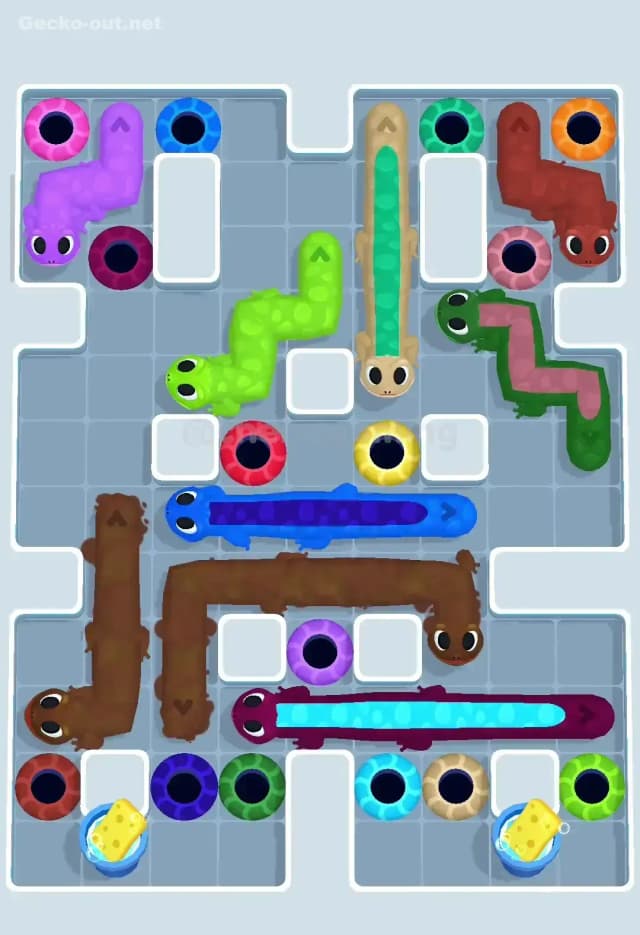
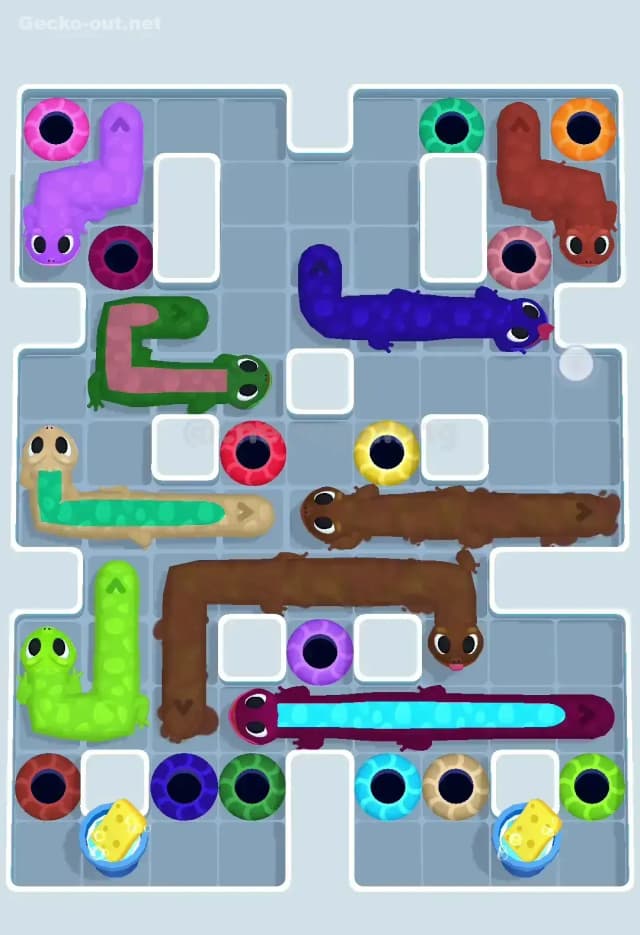
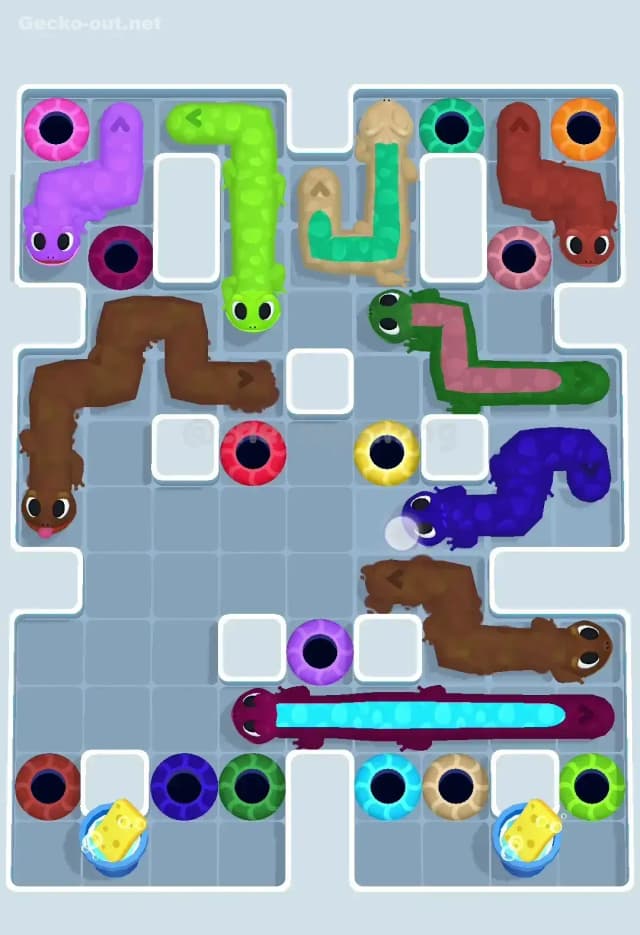
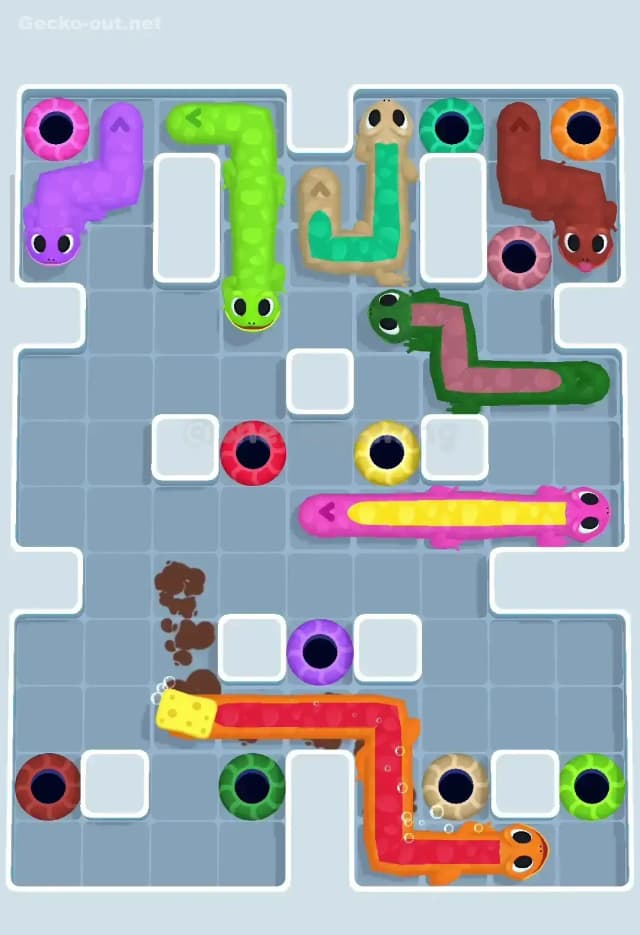
In Gecko Out Level 256 you start with a very busy board: eight geckos, all different colors, packed into narrow channels with thick white wall blocks between them. Most of the grid’s center is clogged by three long geckos lying in parallel lanes, while the shorter ones cling to the outer edges.
- The top edge holds a short purple gecko on the left, a tall tan gecko running vertically near the center, and a chunky red gecko tucked into the top‑right corner.
- On the left‑center you’ve got a curved lime‑green gecko, and on the right‑center there’s a green gecko with a zig‑zag body.
- Across the middle and bottom lanes are the true monsters: a long blue gecko stretched horizontally across the central corridor, a huge brown L‑shaped “gang” gecko that wraps down the left edge and then right across the board, and a long magenta/teal gecko covering most of the bottom lane.
Colored exit holes ring the board: clusters of holes sit under the central lanes, on the bottom edge, and in pockets near the corners. Crucially, several geckos are already lying directly on top of the corridors that lead to those holes, so every move you make in Gecko Out 256 either opens a lane or closes it for good.
There are also two cheese-style boosters near the bottom corners. They’re easy to reach only after you’ve cleared at least one of the long bottom geckos, so you can’t count on them for your early moves.
Win Condition, Timer, and Path-Based Movement
Like all Gecko Out levels, Gecko Out Level 256 is simple on paper: drag each gecko’s head so its body slithers along the path and ends with its tail in the matching color hole. If even one gecko is still out when the strict timer hits zero, you fail.
The catch is the pathing system. When you drag a head, the body exactly retraces the line you draw:
- If you loop around a wall, the whole gecko will snake around it and potentially block a corridor.
- You can’t cross other geckos, cut through walls, or “clip” through holes that belong to other colors.
- Once a gecko reaches its hole, it disappears and frees that path—so the order you clear them in Gecko Out 256 matters a lot.
Because the timer is unforgiving, you can’t brute‑force the puzzle. You need to read the board, decide your exit order, and then execute smooth, minimal paths with almost no wasted dragging.
Pathing Bottlenecks and Logical Traps in Gecko Out Level 256
The Main Bottleneck Corridor
The single biggest bottleneck in Gecko Out Level 256 is the central lane where the tall tan gecko, the long blue gecko, and the brown L‑gecko all interact.
- The tan gecko stands vertically like a pillar near the middle, blocking access between the upper and lower halves of the board.
- Right under it, the blue gecko stretches horizontally from left to right, sealing off most crossings.
- Below that, the brown L‑gecko forms a wall along the left edge and then turns right, enclosing the lower exits.
Until you move at least one of these three, almost every exit path is either fully blocked or requires ridiculous detours. The whole level is basically about untangling this “three‑gecko lock” without trapping yourself.
Subtle Problem Spots You’ll Probably Underestimate
There are a few less obvious traps that make Gecko Out 256 tricky:
-
The zig‑zag green gecko on the right side. It looks harmless, but if you drag it carelessly, it will sprawl across the entrances to multiple colored holes in the lower‑right cluster. It’s better used as a temporary “parked” gecko in a side alcove, not as a long sweeping diagonal.
-
The short purple gecko in the top‑left. Many players rush it out first because it’s small and near its holes. But if you send it down or across too early, you can block the route you’ll later need for the tan or blue gecko to escape.
-
The long magenta/teal bottom gecko. Its exit is in the lower cluster, but the brown L‑gecko sits right above it. If you pull the magenta gecko prematurely, you usually force yourself to draw a wide wiggly path that eats up the bottom space you need for the brown gecko’s turn.
When the Level Finally “Clicks”
I’ll be honest: my first few runs of Gecko Out Level 256 felt like trying to untie headphones in the dark. I kept freeing one gecko only to realize I’d drawn a pretty path that made the board strictly worse.
The “aha” moment came when I stopped thinking in terms of individual colors and started treating the central trio (tan, blue, brown) as one composite lock. Once I decided that the whole goal of the early game was simply to clear a vertical channel through them—regardless of which gecko left first—the puzzle snapped into place. From there, the exits almost chain‑react.
Turn-by-Turn Path Strategy to Beat Gecko Out Level 256
Opening: Early Priorities and Safe Parking
Your first goal in Gecko Out 256 is to create breathing room in the middle without letting any gecko sprawl across multiple lanes.
-
Nudge, don’t finish, the short edge geckos.
- Slightly reposition the purple and the top‑right red gecko so their bodies hug the outer walls instead of jutting toward the center. You don’t have to send them to their holes yet; just tuck them neatly into the corners.
-
Free the tan vertical gecko first.
- Plan a path that sends the tan gecko either straight up or straight down into its matching hole, using as few bends as possible.
- The key is to clear that vertical column so the upper geckos can reach the lower exits later.
-
Park the lime‑green and zig‑zag green geckos.
- Pull each into a compact shape that stays close to their current side walls.
- Avoid dragging them deep into the middle; you want the central area reserved for the blue, brown, and magenta geckos.
If you finish the opening correctly, you’ll have a mostly clear vertical path near the center and all the shorter geckos tucked away along the edges.
Mid-game: Keeping Lanes Open and Moving the Long Bodies
The mid‑game of Gecko Out Level 256 is where you deal with the long bodies.
-
Evacuate the blue central gecko.
- With the tan gecko gone, you can route the blue one slightly up or down to its exit.
- Draw a tight S‑shape that hugs existing walls instead of wandering across the grid. This prevents it from blocking the brown L‑gecko’s future turn.
-
Re-route the brown L‑gecko.
- First, straighten the bottom part of the L so it no longer covers the central cluster of holes. You can drag it into a longer but straighter line that follows either the very bottom or the left border.
- Once it’s aligned, snake it to its matching brown exit with the minimum number of corners.
-
Prepare the bottom magenta/teal gecko.
- Now that the brown gecko isn’t squatting over its lane, the magenta gecko can slide directly toward its hole in the lower cluster.
- Don’t overcomplicate this; a mostly straight path along the bottom edge is ideal.
By the end of the mid‑game, all three long central geckos should be gone or nearly gone, and the board will feel shockingly empty compared to the start.
End-game: Exit Order, Choke Points, and Low-Time Panic
With the big bodies cleared, Gecko Out Level 256 turns into a quick tidy‑up phase.
-
Clear the remaining edge geckos clockwise.
- I like to go top‑left purple → top‑right red → right‑side zig‑zag green → lime‑green on the left, but any order that keeps paths short works.
- Always check that the path you draw doesn’t cut off another gecko’s direct line of sight to its hole.
-
Watch the tiny choke points around hole clusters.
- Some clusters have a single tile entrance. Make sure your final paths go straight through those openings without curling back around; otherwise you can trap the last gecko outside its own exit ring.
-
If time is low, prioritize direct matches.
- When the timer is in the red, stop fine‑tuning. For each remaining gecko, drag the head in the shortest legal line to the hole, even if the path looks ugly.
- If you’ve followed the earlier steps, there’ll be enough free space that direct paths won’t collide.
Why This Path Order Works in Gecko Out Level 256
Using Head-Drag and Body-Follow to Untangle Instead of Knot
The whole plan for Gecko Out 256 is built around the fact that the body exactly follows the head’s path. By sending the tan and blue geckos out with very tight, wall‑hugging routes, you avoid creating new curves that later geckos would have to snake around.
Re‑shaping the brown L‑gecko into a long straight segment is especially important: a bend in a long body effectively acts like an extra wall. Straight lines leave imaginary “hallways” behind for others. You’re not just clearing geckos; you’re drawing temporary corridors with their bodies as you move them.
Timer Management: When to Think and When to Move
In Gecko Out Level 256, I recommend a two‑phase timer mindset:
- Phase 1 (first few seconds): Don’t move anything. Scan the board and mentally confirm the exit order: tan → blue → brown → magenta → edges. Ten seconds of planning saves multiple failed runs.
- Phase 2 (execution): Once you start dragging, commit. Draw decisive, confident paths with as few corrections as possible. The more you hesitate and redraw, the more the timer punishes you.
Because the level is mostly about order, not ultra‑precise micro‑paths, calm planning up front gives you huge time savings later.
Booster Use: Optional, Not Required
Gecko Out Level 256 is absolutely beatable without boosters, but they can help if you’re stuck:
- Extra‑time cheese: Use it only if you reach the end‑game with 2–3 geckos left and the timer already flashing. Trigger it right after clearing the last long gecko so you can clean up the small ones calmly.
- Hammer/clear tool (if available in your version): Save it for a truly mis‑parked long gecko that turns the center into a maze. I’d target the brown L‑gecko if you manage to coil it into something unfixable.
Don’t rely on boosters to brute‑force bad pathing; treat them as insurance after you’ve followed the main plan.
Mistakes, Fixes, and Logic You Can Reuse in Other Gecko Out Levels
Common Mistakes in Gecko Out Level 256 and How to Fix Them
-
Rushing the small corner geckos first.
Fix: Leave purple and red for later. Use the opening moves to unlock the middle; edges are almost never the true bottleneck in Gecko Out 256. -
Drawing big, pretty loops.
Fix: Hug walls and use straight lines. If a path has more than two or three bends, you’re probably wasting space and time. -
Parking geckos in the central lane.
Fix: Whenever you reposition a gecko without finishing it, park it along an outer wall or in a dead‑end alcove. Never stop in the middle corridors. -
Cross‑blocking hole clusters.
Fix: Before confirming a path, quickly check whether that body will run directly over another color’s only entrance. If yes, redraw tighter or choose a different route. -
Panicking when the timer turns red.
Fix: Trust your planned exit order. Even with low time, direct straight paths are faster than freestyling new ideas under pressure.
Reusing This Logic on Other Knot-Heavy Levels
The habits you build in Gecko Out Level 256 carry over really well to other tough Gecko Out stages:
- Always identify the longest gecko in the tightest lane and plan around freeing it first or second.
- Treat every move as corridor design: you’re sculpting temporary hallways using gecko bodies.
- Use safe parking on edges whenever you don’t intend to finish a gecko right away.
- Respect hole cluster entrances; think of them as doors that can’t be permanently blocked.
Any time you see multiple geckos forming an L or T shape in the middle of the board, you can apply the same “unlock the composite block, then clean up the edges” approach you used in Gecko Out 256.
Final Encouragement: Tough but Totally Beatable
Gecko Out Level 256 looks brutal at first glance, but once you see that the tan, blue, and brown geckos form a single central lock, the level stops being random and starts feeling logical. You’re not trying to be fast and lucky—you’re just following a clear sequence: open the middle, straighten the long bodies, and then sweep the edges.
Give yourself a couple of runs just to practice that order. Once it clicks, you’ll start clearing Gecko Out 256 consistently, with time left on the clock and a much better feel for how to tame the knottiest Gecko Out levels that come after it.