Gecko Out Level 627 Solution Walkthrough | Gecko Out 627 Answer
How to solve Gecko Out level 627? Get step by step solution & cheat for Gecko Out level 627. Solve Gecko Out 627 easily with the answers & video walkthrough.
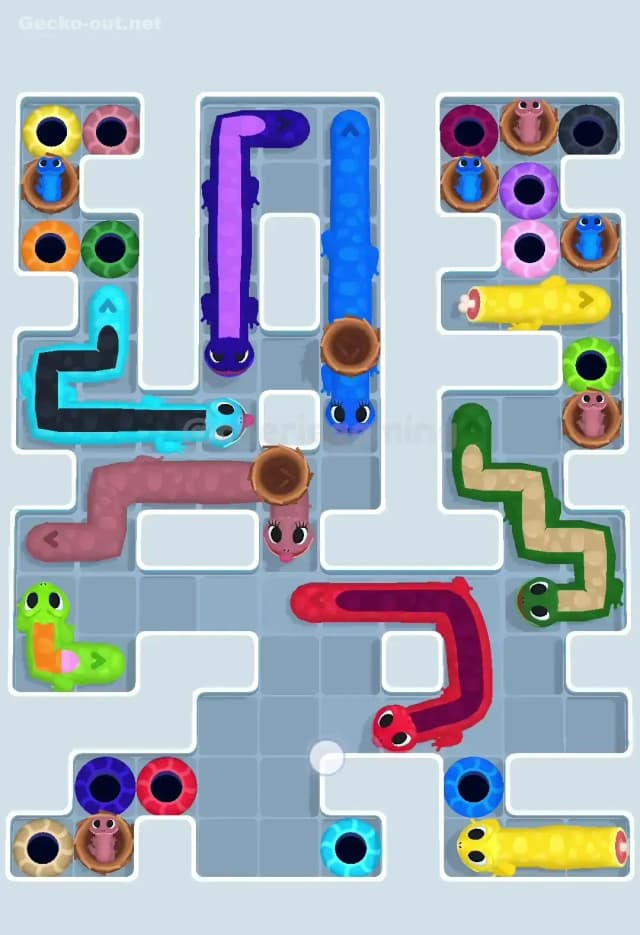
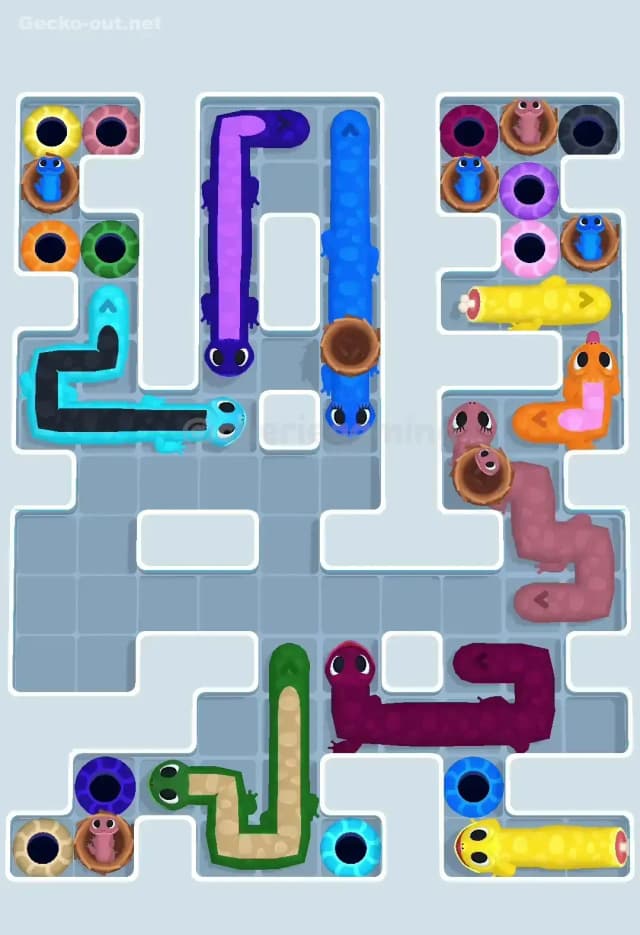
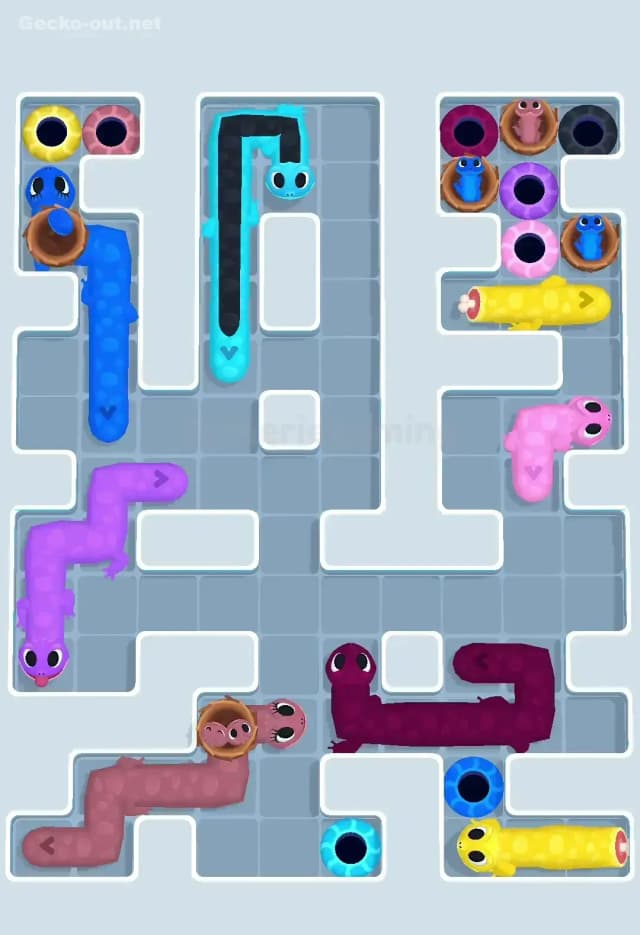
Gecko Out Level 627: Board Layout, Rules, and Win Condition
How the board is set up
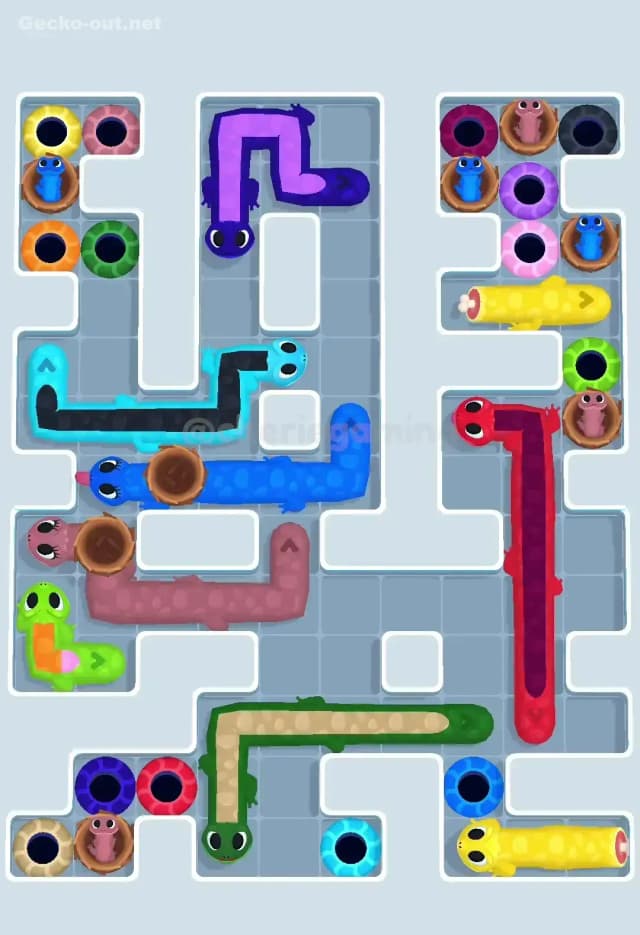
In Gecko Out Level 627 you’re dealing with a very crowded maze: four long “adult” geckos plus a bunch of short ones packed around shared exit clusters. You’ve got a tall red gecko running down the right side, a long blue one snaking horizontally across the middle, a big purple gecko folded near the top center, and an L‑shaped green gecko occupying most of the bottom corridor. Around them sit several tiny geckos (pink, blue, yellow, lime) tucked into small alcoves or nests right beside multi‑color exit rings.
The exits are grouped: a stack of four on the top‑left, a tight cluster on the right, and another cluster along the bottom‑left, plus a couple of single exits in side corridors. Many of these clusters mix correct colored holes with black warning holes, so you can absolutely throw away a run by lazily dragging into the wrong one. On top of that, some paths are partially blocked by brown “pots” that create narrow choke points the long geckos must squeeze through in a precise order.
Because geckos in Gecko Out 627 follow the exact path you draw, any loopy detour becomes a long body you then have to work around. With so many long bodies and shared corridors, the board starts in a semi‑knotted state: one wrong move and the red or blue gecko will wall off whole sections of the maze for everyone else.
Why the timer and drag-path movement matter here
To win Gecko Out Level 627 you need to get every gecko into a hole of the same color before the timer hits zero. Since the timer is strict, you can’t treat this as a slow untangling puzzle where you redraw paths over and over. The drag‑path rule means the “cost” of experimenting is high; a long experimental path makes a long permanent obstacle.
That’s why Gecko Out 627 rewards planning more than fancy hand speed. The real challenge is visualizing clean, mostly straight routes for each gecko that don’t cross the main choke points more than once. When you’ve decided on an order and rough routes, actually executing them is fast: two or three decisive drags per gecko, no wiggling. Think of it as spending the first attempt learning the knot, and the second attempt racing through a route you already trust.
Pathing Bottlenecks and Logical Traps in Gecko Out Level 627
The main bottleneck corridor
The single biggest bottleneck in Gecko Out Level 627 is the central vertical lane that links the middle of the board to the bottom corridors. At different points, the long blue gecko, the tail of the green gecko, and the base of the red gecko all want to pass through or across this same space. If you let any one of them fully occupy it too early, the others become almost impossible to route without massive, time‑draining redraws.
Your golden rule: use that central lane early for short geckos and temporary parking only. Don’t send red or blue fully to their exits until every small gecko that needs to cross the board is already gone.
Subtle problem spots that cause soft-locks
One subtle trap is the area around the top‑right exit cluster. It looks open, so it’s tempting to swing the yellow and nearby small blue geckos out immediately. But if you curl a long body in there (especially the red gecko turning across the top of the right side), you’ll block the tiny pink and blue geckos that share those exits, forcing a restart.
Another nasty spot is the bottom‑left cluster of exits. The L‑shaped green gecko naturally wants to sit horizontally across that zone, but if you park it there while the red gecko still needs to reach its red hole or the long blue still has business in the bottom corridor, you’ve effectively sealed your own fate. Finally, the little alcove on the mid‑left where the lime and pink geckos sit is a trap: moving the wrong one first can box in the other against the brown pots.
When the level “clicks”
Gecko Out 627 feels frustrating at first because every “obvious” move makes the knot tighter. I remember sending the tall red gecko down early, feeling proud, and then realizing I’d just built an unbreakable wall for half the board. The run where it finally clicked was when I treated the long geckos like sliding barriers instead of “things to finish” and focused on clearing every short gecko first.
Once you see that the long ones are tools to briefly open or close lanes—and that you can park them along walls without committing to their exits—the whole level feels less chaotic. The solution starts to look like a scheduled traffic pattern rather than a scramble.
Turn-by-Turn Path Strategy to Beat Gecko Out Level 627
Opening: clear shorts and set parking lanes
In the opening of Gecko Out Level 627, your priority is to remove the small, near‑exit geckos while the big bodies are still mostly in their starting shapes.
- Take the tiny geckos that already have almost straight routes to their matching holes: the lime green on the left and the yellow at the bottom‑right are quick wins. Drag them in short, direct lines that hug the walls so their bodies don’t clutter central tiles.
- Next, free the small blue and pink geckos sitting near their exit clusters on the right. Use tight, L‑shaped routes that slip between the red gecko and the walls, avoiding sweeping arcs that will leave long, annoying tails.
- During this phase, only “nudge” the long geckos: slide the blue one a square or two if you must to open room for a small gecko, or pull the green’s head slightly down to clear a junction. Always park them straight against edges, never curled into the open lanes.
The goal of the opening is simple: by the time you’re done, only the four big geckos (and maybe one mid‑size pink) remain, and your key corridors are empty.
Mid-game: keep lanes open while repositioning the long geckos
Mid‑game in Gecko Out 627 is all about lane management. This is where you move the long geckos into “staging positions” that keep exits reachable.
- First, straighten the purple gecko along the top corridor and route it toward its purple hole on the top‑left stack. Draw a path that skirts the outer edges so it doesn’t snake down into the middle.
- Then, move the long blue gecko into a mostly horizontal parking spot across the mid‑section, but keep its tail clear of the central vertical. You want it ready to drop down toward its blue exit later without wrapping around any corners that others still need.
- Now gently rotate the L‑shaped green gecko so its long segment runs along the bottom wall, leaving a gap in front of the bottom‑left exit cluster. This sets up space for the red gecko to descend and turn left in the end‑game.
Throughout this stage, never draw S‑curves or spirals. Every extra bend is extra body length blocking your own routes. Short, rectangular paths that hug outer walls are what make Gecko Out Level 627 manageable.
End-game: exit order and time-saving tips
The end‑game of Gecko Out Level 627 usually comes down to just three actors: green, blue, and red.
- Finish the purple if you haven’t already; its exit is far from the main traffic, so it’s safe to send now.
- Next, commit the long blue gecko to its blue hole, using the central vertical lane one final time. Once it’s gone, that lane is permanently blocked, so do a quick mental check that no other gecko still needs to cross it.
- After blue is out, move the green gecko into its green exit from its bottom parking spot, leaving a clean corridor for the red gecko.
- Finally, send the tall red gecko straight down its column, then turn it left along the bottom corridor into the red exit.
If you’re low on time, don’t panic‑drag. It’s better to trace one clean, straight path per gecko than to redraw a sloppy one twice. Most successful clears of Gecko Out 627 finish with a couple of seconds to spare once you know the order.
Why This Path Order Works in Gecko Out Level 627
Using head-drag pathing to untangle, not tighten
This plan works in Gecko Out Level 627 because you use the head‑drag rule to place bodies exactly where they’ll be harmless. Short geckos go first because their bodies barely extend beyond their heads, so their routes almost never interfere later. Long geckos are always dragged along walls and in rectangles, so they form temporary boundaries instead of unpredictable knots.
By postponing the commitment of the longest geckos until lanes are clear, you avoid the classic failure state: a red or blue body pasted right across the only path to someone else’s exit. You’re not just escaping; you’re actively sculpting the maze into a simpler shape as you go.
Balancing planning time vs. execution speed
In Gecko Out 627 you should consciously split your run into two phases: planning and execution. Spend the first attempt or two slowly dragging ghost routes in your head—no need to finish the level, just learn which exits share lanes. Once you’ve internalized the order (shorts first, purple top, blue, green, red), the actual winning run is fast and calm.
During the winning attempt, pause briefly before moving any long gecko and ask, “Does anyone still need this corridor?” If the answer is yes, wait and move a different gecko. That one‑second pause saves you far more time than frantically undoing a bad path.
Boosters: nice to have, not required
Boosters in Gecko Out Level 627 are absolutely optional. You don’t need extra time if you stick to the clean path order; you’ll finish well within the limit. If you’re really stuck, a single hint booster can help by revealing which gecko the game expects you to move next, but I’d save that for after a few serious attempts so it actually teaches you something.
A hammer‑style tool that frees a stuck gecko is overkill here; if you’ve knotted a body that hard, it’s faster to restart with the correct lane discipline. Treat boosters as comfort items, not crutches—the core logic of Gecko Out 627 stands on its own.
Mistakes, Fixes, and Logic You Can Reuse in Other Gecko Out Levels
Common mistakes on Gecko Out 627 and how to fix them
- Moving the tall red gecko first and walling off half the board. Fix: keep red almost completely still until the end‑game; it’s one of your last two exits.
- Curling the long blue gecko through the middle in a big S‑shape. Fix: always drag blue in straight or L‑shaped paths hugging the edges; never loop it around empty tiles.
- Ignoring the tiny geckos beside exit clusters. Fix: always scan for “one‑drag clears” at the start and do them immediately.
- Parking the green gecko across the bottom‑left exits. Fix: park it flush against the bottom wall with space to let red turn left later.
- Overusing the central vertical lane. Fix: mentally treat that lane as a shared bridge: cross it only when you’re sure this is the last gecko that needs it.
Reusing this logic on other knot-heavy levels
The habits you build beating Gecko Out Level 627 carry straight into other tough Gecko Out stages. On gang‑gecko levels, the same “short first, long later” rule keeps combined bodies manageable. On frozen‑exit or toll‑gate boards, you still want to plan around shared corridors first, then spend special tiles once most traffic is gone.
Whenever you see multiple exits in a cluster, assume at least one is a trap or distraction. Trace quick mental routes from each nearby gecko to those clusters and decide who “owns” each lane before you touch anything. That’s exactly how you solved Gecko Out 627, just applied to new layouts.
Final encouragement for Gecko Out Level 627
Gecko Out Level 627 looks like chaos the first time you open it—the board is stuffed, the timer nags you, and every move seems to make things worse. But with a clear order (shorts → purple → blue → green → red) and strict lane discipline, the level turns into a smooth little choreography instead of a panic mess.
If you’re still stuck, don’t assume you’re bad at the game; Gecko Out 627 is genuinely tight on space and punishes random dragging. Take a breath, map the corridors, treat long geckos as moving walls, and give it two or three focused tries. Once you nail it, you’ll find that later Gecko Out levels that look scary feel much more manageable—because you’ve already cracked one of the nastiest knots.