Gecko Out Level 1025 Solution Walkthrough | Gecko Out 1025 Answer
How to solve Gecko Out level 1025? Get step by step solution & cheat for Gecko Out level 1025. Solve Gecko Out 1025 easily with the answers & video walkthrough.
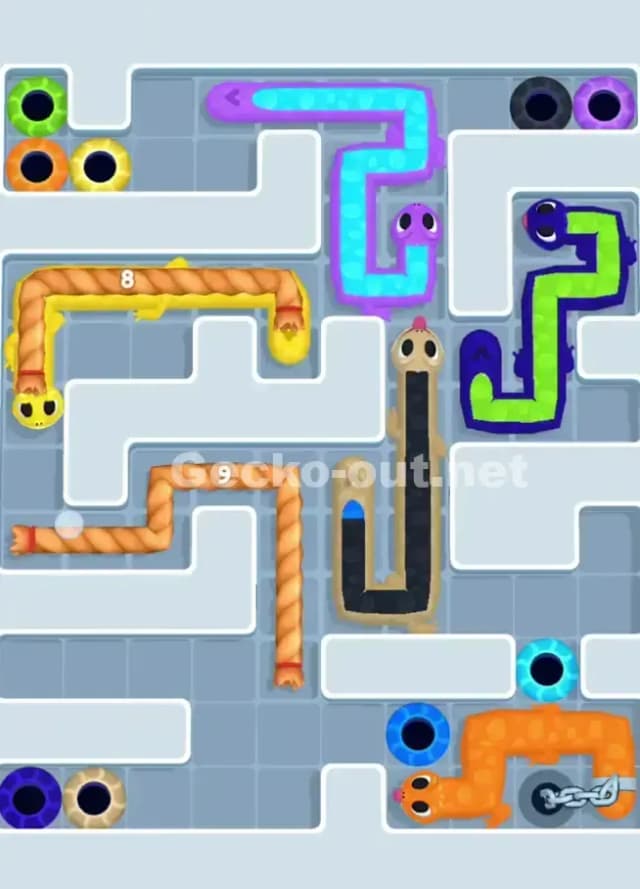
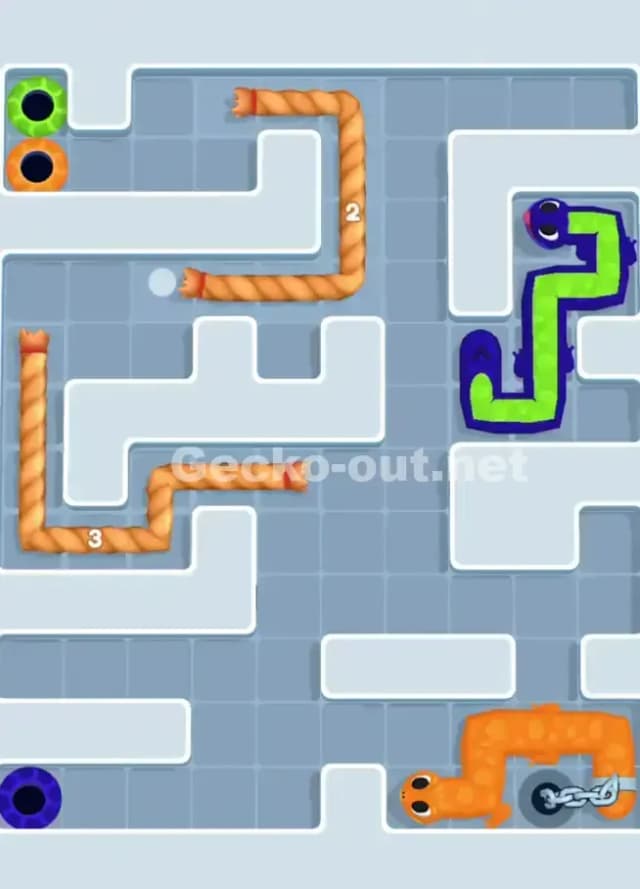
Gecko Out Level 1025: Board Layout, Rules, and Win Condition
Understanding the Starting Board
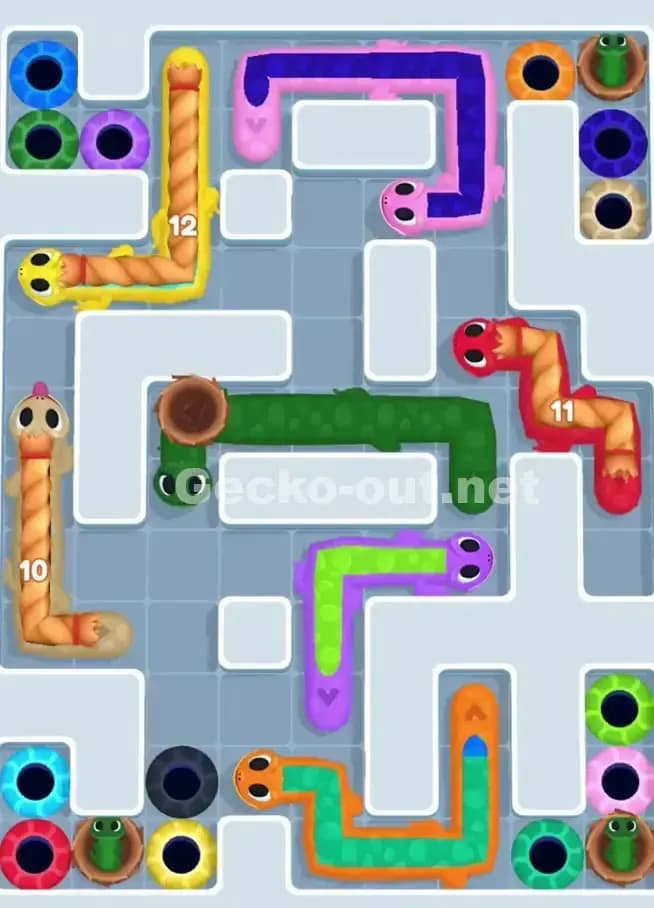
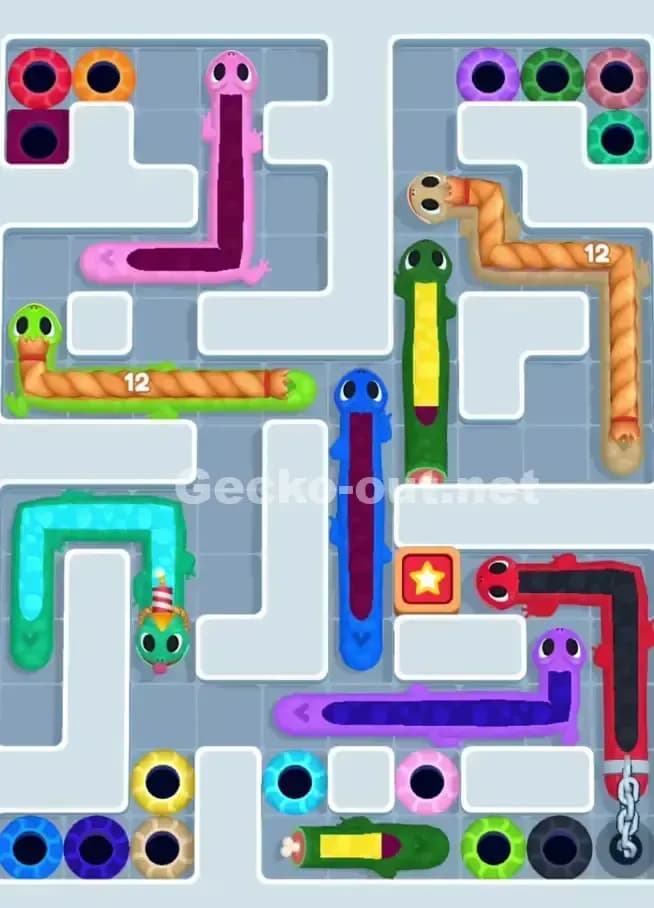
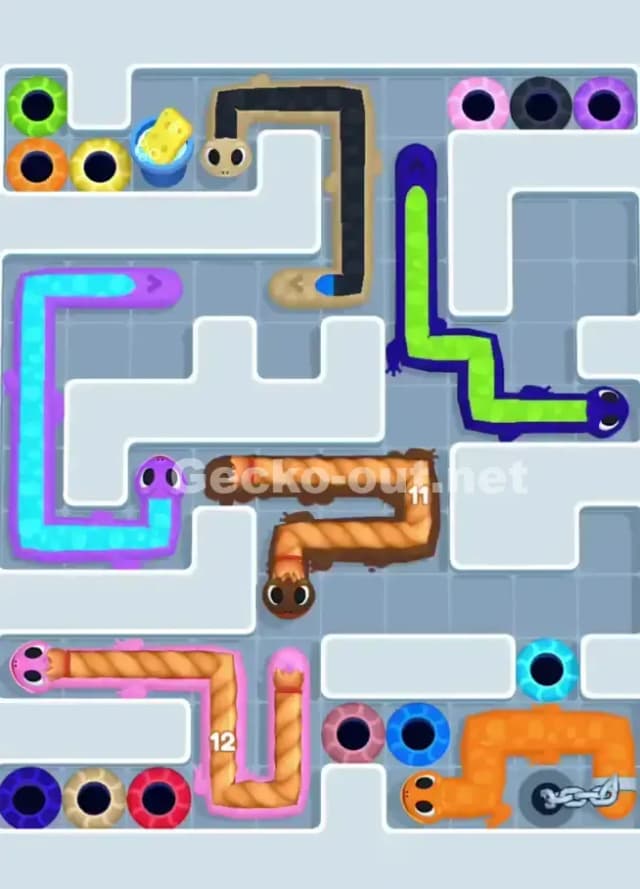
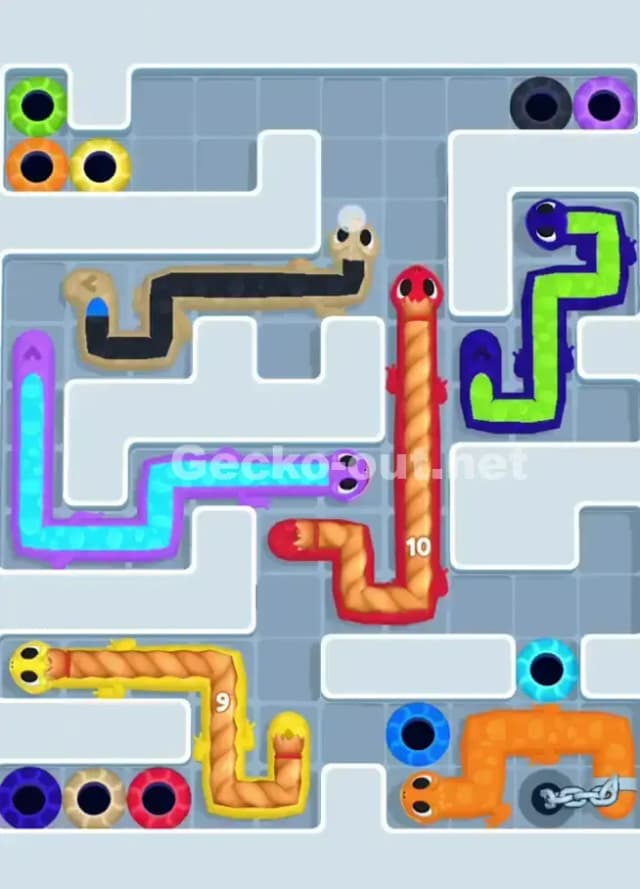
Gecko Out Level 1025 is a multi-gecko puzzle that'll test your spatial reasoning and nerve. You're looking at a dense board with nine geckos spread across multiple colors: green, yellow, pink, purple, blue, orange, and cyan. The geckos aren't just sitting idle—they're tangled into long chains and positioned in tight clusters that make a single mistake feel catastrophic. You've got a compact timer that doesn't give you much breathing room, so hesitation here costs you dearly.
The board features several gang-linked geckos (geckos connected in chains that move as one unit) and some positions so cramped that you'll swear there's no solution until you see it. Walls, choke points, and narrow corridors dominate the layout, and here's the kicker: the holes you need to reach are scattered across opposite corners and edges. This isn't a level where you can brute-force one gecko at a time and hope it works out.
Win Condition and Timer Pressure
To beat Gecko Out Level 1025, every single gecko must reach its matching-colored hole before the timer expires. That means you can't just rush the easy ones and hope the hard ones solve themselves. The timer is your constant opponent—it's tight enough that wasted moves (like dragging a gecko in the wrong direction and having to retrace) will genuinely cost you the level. You need a plan before you start dragging, because trial-and-error is a luxury you don't have here.
Pathing Bottlenecks and Logical Traps in Gecko Out Level 1025
The Central Corridor Chokepoint
The biggest bottleneck in Gecko Out Level 1025 is the narrow central pathway that connects the upper cluster to the middle and lower sections of the board. You've got multiple geckos that want to move through this same tight channel, and if you route them carelessly, you'll create a traffic jam that no amount of clever repositioning can untangle. The brown and orange gang-geckos particularly compete for space here, and if you move the wrong one first, the other gets locked behind it with no escape route except a complete restart.
This single corridor is what separates "I almost had it" from "I nailed it." It's the puzzle's main defensive wall, and respecting it—by committing to a specific order and not deviating—is half the battle.
Subtle Problem Spots
The cyan and pink gang-gecko interaction: These two are interlocked in a way that looks like they can exit independently, but their paths overlap in a tight corner. If you drag cyan first without planning pink's exact route, you'll find pink wedged behind cyan with nowhere to go. The solution requires you to think ahead about where cyan ends up, not just where it starts.
The upper-left green gecko and the jam: The green gecko in the top-left corner has a deceptively long body that snakes across premium real estate. Dragging it carelessly will leave its tail blocking exits for other geckos, even though its head is already safe. You need to drag it along a path that keeps its body tight and out of everyone else's way.
The blue gang and the purple exit: The blue gecko chain is positioned so close to the purple-hole area that it's tempting to route it that way. But if you do, you block the purple gecko's direct exit, and purple ends up having to take a massively longer, twisted path that eats time and risks overlapping the blue chain mid-move.
Personal Reaction to the Difficulty
Honestly? Gecko Out Level 1025 frustrated me the first few attempts because it looks like there's no solution—the board is so packed that every gecko seems to block every other gecko. But then I realized the trick isn't to solve it simultaneously; it's to strategically "park" geckos in safe zones while you clear critical paths for others. The moment it clicked was when I stopped thinking of each gecko individually and started thinking of them as nodes in a network. Once I mapped out which gecko had to move first to unblock the rest, the whole puzzle unfolded like dominoes. It's tough, but it's fair—and that's what makes it satisfying.
Turn-by-Turn Path Strategy to Beat Gecko Out Level 1025
Opening: First Geckos to Move
Start by tackling the yellow gecko in the upper-left cluster. This might seem counterintuitive, but yellow isn't blocked by much, and moving it first opens up breathing room for the trickier geckos. Drag it cleanly downward and then right, hugging the walls so its body doesn't sprawl across the center. This "opens" the upper zone without creating a roadblock.
Next, move the green gecko from the same cluster. Follow it down and to the right, routing it around the central corridor by taking the longer perimeter path instead of trying to push through the middle. Yes, it's longer, but it doesn't interfere with anyone else. Park it near its exit hole but don't complete the exit yet—you'll need this path clear for other geckos to pass.
The reason this opening works is that Gecko Out Level 1025 has a top-heavy starting position. Clearing the upper geckos first gives you a blank slate for the gang-geckos and longer chains lower on the board to maneuver without constantly bumping into something. Think of it like draining water from the top of a sink before you pull the plug.
Mid-Game: Keeping Critical Lanes Open
Now here's where Gecko Out Level 1025 gets tricky. You've got the cyan-pink gang and the brown-orange gang competing for central real estate. The order matters desperately. Move the brown gecko chain first, but route it around the central corridor via the left side. It's a longer path, yes, but it keeps the corridor completely clear for pink and cyan to use.
While brown is settling into its corner, drag the orange gang straight down and to the right using the eastern side of the board. Keep orange away from the central lanes entirely. This prevents orange from blocking blue later.
Next, commit to the cyan gecko and drag it through the now-open central corridor. It should glide through without obstruction, curving toward its cyan exit hole on the right side. Immediately after cyan exits, route pink through the same corridor—pink's path will now have clear passage because brown and orange are already out of the way.
The key insight for Gecko Out Level 1025 at this stage is sequential extraction from the middle outward. You're not trying to optimize every gecko's path simultaneously; you're creating a cascade where each exit unblocks the next one. Patience here saves you from last-second panics.
End-Game: The Final Geckos and Avoiding Last-Second Disasters
With the gang-geckos gone, you're left with the blue gecko and the purple geckos (there are multiple purples). The blue gecko is long, so drag it carefully along the eastern perimeter, making sure its tail doesn't wrap around and block purple's direct exit. Blue should curve smoothly down and exit from the bottom-right hole.
For the purple geckos, move them in this order: first the purple on the right side of the board, then the purples in the middle and left. Each one should take a distinct path so they never cross their own bodies or each other. If you're low on time, move swiftly—but don't skip planning; a wrong turn here costs you more time than you'll save by rushing.
The final gecko is always the orange exit on the right side. If you've followed the above plan, its path will be completely clear. Drag it straight in and breathe.
Why This Path Order Works in Gecko Out Level 1025
Body-Follow Physics and Untangling, Not Tightening
The entire strategy for Gecko Out Level 1025 leverages the rule that the gecko's body follows exactly where you drag the head. This means you can't bend a gecko's path after it's moving—you have to commit to a route entirely. The opening move (yellow and green) works because their exit points aren't contested; their bodies can follow without intersecting anything.
The mid-game (brown and orange perimeter routing) works because you're using the full board's width and length, not trying to optimize through the narrow center. The game's physics reward you for taking the scenic route if it keeps the critical path clear for others.
Gecko Out Level 1025 is designed so that the optimal solution isn't the shortest path for each gecko—it's the order that keeps the shared spaces unblocked. Your body-follow understanding lets you pre-visualize where each gecko's tail will end up, which is exactly what you need to spot the right sequence.
Timer Management: Pause vs. Commit
You have maybe 90–120 seconds on Gecko Out Level 1025 (depending on your difficulty setting). That sounds like a lot, but it evaporates fast if you second-guess yourself. The strategy here is to pause for 5–10 seconds at the start, trace through the sequence mentally, and then commit and move quickly. Once you start dragging, don't hesitate between moves—each drag-release is a single action, and lingering between them wastes precious seconds.
If you feel stuck mid-level, it's usually because you moved a gecko out of order and blocked someone else. Rather than try to fix it (which is impossible mid-move), just restart and trust the sequence above. Restarting costs 5 seconds; flailing costs 30+.
Booster Strategy for Gecko Out Level 1025
Boosters are optional here, not necessary. If you have a Time+ booster, I'd recommend not using it on your first attempt. The puzzle is solvable in the given time if you follow the sequence. However, if you've tried three times and keep getting stuck by a single gecko, a Time+ booster or a Hint booster is fair game. A hint will show you the order, which is half the puzzle. Use it if you're truly stuck—don't let pride get in the way of progress.
Mistakes, Fixes, and Logic You Can Reuse in Other Gecko Out Levels
Common Mistakes on Gecko Out Level 1025 and How to Fix Them
Mistake #1: Moving the long geckos first. Players often grab the biggest, most prominent gecko (brown or orange) and drag it immediately, thinking they're making progress. This locks the central corridor and cascades into a complete board jam. Fix: Always start with shorter geckos or those on the periphery. Clear the edges first, then tackle the central gang-geckos.
Mistake #2: Trying to "optimize" every gecko's path. You'll see a shorter diagonal route for cyan and convince yourself it's better. Then pink can't use the corridor because cyan's body is in the way. Fix: Sacrifice path length for order reliability. A longer perimeter route is always safer than a shorter central route if the central route is shared.
Mistake #3: Not planning exits before moving. You move a gecko two-thirds of the way across the board, only to realize its hole is on the opposite side. Now you've wasted time and carved out a long body-trail that blocks others. Fix: Before dragging any gecko, trace a mental line from its starting position to its exit hole. Make sure the path is clear or that clearing it is your next move.
Mistake #4: Panicking when the timer hits 30 seconds. With three geckos still on the board and 30 seconds left, you start dragging frantically, making random moves. This guarantees failure. Fix: Stick to the sequence even if it's tight. Trust that the plan works; panic always makes it worse.
Mistake #5: Dragging geckos diagonally when they should go axis-aligned. On Gecko Out Level 1025, diagonal paths eat up space because the body stretches across more cells. Stick to L-shaped paths (down then right, or left then down). Fix: Prefer axis-aligned movement. It's cleaner, takes less space, and leaves room for other geckos to pass.
Reusing This Approach on Similar Levels
The logic here transfers directly to any gang-gecko or multi-gecko knot level. Whenever you see multiple long geckos competing for narrow corridors, ask yourself:
- Which gecko is least contested? Move it first.
- Which gecko blocks the most others? Move it second, but route it around the contested zone, not through it.
- Which order creates a domino effect where each exit unblocks the next? That's your sequence.
This works on frozen-exit levels too. If an exit is frozen, you know it'll open only after a certain gecko leaves; use that to plan your order. On levels with warning holes, route geckos away from them unless their exit is literally next to the warning hole.
Gecko Out Level 1025 is really teaching you the meta-skill: read the board, identify the bottleneck, and solve for the bottleneck first. Every knot-heavy level follows this pattern.
Final Encouragement
Gecko Out Level 1025 is absolutely brutal the first time you see it—no question. The board looks impossible, the timer feels short, and the geckos seem determined to block each other. But here's the truth: it's solvable, fair, and almost elegantly designed once you understand the sequence. You've got the plan now. Trust it, execute it, and you'll beat Gecko Out Level 1025 within your next two or three attempts. The puzzle isn't cruel; it's just teaching you to think ahead. And that skill? That makes you unstoppable on every level that comes after.