Gecko Out Level 291 Solution Walkthrough | Gecko Out 291 Answer
How to solve Gecko Out level 291? Get step by step solution & cheat for Gecko Out level 291. Solve Gecko Out 291 easily with the answers & video walkthrough.
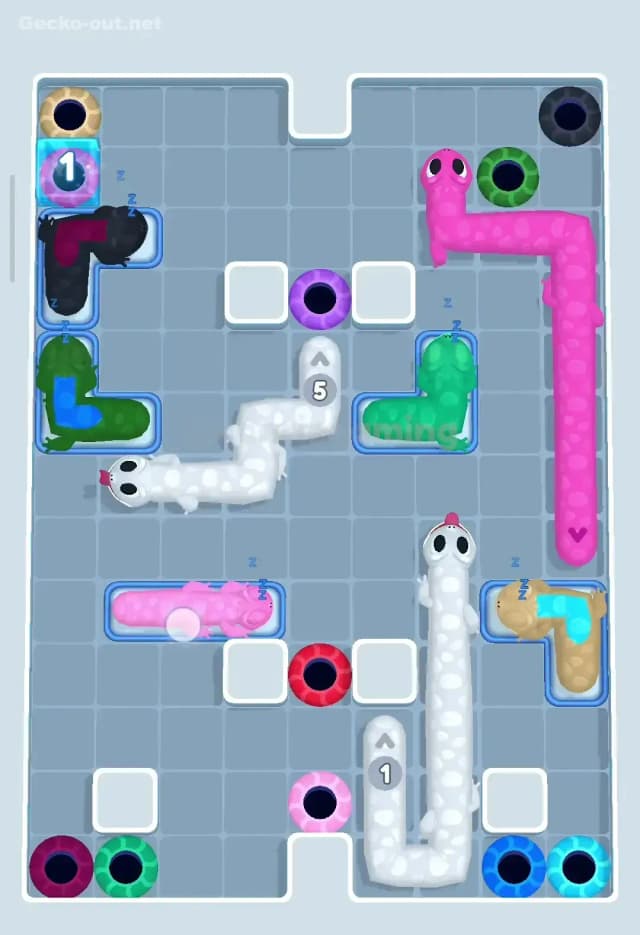
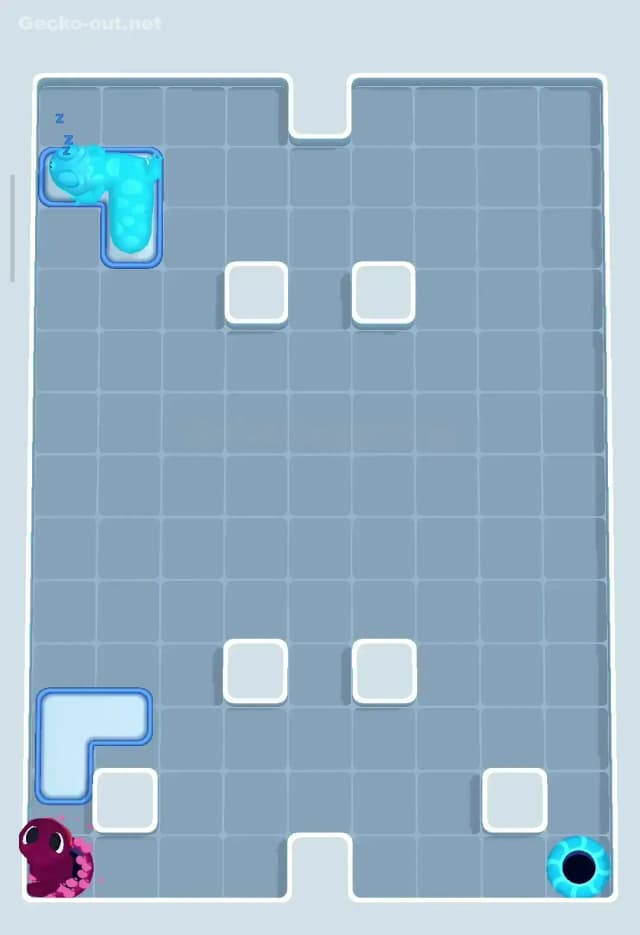
Gecko Out Level 291: Board Layout, Rules, and Win Condition
Packed board with long geckos and shared bodies
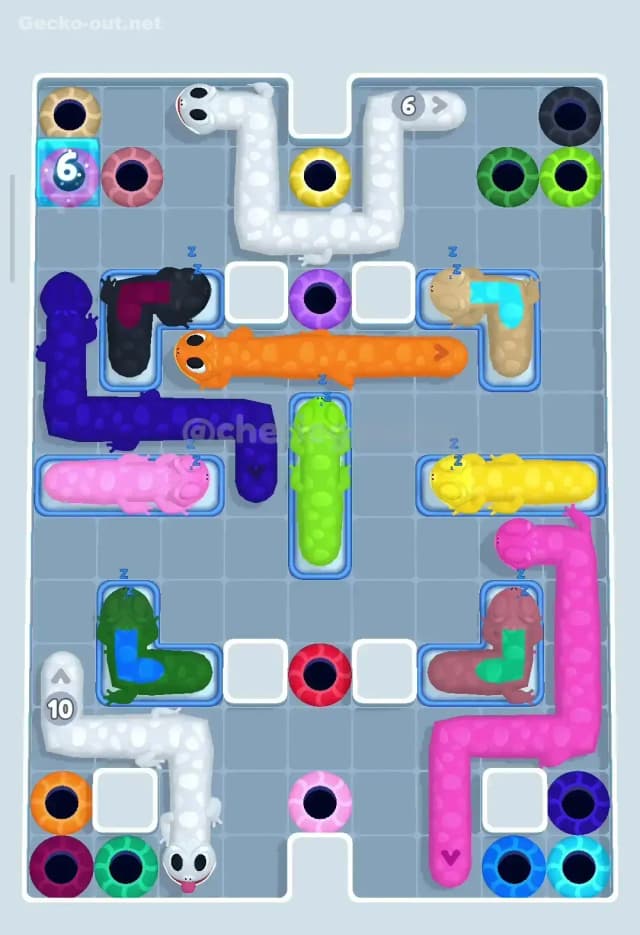
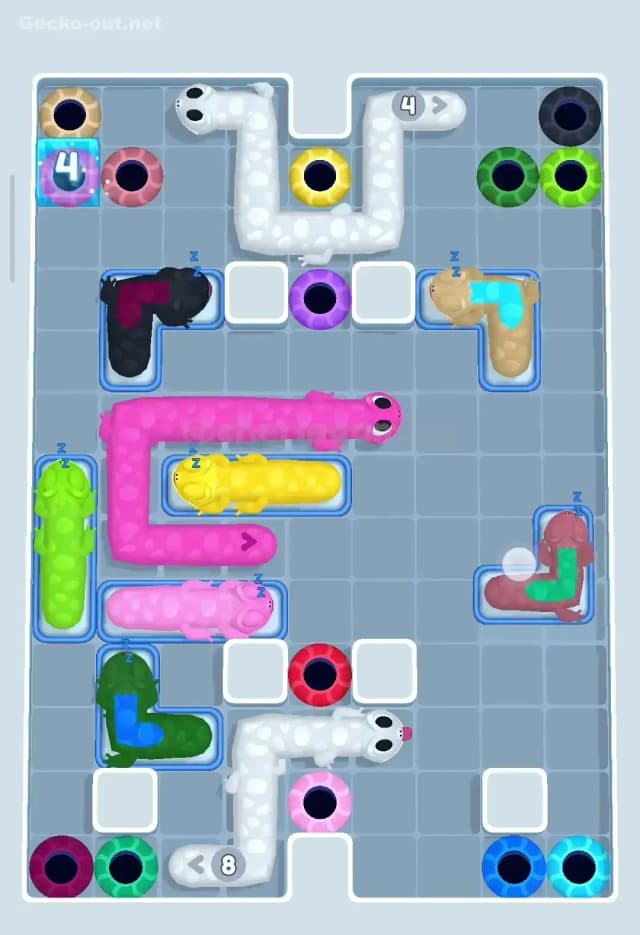
In Gecko Out Level 291 you’re dealing with a tall, cramped board packed with geckos of all sizes and a lot of overlapping exits. You’ve got:
- Two long white geckos, one wrapped in a big U-shape near the top, another stretched along the bottom-left.
- A bright orange gecko running horizontally across the middle and acting like a giant barrier.
- A tall pink gecko hugging the right edge from mid‑board downwards.
- Several shorter geckos: yellow, tan, green, and dark blue, plus “gang” pairs where one body is split between two colors (green/blue and brown/green).
- Exit clusters at the top-left, top-right, bottom-left, and bottom-right, plus a central pink hole.
- A frozen or toll-style exit near the top-left with a “6” on it, and move counters on the two white geckos.
From the very first second, Gecko Out 291 feels tight. Almost every row or column is already occupied, so any sloppy drag will instantly block two or three other geckos.
Win condition and how the timer changes your plan
The win condition is classic Gecko Out: every gecko head must reach a hole of its own color. No part of a gecko can pass through walls, other geckos, or locked/icy exits. Because the body retraces the head’s exact path, every line you draw becomes a permanent “pipe” until that gecko exits.
In Gecko Out Level 291 the strict timer forces you to think in phases rather than pixel-perfect single moves:
- You can’t afford to brute-force random paths.
- You want to move in long, clean drags that cover distance and solve multiple problems at once.
- You need to use “parking spots” along the edges where a gecko can sit without choking key corridors.
Once you treat the level like a small traffic puzzle—clearing lanes in a specific order—the chaos suddenly becomes manageable.
Pathing Bottlenecks and Logical Traps in Gecko Out Level 291
The main bottleneck: the orange–pink–white corridor
The single biggest bottleneck in Gecko Out 291 is the middle corridor where the orange gecko stretches across the board and the tall pink gecko hugs the right wall. Together with the lower white gecko, they form a kind of three‑piece barricade that controls:
- Access to the bottom-left exit cluster (orange, green, black).
- Access to the central pink hole.
- Vertical lanes that the upper geckos need later to reach their exits.
If you move orange or pink the wrong way, you’ll either:
- Seal off the bottom-left exits so nothing else can reach them, or
- Trap the lower white gecko so it can’t curve into its exits at all.
So your entire route planning in Gecko Out Level 291 revolves around opening that corridor methodically and never blocking it again.
Subtle problem spots that ruin otherwise good runs
A few sneaky traps keep this level from being trivial:
-
The upper white U-shaped gecko
It looks tempting to exit it early because the yellow and purple holes are nearby. But if you drag it out too soon, you’ll block top lanes that the tan and right-side geckos need later. -
Gang geckos (green/blue and brown/green)
These have two colored heads on one shared body. If you draw a path that reaches only one of the pair’s exits comfortably, the second head ends up doing an impossible U-turn in a tiny corner. -
The icy/toll exit with “6”
That frozen-looking exit near the top-left is easy to ignore, but it shapes where you can park geckos. If you block its neighboring tiles, you’ll have nowhere to pivot one of the short geckos when you finally open that side.
I’ll be honest: my first few attempts on Gecko Out Level 291 felt like I was just making a prettier knot. It only started to click when I stopped trying to “solve” individual geckos and instead thought, “Which corridor do I need alive for the next 20 seconds?”
Turn-by-Turn Path Strategy to Beat Gecko Out Level 291
Opening: free the middle without committing to exits
Your opening goal in Gecko Out 291 is to unlock the center while keeping exits reachable. Do this:
-
Nudge the lower white gecko upward and slightly right
Don’t send it straight to its exits yet. Curve it gently into the central area so its body runs along the bottom edge, leaving gaps to the bottom-left exits. Think of it as a flexible wall you can still route around. -
Shift the dark blue L-shaped gecko off the orange gecko’s back
Move dark blue down/left just enough so it’s not sitting on top of orange. Park it against the left edge or near the lower middle so it doesn’t block vertical lanes. -
Slide the orange gecko upward and slightly toward whichever side gives you a vertical channel
I like to lift orange toward the top-middle, hugging the upper white gecko’s underside. That frees a vertical lane near the right for pink and near the left for the gang geckos later. Again, you’re not exiting orange yet—just getting it out of the crosswalk. -
Keep pink tall and anchored to the right
Don’t drag pink across the board immediately. Just make sure its body isn’t snaking into the central column. Your goal is to keep a clean vertical “highway” from top to bottom.
If you do the opening right, the board suddenly feels twice as spacious, even though almost no one has exited.
Mid-game: clear short geckos and gang pairs while lanes are open
The mid-game in Gecko Out Level 291 is where you cash in on that space. Your priorities:
-
Exit the nearby short singles
- Send the vertical green gecko to one of the right-side green holes while the central lane is open.
- Route the yellow gecko out through the right side once there’s a clean path—usually after pink shifts slightly away from its starting pad.
- Move the tan gecko from the upper-right toward its exit when the top corridor isn’t blocked by the white U.
Use smooth, arcing paths along walls; avoid zig-zags that eat space and time.
-
Handle the gang geckos carefully
For the green/blue and brown/green gangs, plan a path that:- Starts near their shared body,
- Passes by the first color’s exit,
- Then continues on to the second color’s exit without sharp reversals.
A good pattern is a big “C” or “S” curve that sweeps through both exits. Draw it in your head before you put finger to screen; you don’t have time to redraw if you mess it up.
-
Start positioning orange and pink for their exits
As the central area empties, you can:- Steer orange toward the bottom-left orange hole with a simple down-and-left curve.
- Prepare pink to swing left toward the central pink hole, but don’t complete the run until lower traffic is mostly gone.
During this phase you’ll feel the board “unlock” as shorter geckos vanish and the gang bodies untangle. That’s your cue you’re entering the end-game.
End-game: finishing order and last-second choke points
For the final 3–4 geckos in Gecko Out Level 291, I recommend this general order:
-
Exit orange first (if it’s still around)
Its body is long and likes to sit across the middle. Send it to the bottom-left orange hole in a clean sweep so it never re-blocks anything. -
Exit the lower white gecko next
With bottom exits open, curve white along the bottom and into its matching holes. Make sure its path doesn’t snake back up into the center. Think “low and wide,” not “tall and twisty.” -
Exit pink via the central pink hole
Now that the lower region is almost empty, drag the pink head left through the now-free middle and down into the central pink exit. Do this in one fast motion so you don’t hesitate and draw a weird loop that blocks nothing but wastes time. -
Finish with the upper white U-shaped gecko
Finally, route the top white gecko to its matching exit (usually one of the top colored holes). At this point almost all traffic is gone, so you can afford to use the top corridor freely.
If you’re low on time in this phase, skip fancy parking and commit to bold, minimal paths. It’s better to risk a slightly tight turn than to sit planning while the timer bleeds out.
Why This Path Order Works in Gecko Out Level 291
Using body-follow rules to untangle instead of tighten
Every move in this Gecko Out 291 plan is about exploiting the “body follows the head” rule:
- Early on, you drag long geckos (white and orange) into positions where their bodies act like neutral walls instead of active blockers.
- You always send short geckos and gang pairs out while the big bodies are holding stable, so they have clean lanes.
- You save the most flexible geckos (pink and the upper white) for last, when there’s empty space for them to swing wide.
Because you’re not constantly re-dragging the same long gecko through the crowded center, you avoid tightening the knot and piling bodies onto the few critical corridors.
Timer management: when to think and when to move
On Gecko Out Level 291 I like this rhythm:
- First attempt or two: don’t care about the timer; just study where each color exit lives and how corridors line up.
- Once you know the layout, pause briefly at the start of each phase (opening, mid-game, end-game) to picture 1–2 paths ahead.
- During actual drags, commit. A clean, confident curve is almost always better than a slow “perfect” scribble.
You’re basically spending brain-time in small bursts so you can move quickly in between.
Boosters: optional helpers, not required
Boosters in Gecko Out 291 are absolutely optional if you follow this plan. That said:
- An extra-time booster can help if you struggle with gang gecko paths and need a couple extra seconds to visualize.
- A hammer/clear-style booster is overkill here; the level is designed to be solvable with every gecko present.
- Hints might show you one or two exits, but they rarely explain lane management, which is the real puzzle.
I’d only use boosters after a few serious attempts once you’re sure your logic is sound but your execution is just barely too slow.
Mistakes, Fixes, and Logic You Can Reuse in Other Gecko Out Levels
Common Gecko Out Level 291 mistakes and quick fixes
-
Exiting the upper white gecko too early
- Problem: You block the upper lanes and trap the tan and right-side geckos.
- Fix: Treat upper white as a final or near-final exit. Keep it parked in its U shape until the board is mostly clear.
-
Dragging pink across the middle in the opening
- Problem: Pink’s tall body slices the board in half and kills your central highway.
- Fix: Keep pink glued to the right edge until orange, gang geckos, and most short singles are gone.
-
Forcing gang geckos into tight U-turns
- Problem: One head reaches its exit, the other gets impossible angles.
- Fix: Plan a broad, gentle curve that visits both exits in sequence, using mid-board space before it fills up.
-
Over-parking geckos near exit clusters
- Problem: A “temporary” park on an exit cluster ends up making that entire corner unusable.
- Fix: Park in long straight stretches along outer walls, not directly on or in front of holes.
-
Panicking about the timer
- Problem: You redraw paths repeatedly and lose more time.
- Fix: Accept that early runs are for learning. Once you know the order, you’ll naturally move faster.
Reusing this logic on other knot-heavy levels
The strategy that works on Gecko Out Level 291 scales really well:
- Identify the one or two critical corridors and protect them at all costs.
- Use long geckos as temporary walls, moving them once and then leaving them.
- Clear short singles and gang pairs while lanes are open; don’t let them linger and clutter.
- Save the most flexible long geckos for last, when the board has breathing room.
Any time you see frozen exits, toll gates, or dense exit clusters in other Gecko Out levels, take the same “lane management first, exits second” approach and you’ll notice they become way more manageable.
Final encouragement for Gecko Out 291
Gecko Out Level 291 looks intimidating—there’s a lot of color, a lot of length, and not much space. But once you treat it like a traffic puzzle and follow this path order, it turns from chaos into a precise little routine. Stick to the corridor-first mindset, respect how the bodies follow your lines, and you’ll clear Gecko Out 291 without needing a single booster.