Gecko Out Level 677 Solution Walkthrough | Gecko Out 677 Answer
How to solve Gecko Out level 677? Get step by step solution & cheat for Gecko Out level 677. Solve Gecko Out 677 easily with the answers & video walkthrough.

Gecko Out Level 677: Board Layout, Rules, and Win Condition
Understanding the Starting Board
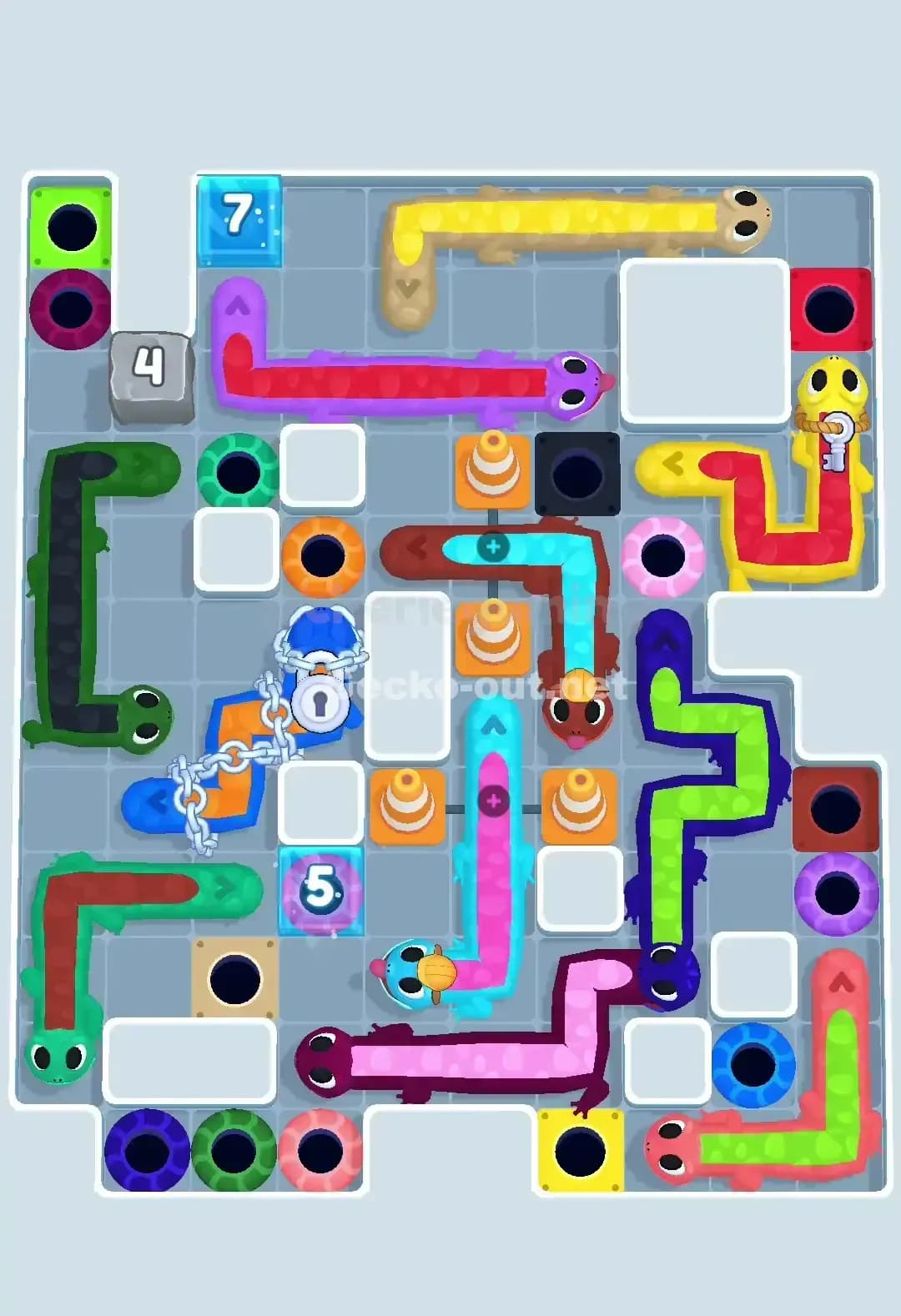
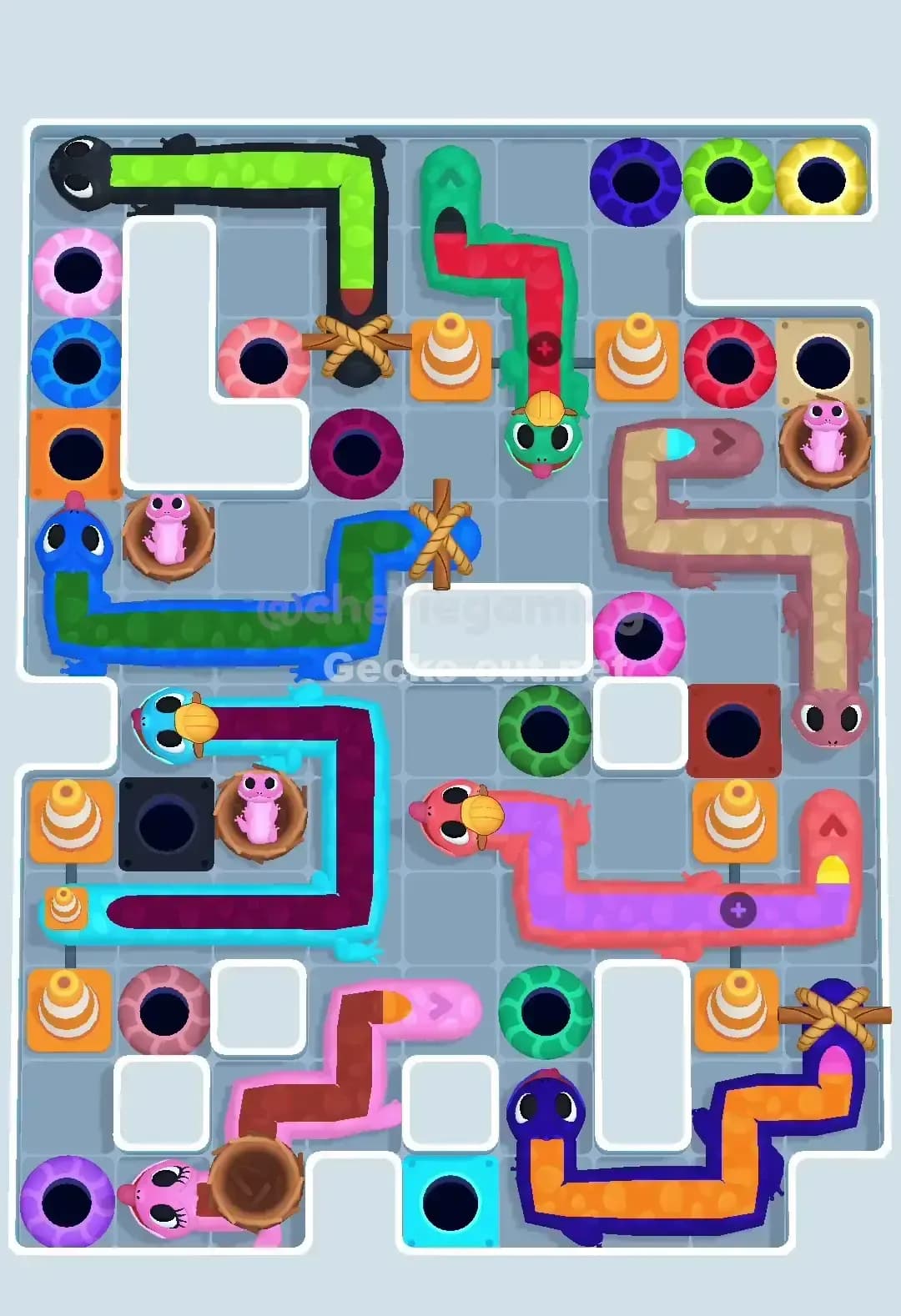
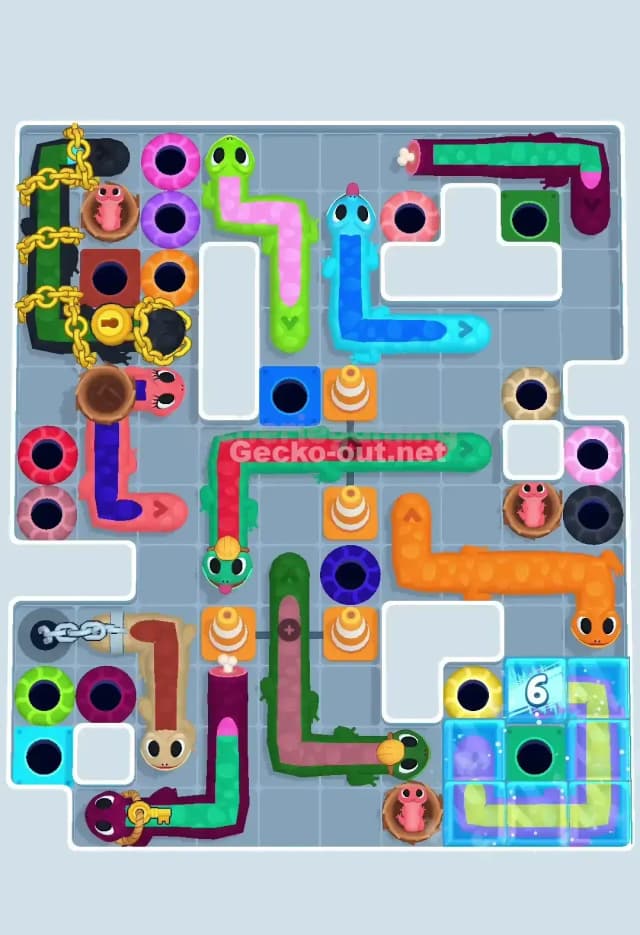
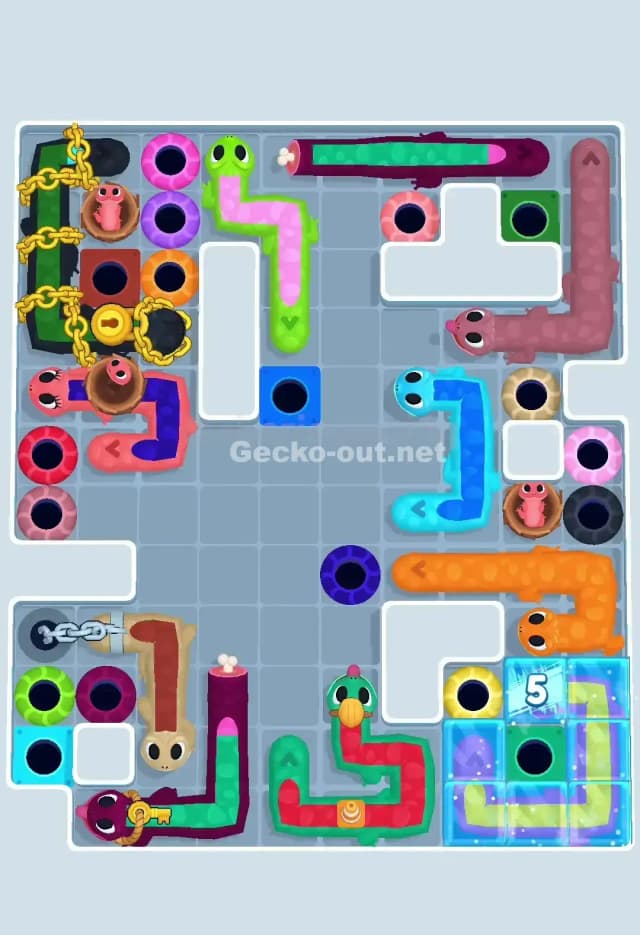
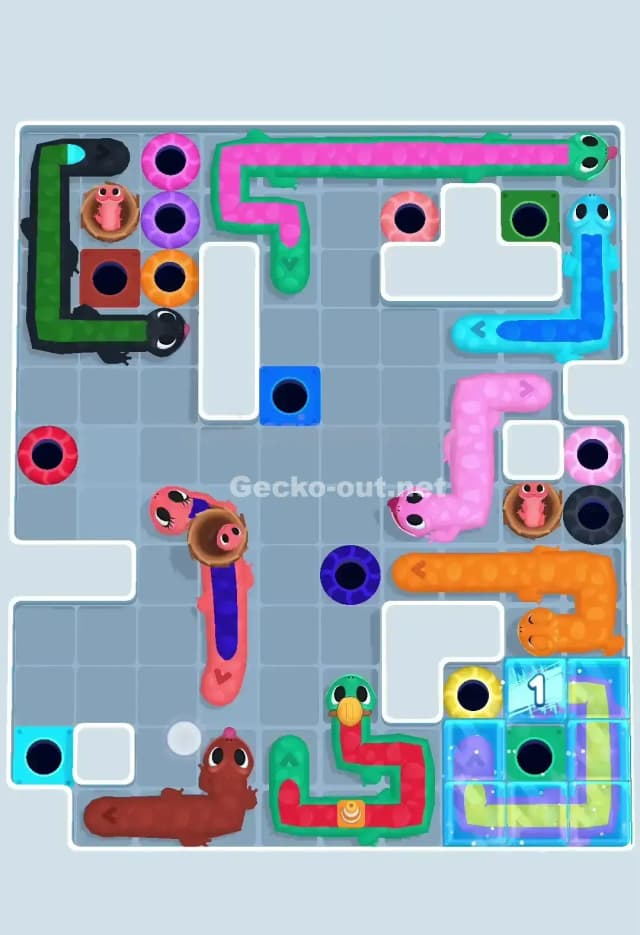
Gecko Out Level 677 is a beast. You're looking at a densely packed board with at least 12 geckos scattered across multiple color groups, and that's where the tension starts to build. The board features a sprawling mix of pink, green, blue, orange, cyan, and yellow geckos, all of whom need to reach their matching-colored holes before the timer runs out. What makes Gecko Out 677 particularly nasty is the sheer number of long, winding gecko bodies that snake across the board—some of them stretch 5–7 cells in length—which means moving one gecko often creates a domino effect of blockage.
You'll notice that several geckos are locked together in "gang" formations (chained geckos that move as a unit), which immediately cuts your degrees of freedom. There are also multiple white wall obstacles that create narrow corridors and choke points, forcing you to thread long gecko bodies through impossibly tight spaces. The timer is generous enough to give you breathing room, but it's not forgiving—you'll need to execute your drags with precision and minimal backtracking. The board layout itself is a puzzle: the holes are distributed across the entire grid, some tucked into corners, others in the middle of traffic zones.
The Win Condition and Why Timing Matters
To win Gecko Out Level 677, every single gecko must reach a hole matching its color before the timer hits zero. Unlike simpler levels, you can't afford to solve this one gecko at a time in isolation—you have to choreograph the entire escape like a traffic puzzle. The drag-path movement system means that when you pull a gecko's head, its body follows the exact route you've drawn, which is why overlapping paths become a nightmare. If you don't plan the exit sequence correctly, you'll end up with a gridlocked board where one gecko's body is blocking another's only viable route to safety. The timer adds real pressure: you need to be fast, but not so fast that you make careless mistakes that force a restart.
Pathing Bottlenecks and Logical Traps in Gecko Out Level 677
The Critical Bottleneck: The Center-Left Corridor
The single biggest chokepoint in Gecko Out Level 677 is the center-left area where multiple long geckos converge toward a narrow vertical corridor. I'm talking about the space where the pink, green, and blue long-body geckos all need to squeeze through toward their respective holes. This is the critical junction because whichever gecko you route through this corridor first essentially "claims" the path, and the others have to wait or find an alternate route. The gang-locked geckos are particularly problematic here because they move as one rigid unit—you can't split them up to thread them through gaps more efficiently.
Subtle Traps That'll Catch You Off Guard
First, there's the issue of the cyan gecko on the right side of Gecko Out Level 677. Its body is long enough that if you drag it carelessly, it'll snake back across the board and block access to adjacent holes. You need to plan its path so it exits cleanly without looping back over itself. Second, the orange geckos near the center are surrounded by white walls on multiple sides, which creates an optical illusion—you think there's more space to maneuver than there actually is. Your drag paths will be far more restrictive than you initially expect. Third, the bottom-right area has a 2×2 colored block puzzle that looks decorative but can actually trap smaller geckos if you're not careful about the order you solve them in. It's easy to accidentally block one gecko's exit while solving another's puzzle.
The Moment It Clicked For Me
Honestly, when I first looked at Gecko Out Level 677, I felt that familiar frustration—the board looks impossibly tangled, and you can't immediately see the path forward. But then I realized the key insight: the gang-locked geckos aren't your enemy, they're your guide. By routing them first, you claim the main corridor, and then all the other geckos have to be more creative with their paths. Once I accepted that constraint instead of fighting it, the puzzle suddenly felt solvable. The moment I stopped trying to find the "perfect" path for every gecko and instead focused on clearing the board in logical waves, Gecko Out Level 677 went from frustrating to genuinely satisfying.
Turn-by-Turn Path Strategy to Beat Gecko Out Level 677
Opening: Clear the Gang and Claim the Corridor
Start Gecko Out Level 677 by moving the gang-locked geckos first—specifically, the maroon/burgundy gang on the bottom-left with the chain symbols. These geckos move as a single unit, so they're your most inflexible pieces. Route them toward their hole, and plan a path that doesn't loop back over the center of the board. As they exit, you're essentially clearing a "main highway" for everyone else. While they're moving, mentally note which other geckos will need to use that same general area: the green, pink, and blue long-bodies waiting in the center-left will eventually need access to that corridor.
Next, move one of the simpler single-gecko units that's not blocking anyone—for instance, if there's a yellow gecko with a clear shot to its hole, take that exit. This gives you some breathing room on the board and reduces the total number of pieces you're juggling. The key to the opening phase of Gecko Out 677 is to remove "obvious" geckos first so that the board becomes less visually overwhelming and you have room to plan the harder moves ahead.
Mid-Game: Keep Lanes Open and Reposition Strategically
Once you've cleared the gang and a couple of easy geckos, the board still looks messy, but now you have actual space. This is where Gecko Out Level 677 becomes a game of spatial chess. Identify which geckos are still blocking major corridors—usually, it's the long-bodied cyan and orange geckos in the center. Before you move them, trace their potential exit paths with your eyes. For the long geckos, you want to drag them in a way that hugs the edges of the board rather than cutting through the middle, because the middle is where all the traffic is.
Here's a critical move: if there's a gecko that's currently not blocking anyone but will become a blocker once you move other pieces, go ahead and move it to a "holding zone"—an empty corner or side area where it can sit without interfering. This buys you flexibility later. For the green gecko paths in Gecko Out 677, watch out for the white walls; they create forced turns that look annoying at first but actually create natural "lanes" if you work with them instead of against them.
End-Game: Exit Order and Last-Second Scrambling
As you approach the final three or four geckos in Gecko Out 677, the board should feel much more open, but also much more tense. You're watching the timer, and you need to nail the exit sequence. A good rule of thumb: move the longest-bodied geckos second-to-last, and save the shortest, simplest gecko for the very end. This minimizes the risk of a long gecko blocking your final exit.
If you're cutting it close on time, don't panic—just commit to straight, simple paths. Avoid elaborate loops or detours. The cyan and blue geckos especially should go straight if possible. If the timer is genuinely tight (sub-10 seconds remaining), consider using a time-extension booster at that point rather than risking a failed run. Better to burn a booster and win than to fail Gecko Out Level 677 because you were trying to play without one and ran out of seconds.
Why This Path Order Works in Gecko Out Level 677
How Body-Follow Pathing Prevents Gridlock
The genius of solving Gecko Out Level 677 in waves is that you're respecting the fundamental mechanic: the body follows the head's path exactly. When you route a gecko through a corridor first, its body occupies that space, but only along the specific path you drew—it doesn't "spread out" unpredictably. By moving the most constrained pieces (gang geckos, long-bodied geckos) early, you're preventing them from becoming obstacles that block shorter geckos later. Short geckos are more flexible, so they should go later when the board is open and you can improvise if needed. This is why the order matters so much in Gecko Out 677: the sequence prevents the board from ever becoming truly gridlocked.
Balancing Speed and Caution
The timer in Gecko Out Level 677 is designed to keep you moving, but rushing leads to sloppy paths that create new obstacles. A good rhythm is to pause for 3–5 seconds after moving each gecko, scanning the board for any bodies you've left in awkward positions, and mentally planning the next move. If you move at a medium pace—not glacially slow, but not frantic—you'll complete Gecko Out 677 with 15–20 seconds to spare, which feels comfortable. If you find yourself down to under 10 seconds before the last gecko, it usually means you made a wrong turn earlier and wasted moves repositioning. Learn to trust your initial plan in Gecko Out 677; second-guessing yourself burns time.
Booster Strategy for Gecko Out 677
Boosters in Gecko Out 677 are optional if you execute the plan cleanly, but they're not a waste. A time extension booster is the most valuable here—it gives you an extra 30 seconds, which is plenty of buffer to handle any mistakes or unexpected blockages. If you've already tried Gecko Out Level 677 once or twice and know your path plan but keep getting ambushed by time pressure, a time booster is a smart safety net. Avoid using hint boosters unless you're genuinely stuck; the whole point of Gecko Out 677 is that the solution is logical if you read the board carefully. A hint will break the satisfaction of solving it yourself.
Mistakes, Fixes, and Logic You Can Reuse in Other Gecko Out Levels
Common Mistakes and How to Fix Them
Mistake 1: Moving long geckos through the center first. This immediately creates a tangle in Gecko Out 677. Fix: Always route long geckos toward the outside edges or straight lines, never in loops through the middle. Mistake 2: Forgetting to account for gang-locked geckos until the very end. By that point, their rigid body is blocking exit routes you need. Fix: Move gang geckos in your first or second move so they don't become surprise obstacles. Mistake 3: Dragging a gecko's path without checking if it will overlap another gecko's body. This creates an instant dead-end in Gecko Out 677. Fix: Before you release a drag in Gecko Out 677, trace the path with your eyes one more time and make sure no other gecko's body is in the way.
Mistake 4: Getting tunnel vision on one gecko. You'll spend 20 seconds perfecting a path for a single gecko when you could've moved three simpler ones in that time. Fix: Work in batches—move all the obvious, unblocked geckos first, then tackle the complex ones. Mistake 5: Not leaving space for geckos to pass each other. Gecko Out 677's white walls create narrow corridors, and if two geckos' paths try to use the same corridor, you're stuck. Fix: Plan at least two alternate routes through congested areas and be ready to use the one that's open.
Reusing This Logic on Similar Levels
The Gecko Out Level 677 solution—move gang geckos early, use edges and straight lines for long bodies, save short geckos for last—is a template you can apply to any level with similar challenges. Whenever you see a board packed with long-bodied geckos and gang-locked units, default to this order: gangs first, long bodies second, short bodies last. This dramatically reduces your failure rate on levels like Gecko Out 677. Additionally, the "holding zone" concept (parking a gecko in an empty area to free up space) is universally useful. On any crowded Gecko Out level, look for corners or side areas where you can temporarily position geckos without them interfering, and use those zones to decompress the board.
Final Encouragement
Gecko Out Level 677 is genuinely one of the trickier levels in the game, but it's not unfair. The puzzle is solvable with clear thinking and a methodical approach. The board looks chaotic, but every obstacle and every gecko's starting position is carefully designed to guide you toward the right solution. Trust the logic, move the constrained pieces first, and don't second-guess yourself once you've committed to a path. You've got this—Gecko Out 677 is waiting for you to crack it, and the satisfaction when you do is absolutely worth the effort.