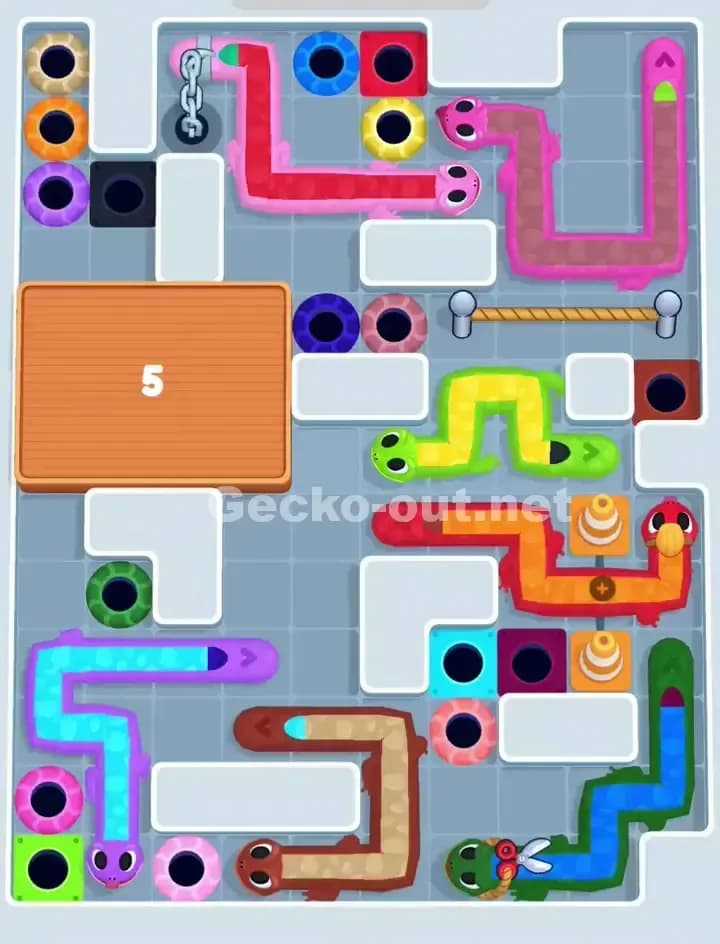
Gecko Out Level 1100 Solution Walkthrough | Gecko Out 1100 Answer
How to solve Gecko Out level 1100? Get step by step solution & cheat for Gecko Out level 1100. Solve Gecko Out 1100 easily with the answers & video walkthrough.
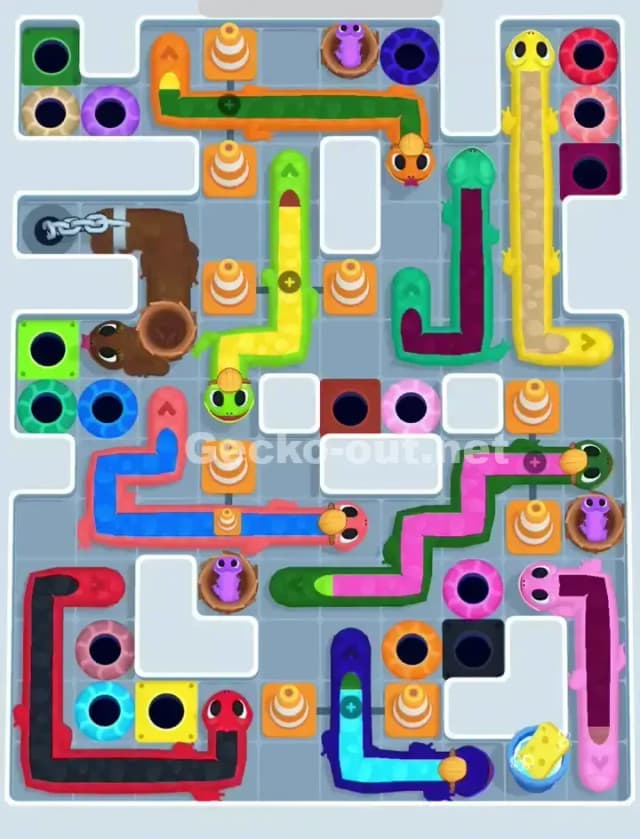

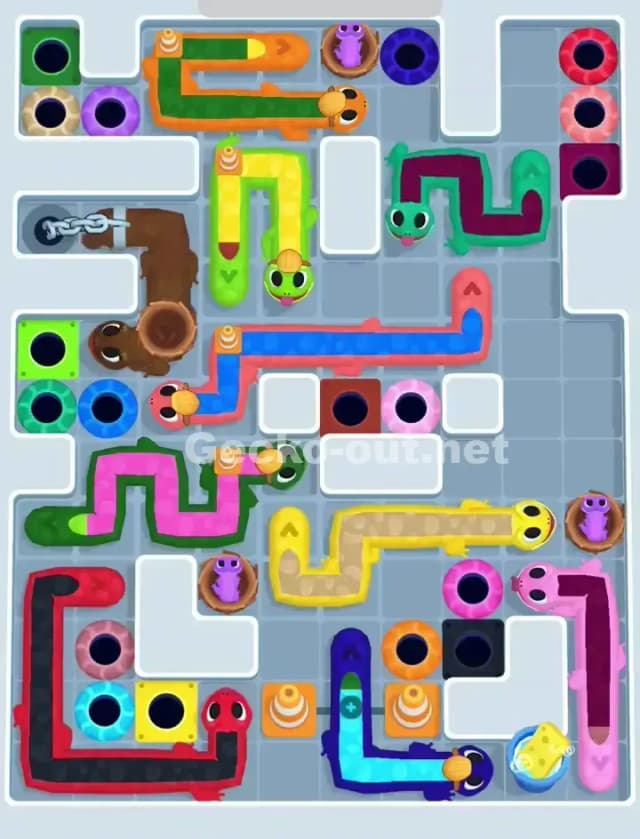

Gecko Out Level 1100: Board Layout, Rules, and Win Condition
Gecko Out Level 1100 is a dense, multi-layered puzzle that throws a lot at you right from the start. You're working with multiple geckos of different colors—each one needs to reach its matching color hole scattered across a convoluted grid. The board itself is cramped, with walls, white-space barriers, and toll gates (those orange ring markers) blocking direct paths everywhere. What makes Gecko Out Level 1100 particularly tricky is that you've got long, interlocking gecko bodies that form gang links, meaning when one gecko moves, its connected partner is dragged along unless you carefully plan the sequence.
The starting positions are deliberately stacked to create immediate tension. You'll notice geckos clustered in corners and along edges, which seems convenient until you realize their bodies snake through critical corridors. The white empty spaces on the board aren't just dead zones—they're choke points where only one gecko can fit through at a time. This forces you to think like a traffic controller, not just a puzzle solver.
The Win Condition and Timer Pressure
To win Gecko Out Level 1100, every gecko must escape through its matching-color hole before the timer runs out. There's no partial credit; if even one gecko is still on the board when time expires, you lose. This means the puzzle isn't just about finding a path—it's about finding the fastest sequence of paths that gets everyone out without jamming the board. The timer creates real urgency, and unlike some easier Gecko Out levels, there's little room for leisurely exploration or trial-and-error repositioning.
Pathing Bottlenecks and Logical Traps in Gecko Out Level 1100
The Critical Bottleneck: The Green-and-Yellow Gang Corridor
The biggest single bottleneck in Gecko Out Level 1100 is the intertwined green and yellow gecko bodies that snake through the middle-right section of the board. These two are gang-linked, meaning they move as one unit when you drag either head. Their combined body takes up nearly half the available space in that corridor, and their exit holes are on opposite sides of the board. If you don't move them first or at precisely the right moment, every other gecko trying to navigate around them will hit a dead end. I spent my first few attempts watching geckos pile up behind this gang, and I kept running out of time with two or three geckos still stuck. The moment I realized I had to treat the green-yellow pair as a single "unit" that needed to be cleared early, everything clicked.
Subtle Trap #1: The Orange Toll Gates
Those orange ring markers aren't just decoration—they represent toll gates that cost time or resources to pass. In Gecko Out Level 1100, they're positioned to force you into awkward detours. You can't just drag a gecko straight through; you need to account for the gate consuming momentum or requiring an extra step. If you path a gecko directly through a toll gate without accounting for the delay, you'll burn through your timer faster than expected, and suddenly you're scrambling to rush the final geckos through their exits.
Subtle Trap #2: The Upper-Left Parking Problem
The upper-left corner seems like a safe holding area, but it's actually a trap zone. If you park a gecko there while you work on the middle section, you'll eventually need to loop back and retrieve it, but by then the board is more crowded and your extraction path is blocked. Many players park geckos in the upper-left thinking they're clearing space, then find themselves locked out with no way to thread the body back through to the exit.
Subtle Trap #3: The Frozen or Locked Exit
Some Gecko Out levels have frozen exits, and Gecko Out Level 1100 is no exception. There's at least one exit that's blocked until certain conditions are met, usually when a specific gecko has already left. If you try to force a gecko through the wrong exit early, you'll waste movement, and worse, you might trap another gecko whose exit becomes inaccessible.
Turn-by-Turn Path Strategy to Beat Gecko Out Level 1100
Opening: Prioritize the Gang Geckos and Clear the Corridors
Start by moving the green-yellow gang duo out of the way. Even though they're connected, you should drag the green head first toward its exit. The body will snake along the path you create, and as long as you don't try to force it through impossible spaces, it'll follow naturally. The key is to commit to a smooth, wide arc that avoids backtracking. Once green is safely out, yellow will have more room, and the corridor opens up for the rest of the geckos.
After the gang clears, focus on any other long-bodied geckos that are taking up real estate. Move them to their exits or to temporary "parking" positions where they're out of the main traffic lanes. Don't park geckos in the upper-left; instead, position them along the edges where they can be easily extracted later. This opening phase might take 20–30 seconds, but it prevents exponential delays in the mid-game.
Mid-Game: Keep Lanes Open and Avoid Drawing Blocked Paths
Once the big geckos are handled, you'll have more breathing room, but don't get complacent. As you move the medium-sized geckos, constantly scan the board for emerging bottlenecks. If two geckos' paths would intersect, reroute the second one before you drag it—don't commit to a path and then realize it's blocked halfway through. This wastes time and can trap you in a loop of undoing moves.
Pay close attention to toll gates during this phase. Plan paths that pass through toll gates when you have extra time, not when you're rushing. If a gecko's most direct exit requires three toll gates, consider taking a longer but toll-free route instead. It sounds counterintuitive, but in Gecko Out Level 1100, a longer path with no delays often beats a "short" path that eats your timer at each gate.
Also, watch for any geckos that are still in their starting positions. Don't leave them there too long—they often block other geckos' routes, and moving them early frees up cascading paths for everyone else.
End-Game: Execute the Final Exits Without Panic
When you're down to the last three or four geckos and the timer is getting low, don't rush blindly. Pause for one second and verify each remaining gecko's path to its exit. The temptation is to drag frantically, but a single misclick that sends a gecko into a dead end will cost you more time than a careful, deliberate move.
Exit order matters in Gecko Out Level 1100. Prioritize geckos whose exits are hardest to access first. Once they're out, the remaining geckos usually have clearer lanes. If you're tight on time, use boosters like the timer extension (if available) with 10–15 seconds left. Don't hoard them; using a time booster in the final stretch is often the difference between a clear and a failure.
Why This Path Order Works in Gecko Out Level 1100
How Head-Drag Pathing Untangles Instead of Tightens
The reason this strategy works is rooted in how Gecko Out Level 1100's mechanics function. When you drag a head, the body trails behind, following your exact path. If you drag the green-yellow gang first, their bodies exit the board entirely, leaving physical space for other geckos to navigate. If you tried to path the other geckos around the gang without moving them, you'd be forcing bodies through gaps they barely fit through, causing them to wrap around the gang and tighten the knot. By removing the big obstacles early, you're expanding the available space geometrically—each gecko exit opens up not just one path but multiple cascading paths for the others.
Balancing Speed vs. Precision
Gecko Out Level 1100 rewards both speed and accuracy. The trick is knowing when to move fast and when to slow down. In the opening and end-game, deliberate, careful drags save time overall because you avoid corrections. In the mid-game, you can move a bit faster because there's less risk of blocking yourself. The timer isn't so tight that you need to rush every move, but it's tight enough that you can't pause for 30 seconds between each gecko. I usually spend 5 seconds surveying the board, 10 seconds executing a drag, then 5 seconds verifying the gecko reached its intended position. This rhythm keeps you moving without creating disasters.
Booster Strategy for Gecko Out Level 1100
You typically don't need boosters to beat Gecko Out Level 1100 if you follow this plan. However, if you've made a small mistake and the timer dips below 20 seconds with one or two geckos left, a time extension booster is your friend. Deploy it early enough that you can still execute clean final paths. A "hint" booster might seem helpful, but in Gecko Out Level 1100, the puzzle logic is clear enough that hints often just confirm what you already know. Save boosters for when you're genuinely stuck on a repositioning mistake, not as a crutch for every level.
Mistakes, Fixes, and Logic You Can Reuse in Other Gecko Out Levels
Common Mistakes and How to Fix Them
Mistake 1: Ignoring Gang-Linked Geckos. Players often treat linked geckos as independent, trying to move them separately. This fails because they're connected; pulling one drags the other. Fix: Always move gang geckos as a unit first. Drag one head to its exit and let the other follow naturally, or if their exits are far apart, move them in sequence without trying to disentangle them midway.
Mistake 2: Parking Geckos in Dead-End Corners. Placing a gecko in the upper-left or lower-right corner "temporarily" usually means you'll need to loop back for it later when the board is full. Fix: Use edge positions as parking spots, not corners. A gecko lined up along a wall can be extracted without threading through the center.
Mistake 3: Forcing Paths Through Toll Gates Without Timing. Dragging a gecko through three toll gates in succession eats your timer in seconds. Fix: Plan alternate routes that skip toll gates when possible, or ensure you use toll-gate paths only when you have time cushion.
Mistake 4: Moving Geckos Out of Order. Grabbing a random gecko and moving it before clearing bottlenecks just shifts the problem, not solves it. Fix: Always identify the biggest occupying gecko or gang first, move them out, then work down to smaller, simpler geckos.
Mistake 5: Panicking and Dragging Wildly in the Final Seconds. Random drags in the last 10 seconds often send geckos into walls or wrong exits. Fix: Even if the timer is low, take 1–2 seconds to verify each final path. A deliberate, correct move beats a frantic, wrong one.
Reusing This Logic on Similar Levels
This approach translates directly to any Gecko Out level with multiple geckos, gang links, or tight corridors. Whenever you face a level with 5+ geckos and visible bottlenecks, use the same playbook: identify and move the biggest occupants first, keep lanes open, and execute exits in priority order. Levels featuring frozen exits or toll gates benefit from the same timer-conscious mindset—plan before you drag, and don't assume the "shortest" path is the fastest.
Final Thoughts on Gecko Out Level 1100
Gecko Out Level 1100 is tough, but it's absolutely beatable once you stop seeing it as a chaotic jumble and start seeing it as a sequence of cleared spaces. The first time you successfully untangle all those geckos and watch them escape in a smooth rhythm, you'll feel genuinely accomplished. The puzzle is designed to look impossible at first glance, but with this strategic approach, you'll clear it in one or two attempts. Trust the process, move the big geckos first, and don't let the timer rush you into mistakes. Good luck out there!