Gecko Out Level 372 Solution Walkthrough | Gecko Out 372 Answer
How to solve Gecko Out level 372? Get step by step solution & cheat for Gecko Out level 372. Solve Gecko Out 372 easily with the answers & video walkthrough.
Gecko Out Level 372: Board Layout, Rules, and Win Condition
Starting layout: colors, knots, and obstacles
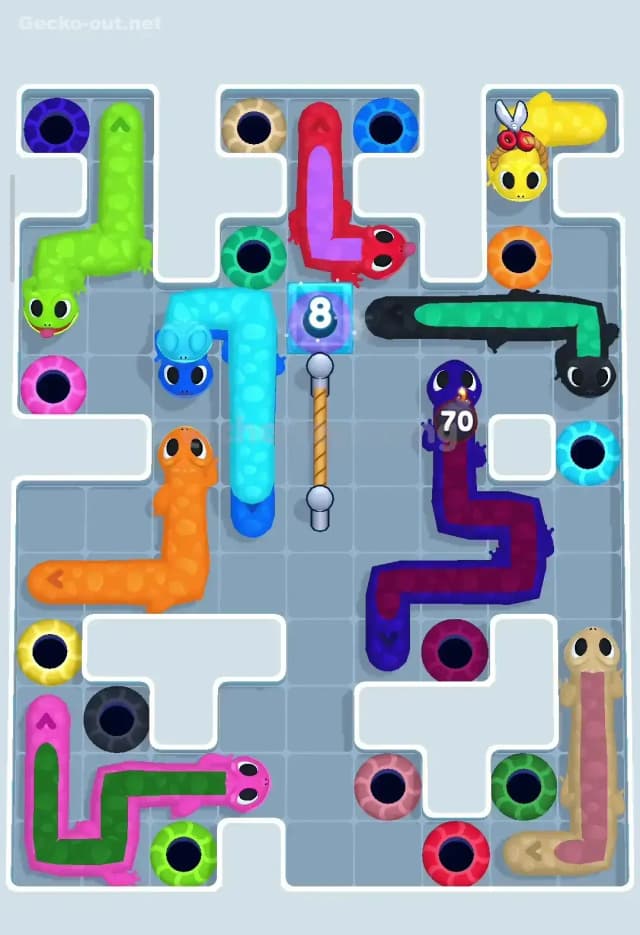
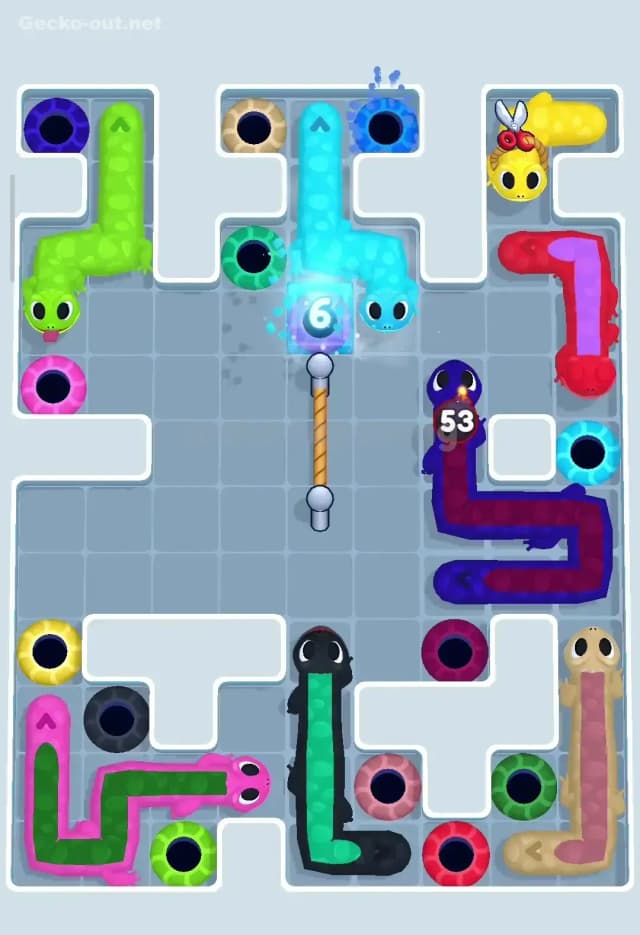
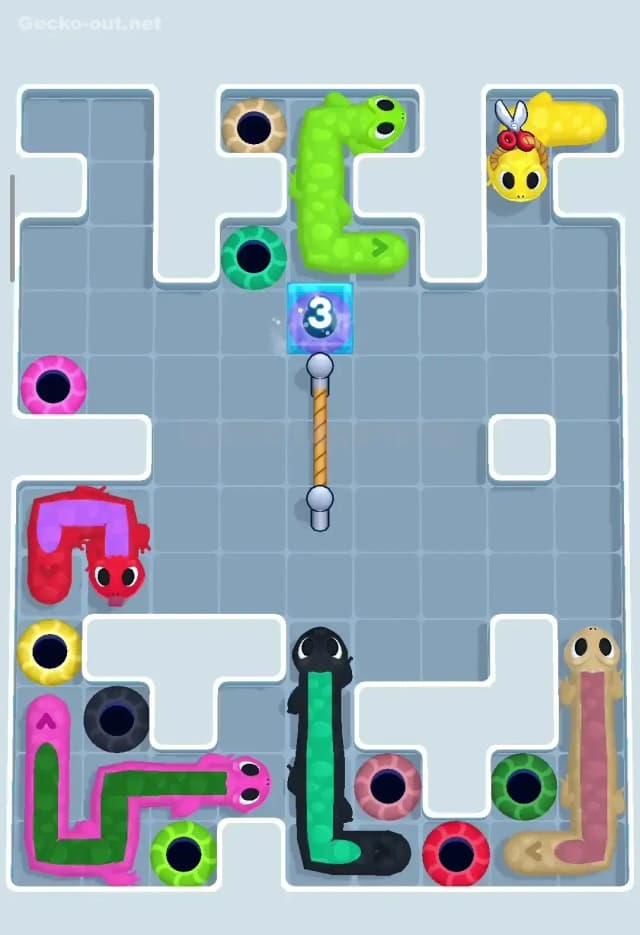
In Gecko Out Level 372 you’re dropped onto a very cramped board packed with long, bendy geckos. You’ve got roughly ten geckos in play: lime green in the top-left, a long cyan L in the middle, a red L near the top, a yellow gecko tucked into the top-right, a chunky orange one on the left side, a dark purple monster running down the right, a beige gecko on the far right, plus a pink/green gang in the bottom-left corner and a short black gecko in the middle-right area. Every one of those has a matching colored hole, but the holes are scattered all around the rim and center.
The board is split vertically by a narrow central corridor. In that corridor you’ve got two important obstacles: a frozen tile with an “8” on it and a toll-style rope gate just below. Around the map you also see several black “warning holes” that will swallow a gecko if the color doesn’t match. Gecko Out 372 doesn’t give you many completely open spaces; almost every gecko starts bent around a corner or nesting in an alcove.
Timer, path-dragging, and what you must do to win
The win condition on Gecko Out Level 372 is simple on paper: drag each gecko head so its body follows a path that ends exactly on the hole of the same color, without crossing walls, other geckos, locked exits, or warning holes. In practice, the path-drag rule is the real enemy. Any big detour you draw stays on the board as the gecko’s permanent body, stealing space you’ll desperately need later.
On top of that, there’s a strict timer hovering over the right side near the purple gecko. When it hits zero, you fail even if only one tail is still wiggling on the board. So Gecko Out 372 forces you to plan like a slow puzzle game but execute like a fast one. You can’t micro-drag every square or you’ll run out of time, but if you rush a line and accidentally block the corridor, you lock yourself out of several exits and need to restart.
Pathing Bottlenecks and Logical Traps in Gecko Out Level 372
The main bottleneck: the central corridor and purple gecko
The single biggest bottleneck in Gecko Out Level 372 is the central vertical lane that runs past the frozen “8” tile and the rope gate. Top and bottom halves of the map essentially share that one highway. The long dark purple gecko on the right wants to cross that column to reach its hole at the lower-right, and the cyan and orange geckos also depend on that lane to swing around.
If you let the purple gecko claim the corridor too early, its long body snakes across several intersections and traps the beige and bottom holes. If you ignore it for too long, there’s no clean way to draw its path without colliding with geckos you already placed. The whole solution turns on managing that lane and deciding exactly when the purple gecko gets to move.
Subtle traps that quietly ruin your run
There are a few sneaky problem spots on Gecko Out 372 that look harmless at first:
-
The bottom-left pink/green gang corner is tight, and if you drag pink through the middle too early, you wall off the green gecko from its hole. The fix is to clear green first with a short, direct route and only then curl pink around the outside.
-
The cyan L in the center loves to sprawl into the central corridor. If you draw a big looping path to reach its hole, its tail blocks the orange gecko and forces the purple gecko into a sharp, awkward U-turn later. Keeping cyan’s route short and hugging one wall is critical.
-
The yellow top-right gecko sits next to multiple holes of different colors. It’s very easy to reflex-drag it to the nearest open hole, but if you mis-aim by a single square, you either hit a warning hole or clip the lane that red needs to exit. Waiting to move yellow until red is gone keeps that corner clean.
When the level “clicks” emotionally
The first few attempts at Gecko Out Level 372 feel like chaos. I remember thinking, “There’s no way all of these noodles fit through that tiny middle gap.” Everything seems to jam at the same spot, and the timer makes it tempting to panic-drag lines just to see what happens.
The breakthrough comes when you start treating geckos as temporary blockers and parked cars rather than “must exit now” pieces. Once I realized I could park cyan against the left wall, slide orange into the lane, and hold purple back until the bottom-left pair cleared, the level changed from frantic to almost scripted. That moment when you finally route purple smoothly to its hole with seconds still on the clock is incredibly satisfying.
Turn-by-Turn Path Strategy to Beat Gecko Out Level 372
Opening: first moves and safe parking spots
For the opening of Gecko Out 372, you want to create breathing room without committing to long, irreversible paths.
Start with the bottom-left corner. Drag the small green gecko straight into its matching green hole using the shortest possible route; don’t loop around the middle. Then route the pink gecko around the outer wall toward its own pink hole, keeping its body hugging the edge so it doesn’t stick into the central lanes.
Next, handle the lime green and orange geckos on the left side. Lime green can usually slip straight into its hole near the top-left with a simple bend. For the orange gecko, drag it down and left into its exit, again hugging the wall. After this opening, the entire left side is mostly cleared, and you’ve gained a lot of free tiles to use as temporary parking later.
Mid-game: keeping lanes open and moving long bodies
The mid-game of Gecko Out Level 372 is where you manage the long cyan, red, and purple geckos without closing your own doors.
Take the cyan L and drag it upward or left in a tight, efficient line to its blue hole, making sure its body stays aligned parallel to the central corridor rather than cutting across it. Think of cyan as forming a new “soft wall” that doesn’t interfere with future exits. Once cyan is clear, you can bring the red gecko down and around into its red hole, staying above the central corridor so you don’t prematurely block the frozen tile or rope gate.
Now you’re ready to set up the purple and beige geckos on the right. Don’t exit purple yet. Instead, gently reposition its head so it faces the route you’ll want later, but leave its body mostly in place. Move the beige gecko first, sliding it along the right edge into its beige/pale hole. That frees space for purple’s eventual turn without crossing over previously laid bodies.
End-game: exit order and timer pressure
The end-game in Gecko Out 372 usually comes down to four pieces: purple, yellow, black, and any stragglers you parked. Once the left and bottom-left are cleared, and beige is gone, the right-hand area is much looser.
At this point, drag the small black gecko through the central lane if it needs to cross; its path is short, so it’s the safest to thread through remaining gaps. Then commit to the purple gecko: draw a smooth S-curve that moves it through the newly opened central corridor and down into its hole. Avoid tight zigzags; they waste time and create needless extra body length.
With purple off the board, you can finish with the yellow top-right gecko. Double-check the hole color before you drag—there are multiple holes nearby—and draw a clean path that doesn’t cross leftover bodies. If the timer is low, don’t overthink: on Gecko Out Level 372, the last move is usually just one or two bends, so it’s better to commit quickly than to hesitate and lose the remaining seconds.
Why This Path Order Works in Gecko Out Level 372
Using head-drag pathing to untangle instead of tighten
This plan works because it respects how gecko bodies follow the exact path of the head. On Gecko Out Level 372, if one long gecko cuts diagonally through the middle too early, every later move has to snake around it, multiplying the difficulty. By solving the compact corner pairs first (pink/green, lime/ orange) and then placing cyan as a controlled “wall,” you define safe corridors.
Saving purple until the board is mostly empty means its long body can travel in a broad, simple curve instead of a desperate maze. Each move reduces the number of intersections rather than adding new ones, so the knot gets looser as you go instead of tighter.
Balancing planning time vs. execution speed
For the timer, I like a two-phase rhythm on Gecko Out 372. At the very start, pause for a few seconds and mentally mark the bottlenecks: bottom-left corner, central corridor, and right side. Visualize where each long gecko will go. That little investment pays off huge.
Once you start executing the plan—green, pink, lime, orange, cyan, red—you should move quickly and confidently. Those routes are short and mostly wall-hugging, so you don’t need to micro-adjust. When you reach the purple/end-game section, give yourself one more quick scan to confirm nothing blocks the final route, then commit. Flicking back and forth indecisively is what drains the timer on Gecko Out Level 372.
Boosters: helpful but not required
Boosters in Gecko Out 372 are completely optional if you follow this order. You don’t need extra time if you keep early paths short; most wins end with several seconds left. A hammer-style obstacle breaker could be used on the frozen “8” tile or to punch a hole in a misplaced body, but that’s more of a safety net for experimentation than a core tactic.
If you’re really stuck, the best way to use a hint here is after you’ve cleared the left side. Let the hint suggest the next critical gecko (usually cyan or purple), then integrate that into the overall plan rather than blindly following every hint-drawn line.
Mistakes, Fixes, and Logic You Can Reuse in Other Gecko Out Levels
Common mistakes on Gecko Out Level 372 and how to fix them
A very common mistake is sending the purple gecko first because it looks like the scariest. Doing that fills the central lane early and makes orange, beige, and black almost impossible; fix this by mentally labeling purple as “second-to-last” instead.
Another mistake is over-drawing cyan and pink paths. Long, loopy routes feel satisfying, but they turn into permanent walls. Force yourself to hug edges and keep paths as straight as possible. If your route touches the central corridor more than once, it’s probably too long.
Many players also panic about the timer and start dragging multiple geckos halfway, then abandoning those paths. On Gecko Out Level 372, half-moves just create needless spaghetti. Commit to finishing one gecko at a time, especially in the tight starting corners.
Reusing this logic on other gang, knot, and frozen levels
The strategy you’re using on Gecko Out 372 transfers well to other difficult Gecko Out levels. Any time you see a “gang” of geckos sharing a cramped corner, solve the inner one first with a short, straight path, then wrap the outer one around the edge. When you face frozen gates or toll corridors, always decide which single long gecko gets to own that space and move it only after everything else that depends on the lane is cleared.
In knot-heavy layouts, think of your early geckos as tools to draw artificial walls that help guide later ones. Short, intentional lines are always better than flashy spirals that look clever but box you in.
Final encouragement: tough but absolutely beatable
Gecko Out Level 372 looks overwhelming because there’s color everywhere and almost no open floor, but once you respect the central corridor and tackle the corners in a smart order, it becomes a very fair puzzle. You don’t need perfect reflexes or boosters; you just need a clean plan: clear the bottom-left pair, free the left side, place cyan and red carefully, then finish with beige, purple, and yellow.
Stick with that structure, don’t let the timer spook you into random drags, and you’ll see Gecko Out 372 flip from “impossible hairball” to “oh, that’s actually elegant.” And once you’ve beaten it, other cramped Gecko Out levels suddenly feel a lot less scary.