Gecko Out Level 384 Solution Walkthrough | Gecko Out 384 Answer
How to solve Gecko Out level 384? Get step by step solution & cheat for Gecko Out level 384. Solve Gecko Out 384 easily with the answers & video walkthrough.


Gecko Out Level 384: Board Layout, Rules, and Win Condition
Reading the Color Clusters and Exits
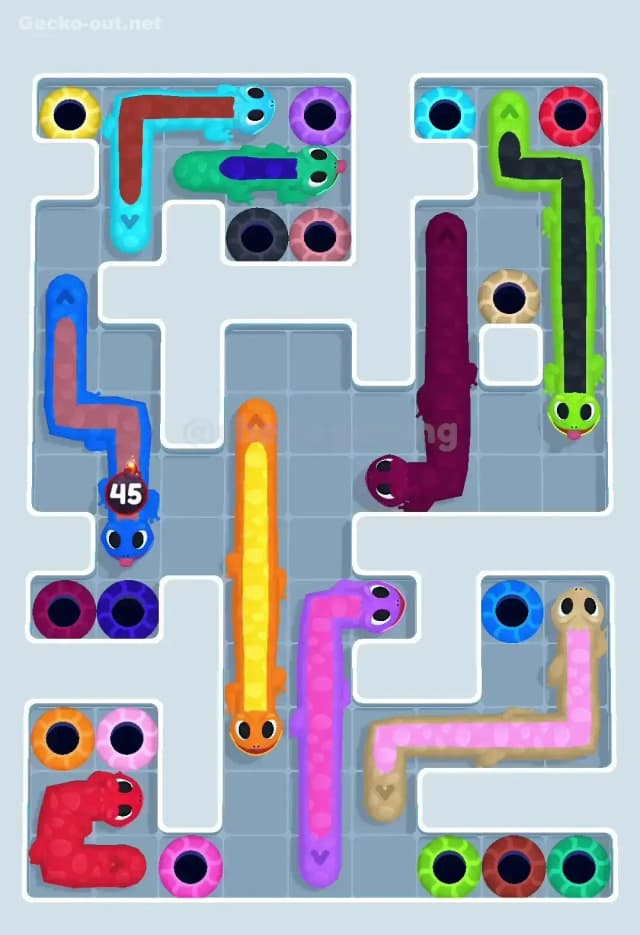
In Gecko Out Level 384 you’re dealing with a cramped maze split into several little rooms and two main vertical corridors. There are a lot of geckos on this board: short blue and cyan geckos, a curled red one in the bottom-left pocket, a long orange gecko in the middle column, a tall magenta/pink one a bit to the right, a beige gecko along the bottom-right, plus a lime-green and a dark maroon gecko stacked on the right side. Up in the top-left chamber you’ve also got a teal “gang” gecko sharing space with cyan and brownish-red geckos. It looks chaotic because so many bodies already fill the tight lanes before you even move.
Exits are grouped into clusters rather than spread evenly. There’s a block of holes in the top-left room, another cluster in the bottom-left, and several exits lined along the bottom edge and right side. Some colors sit very close to their matching geckos, but the bodies of other geckos are lying across those routes like living walls. You’ll also see a blue gecko with a timer icon on its head; that’s your reminder that Gecko Out 384 doesn’t give you much time to think once you start dragging.
How Timer Pressure and Path-Drag Movement Shape the Challenge
Gecko Out Level 384 follows the usual rules: you drag each gecko’s head to a hole of the same color, and the body traces the exact path you drew. No part of any gecko can cross walls, other geckos, or blocked exits. Once a gecko has snaked through a corridor, its body becomes a permanent obstacle for every remaining gecko. That “body follows the path” rule is exactly why this level feels like a knot you’re either carefully untangling… or yanking tighter.
The timer is strict here (you start with a small window, around three-quarters of a minute), and it keeps counting while bodies are following your path. That means Gecko Out 384 punishes slow, experimental dragging. You can’t just scribble a path, see what happens, and undo calmly. You need a clean plan: which corridors must stay open the longest, and which geckos can leave without ruining those lanes. Spend a moment reading the board before you move, then commit to your order and use simple, efficient paths.
Pathing Bottlenecks and Logical Traps in Gecko Out Level 384
The Central Column and Right Corridor as Main Bottlenecks
The single biggest bottleneck in Gecko Out Level 384 is the combination of the central orange gecko and the tall maroon and green geckos on the right. Those three bodies occupy almost every vertical lane that connects the top half of the map to the exits at the bottom. If you drag any of them carelessly, you turn the board into a series of dead ends for everyone else.
Think of the center column where the orange gecko stands as your main “highway.” The right-hand corridor where the maroon and lime-green geckos sit is your backup highway. If you close both with long, winding paths too early, there’s literally nowhere for the remaining geckos to pass. The whole solution to Gecko Out 384 is about deciding which of those highways is open at each stage, and making sure at least one remains usable until almost every gecko is gone.
Subtle Traps: Fake Shortcuts and Early-Exit Temptations
There are a few sneaky problem spots that catch most players:
-
The top-left chamber looks like it wants you to clear the teal gang gecko first, because its head points toward the middle. If you do that, its long body often sprawls into the central corridor and blocks paths that the orange, pink, or blue geckos will need later. The trick is to use the walls of that chamber as temporary parking instead of immediately pushing that teal gecko toward the exits.
-
The blue timer gecko on the left is another trap. You see the countdown and panic-drag it with a big zigzag path just to get it “somewhere safe.” Because its body follows every turn, that zigzag slices across the entry to the bottom-left exits and blocks the red gecko or pink gecko’s clean route. The blue gecko must leave early, but its path needs to hug the edges and be as straight as you can make it.
-
The curled red gecko at the bottom-left loves to ruin endgames. If you send it out through the center column too soon, its tail locks the exact tiles the long pink and orange geckos need later. It’s much stronger to keep the red one parked in its pocket until the central column has already been used by other geckos.
When Gecko Out 384 Finally Starts to Make Sense
When I first played Gecko Out Level 384, I kept trying to “solve” each little room independently: clear the top-left trio, then the bottom-left red, then figure out the right side. Every time, I’d end up with one sad gecko blocked by a wall of bodies in the middle and no time left on the clock. It was frustrating because I felt like I was doing lots of correct micro-moves but still losing.
The level finally clicked when I stopped thinking in terms of rooms and started thinking in terms of lanes. Once I viewed the orange, maroon, and lime-green geckos as keys that open or shut entire highways, the logic became clear. I realized I should remove short geckos through side exits first, then route the timer gecko with a minimal path, and only then start committing the long vertical bodies. After that shift, Gecko Out 384 felt less like chaos and more like running a carefully timed evacuation.
Turn-by-Turn Path Strategy to Beat Gecko Out Level 384
Opening: Safe Early Clears and Parking Spots
In the opening of Gecko Out Level 384, your goals are to handle the timer pressure and create space without clogging the central lanes.
- Slightly reposition the teal gang gecko in the top-left. Nudge it along the upper wall or park it horizontally so the exits in that chamber are exposed, but don’t send it toward the center yet.
- Use that space to clear the short cyan and brownish geckos in the same room into their matching holes. Their paths are short, and you can hug the interior walls so you don’t waste tiles.
- Next, deal with the blue timer gecko on the left side. Drag it along the outer wall toward its matching exit cluster with as few turns as possible. No big spirals—think “straight line plus one or two corners.” Once it’s out, the timer pressure relaxes a lot.
- Leave the central orange and right-side maroon/green geckos basically where they are for now. They’re your structural “pillars” and will guide the rest of the plan.
Parking spots in this early phase include the top-left chamber (for the teal gang), the bottom-left pocket (for the red gecko, which you don’t move yet), and the tight right-side alcoves that let you slide a head a tile or two without closing the entire lane.
Mid-game: Keeping Highways Open and Moving Long Bodies Safely
The mid-game of Gecko Out 384 is where most runs fall apart. Your priority here is to clear shorter geckos that depend on the main highways while ensuring that at any moment, at least one vertical route from top to bottom remains free.
- Start using the right-hand corridor as a working lane. If the lime-green gecko has a relatively clear exit below, send it down hugging the right wall so its body forms a tidy column. That frees space near the maroon gecko’s head and opens the middle-right for the pink and beige geckos later.
- Take the beige bottom-right gecko next, threading it carefully through the gap left by the green one. Again, keep the path tight to the wall so the pink gecko can still slide by.
- Only after these smaller right-side pieces are handled should you move the maroon gecko. Route it in a mostly straight path toward its exit, using whichever vertical lane the orange gecko isn’t going to need. If maroon and orange ever fully share a column, the last gecko will have no way out.
During this phase, you can also begin planning exit routes for the long pink and central orange geckos. Try to align them so that each one uses a different vertical track for most of its journey. If they must cross, do it near the top, not near the exits, so tails don’t wall off the holes.
End-game: Final Exit Order and Low-Time Decisions
By the time you reach the end-game of Gecko Out Level 384, most of the side pockets should be empty. You’ll usually be left with the orange center gecko, the long pink gecko, the red bottom-left gecko, and the teal gang gecko in the top-left.
A reliable finish order is:
- Pink gecko: Guide it through the clearer of the two remaining vertical lanes, hugging the wall and going almost straight to its exit.
- Orange gecko: Send it down the other lane, again with a very simple path. Because orange started in the middle, its exit path is often nearly vertical; exploit that.
- Red gecko: Now that the central column isn’t needed by anyone else, you can unwind the red gecko from its pocket and steer it through the center to its hole.
- Teal gang gecko: With everything else gone, there’s enough space to snake the gang gecko out without worrying about blocking anyone. Use the emptiest side of the board and go straight to its matching exit.
If your timer is low, prioritize drawing the longest remaining paths with the fewest possible bends. Don’t hesitate or adjust mid-drag; a clean, fast, single motion is better than a “perfect” but slow path. If you have an extra-time booster, this is the moment to trigger it—just before you commit to the final one or two geckos.
Why This Path Order Works in Gecko Out Level 384
Using Head-Drag Pathing to Untangle the Knot
This plan beats Gecko Out Level 384 because it respects how bodies follow the exact path of the head. Early on, you clear short geckos whose routes don’t occupy full lanes, so their bodies create minimal new walls. You also keep the long structural geckos (orange, maroon, pink, teal) mostly still until you know exactly which lanes they’ll occupy.
By reserving the central and right-hand corridors and then assigning each long gecko its own “highway,” you essentially comb the knot straight rather than weaving it tighter. When each gecko leaves, it creates a tidy, predictable wall that doesn’t surprise you later.
Balancing Planning Time vs. Fast Execution
For Gecko Out 384, it’s worth spending the first 8–10 seconds just looking. Identify which exits match each color, decide which vertical lane belongs to which long gecko, and mentally confirm your exit order. Once you start dragging, you should be executing, not still solving.
I like to think of it this way: the first few seconds are turn-based puzzle time, and the rest is almost an action game. If you’re halfway through and still improvising paths, the timer will beat you even if your logic is good. Commit to your route, then play confidently.
Boosters: Needed or Optional?
Boosters in Gecko Out Level 384 are helpful but not required. A time booster is the only one I’d even consider; use it right before drawing the final long paths if you’re consistently finishing just a few seconds short. Hammer-style tools or wall breakers tend to be overkill here—the level is designed to be solved with lane management, not demolition.
Hint boosters can show you part of a path, but they rarely teach you the lane-order logic that actually matters. I’d treat them as a last resort if you’re truly stuck, not as your main solving tool.
Mistakes, Fixes, and Logic You Can Reuse in Other Gecko Out Levels
Common Mistakes on Gecko Out Level 384 (and How to Fix Them)
-
Moving the teal gang gecko first and blocking the center.
Fix: Use that gecko as parked mass early on; clear cyan and brown in the top-left before you snake teal toward the exits. -
Drawing big zigzag paths for the blue timer gecko.
Fix: Hug the outer wall and use the shortest possible path. Think “emergency evacuation,” not “tour of the maze.” -
Sending the red bottom-left gecko out too early.
Fix: Keep red parked until pink and orange no longer need the central lane. Treat red as almost an end-game piece. -
Letting maroon and orange share the same vertical lane.
Fix: Decide early which column each long gecko will use and stick to it. If they must cross, do it high up, away from exits. -
Panicking when the timer dips into the red.
Fix: Trust your plan. Even with little time left, a quick, simple path beats hesitation. If you keep losing with one gecko left, revise your exit order, not your drawing speed.
Reusing This Logic in Other Knot-Heavy and Gang-Gecko Levels
The lane-first mindset you build in Gecko Out 384 is gold for other levels with gangs, frozen exits, or heavy knots. In any crowded map:
- Identify one or two “highways” that connect most of the board to the exits.
- Park long or gang geckos in side alcoves until you know exactly where their final lane will be.
- Clear short geckos that depend on shared corridors early, with tight, efficient paths.
- Leave geckos near frozen or locked exits for later, when there’s enough empty space to maneuver around the thawed holes.
Once you start thinking “Which lanes must stay open?” instead of “Which gecko can I move right now?”, tricky layouts suddenly feel much more manageable.
A Final Encouragement for Tackling Gecko Out Level 384
Gecko Out Level 384 looks brutal at first glance—too many geckos, not enough space, and that nagging timer ticking in your face. But with a clear lane-based plan and a calm opening that handles the timer gecko smartly, the level becomes absolutely beatable. After a couple of runs where you practice the order and clean up your paths, you’ll find yourself finishing with time to spare and wondering how it ever felt impossible.