Gecko Out Level 423 Solution Walkthrough | Gecko Out 423 Answer
How to solve Gecko Out level 423? Get step by step solution & cheat for Gecko Out level 423. Solve Gecko Out 423 easily with the answers & video walkthrough.
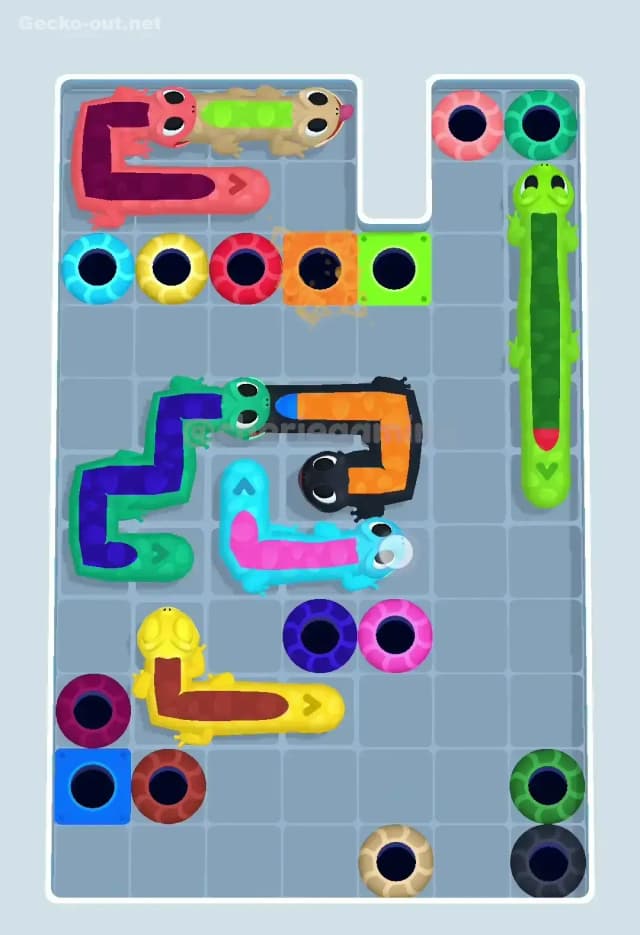

Gecko Out Level 423: Board Layout, Rules, and Win Condition
The Starting Board: Colors, Knots, and Obstacles
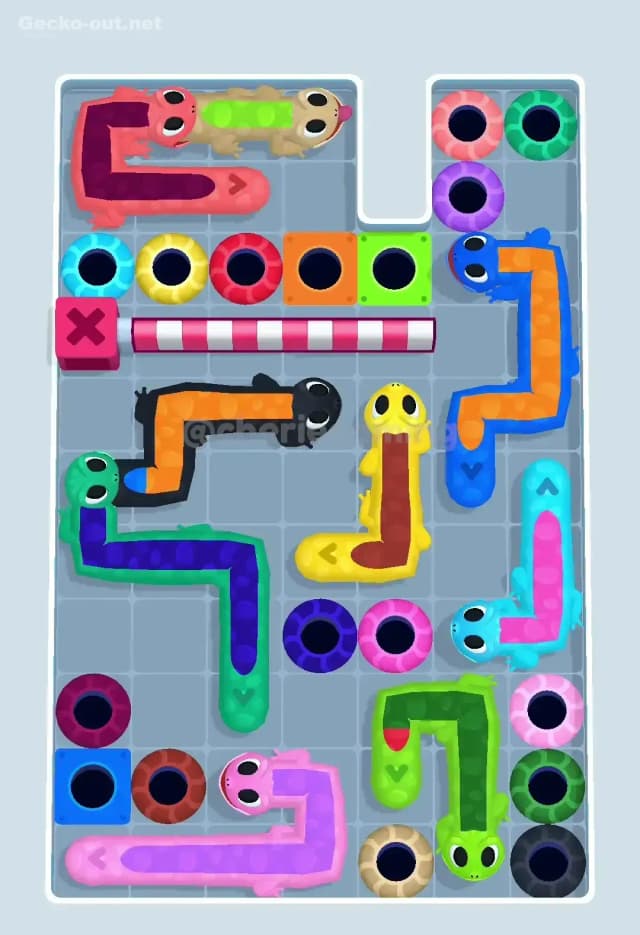
On Gecko Out Level 423 you’re dropped into a tall, narrow board that’s already a mess. You’ve got a bunch of geckos of different colors: a chunky pink one curled in the top-left, a tan one right beside it, a long green-and-purple gecko running up from the lower left, a black‑outlined orange gecko in the middle, a bright yellow gecko standing vertically, a long blue‑and‑orange L on the right wall, plus a cyan‑and‑pink gecko and a short green gecko guarding the lower‑right exits. A second long pink gecko wraps around the bottom-left. Every color has a matching hole, and most of the rings are packed in three clusters: a strip near the top, a group on the right side, and a bunch along the bottom edge.
The big structural obstacle in Gecko Out 423 is the horizontal candy‑striped barrier sitting just below the top exit strip. It leaves only a small passage near the center for bodies to snake from the lower half of the board to the upper exits. There’s also a solid pink block on the left of that barrier that closes off any shortcut, so all traffic has to funnel through that narrow central gap. With so many long bodies and L‑shapes, the board is basically one giant knot wrapped around that choke point.
Win Condition, Timer, and Path-Based Movement
As always in Gecko Out 423, you win only when every gecko is safely in a hole of the same color before the timer hits zero. The twist is how the pathing works: you drag the head to sketch a route, then the whole body traces that exact path. If your route crosses itself, cuts through a fragile lane, or curls around a hole you still need later, you can accidentally lock out other geckos even though you haven’t placed any “hard” walls.
Because of the strict timer, you don’t have time to experiment wildly. You need to read the knot once, decide an exit order, and then draw clean, efficient paths. Gecko Out Level 423 really punishes hesitation: you can clear it comfortably on time, but only if you avoid redraws and unnecessary zig‑zags with the long geckos.
Pathing Bottlenecks and Logical Traps in Gecko Out Level 423
The Primary Bottleneck: The Central Gate Corridor
The single biggest bottleneck in Gecko Out 423 is the narrow lane under the candy‑striped barrier. Every gecko whose hole is up in the top strip must pass through that corridor. At the same time, several long bodies start already wrapped around that area, especially the green‑and‑purple gecko and the black‑outlined orange one. If you send the wrong gecko through first, its tail sits across the gate and nobody else can get by without a full reset.
Your job is to “reserve” that central corridor for the geckos that actually need to reach the top exits and to route bottom‑edge exits in ways that never cross it. Think of it as a one‑way, one‑car bridge: only send one long gecko across at a time, and clear it completely before starting the next.
Subtle Problem Spots That Cause Softlocks
There are a few traps in Gecko Out Level 423 that look harmless until it’s too late:
- The long green‑and‑purple gecko on the left loves to snake around the middle and sit exactly where later geckos need to turn upward. If you exit it too early using a big sweeping path, you can wall off the central gate or the lower-right exit cluster.
- The blue‑and‑orange L on the right can easily block the vertical lane that several geckos use to swing up into the top and right‑side holes. Parking it one tile too far inward makes later paths impossible.
- The short green gecko and cyan‑and‑pink gecko near the lower‑right are easy to leave parked across their own exits. They look like they’re “out of the way,” but they actually cap the entire right‑side corridor if you’re careless with angles.
None of these are obvious on your first glance, which is why Gecko Out 423 feels unfair at first. You think you’re clearing space, but you’re actually tightening the knot.
When the Level Finally Clicks
For me, Gecko Out Level 423 felt chaotic until I realized one key idea: the bottom exits and right‑side exits can be cleared almost completely without touching the top gate at all. Once that clicked, I stopped trying to weave everyone through the center and instead treated the board like two separate zones. I solved the bottom and right clusters first, then used the now‑empty lower half as a huge staging area to feed geckos through the gate one by one.
That moment when you send a long gecko through the gate and nothing gets stuck behind it is really satisfying. It stops feeling like random trial‑and‑error and more like running traffic control.
Turn-by-Turn Path Strategy to Beat Gecko Out Level 423
Opening: Create Parking and Clear Immediate Exits
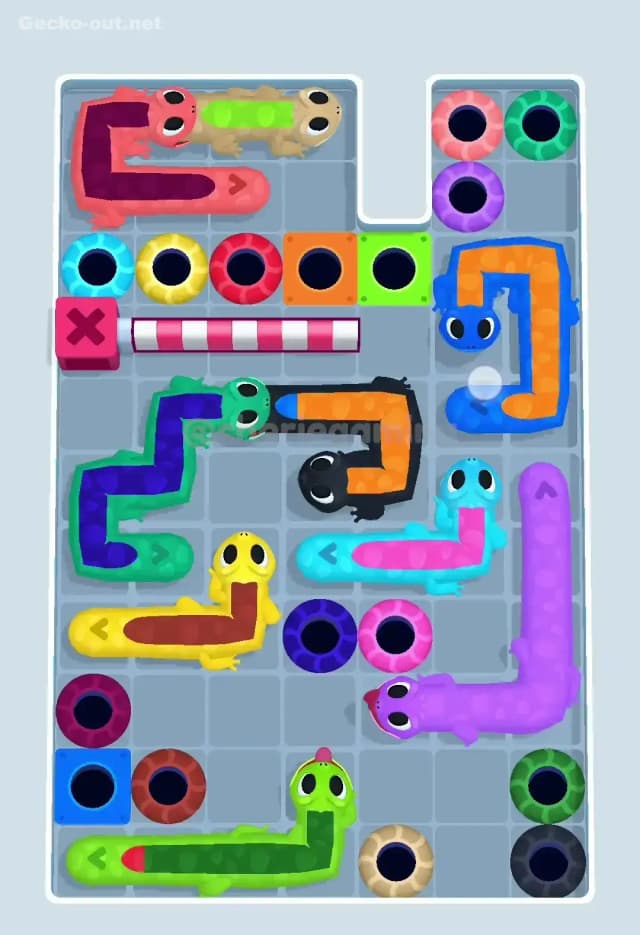
In Gecko Out 423, open by creating safe “parking lanes” rather than rushing anyone to a hole. Gently nudge the blue‑and‑orange right‑wall gecko upward so its body hugs the wall and leaves a vertical corridor inside it. Do something similar with the cyan‑and‑pink gecko in the lower‑right: tuck it tight against the right side so the interior tiles stay open. You want the center of the board as empty as possible.
Next, look for geckos whose exits are on the bottom edge and don’t require crossing the gate. The long pink gecko at the bottom-left and the green‑and‑purple gecko often have direct routes to matching lower holes once you unhook their tails from corners. Draw smooth, minimal paths hugging the left and bottom edges, keeping their bodies away from the central lane under the striped barrier. Use those early exits to open even more parking space in the bottom half.
Mid-game: Keep the Central Lane Clear and Reposition Long Bodies
Mid‑game Gecko Out 423 is all about discipline. Use the extra space you’ve created to lay geckos flat along the edges: one can park along the absolute bottom, another up the left edge, and another vertically on the right. Any time you drag a long gecko, imagine where its tail will swing through the board, not just where the head finishes. If the tail would cross the gate or wrap around a cluster of exits you still need, redraw the route before you release.
This is the right moment to send geckos whose holes are on the right‑side ring cluster. Use that vertical corridor you kept clear beside the blue‑and‑orange L to slide them up or down, then curve directly into their matching rings. Again, your rule for Gecko Out 423 is: never leave a resting body forming a “C” shape around an unused hole. Straight lines along walls are safe; tight spirals in the middle are not.
End-game: Feed the Gate and Finish in a Clean Order
By the time you reach the end-game, you should have most bottom and right exits cleared, with only the geckos that need top exits remaining. Now you can finally use the candy‑striped gate area. Move one gecko at a time through the narrow central corridor, making a simple S‑shaped curve up into its ring. As soon as a gecko exits, look at where its tail swept; if it brushed close to another gecko, re‑park that survivor along an outer wall before sending the next one.
For the last two geckos in Gecko Out 423, prioritize the longest one first so its body doesn’t have to thread through other snakes. Leave a short, flexible gecko for the very end; it can squeeze through awkward turns even when time is running low. If the timer’s flashing red, stop trying to optimize perfect paths—just draw the most direct route that doesn’t obviously cross another gecko or the gate. A slightly messy, fast path is better than timing out with a “beautiful” one you never finish.
Why This Path Order Works in Gecko Out Level 423
Using Head-Drag Pathing to Untie Instead of Retie
The whole plan for Gecko Out Level 423 is built around the body‑follows‑the‑head rule. By exiting bottom and right geckos first, you’re using paths that run along the outer edges, which barely disturb the tangled center. Each time a gecko leaves, the knot in the middle shrinks instead of re‑wrapping around the gate. When you finally start feeding geckos through the central corridor, there’s nothing left whose tail can swing back and lasso the board again.
You’re also consciously avoiding loops. Every recommended path is either a straight line or a wide curve that never doubles back across itself. That’s the real “secret sauce” of Gecko Out 423: simple paths that don’t set hidden traps for the next gecko.
Timer Management: When to Think vs. When to Move
In Gecko Out 423, I like to spend the first few seconds just staring at the board. Identify which geckos clearly exit bottom/right and which clearly go up top. That tiny pause pays for itself because it prevents panicked redraws later. Once you’ve mentally locked in your exit order, shift into execution mode and drag confidently—no tiny micro‑adjustments.
The timer becomes tight only if you waste moves. If you ever feel yourself dragging a head in circles, stop, reset your idea, and then commit to one clean line. It’s better to sacrifice two seconds to plan than ten seconds undoing a bad knot.
Boosters: Nice to Have, Not Required
The good news: Gecko Out Level 423 is absolutely beatable without boosters if you follow a structured path order. A time‑extension booster can give you breathing room while you’re learning the pattern, but it shouldn’t be necessary once you understand the edge‑first strategy. A hammer‑style remover is overkill here and can even rob you of the fun of solving the knot.
If you’re going to use anything, I’d save a time booster for the end-game, right after you clear the last bottom/right gecko and before you start sending geckos through the gate. That’s the only moment where extra seconds translate directly into less stress and fewer mistakes.
Mistakes, Fixes, and Logic You Can Reuse in Other Gecko Out Levels
Common Mistakes on Gecko Out Level 423 (and How to Fix Them)
- Dragging the longest green‑and‑purple gecko through the central corridor first and leaving its tail across the gate. Fix: exit or park long geckos along the bottom and sides before you ever use the gate.
- Parking the blue‑and‑orange right‑wall gecko diagonally in the middle. Fix: always tuck it flush against the wall so it becomes a border, not a plug.
- Drawing fancy spiral paths around exit clusters “because there’s space.” Fix: favor straight or gently curved routes that never wrap around holes you haven’t used yet.
- Letting the timer scare you into constant small corrections. Fix: plan the order once, then drag bold, decisive paths; you’ll actually finish sooner.
- Trying to clear top exits mixed in with bottom exits right away. Fix: treat Gecko Out 423 as two phases—bottom/right first, top via gate second.
Reusing This Logic on Other Knot-Heavy Levels
The logic that cracks Gecko Out Level 423 carries over to a lot of later stages. Any time you see a narrow gate or choke point, mentally reserve it for the final phase and clear “outer” exits first. On levels with gang geckos or frozen exits, the same edge‑parking idea works: keep the center lanes empty and lay long bodies along the perimeter until it’s their turn to leave.
Whenever a level feels like an impossible knot, ask yourself three questions: Which exits can be reached without crossing the worst bottleneck? Which single corridor absolutely must stay clear? And which gecko is safest to leave for last because it’s short and flexible? If you answer those, the board usually starts to open up.
Final Encouragement for Gecko Out 423
Gecko Out Level 423 looks brutal the first time you see it, but it’s one of those puzzles that becomes almost relaxing once the pattern clicks. As long as you respect the central gate, clear the bottom and right exits first, and keep your paths simple and edge‑hugging, you’ll beat it without burning boosters. Stick with the plan, trust the order, and you’ll watch the last gecko slide into its hole with time to spare.