Gecko Out Level 443 Solution Walkthrough | Gecko Out 443 Answer
How to solve Gecko Out level 443? Get step by step solution & cheat for Gecko Out level 443. Solve Gecko Out 443 easily with the answers & video walkthrough.
Gecko Out Level 443: Board Layout, Rules, and Win Condition
Reading the Starting Tangle
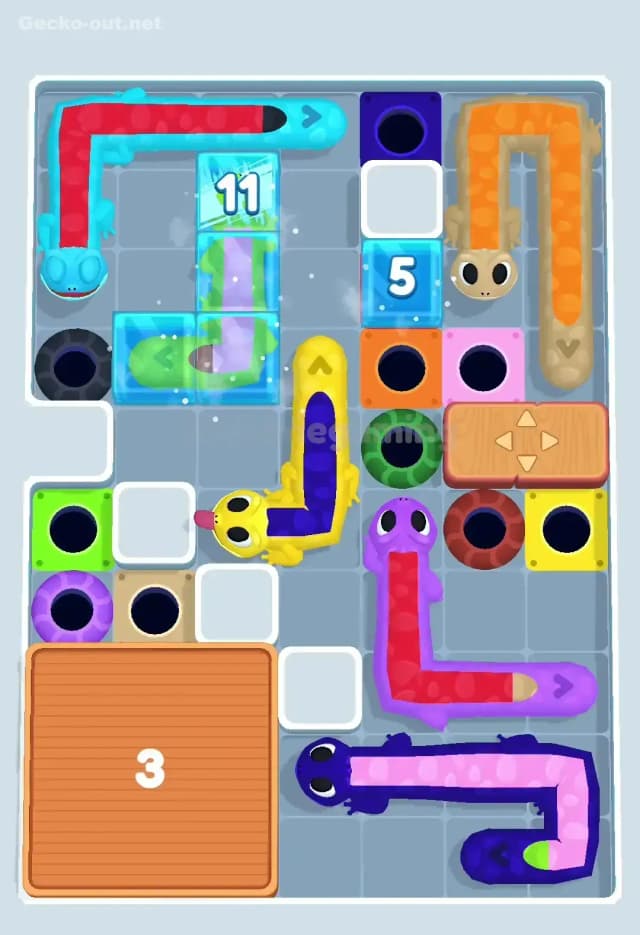
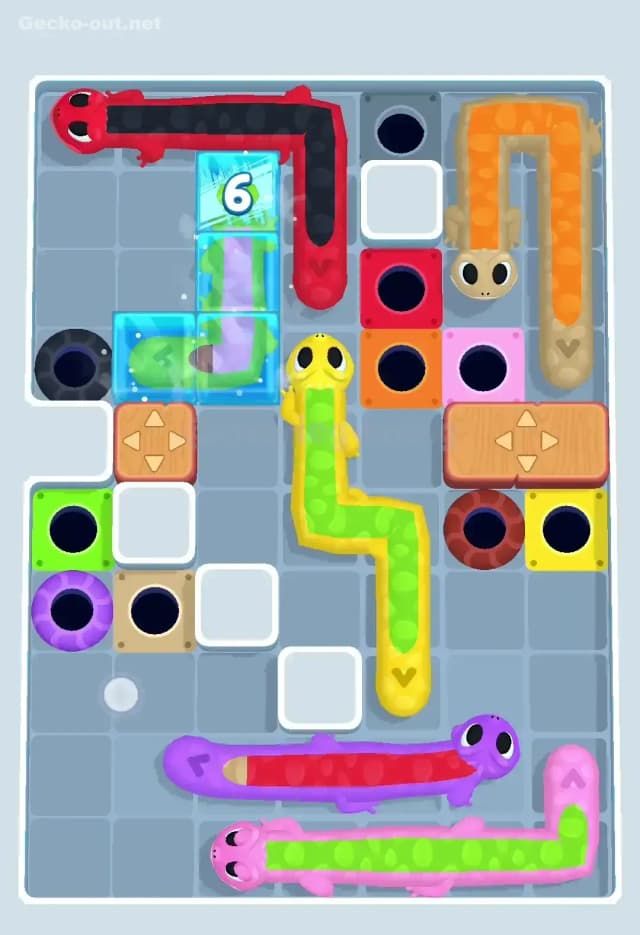
Gecko Out Level 443 throws you into a cramped board packed with long, twisty bodies. You’ve got several geckos:
- A long cyan gecko stretched along the top row.
- An orange U‑shaped gecko hugging the right side.
- A chunky yellow gecko in the middle, bent into an L.
- Two longer geckos at the bottom (purple/red and dark blue/pink) coiled near the large wooden gate.
- A green gecko section trapped inside the tall ice column in the center.
Around them are matching colored holes in two clusters: one in the lower-left corner and another on the right side. On top of that, you’ve got:
- A tall stack of frozen tiles in the middle with an
11counter. - A separate frozen tile on the right with a
5counter. - A big wooden “3” gate in the bottom-left that only opens after three geckos escape.
- A solid wooden block with arrows on the right that acts as a permanent wall.
Everything is already interlocked, so Gecko Out Level 443 is less about “finding free space” and more about creating it deliberately.
Win Condition and How the Timer Bites
The win condition in Gecko Out 443 is straightforward: every gecko has to slither into a hole of its own color before the timer runs out. You drag a head, and the tail follows the exact path you trace. That matters because:
- Any detour you draw leaves a permanent “snake trail” behind it.
- If you weave a gecko through the middle early, you can block exits you’ll need later.
- You can’t path through walls, other bodies, frozen blocks, or locked exits.
The timer is strict here. You don’t have room for multiple full-board rewrites. You get maybe one deliberate “planning pause” at the start, then you need to execute a clean sequence. Gecko Out Level 443 rewards a clear move order more than raw speed–but once you decide, you have to commit.
Pathing Bottlenecks and Logical Traps in Gecko Out Level 443
The Main Bottleneck: The Central Column
The single biggest bottleneck in Gecko Out 443 is the central vertical column: the tall 11 ice stack and the yellow gecko sitting just below it. That column:
- Blocks the natural highway between the left exits and the right exits.
- Keeps the green gecko segments frozen in place until the counter runs down.
- Sits right between the long bottom geckos and most of their exits.
If you move other geckos into this column too early, you effectively weld the board shut. The level only really opens up once you’ve cleared yellow and used the thawed green path correctly.
Subtle Trouble Spots You Don’t Notice at First
A few less obvious traps in Gecko Out Level 443:
- The right-side choke lane. The orange U‑gecko and the wooden arrow block form a tiny corridor. If you park a long gecko there, you block half of the right exits and have no room to pivot back out.
- The bottom-left exit cluster before the “3” gate opens. It looks like usable ground, but the big wooden “3” slab means you’re effectively playing on half a board until three geckos are already gone. Planning as if that space is available from the start is a classic way to soft‑lock yourself.
- Frozen counters (
11and5). It’s easy to ignore what they’ll become once they thaw. When the ice breaks, the freed tiles actually create new, crucial corridors. If you’ve already cluttered those lanes, you don’t benefit from the opening.
When the Level Finally Clicks
The first time I played Gecko Out 443, I kept trying to free the cyan top gecko first. Every time, I ended up with a huge body drawn through the middle, no space for yellow, and a timer flashing red. It was frustrating because I could feel I was “almost” there but kept tightening the knot.
The moment it started to make sense was when I flipped the logic: instead of sprinting for the easiest exit, I treated yellow and the frozen center as the main objective. Once I focused on:
- Parking the bottom geckos safely out of the center.
- Waiting for the ice counters to unlock a straight path.
- Using that new space to slide green and yellow out early.
…the rest of Gecko Out Level 443 turned into a simple cleanup job.
Turn-by-Turn Path Strategy to Beat Gecko Out Level 443
Opening: Safe Parking and Early Space
Your opening in Gecko Out 443 is all about staging:
- Quick scan (1–2 seconds). Identify every gecko and its matching hole so you’re not guessing mid-move.
- Park the bottom geckos.
- Coil the dark blue/pink gecko tightly along the bottom edge, staying away from the central column.
- Fold the purple/red gecko into the lower-right corner, keeping its body below the wooden arrow block.
Your goal is to clear as much of the central vertical lane as possible without blocking exits.
- Leave cyan and orange mostly where they are. Just nudge the cyan top gecko so its body hugs the very top edge and doesn’t droop downward. The orange U on the right should keep its bend tight near the wall; don’t stretch it across the center.
You’re basically creating a “U” of parked geckos around the edges, keeping the middle lanes reserved for later.
Mid-game: Unlocking Yellow and Green, Protecting Lanes
Once your parking is done, move into the real work:
- Let the
11and5counters tick as you make short adjustments. Every tiny head drag counts, so don’t waste moves, but don’t be afraid of micro‑tuning positions while time passes. - When the central ice breaks, free green quickly.
As soon as the ice column releases the green segment, drag the green gecko in a mostly straight line down into its matching green hole in the lower-left cluster. Don’t zigzag; it’s both a time sink and a future wall. - Use green’s departure to loosen yellow.
With green gone, the yellow L in the center has more space to pivot. Curl yellow toward the right exit cluster and send it directly into its yellow hole, again with the shortest possible line. - Let orange slip out next if its path is clear.
Now that yellow is gone, the right side is less cramped. Thread the orange gecko along the right wall into its matching exit without entering the central column.
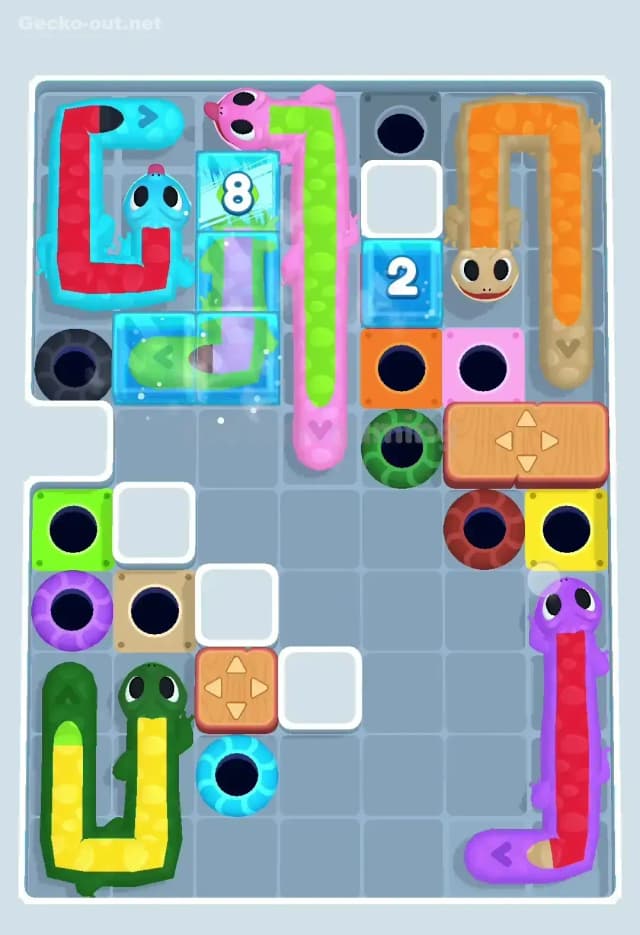
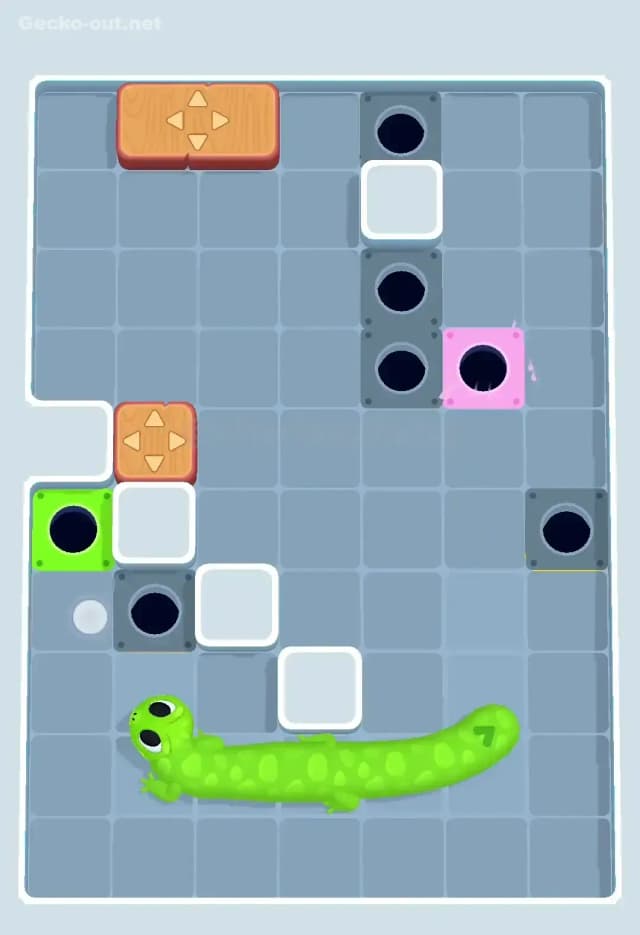
By this point, you should have three geckos out (typically green, yellow, and orange). That’s enough to open the big wooden “3” gate at the bottom-left, giving you a huge new parking lot for the end-game.
End-game: Exit Order and Last-Second Choke Points
With Gecko Out 443 opened up, you finish in a controlled order:
- Move cyan while the board is open.
Route the long cyan top gecko either directly to its hole or coil it briefly in the now-open bottom-left area so its final path doesn’t cross the central exits. - Use the bottom-left area as a staging zone.
If you need to rearrange, temporarily drag the dark blue/pink and purple/red geckos into the freed bottom-left squares. This keeps the center and right exits unblocked. - Exit the shorter of the remaining geckos first.
Usually the purple/red one can reach its matching hole with a short, clean path. Do that before moving the final long one so you don’t thread a long body around a short one. - Finish with the last long gecko.
With everything else gone, draw a simple, direct line from the last gecko to its hole. At this point, you can afford to be fast rather than fancy—there’s nothing left to block.
If you’re low on time, prioritize straight lines and avoid decorative curves. A slightly sloppy final body path is fine as long as it doesn’t cut off the last exit.
Why This Path Order Works in Gecko Out Level 443
Using Path-Following to Untangle, Not Tighten
The whole plan in Gecko Out Level 443 abuses the body-follow rule in your favor:
- By parking long geckos flush against walls and edges, their bodies become harmless borders instead of interior obstacles.
- Sending green and yellow out early removes the pieces that sit in the most “central” squares, turning a jammed column into a wide corridor.
- Exiting the short geckos before the final long one means you never have to thread a huge body through a maze of smaller ones.
You’re always drawing paths that either hug the outer frame or dive straight to a hole. That’s how you avoid the common trap of weaving a fancy spiral that permanently splits the board in half.
Timer Management: When to Think vs. When to Move
In Gecko Out 443, there are two phases of timer management:
- Planning phase (first few seconds): Stop, breathe, and locate every hole and the frozen counters. This small pause saves you from panic-dragging a gecko into the middle and losing.
- Execution phase: Once you start parking and freeing green/yellow, you shouldn’t stop. Commit to short, efficient routes. Any hesitation later in the run is more expensive because the timer’s already low.
If you’re consistently timing out, your routes are probably too curvy. Redraw your mental plan to use fewer turns per gecko.
Boosters: Optional, Not Required
Boosters in Gecko Out Level 443 are helpful but not necessary:
- An extra time booster can save a sloppy run if you’re still mastering the route. Use it only after you’ve exited the first two geckos and see the timer dipping dangerously.
- A hammer/ice breaker booster that cracks a frozen tile early would trivialize the central column, but it’s overkill; the level is designed to be solved by waiting out the counters and planning around them.
- A hint booster might highlight one gecko’s path, but it won’t teach you the parking logic you’ll reuse later.
If you’re aiming to get good at Gecko Out 443 (and future levels), try to clear it cleanly without boosters first.
Mistakes, Fixes, and Logic You Can Reuse in Other Gecko Out Levels
Common Mistakes in Gecko Out Level 443 (and How to Fix Them)
- Exiting cyan first.
You drag the top gecko straight to its hole and end up with a fat red body slicing across the board. Fix: leave cyan until after green and yellow are gone and the “3” gate has opened. - Overusing the central column early.
Running paths through the frozen area before it thaws means you block the very corridor that needs to open later. Fix: keep that lane as empty as possible until the11counter breaks. - Parking in front of exits.
A gecko sits right on a colored hole that isn’t its own, and later you can’t reach that hole at all. Fix: only park along walls and in the newly opened bottom-left zone, not directly on exit tiles. - Curvy, decorative routes.
Loopy paths look fun but eat time and create permanent walls. Fix: aim for straight segments and right angles, no unnecessary loops. - Ignoring the “3” gate.
Planning as if the bottom-left is open from the start leads to impossible end-games. Fix: mentally treat that entire corner as solid until three geckos are out.
Reusing This Logic in Other Knot-Heavy Levels
The approach that beats Gecko Out Level 443 scales really well:
- Park first, solve second. Always decide where your “parking lanes” are before you send anyone to a hole.
- Free the central pieces early. In any knot-heavy level, the geckos occupying the middle should usually exit first.
- Respect delayed tiles (ice, toll gates, warning holes). Think about what they’ll become after their counters tick down, and avoid clogging those future corridors.
- Exit short geckos before the final long one. Long bodies are easiest to manage when the board is almost empty.
Once you start seeing levels as “how do I create space?” instead of “how do I escape fastest?”, many tricky Gecko Out stages suddenly feel fair.
Final Encouragement for Gecko Out 443
Gecko Out Level 443 looks brutal at first glance: frozen pieces, a giant gate, and barely any room to breathe. But with a calm opening, smart parking, and an exit order that prioritizes green and yellow, the level completely opens up. Stick to clean, straight routes, avoid clogging the center too early, and you’ll see Gecko Out 443 go from “impossible” to “actually pretty satisfying” in just a few attempts.