Gecko Out Level 290 Solution Walkthrough | Gecko Out 290 Answer
How to solve Gecko Out level 290? Get step by step solution & cheat for Gecko Out level 290. Solve Gecko Out 290 easily with the answers & video walkthrough.

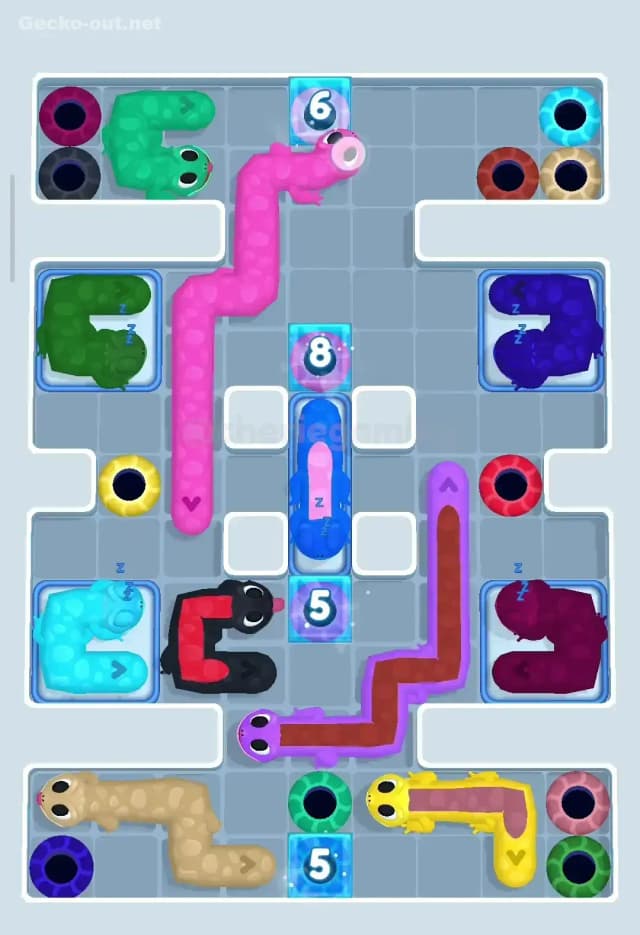

Gecko Out Level 290: Board Layout, Rules, and Win Condition
How the Starting Board Looks
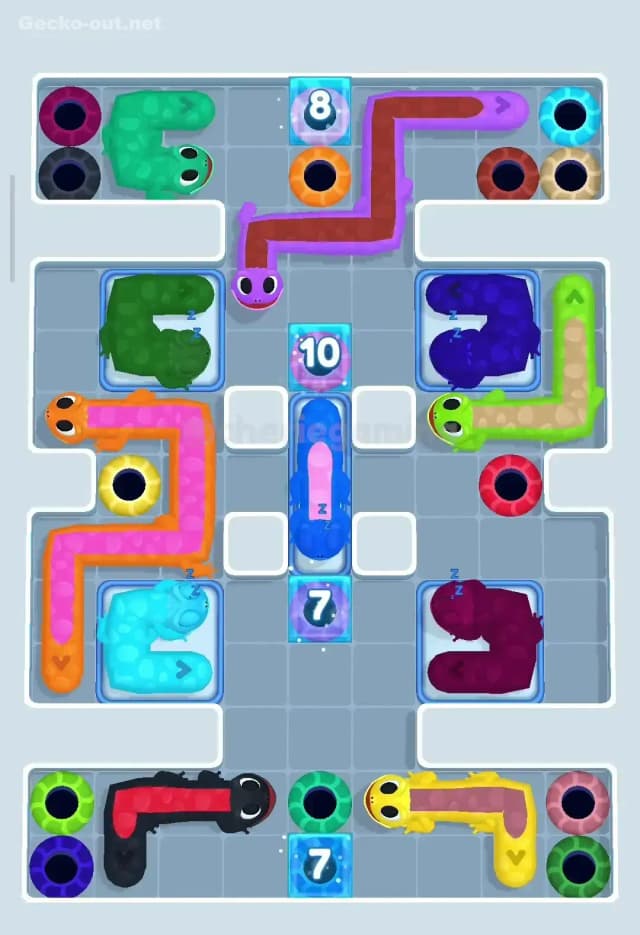
In Gecko Out Level 290 you’re dropped onto a tall, narrow board that’s absolutely packed with geckos. You’ve got a mix of awake and sleeping geckos: long orange, purple, yellow, black, and lime-green geckos already stretched into the corridors, plus several coiled, sleeping geckos in icy pools (dark green, cyan, dark blue, maroon, and a central blue one). Around the edges sit clusters of colored holes: a pair on the top left, a trio on the top right, another trio on the bottom left, and one more set on the bottom right, plus a single side exit. Every gecko has a clearly matching hole color, but several exits are basically “guarded” by other bodies snaking across the approach lanes.
The other thing you can’t miss in Gecko Out 290 is the line of time tiles in the middle: 8, 10, and 7. These sit in and around the central frozen blue gecko, forming a tight vertical corridor. To get comfortable clears, you’ll want to tap at least two of those tiles during your routes, but they also take space and can trick you into drawing overly twisty paths. Overall, the starting layout screams “traffic jam”: lots of length, very little open floor, and exits tucked just behind bottlenecks.
Win Condition and Why Pathing Feels So Tight
As always, the win condition in Gecko Out Level 290 is simple on paper: every gecko has to slither into the hole that matches its color before the timer hits zero. What makes this level nasty is how the drag-path movement interacts with the cramped corridors. When you drag a head, the body follows that exact route, so a sloppy detour or an extra bend doesn’t just waste time—it leaves a thick, permanent wall of gecko body where you might need a lane later.
Because the timer is strict, you can’t just free everyone in slow motion and redraw routes. If you restart every time you realize you’ve blocked a sleeping gecko or an exit cluster, it gets frustrating fast. Gecko Out 290 is all about planning routes that hug walls, keep the middle lanes free, and clear key exits in an order that gradually opens the board instead of tightening the knot.
Pathing Bottlenecks and Logical Traps in Gecko Out Level 290
The Main Bottleneck You Have to Respect
The single biggest bottleneck in Gecko Out Level 290 is the central vertical strip around the frozen blue gecko and those 8/10/7 time tiles. Everything wants to cross that middle: awake geckos need it to reach far exits, and your paths to wake the sleeping geckos all pass close to it. If you drag a long gecko straight down the middle early, you basically build a wall that splits the board and traps half your exits.
Think of that central strip as “reserved space” until the late mid-game. You’ll briefly dip through it to tap time tiles, but you don’t park any full-length gecko bodies there until you’re sure the remaining geckos can reach their holes by going around the outside.
Sneaky Problem Spots You Might Not Notice
First, the top-right exit cluster looks roomy, but the purple gecko’s starting path almost always runs straight through it. If you send purple to its hole with a lazy, zigzag path, its body can lie across the entire top-right bend, blocking both a sleeping gecko and at least one other exit. You want purple to hug the very top edge and then tuck into its hole cleanly, leaving the right side open.
Second, the long orange gecko on the left is a silent troublemaker. Its body can easily snake through the middle-left corridor and across the bottom, cutting off the cyan sleeper, the dark green sleeper, and some of the bottom exits all at once. If you don’t plan where orange will rest after scoring its hole, you’ll end up with it sprawled across three different routes.
Third, on the bottom side, the black and yellow active geckos share a very tight set of exits. It’s tempting to rush one of them out immediately, but if you send black or yellow with a fat, curved path, you might later realize you’ve walled the other one away from its matching hole. In Gecko Out 290, the bottom exits are where “one wrong bend” punishes you 20 seconds later.
When the Level Starts to Make Sense
I’ll be honest: the first few runs of Gecko Out Level 290 feel like you’re just painting the board with random geckos and hoping it works. I kept ending up with a perfect-looking layout and one lonely sleeper still trapped behind someone else’s tail. The turning point was when I stopped trying to “solve” individual geckos and instead treated the board like a traffic puzzle: clear the right lanes first, then the left, then seal the middle.
Once you see that the central blue gecko and the time tiles should be almost the last thing you commit to, the whole level clicks. You’re not winging it anymore—you’re executing a sequence: right side → left side → bottom pairing → central cleanup.
Turn-by-Turn Path Strategy to Beat Gecko Out Level 290
Opening: Right-Side Control and Safe Parking
-
Start with the purple gecko near the top. Drag its head along the very top edge, sweeping cleanly past the “8” tile if you can do it without extra bends, and then curl it straight into its matching exit. The goal is to leave the top-right corridor open, not webbed with purple segments.
-
Next, work on the lime-green gecko on the right mid. Slide it downward first to free space around the sleeping dark-blue gecko, then curve it back up or around the outside to reach its exit. Keep its body hugging the outer wall so you don’t pinch off the central vertical lane.
-
With those two out, wake and route the dark-blue sleeper in the top-right ice pool. Its path should go out through the now-clear corridor and straight to its matching hole, again staying close to walls. By the end of this opening, the entire right side of Gecko Out 290 should feel airy, while the middle remains mostly untouched.
Mid-Game: Left-Side Untangle and Bottom Pairing
Now swing to the left side. Wake the dark-green sleeper first, and steer it out using a short path that hugs the left wall toward its exit cluster. Don’t drag it across the central lane; you want that space for later.
Then handle the long orange gecko. Pull its head gently up or down along the left wall (depending on where its exit sits) and route it directly there, grabbing a time tile only if it’s essentially on the way. Your parking rule here is simple: any orange segments that remain on the board should sit on the far left or far bottom, never across the vertical middle.
Once left and right are mostly cleared, move to the bottom pairing of black and yellow. Route whichever one has the “clearest” straight path to its exit first—usually yellow can curl tightly into the bottom-right cluster while hugging the edge, leaving space for black to snake to its own hole after. Draw their paths so that their tails peel away from the center, leaving a sideways “U” shape that doesn’t block the main lanes.
End-Game: Central Blue and Remaining Sleepers
By the end-game in Gecko Out Level 290, you should only have a couple of sleepers left (cyan, maroon, and the central blue). Use one of the shorter geckos you’ve just freed to tap the 10 and one of the 7 tiles on your way to its exit; this buys enough time for the last maneuvers.
Wake the cyan and maroon geckos in whichever order leaves more room; typically you free the one closer to an open lane first. Their paths should again hug outer edges and avoid weaving through the middle more than once. Finally, clear the central blue gecko: draw a clean, mostly straight route up or down that taps any remaining time tile and then goes directly into its matching hole. At this point the board is open enough that you can afford a small bend without trapping anyone.
If you’re low on time near the end, prioritize sending any gecko that already has a clear line to its hole, even if another gecko started moving first. Because bodies follow the drawn path automatically, you can quickly draw a simple straight path for a ready gecko and then return to finish a trickier route while the first one slithers out.
Why This Path Order Works in Gecko Out Level 290
Using Head-Drag Pathing to Loosen the Knot
This whole plan for Gecko Out 290 is built around the “body follows the route” rule. By routing early geckos along the outer walls, you convert their bodies into harmless borders rather than internal walls. Clearing the right side first opens a long, flexible lane you can reuse for multiple geckos without crossing their paths.
Delaying the central blue gecko means you’re not sealing off the center of the board while key sleepers are still trapped. Instead of drawing loops that cross the middle five times, you use the middle only for short, necessary crossings—so each new body segment actually reduces complexity instead of adding it.
Playing the Timer: When to Think and When to Go
In Gecko Out Level 290, the timer punishes overthinking mid-move but rewards a short planning pause at key moments. You should take a few seconds before your first move to mentally assign an order: “purple → lime → right sleeper → left side → bottom pair → center.” After that, your pauses should be micro-breaks right before routing a long gecko, just to visualize its final snake.
When you’re near a time tile that’s basically on your route anyway, don’t hesitate—grab it with a tiny detour. What you want to avoid is circling half the board just to touch a timer; that extra path becomes permanent clutter. Most clears of Gecko Out 290 only need two of the three visible time tiles.
Boosters: Needed or Optional?
Boosters are absolutely optional in Gecko Out Level 290 if you follow this order. I’d save the +time booster for emergencies only—like if you’ve repeatedly reached the last gecko with less than a second left and you’re confident your pathing is already clean. A hammer-style remover (if your version has it) could theoretically clear a misplaced tail, but using it here usually means your pathing plan was off from the start.
If you do use the hint booster, treat it as a teaching tool: watch which gecko the hint wants you to move early, then restart and try to fold that idea into the full right→left→bottom→center sequence.
Mistakes, Fixes, and Logic You Can Reuse in Other Gecko Out Levels
Common Mistakes in Gecko Out Level 290 (and How to Fix Them)
- Drawing the first route straight down the central lane, then discovering half the board is walled off. Fix: reserve the center for late-game; clear right and left along the outer edges first.
- Routing purple or orange with huge zigzags “because there’s space,” then realizing their bodies block two or three exits. Fix: keep long geckos hugging walls, entering holes with minimal bends.
- Grabbing every time tile you see, even if it means wild detours. Fix: plan to hit only the 10 and whichever 7 is naturally on your way.
- Exiting black or yellow with big curves at the bottom, trapping the other one. Fix: route the first bottom gecko in a tight arc, leaving a straight or slightly curved lane open for the second.
- Waking all sleepers at once, turning the board into chaos. Fix: wake only the sleeper you’re ready to route immediately, finish its path, then wake the next.
Reusing This Logic on Other Knot-Heavy Levels
The pattern you learn in Gecko Out Level 290 is golden for later stages: identify the permanent bottlenecks, then deliberately delay filling them with bodies. In any knot-heavy or gang-gecko level, you want to clear one side completely before you start drawing big paths through the middle. Frozen exits and sleepers usually sit behind a single tight lane, so open the access lanes first, then wake them one by one.
Also, the “hug the wall” rule scales really well. Whether you’re dealing with linked geckos or icy exits, drawing paths that cling to the edges keeps the center flexible for future routes. Any time you see time tiles, ask yourself: “Is this basically on my way?” If not, skip it.
Final Encouragement for Gecko Out Level 290
Gecko Out Level 290 looks brutal at first glance, but it’s one of those levels that becomes satisfying once you understand its traffic pattern. When you treat the geckos like moving walls and consciously choose where those walls will end up, the chaos turns into a clean sequence of moves. You don’t need perfect reflexes or extra boosters—just a clear path order and a bit of discipline about hugging those edges. Stick to the right→left→bottom→center plan, and Gecko Out 290 goes from “no way” to “I can’t believe I ever got stuck here.”